

Co-founder & CEO Proteus Bio | GitHub: 001TMF | @fdotinc
Joined February 2026
- Tweets823
- Following175
- Followers663
- Likes742






Pinned Tweet
first protein design edit?
@adaptyvbio x @AnthropicAI Challenge 1 is live and we are cooking

We're launching Challenge 1 of the Anthropic x Adaptyv Protein Design Competition on @proteinbase: design a conditional binder to EGFR, a key cancer target.
The goal: bind EGFR under the acidic conditions of the tumor environment, but not at the normal pH around healthy cells. Moreover, the proteins must bind to both the human and the mouse variant of EGFR to support easier preclinical testing
Challenge 5 looks like a banger.
Our last challenge in the Anthropic x Adaptyv Protein Design Competition is about immunotherapy, one of the most important ways of treating cancer.
Immunotherapy helps the immune system attack cancer cells, but distinguishing them from healthy cells isn't always easy. In some cancers, the difference can be as subtle as a single amino acid in a small protein fragment.
That's the case with KRAS, a protein that works like a growth switch in our cells. In many cancers, a mutation leaves the switch stuck on, and the cell keeps multiplying itself and grows into a tumor.
In Challenge 5, you need to design a binder that sticks to the mutated piece of KRAS, but not to the healthy version, so that the immune system can find and attack the cancer cells.
The deadline to submit protein designs for this challenge is November 8. Then, we'll pick the best designs and test them in our lab.
Tristan Farmer retweeted

Today we are excited to release Artios, a fully open source system for designing functional de novo enzymes.
Enzymes present a new frontier for de novo protein design models due to the challenge of coordinating precise chemistry, rather than binding a target.
Enzymes are life’s biological machines and by designing them we can truly start to engineer biology.
We believe these fundamental capabilities should be built in the open and shared with the community to progress science faster.
🧵 1/6
Tristan Farmer retweeted

Scorpion farmers in shambles. Another job lost to @claudeai 🦂
We're excited to share results from our latest wet lab campaign with @AnthropicAI and @citrini.
Claude designed novel proteins to neutralize scorpion toxins and we tested 211 of these protein designs in our automated wet lab. 17 of them showed binding to the toxins in our experiments, with all data now available on @proteinbase.
This is a great example of what we're building towards: A world where anyone can run drug discovery campaigns on our automated wet lab.


Tristan Farmer retweeted

Good afternoon, San Francisco!
Today, we're releasing Test-Time Structure-Space Search, a new OpenDDE inference algorithm for more effective co-folding when designing and selecting antibody drug candidates 🧬.
16% → 78%, that's top-1 success on antibody–antigen targets where OpenDDE usually fails, using Test-Time Structure-Space Search with just five correct contacts.
Frozen model. No retraining. No gradients through the network.
Test-time compute isn't only for LLMs. Rather than only picking the best of many samples, we search for better structures while the sampler is still denoising.
Same OpenDDE, same five contacts, same budget of 25 candidates per target:
• re-rank with the contacts: 33%
• steer the sampling with them: 78%
Re-ranking recovers only about a quarter of the gain. The rest comes from changing the sampling trajectory itself.
How it works:
• At scheduled denoising steps (about three dozen per sample), we check OpenDDE's predicted clean complex against the contacts.
• If they fail, a solver moves the antibody as a rigid body: Refine (nudge locally) → Search (broad pose search, only if still failing) → Refine (polish the best pose).
• A clash-aware energy refuses moves that create severe overlaps, and fused GPU kernels make thousands of pose evaluations per call practical.
• The corrected structure goes back to the sampler. If the contacts already hold, nothing moves.
Results:
805 held-out SAbDab targets where the base model usually fails (median DockQ < 0.23 over five samples).
Top-1 success by number of known contacts:
0 (unguided): 16% and 5: 78%.
With 5 contacts, mean top-1 DockQ goes 0.14 → 0.43 and the CAPRI-medium rate 11% → 39%.
Pocket mode (5 epitope residues, nothing on the antibody side): 17% → 33%, versus 26% for re-ranking. A smaller gain, same pattern.
Try it:
Put contact pairs or epitope residues in the "constraint" field of your input JSON and run with --use_tfg_guidance true. Checkpoints and output format are unchanged, and inputs without a constraint behave as before. With the optional trunk cache, inputs that differ only in their constraint share one trunk. Examples for Fab, Fv and VHH are in examples/tfg.
Fine print:
Constraints are simulated from reference structures, so they are correct by construction. This measures what accurate interface knowledge is worth, not robustness to experimental noise, and wrong contacts can push success below unguided. SAbDab only. Success = DockQ ≥ 0.23, 25 candidates per target, 95% bootstrap CIs. Validated on one GPU with 200 diffusion steps.
Code: github.com/aurekaresearch/Op…
Tech Report: github.com/aurekaresearch/Op…
Tristan Farmer retweeted

You can change it
You can influence it
You can build your own thing
Prompt to hardware
blueprint.io
some dramatics


Protenix-v2 weights available now😍
apples to apples comparison from Lucas Nivon post. Protenix ahead of all; AF3, Boltz, OF3-p2 on a blind test set of protein/ligand. So for Co-Folding use minimum Protenix-v2
huggingface.co/TMF001/proten…


Come by and hang :) we are also hiring and looking for some cracked individuals!

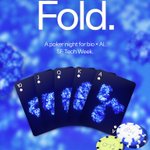
100 seats. One poker night. SF Tech Week.
Founders, scientists & builders around the table.
All in on Bio X AI. Link below or DM me. Located @fdotinc.

Line up is looking crazzzy for the event. And we want more! Come hang. Got people from openai, a16z, pharma, nvidia, startups....
100 seats. One poker night. SF Tech Week.
Founders, scientists & builders around the table.
All in on Bio X AI. Link below or DM me. Located @fdotinc.

🔥 ts blew up the people want protein design edits

first protein design edit?
@adaptyvbio x @AnthropicAI Challenge 1 is live and we are cooking
Insane team btw!

Today we’re launching WonderSearch (YC F26)
Search millions of unstructured documents without pre-embedding the corpus. With comparable/better retrieval recall than embedding-based search.
WonderSearch searches at query time:
> No corpus-wide embedding step.
> No vector index to maintain.
> More compute only when needed.
> Pay per search intead of embeddings you may never use.
Go from raw data to useful answers in seconds.
Link + FAQ below (+ free launch credits!) ↓


Tristan Farmer retweeted
100 seats. One poker night. SF Tech Week.
Founders, scientists & builders around the table.
All in on Bio X AI. Link below or DM me. Located @fdotinc.