

Macroeconomics || Markets || Fixed Income || Commodities. Views are Independent and Intellectually Genuine. DM for Academic & Non-Academic Research Assistance
🌎
Joined February 2024
- Tweets10.4K
- Following1.9K
- Followers1.9K
- Likes2.7K


Pinned Tweet
Zero Equilibrium Economic Community (ZEEC):
Zero Equilibrium is a think-tank dedicated to the enlightenment of individuals, and spreading knowledge. The objective of this Economic Community is to improve economic thinking and synchronize seekers of knowledge and people of knowledge.
We have a strong passion for education, so academic development and support is a big part of our objective, but we are no less dedicated to professional (academics or institutional research support and analysis).
The community welcomes certified economists, enlightened and ordinary economic enthusiasts. A meeting point for discussing economic theory, and economic policy. Anyone is free to contribute to the discussion with relevant posts, comments and contents.
And as anchor, I will be providing contents centered around core Macro theory: books, journals by renowned economists.
We would also be discussing policy: notable local, and foreign macroeconomic indicators and developmens, as well a broad-based analysis on various segments of the financial markets: Fixed Income, Equity (Indexes), Commodities, Cryptocurrency.
Core Contents and Tenets of ZEEC:
Contents are divided into 6 with the 5th and add-on bonus that would later grow in prominence.
1. Macro/Micro Academia:
Free flowing syllabus, with threads (and papers) on macro economic concepts, from different schools, even though this is a Post-Keynesian outfit.
There would be explanatory comments and responses to questions and queries in order to boost understanding different schools of thought.
[Monthly Spaces to have a chance for an interactive session on published content]
2. Applied Macroeconomics:
Here we link economics to real life, analysing different spheres of the economy, sports, health, government policy, public sector efficiency, Industry,etc.
Debates on Policy and Theories (and Markets):
3. Global/Local Macro:
Economic Indicator Watch Analysis, Commentary, and
Interpretations of trending policies, central bank, fiscal and trade policies.
4. Commodity Watch:
Updated Analytical Research Papers. On a select group of commodity futures.
Should be tailored for traders, or purchasers.
5. [Periodic] Financial Markets Analysis:
a. Currency
b. Bonds
c. Stocks
d. Index movements
e. Crypto
6. Investment Education:
a. Basics of Investing.
b. Portfolio advisory.
Rules of Engagement:
1. Contrarian ideas and against arguments are welcome, and anyone can respond to ZE posts, or articles on the blog, and anyone who wishes can write and send rlevenat articles to our email that we would the then post on the our blog.
2. Queries, questions and demands for clarification on any topic (theory, markets or policy) will be most welcome and responded to swiftly. Anyone with knowledge can also throw in theirs
3. The discussions around policy and national economic development WOULD be factual, objective, and without malice. Emotional arguments are not welcome.
4. There is no right and wrong just reason.
Zero Equilibrium Macro & Markets: The Fed, ECB, BoJ and Markets
Daily Summary:
Markets today reacted to expectations of an eventual ECB monetary policy move that would keep rates unchanged for now, but still pointed towards a possible hike in December.
Meanwhile, Japan’s approaching rate normalisation continued to draw attention to the potential repatriation of domestic capital, while US investors de-risked ahead of tomorrow’s core PCE release.
European and selected Asian markets advanced, US technology stocks sold off, Nigerian equities staged a strong domestic rebound, and commodities eased as some of the geopolitical risk premium appeared to come out of prices.
1/7

The Pause that Wasn’t Really a Pause:
Following Wednesday's Federal Reserve FOMC decision to hold rates, the European Central Bank (ECB) also kept its deposit facility rate at 2.50%, exactly as expected.
But, as usual, the real signal was in the accompanying language and the personal calendar of its president.
Christine Lagarde has announced that she will leave on 7 February 2027, earlier than the end of her original term in October 2027. More importantly, policymakers signalled that a December hike remained firmly in play, with rising energy costs adding to inflation risks. ECB policymakers have reportedly discussed a further hike.
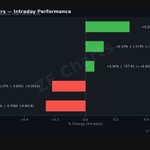
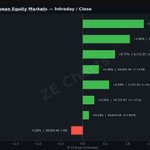
European equities responded positively, with the DAX up +1.36%, the CAC gaining +1.05%, and the Euro Stoxx 50 advancing +0.72%, while Bund yields fell and the euro softened during the session.
2/7

Across the Atlantic in Asia, the story was different. Investors in Tokyo were reportedly pricing in approximately a 78% probability of a Bank of Japan rate hike in December, according to available overnight-rate market pricing.
This remains a market-implied probability, not a confirmed policy decision. The BOJ's October 30 meeting is the next immediate event, while the December outlook will depend on incoming inflation and economic data.
That structural exit from three decades of deflation is already raising the prospect of domestic capital returning home. The Nikkei rose +1.10% and the ASX managed a defensive +0.50% as global funds appeared to rotate into Australian banks and away from the more volatile corners of US technology.
New York, by contrast, spent the session in pre-data caution. Tomorrow’s core PCE release is another important input into expectations for the next FOMC decision.
At the time of this article, the Nasdaq was down -1.46%, the S&P 500 slipped -0.49%, while the Russell 2000 managed a small +0.89%, suggesting that selling pressure was concentrated in large-cap technology rather than uniformly distributed across the US market.
This also spilled over into currencies. The JPY, CHF and GBP found buyers, while the Australian dollar and higher-beta emerging-market currencies underperformed.
3/7


Introducing the Zero Equilibrium® Applied Finance Series
The Zero Equilibrium® Applied Finance Series refers to a micro-niche we've created to add more value to our followers and subscribers across all platforms. The idea is to explain the economics behind financial services.
Through engaging content, we aim to enhance your knowledge of finance across the four domains of personal, retail, institutional and public finance. We also want to improve financial services awareness by helping the public understand the value proposition of any given product or service.
Whether it is bank deposits, fixed savings, fixed income, insurance, brokerages, equities or even crypto, the idea is to tie economic value and understanding to the information we share with our followers and readers. We believe this helps individuals, investors, institutions and governments assess their strategies and evaluate their choices in order to improve final outcomes.
In short, this series is for anyone who wants to understand the financial sector and the expected 'economic' value of its products and service offerings. Or more simply put, the financial sector through an economists lense.
Economic is in quotes because you can easily communicate the benefits of a financial product or service. But economic valuation takes into account the tradeoffs involved, as well as the opportunity costs of decisions concerning financial services and products.
So, instead of measuring monetary gains alone, this series would help you think in terms of what it's costing you (what you're foregoing) and the alternatives available to you.
My time in the financal sector in insurance, banking, and credit, I came to the realization that some products and services in finance might look alike, but they have distinctive characteristics, with different implications for your financial goals and objectives. This applies whether you're an individual, an institution or a policymaker and thinker.
Likewise, some prospective customers, upon understanding of the product/services, find out that they needed the said service and/or product offering more than they initially realized. Successful sales on my end mostly occured when the value proposition was explained, and understood.
So, we aim of this eight (8) part series is not just about creating awareness. The main value proposition is to help you understand the deeper intricacies of the financial sector/markets and what matches your risk appetite, objectives and preferences, whether in terms of timing, asset classes, or even entire financial instruments.
[Stay In-tune with this seri3s as we begin tomorrow through November 6th].

Zero Equilibrium retweeted

Nigerian Breweries Plc | 9M 2026
Revenue rose 5.4% to ₦1.10tn, profit after tax increased 33.4% to ₦114.1bn, and gross margin expanded to 43.3%.
But operating profit grew much more slowly than net profit, while distribution costs climbed sharply. Here's what stood out.
WHAT HAPPENED
Revenue increased to ₦1.10tn from ₦1.05tn, while gross profit rose 15.1% to ₦477.9bn as cost of sales declined. Operating profit reached ₦179.2bn, up 9.8%, and profit after tax rose to ₦114.1bn. The filing does not provide sufficient segment or geographic detail to isolate the sources of revenue growth. The complication lies in the widening gap between gross-profit growth and operating-profit conversion.
WHAT WE FOUND
Gross margin expanded by 3.7 percentage points to 43.3%, supported by lower cost of sales. However, distribution expenses increased 29.4% to ₦100.6bn and advertising and sales expenses rose 17.9% to ₦105.8bn. Net finance costs also fell to ₦7.5bn from ₦33.7bn, helping profit before tax grow faster than operating profit. The earnings recovery therefore reflects both improved gross economics and a more favourable finance-cost burden.
The balance sheet is stronger, with bank borrowings reduced to nil and equity rising to ₦667.2bn. Yet current liabilities still exceed current assets, receivables increased to ₦127.1bn from ₦69.4bn at December 2025, and amounts due for technical service fees and royalties reached ₦90.6bn. The key question is whether reported earnings improvement translates into sustainable cash conversion without renewed working-capital pressure.
WHAT TO WATCH
The central test is whether gross-margin gains can outpace rising distribution costs while receivables convert into cash. Watch distribution-cost growth, receivables collection and Q4 operating margins as evidence of sustainability. The next full-year results should provide a clearer view of earnings quality and seasonal execution.
#NB Apex Invest
Follow @Apex__Invest for institutional-quality earnings breakdowns and market research.

This is such a solid and 'ethical" lineup. You've gor winnings in 7 sectors, I particularly like the 0.56% HBM exposure. Cautious bet that could pay off big (I see HBM outperforming DANGCEM longterm). THIS IS A SOLID AND DIVERSIFIED HALAL SET UP. 👌 😉


Zero Equilibrium Crypto-Currency Alternative Asset Series: Undemanding Cryptocurrency Diversification Plays.
Owning six cryptocurrencies doesn't necessarily mean you have a diversified crypto portfolio.
Every investor insitutional or retail, applies a degree of diversification to its their portfolios. In ZE terminology, this diversification could be in one of two forms (we recommend both);
- a vertical diversification, which involves diversifying (spreading capital) within an asset class. Say owing 5 different sectors in the equtiy portion of your portolio,
- a horizontal diversification, here monies are spread across asset classes. So instead if just stocks, the portfolio includes fixed income, commodities, and crypto.
A combination of both fortifies your investment portfolio on two fronts: The vertical diversification protects you from industry-specific risks, and asset class specific risks.
If there's a fixed income selloff, the market cukd experience a commodities, equity, or Crypto bullring. So a portfolio with just one asset is only half diversified.
Below we discuss and apply the vertical diversification rhetoric to Crypto.
1/8

For Asset backed Coins;
The tokens would generally move in the same direction as the underlying asset. PAXGUSD and XAUtUSD are designed to track gold prices, though they may not match spot or futures prices exactly at all times.
In gaining exposure to these tokens, you are essentially gaining gold-price exposure, which may help diversify against volatility associated with Smart contracts and DeFi's. However, they do not automatically hedge against inflation, exchange-rate risks or capital losses associated with DeFi. Custody, issuer, redemption, liquidity and blockchain risks also remain.
Decentralised Tokens offer monetary and high-yielding price appreciation exposure, but are also very volatile. The value proposition therefore is the potential for outsized gains during a general Crypto appreciation, coupled with the limited supply of some assets.
Smart contracts are equally volatile, with violent up and down swings depending on market sentiment and also as a result of competing capital categories (DeFi).
Just like Asset backed coins, Tokenised real-world Assets, are driven by the underlying asset they represent, subject to their legal structure and associated risks.
By @Muhammad_Okoye for Zero Equilibrium Alternative Asset Watch.
7/8
ZE Remarks:
Crypto currencies presents different uses, and vakue propositon. From the above we have illustrated how, gold backed token has a different economic proposition from a smart-contract platform, even though both use blockchain technology.
This makes crypto asset diversification a consideration of assets based notnjust on returns, but also on economic exposure, not coin count.
Owning six cryptocurrencies does not necessarily provide meaningful diversification if all six depend on speculative risk appetite and crypto-market liquidity.
8/8


USD, Already Softer as the article in the quoted post below suggested.
The USD is already softer against itts major peers (EUR, GBP, CHF, AUD, JPY).
The Sollar index also softer down -0.07%.
But, against Core-BRICS, it is for nky against the Renminbi (USDCNY)


Zero Equilibrium® Macro and Markets: USD, Gold and US Treasuries Pause Ahead of Fed Decision
Summary:
• The Fed delivered the pause ZE anticipated, but tightening risks persist. The Fed held rates at 3.75%–4.00% in a split 10–2 decision, with Lisa Cook and Beth Hammack favouring a 25-basis-point hike. Elevated inflation keeps further tightening in December on the table.
• The initial market response indicates limited cross-asset repricing. The DXY stood at 102.145 pre-decision, gold at $4,051.75 and the US 10-year Treasury yield above 5%. Post-decision, the dollar softened, while sovereign bond yields moved unevenly, suggesting no decisive shift in financial conditions.
• Fixed income, equities and commodities face conditional outlooks. Lower yields could support Treasury prices, growth stocks and gold, but persistent inflation and elevated long-term yields could constrain gains. Industrial commodities remain sensitive to both supply pressures and demand conditions.
• Bitcoin and Ethereum remain technically vulnerable. Both traded below their 50-day moving averages, with bearish daily MACD readings, despite remaining above their 200-day averages. Near-term support levels remain critical to assessing recovery prospects.
• ZE favours another pause at the December 8–9 FOMC meeting, conditional on incoming data. Treasury yields, the DXY, equity breadth, gold and crypto momentum will help determine whether financial conditions ease. The pause buys time, but the tightening cycle may not be over.
Read more of our thoughts and analytical research in the link below:
0equilibrium.substack.com/p/…
#Fed #FederalReserve #FinancialMarkets #Macroeconomics #ZeroEquilibrium


Couldn't have put it better myself. 👏
MMT helps governments understand the leverage they have, and perhaps how to use it. But it falls short as a policy proposition on spending, even with its acknowledgement of real resource constraints. No one can calculate those constraints with complete precision, and so no one can know exactly when that point has been reached. This is exactly why the recognition of a real resource constraint, on its own, is insufficient as a fiscal policy framework.
Economic growth depends not only on productive capacity but also on the effective demand, financing conditions and expectations that determine whether that capacity is utilised and expanded. Financial markets can facilitate that process, but they can also destabilise it.
If the goal is to spend within the limits of real productive capacity, then asset-pricing mechanisms, inflation trade-offs, and the case for fiscal restraint or expansion require a degree of fiscal discipline, calibrated to a given state of output, technology, the exchange-rate ratio, and market liquidity.
The implication of the school's acknowledgement of a real-resource constraint, combined with the difficulty of gauging that constraint in real time, is that it makes an equally strong case for fiscal restraint when conditions warrant it, contrary to the impression that its proponents seem to abhor restrictive fiscal policy. At least until we reach that unknowable 'real-resource constraint'.
Acknowledging a real-resource constraint does not, by itself, tell policymakers how to identify, measure or respond to that constraint in real time. This acknowledgement ironically makes a strong case for the very fiscal restraint that its proponents seem to abhor, at least until that constraint can be identified with sufficient confidence.

MMT tells you a monetarily sovereign nation can issue all the currency/debt it wants and nothing will happen, claiming that currency and market volatility can easily be eliminated by cancelling the capital account.
This nonsense can only be promoted by someone that does not understand that the currency collapse and creditworthiness slump are driven by domestic citizens and savers rejecting the local currency; it is not an evil conspiracy of foreign investors.
Furthermore, no nation is monetarily sovereign. It always depends on demand. Try to force use or restrict flow, and the currency is worth nothing.
And local citizens are the first to reject an increasingly worthless currency issued by an irresponsible government.
You are welcome