
Software Engineer & Web3 Enthusiast Security Researcher | Discord - 0xbeastboy | DM for security reviews.
Joined January 2022
- Tweets175
- Following2.1K
- Followers511
- Likes323








Pinned Tweet
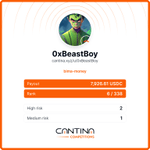
1 of 2 Criticals. 2 of 6 Highs. 7th place. Nearly $7K earned. ⚔️
Feels great to get a strong contest result again while reviewing the XRP Ledger C++ codebase.
Also found 3 Mediums and 2 Lows.
Big thanks to @RippleXDev and @sherlockdefi for making this contest happen.
🔑 Address-Owned Objects in Move (Sui)
In Sui, most objects are address-owned: they belong to a single address, just like assets in your wallet.
Only the owner can use or mutate them.
If a function needs that object, you must pass it in
Ownership = access control, enforced by the type system.
Your objects stay under your key.
In short: address-owned objects make sure only you can touch what’s yours; secured at the language level, not just by convention.

Secured 4th pos in Move based contest.
Thank you @HackenProof for bringing such good projects.

@bluefinapp audit contest results are in 💥
- Reports submitted: 229
- Valid reports: 14
- Budget: $40,500
- Key findings: 7 High, 2 Medium, 5 Low

ERC20 Approvals in Move:
No, there are no ERC-20 approvals in Move.
On Sui/Aptos, coins are first-class resources.
A protocol can’t “pull” your funds; you must hand over the Coin<T> object yourself.
No approve, no hidden allowances.
If you don’t pass the coin, the protocol can’t touch it. 🔒

🚨 The “Hot Potato” Pattern in Move 🚨
Some objects can’t be copied, stored, or dropped.
they must be used before the tx ends or the whole thing fails.
It’s like holding a burning potato 🥔:
you can borrow, act fast, then you must return it.
no escape, no delay, safety by design. 🔒
This is the best concept of move and its used in:
👉 flash loans & one-time proofs
⭐ forces instant repayment & risk-free for the lender.

4
308
Although my approach is completely different.
But a good alpha for beginners and SRs who struggle in finding a good approach for auditing.


This is why Move is trusted for money and assets.
Resources = real-world guarantees in code.
Once you see this model, it’s hard to go back.
127
Why does this matter?
- Your token/NFT can’t vanish from a bug.
- No accidental duplication.
- Strong safety baked into the language itself.
1
1
140
For example:
struct Coin has key {
value: u64
}
Because Coin is a resource, the compiler prevents:
- Duplicating it
- Forgetting to store it
- Dropping it on the floor
1
6
A resource in Move has strict rules:
❌ Cannot be copied
❌ Cannot be destroyed
✅ Must be moved or stored
This means resources behave like real-world assets:
unique, safe, and always accounted for.
1
7
In most languages, assets are just numbers in variables.
That’s risky: you can copy, drop, or overwrite them.
Imagine doing that with a coin in your wallet… 💸
Move fixes this with resource types.
1
27
💡 What if a programming language guarantees to never lose money by accident?
That’s exactly what Move does with resources.
Here’s why they’re a game-changer 👇
1
1
190
Even if you forget to mark a function with #[init], OTW still has your back.
No witness = no way to rerun initialization.
One-time setup stays one-time by design. 🔒
A powerful concept to understand.

🚨 Move/Sui Security Insight 🚨
Ever seen this in a Move module? 👇
public struct SOMETHING has drop {}
That’s a One-Time Witness (OTW).
Here’s why it matters 🧵👇
239
#[syntax(index)] is the link between the [] operator and its function.
without it, v[i] wouldn’t exist as syntax.
Next time you use indexing in Move, remember:
its just a function call in disguise, wired up through #[syntax(index)].
1
95
For vectors, the [] operator maps to:
#[syntax(index)]
fun borrow_vec(v: &vector<u64>, i: u64): &u64 {
&v[i]
}
so when you write v[3], the compiler actually calls borrow_vec(&v, 3).
1
98
In Move, some operators ([], +, -, etc.) are just syntactic sugar.
compiler rewrites them into function calls behind the scenes.
1
16
Ever wondered how v[i] works in Move?
It’s not magic, it’s powered by an attribute:
#[syntax(index)].
lets dive 👇
1
149