






Pinned Tweet
🧵 "What should the role of governments be after the upcoming AI economic transformation?"
We're launching an new anthology on a new "AGI Social Contract" - in collab with 12+ experts to explore new strategies & policy interventions for an AI transition.
In collab with: @akorinek, @degerturann, @steveom, @IasonGabriel, @JulianDJacobs, @sjmanning, @dhadfieldmenell, @sethlazar, @petersalib, @collegraphy, @synchroaphasia, @deanwball, @JustinBullock14,

I’m excited to announce a project I’ve been working on for the past few months - the Windfall Policy Atlas! It’s a comprehensive map of the top 50 policy options for navigating AI's economic consequences, from the immediate and practical, to the ambitious and long-term.
windfalltrust.org/policy-atl…
In the next few years, every country in the world will need to have a preparedness plan on how to respond to the economic disruption caused by powerful AI. They will need a set of concrete, thoughtful policies to be prepared for the possibility of rapid labor displacement, skyrocketing wealth inequality, and the transformation of their tax bases.
There are dozens of AI economic policies being discussed today: both old and new ideas on labor market policies, fiscal revenue, market design, and on strengthening social safety nets. But the landscape is terribly scattered - there’s no simple way to see and compare all these policies, or to start developing comprehensive policy gameplans.
Our Atlas points to the most up-to-date resources for every type of strategy recommended to improve economic outcomes - from industrial policy, to education & reskilling, to international coordination, to novel taxation mechanisms, to large-scale redistribution.
Today, there are zero countries with a national preparedness plan for transformative AI systems. Our mission is to help countries and researchers around the world develop such plans as soon as possible, with the understanding that economic impacts could hit more rapidly than institutions are ready to respond.
The right set of policies will look completely different for every country. It will depend on a country’s institutional capacity, its labor market exposure, its fiscal revenue structure. Every single government will need to prepare a different plan.
We see this Atlas as the first step to helping governments map out these potential strategies, and we plan to keep it continually updated.

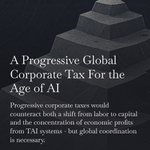
Just published a piece on the potential for progressive global corporate taxation to respond to tax base erosion from transformative AI!
In short:
- Increased corporate taxation would counteract an income shift from labor to capital due to TAI.
- Progressive corporate taxation would mitigate the effects of an increasing concentration of economic profits being captured by a small set of firms.
- Global coordination would still be necessary to prevent profit off-shoring, as capital is highly mobile.
So - a global progressive corporate tax is well-structured to respond to many of the prominent concerns around TAI economic scenarios.
How could this be implemented? BEPS 2.0 by the OECD provides the best existing framework for this approach.
With some small modifications, it could raise the top rungs of the global corporate tax ladder and simultaneously induce progressive tax rates on a national level.

The core interesting idea: if you raised BEPS Pillar 2's minimum global corporate tax rate from 15% to something greater than the average country's corporate tax rate (currently around 20%), you would simultaneously:
1. Create a higher tax rate (e.g. 25%) primarily for the largest, most profitable MNEs already captured by Pillar
2. Eventually induce progressivity for national tax rates, as individual nations seek to narrow the gap between their tax rates and the higher Pillar 2 tax rate for their larger national corporations
In practice, this would look very much like a progressive global corporate tax, but retaining national control over corporate tax rates for the majority of their local corporations

Huge thanks to Gus Docker for hosting me on the FLI podcast earlier this month on the topic of designing a post-AGI social contract!
youtube.com/watch?v=aOh2cqTU…
Had an excellent chat on:
- What's the current gap between AI futurists and traditional economists?
- What could a realistic positive future for a post-scarcity workforce look like?
- What types of jobs are deeply resistant even to ASI?

Publishing a lightweight summary of AI's labor market impacts in 2025, in charts and diagrams!
All credit for the original slide deck goes to @dannybuerkli.
windfalltrust.substack.com/p…

Just published a piece on @ai_frontiers_ about AI's impact on emerging economies!
In short, AI automation threatens to erode export-driven development - one of the foundational economic pathways for developing countries.
ai-frontiers.org/articles/ai…

Thanks to @AndreyFradkin, @cookiechat4_0, @yelizarovanna, @yolandalaanquist, @dannybuerkli, and several more people for feedback and contributions!
🧵Latest AI economics brief, co-written by Jacob Schaal: windfalltrust.substack.com/p…

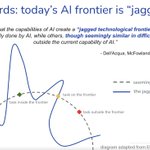
3/ Helen Toner (CSET, Georgetown) argues that the frontier of AI is jagged: AI’s ability to simultaneously solve hard tasks while failing at easy ones should make us cautious about confidently predicting the full automation of remote work. She suggests human-AI collaboration will persist longer than expected.
We (@windfalltrust) just published our first AI Economics Brief! It'll be a bi-weekly curated newsletter with updates on the economics of TAI.
I'll summarize the first one below but you'll need to subscribe for more updates ☺️

Link: windfalltrust.substack.com/p…
- Benchmarks of remote labor from OpenAI and the Center for AI Safety differ dramatically depending on the content and context of the task.
- A new theory suggests AI automation will hit later but faster than expected, which would have major implications for policy timing.
- Anthropic presented various policy proposals on the economic impacts of AI for different scenarios in DC, such as a sovereign wealth fund, tax code changes, and adjustment assistance for displaced workers.
Finally - Windfall is hiring for a comms director!
docs.google.com/document/d/1…


Looked up Xania Monet (Billboard-charting AI artist):
1. It's kind of a banger - Christian music rarely get this level of talent
2. Not a single person in the YT comments seems to be aware or cares that it's AI-generated
It's happening 🤷♂️
youtube.com/watch?v=sE4oFCRL…

Another way to frame it would be: we will be the elderly parents of superintelligence. If designed well, it should want to take care of us - because we are by definition, its forefathers, the source of all of its knowledge, and the reason it exists.

Hinton is no longer afraid of superintelligence.
Readers added context they thought people might want to know
The embedded video says he sees "a ray of hope", not that he is no longer worried
share.google/24UWDB8xSu2O7U…