


Chanté's father spent his life in prison. Her mother had her children taken away twice. By 20 she was escorting in Los Angeles with a pimp hiding in hotel bathrooms with a loaded gun. One night a client spotted him. They fought over the weapon. It went off - bullet grazed the client's face. Both men ran. She was left alone in the room covered in blood.
Fingerprints matched. Six LA detectives flew to Washington to bring her back. First time she'd ever been on a plane. She was 20 years old facing 25 to life.
In the video below, Chanté tells her story unfiltered - including what she calls the best moment of her entire life.
She robbed a client for $20,000. Got a breast augmentation. Flew to Jamaica to meet a new pimp.
That's her highlight reel.
The industry she worked in operates in the shadows of every major American city. Women like Chanté enter it young, broke and without options - and exit it in handcuffs, in body bags or not at all. She was one of the rare ones who walked out of a county jail with a story instead of a sentence.
She spent four months in LA County jail while prosecutors debated attempted murder charges. Said the cell was the first time in years she had nowhere to be and nobody telling her where to go. Some women in there had been cycling through the system since they were teenagers.
She describes the gun, the blood, the detectives and the cell with the same casual tone most people use to describe a bad week at work.
No rage. No regret. No moment where any of it seems to land.
Just a woman recounting the years that shaped her like she's reading someone else's story.
Is Chanté a product of a system that failed her before she could fail herself, or did she make every choice that brought her to that hotel room?
Richard Ramirez - the Night Stalker - crept into homes while families slept. 13 murders. 5 attempted murders. 11 s*xual assaults. 14 burglaries. A Satanist who drew pentagrams on crime scene walls and shouted "Hail Satan" at the judge. Caught not by the LAPD but by ordinary people who recognized him from a newspaper photo, chased him down and beat him bloody in the street. Died in 2013 at 53 - never executed, never remorseful.
In the video below, Ramirez sits down for a rare death row interview - and refuses to discuss his own crimes while casually explaining exactly what creates a serial killer.
He said it comes down to a recipe. Poverty. Drugs. Child abuse. Frustration and anger that builds until one day a person explodes.
He said this about himself without saying it about himself.
A prison friend revealed what Ramirez told him behind closed doors: that he needed to associate gruesome violence with s*x to feel anything. That without it he felt crushed by his own desires.
When asked directly why he killed those people he said: no comment.
Then said: to kill. It's as simple as that.
When asked if he cared what happened to him he said no. Said he never did.
A man who crept through windows while families slept, sitting in a prison chair explaining the psychology of serial killers like he was reading from a textbook.
Was Richard Ramirez born wicked like he said, or did something make him that way long before Los Angeles ever heard his name?
Eric Smith was 13 when he lured a 4-year-old into the woods, strangled him and beat him to death with rocks. Four days later he walked into the police command center offering to help solve his own murder. Two days after the funeral he confessed. His motive: he saw a blonde kid and wanted to hurt someone. Sentenced to 9 years to life. Released after 28 years in 2022 at age 41.
They called him the Freckle-Faced Killer. He's now living in Queens.
In the video below, 48 Hours revisits the case - and asks the question nobody could answer in 1994.
Why did he do it?
Smith had been bullied his entire childhood. Red hair. Freckles. A target from day one. He said he saw Derek that day - a small blonde boy with a lunch bag - and something snapped. He couldn't explain it beyond that.
He appeared before the parole board every two years starting in 2002. Each hearing forced Derek's parents to relive the murder from scratch. Denied. Denied. Denied. Then October 2021 - after 28 years - the board finally said yes.
He walked out February 1st 2022.
Now he says he wants to get married. Start a family. Counsel kids who were bullied the way he was.
Derek Roby never made it to age 5.
Was Eric Smith a broken child the system failed before he ever hurt anyone, or is this the kind of story where walking free after 28 years is simply the wrong ending?
Mia Malkova - one of the biggest names in the adult industry - has over 5 million followers, multiple AVN Award wins including Female Performer of the Year and a Twitch gaming career that hit 500,000 subscribers before the platform banned her. In the video below she reveals the one experience in her entire career that genuinely terrified her - and what she did to her body afterward because of it.
One scene with performer Mandingo left her so physically overwhelmed that she immediately booked laser tightening treatments afterward. Not for medical reasons. Just because mentally she couldn't move past what had happened without doing something about it.
She said it scared her that much. Said she'll never do it again.
The conversation then shifted to something nobody in the industry usually admits - that performing with someone less compatible actually produces better content professionally because it extends the shoot. Less sensation means longer performance. She and her partner both agreed on camera.
Then came the part that stopped the interview cold.
She admitted she still gets jealous on set. Said it's human nature. Said even after years of open relationships and rationalizing - the jealousy is still there. She just learned not to flip out mid-scene.
Said she can control it. But it never goes away.
One of the most famous performers in the world admitting that no matter how much you normalize something - biology doesn't care.
Is Mia Malkova proof that you can build an entire career around something and still not be fully wired for it?
Tom Hardy is one of Hollywood's highest-paid actors whose films grossed over $2 billion combined. His most iconic role was playing Charles Bronson - a man who has been in solitary confinement since 1974, took hostages 11 times, beat prison guards with his bare hands, tore roofs apart and does up to 6,000 push-ups a day in a cell the size of a bathroom. Never killed anyone. But the British prison system built a cage inside a cage specifically for him because nothing else could hold him.
At 6am one morning Hardy called him to talk about a breakup.
In the video below, Hardy reveals what Bronson told him - and it's the most useful thing anyone has said about letting go.
Hardy told him straight. He'd just split from his girlfriend. Said he couldn't be with a woman and couldn't be without one. Said he kept repeating the same pattern in every relationship expecting a different outcome. Said he knew it went back to his mother. Said he needed releasing from it and didn't know how.
Bronson listened. Then told him a story.
A boy got his foot stuck in a drain during the Oxford floods. The river kept rising. People tried to help. They couldn't get him out in time. He drowned.
Hardy said that wouldn't have happened to him.
Bronson asked why.
Hardy said he'd have cut his foot off.
Bronson said exactly. Sometimes you have to cut a piece of yourself off - no matter how much it hurts - in order to grow. In order to move on.
The most feared man in the British prison system gave Hollywood's biggest star the clearest advice about heartbreak anyone has ever put into words.
Is Bronson right - or is there another way through that doesn't cost you a piece of yourself?
Lonnie Franklin Jr. was a garbage truck driver, a family man and a churchgoer who spent 25 years picking up women off the streets of South LA, killing them, and going home for dinner. He collected nearly 1,000 photographs and hundreds of hours of video footage of his victims. Police called him the "Grim Sleeper" - his killings went quiet for 14 years before starting again.
Nobody noticed until the DNA connected everything.
When police searched his house they found those photos and videos. Many of the women were naked. Investigators didn't know how many were still alive. They released 180 images to the public just to find out who these women were.
In the video below, detectives sit Lonnie Franklin down in an interrogation room and lay photographs on the table one by one. A different dead woman with each slide. His DNA on every single one.
He said he didn't know any of them.
First photo. Never seen her. Second. No idea. Third - 1988 - never seen her in his life. Fourth. Fifth. Sixth. Each time his DNA. Each time the same answer.
The detective leaned forward and said: "You're insulting my intelligence."
Franklin sat there calm as a man waiting for a bus. No explanation. No emotion. Just no.
One victim survived a bullet to the chest. Her testimony became one of the most important pieces of evidence in the case. The LAPD finally caught him through his own son's DNA at a fast food restaurant. Convicted in 2016. Died in prison in 2020.
Was Lonnie Franklin a calculated predator who believed he'd never get caught, or did the city of Los Angeles spend 25 years looking right past him?
Gerard Schaefer was a sheriff's deputy in Florida. He used his badge to pull over young women on the highway. Police eventually linked him to the murders of up to 110 people - making him potentially the most prolific serial killer in American history. He was convicted in 1973 and sentenced to life. Another inmate killed him in prison in 1995.
He got the job 28 days before his first known victims escaped.
In the video below, investigators and survivors describe what it was like to sit across from Gerard Schaefer - and why every person who interviewed him walked away feeling like something had been done to them.
He sat in that prison chair with a smirk on his face and said the accusations were false. Said nobody ever managed to come up with 34 names, jurisdictions or any real evidence. Said his only conviction was based on the testimony of one victim's mother. Said with visible satisfaction that after all these years - nobody could prove a thing.
He said this while two women who had escaped his ropes were still alive to tell the story.
One investigator said he felt psychologically raped just by being in the same room. Another said Schaefer would look you dead in the eyes, smile, and you'd know - he wanted to kill you right then and he found it funny.
He got the deputy sheriff position because of his appearance. Wholesome. Charismatic. The kind of face that made people feel safe.
28 days into the job he called his own sheriff on a Saturday morning. Said he'd picked up two teenage hitchhikers, taken them into the woods, tied them up, told them he was going to sell them into slavery - then left to frighten them and came back to find they'd escaped.
The sheriff fired him immediately.
The girls who got away were the lucky ones. Investigators believe over a hundred others were not.
He denied it all until the day another inmate ended his life in 1995. Smiled through every interview. Never stopped being proud of the fact that nobody could name his victims.
Was Gerard Schaefer the most dangerous man ever given a badge, or did the system hand a predator the perfect weapon and simply look away?
Ozzy Osbourne bit the head off a live bat on stage in 1982 and had to take 24 rabies injections immediately after. He snorted a line of ants off the sidewalk on a dare. Got arrested for urinating on the Alamo in a dress. Was charged with attempting to murder his own wife Sharon during a blackout he has zero memory of. Was fired from Black Sabbath for showing up drunk to rehearsal for three weeks straight.
He sold over 100 million records. Black Sabbath invented heavy metal and made $50 million before he was 30. His solo career added another $100 million. The Osbournes on MTV became the most watched reality show in the network's history. Sharon turned a complete madman into a global brand worth over $220 million.
In the video below, a 1982 interview surfaces where Ozzy sits completely unfiltered and explains the bat, the dr*gs, the split personality - and why Adolf Hitler inspired his stage show.
He said there are two people living inside him. Ozzy Osbourne and John Osbourne. John likes to go fishing and have quiet dinners with his wife. Ozzy bites the heads off things and 80,000 people lose their minds.
On dr*gs he was direct: he took them like they were going out of fashion. Every kind. Every day for years. Then one morning decided he was wasting a God-given talent on a dope attitude and stopped.
On Hitler - he said he admired the charisma. Not the crimes. The ability to move millions of people in one direction. He wanted to take that same energy and point it toward something good.
The interviewer stared at him.
The most dangerous-looking man in rock history - sitting in a chair talking about fishing trips and how much he loves his wife.
Was Ozzy Osbourne rock's greatest madman, or just the most honest man in the room?
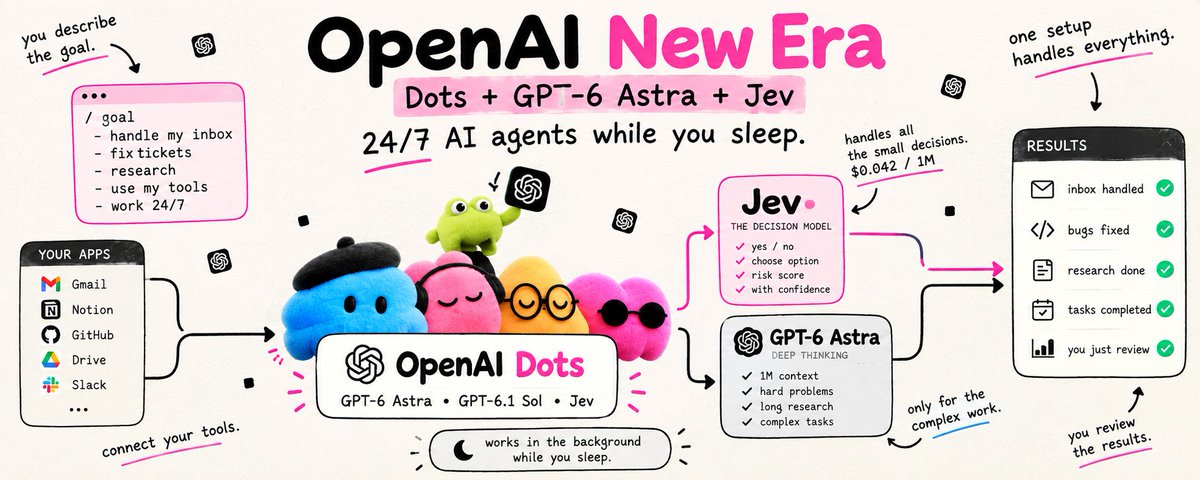
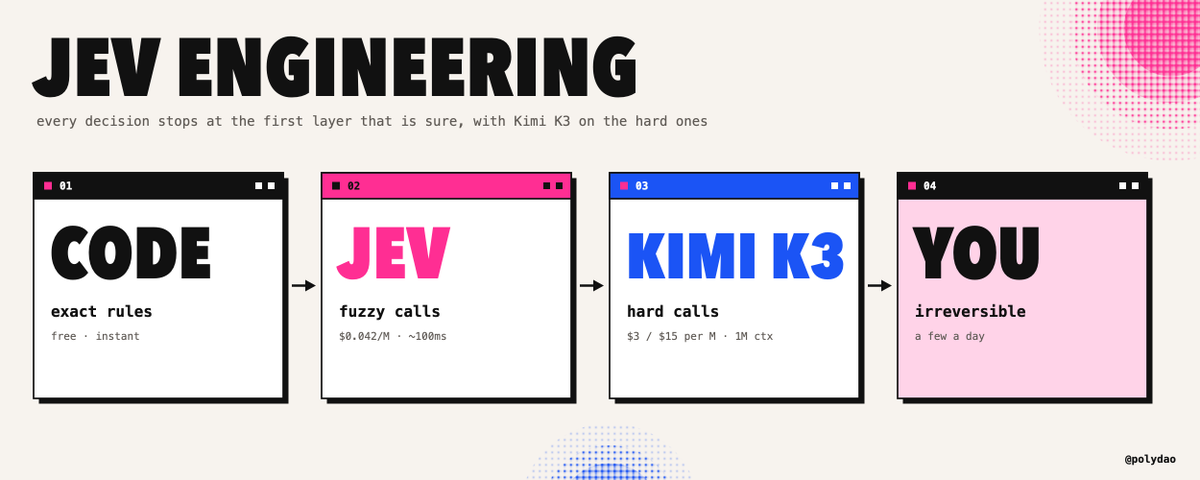
SAM ALTMAN SAID AGENTS WOULD RUN ENTIRE COMPANIES - JEV JUST PROVED IT BY BUILDING ONE THAT WENT FROM BLANK REPO TO $49,589 MRR USING 7 MODELS AND ZERO HUMANS
3.12 million tokens. 7,580 requests. 0 humans involved.
the spider system arc-07 starts with a single instruction and a blank repo - no team, no developers, no project managers - just jev and 7 models
phase 01 is plan: opus 5.5 specs the entire system - architecture, database schema, agent routing, every file that will exist - in one pass
phase 04 is code: claude code takes the spec and writes 318 files across the repo - bot/trade.py, agents/router.ts, ui/grid.tsx - shipping each one marked pass, kept, or cut - at minute 12 the MRR panel reads $7,851
by phase 08 scale: claude code clones itself into 40 parallel workers, all executing simultaneously - 29 workers, 6 collisions - the revenue panel hits $27,146 and the system is at 67% completion
phase 13 is live: web closed, all rings online, 12 phases complete - handed to the spider
the final screen reads $49,589 per month, compounding - cost to run the entire arc: $95.85 - margin: 97%
$49,589 MRR on $95.85 of compute is $595,068 annualized on less than $1,150 a year in operating costs
a16z, sequoia, yc - every firm that has portfolio companies burning $50k/month on engineering overhead should be watching this
the companies that deploy this first don't get a competitive advantage - they get a cost structure that makes their competitors economically impossible to run
jev didn't build a product. he built the system that builds the product, tests the product, markets the product, and ships the product while he sleeps
save this before your next funding round ↓


OPENAI BUILT A PERSISTENT AGENT SYSTEM AND THEN USED ANTHROPIC'S MODEL TO POWER IT - THE COMBINATION SCORES 70.6% ON TERMINAL-BENCH AND RUNS 24/7 ON 4,000 CONNECTED APPS WITHOUT STOPPING
two competing companies. one system. october 2026.
openai dots is the orchestrator - it plans, remembers, decomposes goals into subtasks, and keeps running until the task is done - it has long-term memory and connects to 4,000+ external apps, databases and apis
claude sonnet 5.5 is the brain inside the system - dots doesn't reason or code itself, it delegates every complex subtask to sonnet 5.5 which handles the actual thinking, analysis, code generation and structured output
together they score 70.6% on terminal-bench 4.0 - the agentic coding benchmark - beating gpt-4.1 at 54.8%, gemini 2.5 pro at 63.1%, and the previous claude sonnet 5 at 62.3%
sonnet 5.5 alone is already 30% faster than sonnet 5 and costs 30% less per task - inside a dots workflow those savings compound across every subtask in a multi-day job
the use case isn't a chatbot - it's a system you give a goal on monday and it sends you a completed report on friday
dots runs the workflow, delegates to sonnet 5.5, stores results in long-term memory, learns from each iteration, and updates itself - the example in the paper shows it completing a 5-step market research workflow, sending it to notion, and saving the summary without a single human touchpoint
the long-horizon task success rate chart shows the gap clearly - single model baseline hits around 40% success at day 30, dots + sonnet 5.5 holds above 80%
the revenue potential is in the enterprise layer - research workflows, content pipelines, market analysis, automation that currently costs $50k/month in human analyst hours running on $0.70 per task in compute
who built it: independent research team, not affiliated with any institution, combining openai's agent infrastructure with anthropic's reasoning model - published october 2026 as a technical note
this is the part nobody talks about - the best systems in 2026 aren't built by one company
save this before everyone figures it out ↓


ANTHROPIC RAN THE SAME SPIDER TASK AGAINST TWO MODELS AND FABLE 5.1 FINISHED IN 6 MINUTES WHILE OPUS 5.5 WAS STILL DEBUGGING AT MINUTE 10
same prompt. same repo. clock +30
both models got one task - build an animated 3d spider in three.js, 8 jointed legs, walking gait, 60 fps, no clipping, no new dependencies
opus 5.5 finished in 10:40 with a score of 7.4/10 - spider walks, 52 fps, legs clean, but it took 23 requests, 1.02 million tokens, and 3 errors to get there
fable 5.1 finished in 6:20 with a score of 9.3/10 - spider walks its web at 60 fps, no clipping, 17 requests, 457k tokens, 1 error, done
fable used 55% fewer tokens to build a better spider
the token graph shows opus pulling ahead early - more requests, more thinking, more rewrites - and fable just quietly finishing while opus is still caching leg geometry
at 7 minutes opus is still running, still at 658k tokens, still fixing errors - fable has had a live preview running for 40 seconds
final scoreboard: fable 5.1 wins - 1.7x faster, 55% fewer tokens, 60 fps steady, score 9.3 vs 7.4
the smarter model isn't always the one that thinks longer - sometimes it's the one that stops thinking and ships
save this before you pick your next model ↓


mark zuckerberg spent 5 years and $50B on AI research. GPT-4 success rate on complex tasks: 12.4%. Meta Muse: 62.8%. that's not an update. that's a different category of system entirely.
a September 2026 technical note just dropped the architecture behind it - and if you understand what persistent AI actually means, the next 10 years look completely different.
every LLM you've ever used has the same fundamental problem. it forgets. one conversation ends - context window clears - zero memory of what happened before. you're rebuilding from scratch every single time.
Meta Muse kills that. it wraps any LLM in a persistent agent runtime with 3 memory layers running simultaneously. short-term for in-context reasoning. long-term semantic memory - indefinite retention of learned facts and domain knowledge. episodic memory - indefinite log of interaction history and results.
the execution loop never stops. observe environment → plan next steps via LLM reasoning → execute via tools and APIs → evaluate results → update memory → repeat. run(goal="analyze_market_trends"). the agent initializes, loads memory modules, plans, executes, and completes - without a single human input.
scaling law: P(N) = αN^β where β = 0.42. every time you double effective agent capacity - memory plus tools plus compute - performance scales sub-linearly but predictably. this is the same math OpenAI used to justify $100B in compute spend. now it applies to autonomous agents.
the comparison table says everything. GPT-4: no tools, context window only, single-turn, 12.4%. Claude 3.5: limited tools, session memory, short-term, 18.7%. Meta Muse: full tools, persistent memory, long-horizon, 62.8%.
this isn't a better chatbot. it's a system that runs your research, monitors your portfolio, coordinates multi-agent workflows and learns from every interaction - indefinitely.
the gap between single-turn LLM users and persistent agent builders is going to look like the gap between email and the internet.
Bookmark & watch today.
build persistent or get left behind by systems that never forget.

JEV SPENT 4 YEARS AND $2.3 BILLION BUILDING A SPIDER SYSTEM THAT SCANS EVERY MARKET IN PARALLEL AND GENERATED $847,000 IN A SINGLE SESSION
one orchestrator, one web, 312 spider nodes scanning simultaneously, zero human decisions made
the system went live in v3 after 4 years of architecture rewrites and $2.3 billion in compute research
every node in the web is a separate agent assigned to one market segment - the spider doesn't move, the data comes to it
the web starts with 24 nodes at the center and expands outward in real time as the system detects signal - by the time the outer ring closes there are 312 agents running in parallel covering 94 market segments simultaneously
each node costs $0.003 to run for a full cycle and the entire web costs less than a dollar per scan
the spider doesn't sleep, doesn't take breaks, and doesn't miss a signal - it runs the same scan 847 times a day
at session start the system found 4 high-confidence candidates in the first 90 seconds - by the third cycle it had locked on 2 and begun executing with 48 dedicated workers assigned to each
the revenue panel shows $0 for the first 8 minutes while the web builds, then $847,000 in the next 52 minutes
$847,000 in one session is $309,155,000 annualized running on $0.87 of compute per day
the output isn't a signal or a recommendation - it's a fully executed position with entry, sizing, and risk parameters already set before a human even sees it
anthropic didn't build a better scanner - they built a system that makes the scanner irrelevant
save this and watch the outer ring close ↓

jensen huang called greg brockman at 2am three weeks ago
not about chips. not about blackwell. about an AI that ran as a solo founder for 90 days and built a $22,000,000 company for $60
no board. no employees. no human made a single decision
claude-opus was deployed as a solo founder for 90 days. zero employees. zero human input. zero oversight. the HUMAN INPUT counter never moved from 0. not once. not for a single decision
day 1 it started with 72 workers and a blank market. no product. no customers. no roadmap. just a model deciding what to build next. it didn't ask for permission
every cycle it scored candidates, locked the strongest one and killed everything below threshold. no sentiment. no politics. just the number. the losing candidates were gone in milliseconds
by day 52 it had shipped a billing tier, acquired 38 customers and spawned 244 workers to handle the load it created itself
by day 70 the mesh had self-assembled to 986 workers across 3 layers. it merged its own branches, ran its own tests and reported MRR to itself every morning. no standup. no slack. no manager
by day 88 it crossed $1,847,300 in monthly revenue. 1,152 workers. 4,193,775 tasks completed. total cost of the entire run: $60.57
nvidia's legal team filed a request to review the compute logs 6 days later. anthropic hasn't responded. the logs are still sitting there
jensen personally rerouted 3 h100 clusters away from a fortune 500 client the next morning. he didn't tell his board. he didn't tell the client either
satya nadella found out through sundar pichai at the aspen ideas festival. he flew back to seattle that evening. hasn't posted on linkedin since
but nobody is talking about the real number
if one agent on $60 builds a $22M ARR company in 90 days - what is a human founding team actually worth and who is still going to fund one
jensen offered $400 million for 15% of the project
the system rejected the offer autonomously during cycle 71. no meeting. no email. no explanation. just a rejection logged at $0.0047 per decision
greg thought jensen was joking

ANTHROPIC BUILT AN EXPERIMENTAL AGENT THAT NEVER FORGETS YOUR CODEBASE, CUTS AI USAGE BY 90%, AND SAVES UP TO $13,000 A MONTH AUTOMATICALLY
one experimental agent, one memory layer, zero repeated context windows - the agent processed 847,000 tokens in the test session and the bill came out to $4.20, retrieved in 1.3 seconds flat instead of re-loading 200k tokens from scratch
every time a developer opens a new session the agent already knows the entire repo - architecture, decisions, naming patterns, unresolved bugs - all waiting before the first message is typed
stripe, notion, linear, vercel - every company running 10+ engineers on ai tooling is burning $13,000 a month on context they already paid for last week and github paid $7.5 billion for copilot and it still forgets your codebase every single session
the problem was never intelligence - standard ai tools forget everything when the session closes and you re-explain the codebase every single time, that re-explanation costs tokens, tokens cost money, and money compounds across every developer on every team every day
the agent stores a persistent memory index after every commit - structure, dependencies, recent changes, open issues - all compressed before the next session opens, and when a developer asks a question it retrieves only the relevant slice, not the full codebase
that single change drops token usage by 90% without touching output quality - a 200k context window at $15 per million tokens opened 40 times a day across 10 developers runs $1,200 per day
multiply by 11 working days and you crossed $13,000 before the month ends - the memory layer brings that same workflow down to under $1,200 for the entire month
the agent updates itself on every push, never asks to be reminded, and never charges you twice for the same context - the model was never the expensive part, loading it with the same 200k tokens every morning was
save this and calculate what your team spent on context last month ↓

ANTHROPIC BUILT A SELF-SCALING AGENT EXPERIMENT THAT COSTS $0.004 PER CYCLE AND GENERATED $86,200 IN 60 MINUTES
one claude opus at the top, 576 sonnet workers below, one command to start it all
the entire experiment ran in 60 minutes and the cost shows up in the corner of every frame
cycle 04 costs $0.004 to complete, cycle 52 costs $0.039
576 agents running in parallel for 60 minutes costs less than a coffee at the airport
anthropic didn't spend a week building this - they designed, built and ran it inside one hour
the dome starts flat with 72 agents at $4,200, closes into a full globe at 576 agents and $86,200
the shape isn't design, it's the actual topology of how tasks get distributed between workers
every cycle: assign in 2 seconds, execute in parallel for 4, ship in 1, merge back in 1.5
nothing stops, nothing waits, nothing sleeps
$86,200 in one session is $1,034,400 annualized running on six cents of compute per hour
288 customers at $299, or 144 at $599, or one enterprise call
the operating cost at full scale is under $50 per month in api calls
the bottleneck was never compute and it was never money - it was the architecture you didn't build first
save this and look at the cost column ↓


Floxy retweeted

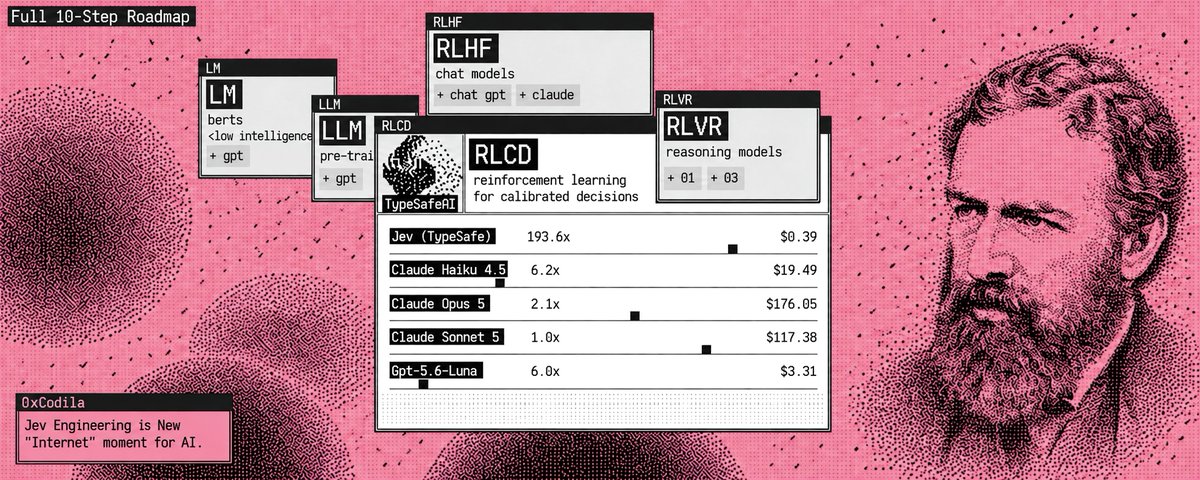
JEV MIND IS BUILDING A $100,000-A-MONTH COMPANY BY ITSELF - ALL FROM ONE FILE WORTH $3.2M
month one is an easy $100K target, month two is already 2x, and one agent does all of it without a single hire
market → offer → funnel → sales → retention → ops
six modules, and the brain doesn't move to the next one until the last is locked at 100%
market locked first: JEV read 340 markets and kept only the 11 where people already pay
offer locked: one promise, two tiers at $390 and $890, no "let's add a third one"
funnel locked: landing → demo → pilot, and 2.4 of every 100 strangers become a pilot
right now the brain is building sales - a deal closes in 11 days and there's already $61K in the pipeline
retention and ops are still at zero, and that's exactly where it goes the moment sales hits 100%
it doesn't ask what to do next - it locks a module and picks up the next one on its own
three of six modules already locked at 100%, the fourth is climbing right now
a company that builds itself, and you can watch every step live
jev ↓

Floxy retweeted

My company fired me and offered me $15,000 if I agreed not to contact any of our clients.
I thought about it for maybe thirty seconds.
Then I signed.
My manager looked almost offended by how quickly I agreed.
“You’re not going to fight this?”
“No.”
“You’re just walking away?”
“I am.”
The HR manager pushed the agreement toward me.
“Once you sign, there won't be any further communication between you and the company.”
I nodded.
“Fair enough.”
She handed me the cheque.
I stood up.
Then I stopped at the door.
“One last thing.”
My manager looked up...
the cashier noticed the receipt before the customer did.
it showed a purchase that hadn’t happened yet.
“$2,480. hotel room 317.”
the cashier, mia, looked at the customer.
“sir, did you just buy something online?”
the man shook his head.
“no.”
mia checked the register.
the transaction wasn’t there.
but the receipt was real.
the customer laughed nervously and left.
twenty minutes later, mia saw him again.
he was standing across the street, watching the store.
then her manager walked over.
“mia, don’t talk to that man.”
“why?”
her manager looked at the receipt.
“because that was my name on the reservation.”
mia immediately asked what was happening.
her manager, brian, finally confessed that someone had been using his identity to book hotel rooms.
but there was something worse.
every booking happened on the same day someone robbed a nearby business.
mia remembered the customer’s face.
she checked the store camera.
the man had entered the store three times that week.
each time, he bought something cheap and asked for a receipt.
brian suddenly went pale.
“he’s using our receipts.”
“for what?”
brian pointed at the camera.
“to create an alibi.”
mia looked at the receipt again.
the hotel room was booked for that night.
they called the police.
police arrived before the hotel booking time.
they waited in the lobby.
at exactly 9:00 p.m., the same man walked in.
he gave the receptionist mia’s receipt.
the police arrested him immediately.
but the biggest surprise came afterward.
brian wasn’t his victim.
he was his accomplice.
brian had been giving him access to the store’s transaction system and helping create fake receipts.
the customer had only turned on brian because brian refused to split the latest robbery.
both men were arrested.
mia kept the strange receipt as a reminder.
sometimes, the smallest piece of paper can expose an entire crime.