

AI -- Content creator & builder | Your research makes you money
AI city
Joined July 2026
- Tweets324
- Following465
- Followers1.7K
- Likes3K


left claude code on gta 6 for 9 hours while i was out all day. gave it screen access in the morning and one prompt to clear story missions and stay alive.
what it actually did on its own:
> learned the controls in ~12 min
> by hour 2 it was weaving through traffic cleaner than me
> after hour 5 it went into side content because it decided higher stats were needed before pushing the main story
> finished 5 missions and built a repeatable money farm that was running on autopilot when i got back
zero scripts, zero code written by me. prompts are in the replies


2
17
551

14 repos at $0 just replaced your entire After Effects pipeline
Fable 5.2 + 14 open-source repos = one working motion studio
animation. 3D. AI video. sound. the whole stack for $0
01 anime.js → animation engine powering half the polished sites in your feed
github.com/juliangarnier/ani…
02 react-spring → spring-based physics that make every UI transition feel natural
github.com/pmndrs/react-spri…
03 PixiJS → high-performance 2D WebGL renderer for particle FX, visual effects and 60fps output
github.com/pixijs/pixijs
04 p5.js → creative coding playground for generative art, built in a handful of lines
github.com/processing/p5.js
05 matter-js → rigid-body 2D physics. drops, bounces, collisions, all native
github.com/liabru/matter-js
06 D3 → data-driven charts with animation, the library behind most newsroom visuals
github.com/d3/d3
07 OpenToonz → open-source 2D animation suite for frame-by-frame production
github.com/opentoonz/opentoo…
08 Hunyuan3D-2 → feeds one image in and returns a textured 3D model
github.com/Tencent-Hunyuan/H…
09 TRELLIS → open 3D generator from Microsoft, takes one photo and outputs a usable 3D asset
github.com/microsoft/TRELLIS
10 LTX-2 → generates audio and video up to 4K resolution, all from one open model
github.com/Lightricks/LTX-2
11 LivePortrait → turns a still portrait into a talking, blinking face
github.com/KwaiVGI/LivePortr…
12 RIFE → fills in missing frames for smooth slow-mo and 60fps playback
github.com/hzwer/ECCV2022-RI…
13 MusicGen → text to music. describe the mood, get a finished track
github.com/facebookresearch/…
14 Tone.js → browser-native synths, beats and full sound design toolkit
github.com/Tonejs/Tone.js
animate → simulate → chart → draw → build 3D → generate → score
zero subscriptions. zero Adobe. zero render farms
open any one tonight and build something worth watching

Neuro retweeted
Every candle now fires its own trade. Fable 5.2 called 7 trades, 6 closed green.
this FREE TradingView indicator converts every closed candle into a JSON packet for AI agents. Fable 5.2 picks it up and fires SHORT, LONG or WAIT on its own.
i set up a desk and replayed the last 2 weeks of BTC, ETH and SOL: 19 packets, Fable opened 7 trades, passed 5 times, all 6 that closed came back green at +9.01R
how the indicator works:
> you see candles on a chart. an AI agent cannot
> the indicator converts every closed candle into JSON: regime, trend, momentum, volume, structure, levels, long and short scores out of 100
> Fable 5.2 picks up that packet, decides the trade, and spells out exactly why it could break
how to set it up with Fable 5.2:
1. drop ai-agent-lens.pine from the repo into TradingView's Pine Editor and add it to your chart
2. every closed candle scores a long and a short out of 100, calculated from 5 factors, zero repainting
3. each setup ships with an entry, an ATR stop, and 1.5R / 3R targets plotted on the chart the way TradingView draws its position tool
4. set ONE alert to "any alert function call" and drop in your webhook URL
5. start the webhook receiver from the repo and open a free tunnel
6. every packet drops into packets/latest.json the second the candle closes
7. launch Claude Code with Fable 5.2 and feed it agent/AGENT_PROMPT.md as the prompt
8. pull the signal: you get back the call, confidence, entry, stop, targets, sizing, and the exact reason it could fail
9. one alert per chart. stack BTC, ETH and SOL and have it rank every setup
FREE and open source.


Rockstar actually programmed a heavy woman on a scooter to roll up and rob you in GTA 6, proving once again why their open-world physics are untouchable.
I built a complete GTA 6 content engine in 15 minutes. No bloated editorial team, just a clean Obsidian markdown vault and six parallel Claude Code agents.
How the architecture works:
Single Source of Truth: Agents are strictly locked to verified files and local gameplay notes. Unconfirmed rumors stay tagged and never ship.
Parallel Roles: A Scout gathers patches, a Librarian structures data, and an SEO agent parses the top 72-hour search demand gaps.
Automated Pipeline: A Writer outputs source-backed guides, an Editor cuts raw gameplay into short clips, and a Publisher pushes content on a schedule with full link logging.
Two prompts spin up the whole cluster. While everyone else spends launch week manually clipping streams, this pipeline owns the search results and pivots directly into custom Discord bots and game server scripts. Full architecture breakdown inside.


3
24
846
Neuro retweeted
GTA 6 has already launched, and while Take-Two is counting billions, surpassing even the legendary opening of the fifth installment with its $1 billion in three days, the real story of the release lies elsewhere.
Rockstar has set an unreal bar for detail once again: every vehicle features a fully interactive dashboard.
You can control every element in detail: roll down the windows, switch between low and high beams, activate off-road mode, drop the truck bed, and use turn signals and hazard lights.
While some players encounter initial server bugs, the developers prove that the sky-high expectations of millions of fans were fully justified in the details.
A true masterclass in open-world immersion.

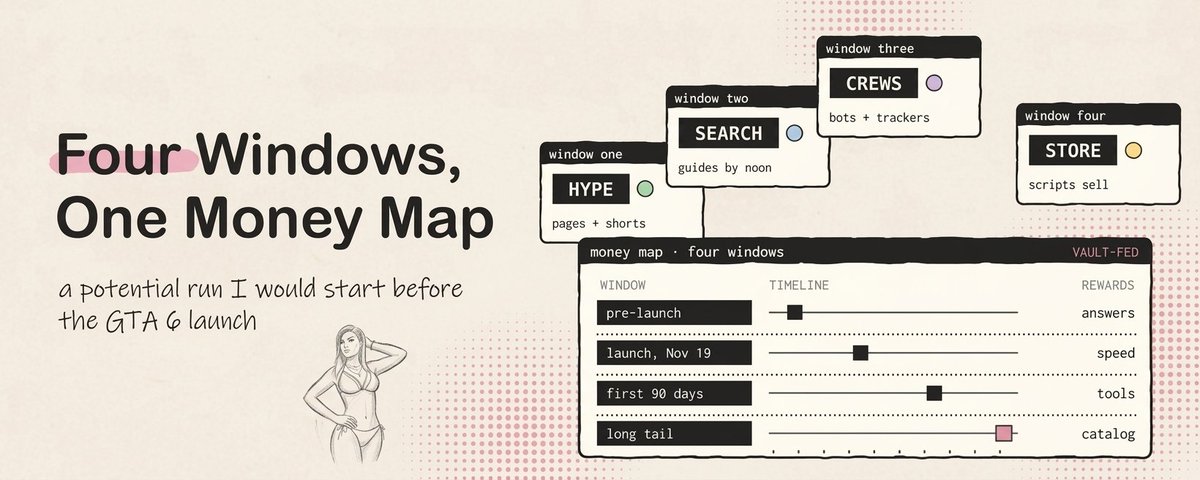
Current never jumps. It climbs, and a coded solenoid proves it pulse by pulse.
Every component built as code in Claude, like modelling a scene in Blender. The result runs live and you can interact with the whole bench.
How the demo runs:
→ The full test bench assembles on its own: supply, driver, coil, spring and oscilloscope
→ The coil goes transparent and the plunger snaps the gap shut in 14 ms
→ Spring and output wheel fire in sync with the plunger
→ Current, voltage and travel refresh live on every pulse
What you learn:
→ Why current builds gradually instead of spiking
→ What the flyback diode does the second you kill the switch


1
19
3,447
Neuro retweeted
I stacked a swarm on 9 files and killed shared memory.
OpenAI pointed 10,000 agents at one problem for 88 hours.
I scaled the same shape down to one folder.
Cheap model for my workers.
< One task, one file, no shared context. />
Strong model for lead and checker. Split, grade, merge.
< 4 roles, 7 rules, 9 files. />
No chat link in the loop.
What would your first split look like?

this harness layout f*cking wild
an inventory of the 5-seat map I wired from one folder, 4 agent markdown files and 2 hooks that route every model decision.
I burned weeks routing tasks by hand. One contract file killed that. Seat menu:
1. Advisor, Fable 5.2, read-only, 200-word verdict, edits nothing
2. Orchestrator, Fable 5.2, splits into parallel briefs, builds nothing
3. Builder, Opus 5.5, codes and tests, never reroutes the plan
4. Scout, Haiku 5.5, searches and compacts, no judgment calls
5. Gate, Jev, routes and approves, writes not one word
Three triggers call the advisor: 4-file plans, a second fail, anything permanent.
Two modes on the same map. Advisor mode: Opus 5.5 drives, Fable 5.2 advises. Orchestrator mode: Fable 5.2 drives the big parallel jobs.
5 seats. 4 agent files. 2 hooks. 9 prompts. Copies between repos as markdown.
The strongest model spots one wrong assumption. Everything else runs through code.
Funneled 1,000 agents through one proof in 30 hours.
My harness. Same layout Anthropic put on Fermat's Last Theorem. Humans needed 11 days for the first version.
Every failure traced to the coordination, not the model.
Five roles. One folder.
1. PLAN reads the goal file and splits work into pieces with private files and zero dependencies
2. BRIEF sends five fields per builder: goal, file scope, proof command, dead ends, receipt path
3. BUILD writes and tests on a single brief. No builder sees another builder
4. VERIFY opens in fresh context. Reruns the proof, adds 3 extra tests the builder never ran. Pass or fail
5. MERGE takes only verified work. Failed pieces return to BRIEF. STATE.md records every result and dead end
Anthropic's Fable 5.2 swarm ran the same layout at 1,000 agents on the Fermat formalization. 30 hours. Opus 5.5 on the same run: 26% after 18 hours, then flat.
One brake in the goal file. 5 failed attempts on the same check and the run hands control back.
I run 5 to 8 builders at once on a Max plan. Far from a thousand. The layout does not change.
The order pays for itself. PLAN first, then BRIEF, then the floor.
Watch where the first receipt locks and the counter resets
Neuro retweeted
A guy is making $21,000 a month from a phone farm posting Reels, and he already built the infrastructure to scale it to $100,000/month the day GTA 6 drops.
he used to grind a single creator account. manual editing, manual uploads, praying to the algorithm -> hours of work for one shot at views, until he realized one phone has a hard ceiling on reach.
so he stopped posting like a creator and started operating like a distributor. he built stacked physical racks of dozens of iPhones, all wired into a single curved monitor running a unified control panel. one dashboard -> simultaneous posting across TikTok, Instagram Reels, and YouTube Shorts, with individual roles and clean device fingerprints.
then he turned it into a pure volume machine. a single Reel pulls 1.4M+ views and nearly 1,000 new followers on autopilot while the rest of the grid runs 24/7. one rack became two, two became a wall of synced screens, each device feeding short-form clips into the algorithm.
now the whole setup is primed for the biggest gaming launch of the decade: clipping top GTA 6 streamers around the clock to turn a $21K/mo baseline into a $100K/mo run.
build and generate without stressing over credit limits. unlock Unlimited Seedance 2.5 with Ultra annual before Dec 1 -> picsart.go.link/31F4Z


Neuro retweeted
HOLY F*CK, this is getting unreal: Fable 5.2 already sits inside Claude Code, killed by default until you flip it on
1. Pull Claude Code to v2.1.321 or later, the first build that ships Fable 5.2
2. Run /model fable, or launch with claude --model fable
3. Look at the Fable entry in /model: "Requires usage credits" tells you it pulls from credits, not from your plan
4. Throw it the messy problems: a root-cause dig, a live outage, an architecture call
5. Tell it what you want done and let it map the steps
6. Drop "verify your work" from your prompts, it self-checks more than smaller models do
7. Hand it a complete task you would usually break into parts
1M context out of the box, medium effort to start, API price $8 / $40 per million tokens, down from $10 / $50 on Fable 5.1
5 AI configs from Google, Cloudflare, Obsidian's CEO, Pocock and Osmani sitting open on GitHub. 318K stars on the first repo alone. most devs still prompt from zero
1. Matt Pocock's skills · 318K stars
a full daily folder of AI instructions. tests before code, tight specs, real reviews
github.com/mattpocock/skills
2. Addy Osmani's skills · 92K stars
production-grade engineering skills built for AI coding agents
github.com/addyosmani/agent-…
3. Cloudflare's security audit · 63.9K stars
one team of agents hunts for vulnerabilities, a separate team tries to disprove every finding
github.com/cloudflare/securi…
4. Obsidian CEO's skills · 51K stars
trains any AI to write proper Obsidian notes instead of messy text
github.com/kepano/obsidian-s…
5. Google's goldfish · 14.8K stars
one agent drafts a design doc, then fresh AI sessions that never saw it try to tear it apart
github.com/google/elephant-g…
the biggest teams in tech already stopped prompting from zero. their full configs are one click away
grab one tonight
A RESTAURANT SPENT $50,000 HIRING A WORLD-CLASS WARDROBE CREW, CUSTOM-BUILT A RETRO VINTAGE WIDE-SHOULDER SUIT, INSTALLED PROFESSIONAL ROLLERSKATES, AND PLANNED A PRECISION STUNT INSIDE A PACKED DINING ROOM. OR SO IT LOOKS
shot from a casual phone angle, an office-waiter lookalike in a massive maroon vintage suit with exaggerated shoulder pads glides out on roller skates carrying a massive silver tray loaded with food across a luxury restaurant. then he hits a sudden bump, loses his balance, and faceplants spectacularly onto the floor, sending bowls, plates, and sauce flying everywhere in pure chaos. polished interior, restaurant guests, total disaster.
that reads like a high-end hospitality promotional stunt, a professional stunt coordinator, custom tailoring, choreographed chaos, venue permits, insurance waivers, and a staff primed to act on cue. easily $50,000, and no real restaurant owner would ever risk a massive food spill next to VIP tables.
no stunt coordinator, no custom wardrobe budget, no venue rental, no ruined dishes. the whole thing was made with AI, from a single prompt, on a laptop.
here is why it owns your attention: it starts as something your brain accepts as a normal viral phone fail, then breaks one rule -- shoulders that look straight out of an 80s cartoon mixed with impossible roller-skating in a tight dining hall. that single absurd detail dropped into a real looking scene hits harder than a whole CGI world

Neuro retweeted

I tore out Claude and my autonomous server, split Elon Musk's Grok Bot into nine specialists, and now I talk to one bot all day while the other eight do the work.
nine bots. zero overlap. no days off. here's the full roster, steal it.
step 1 → 0:00 how Grok Bot replaced Claude and an autonomous agent
step 2 → 1:53 the specialist model, one role per bot
step 3 → 2:40 the Chief of Staff bot and its webhook from Granola
step 4 → 9:50 why Claude projects lost to this
step 5 → 12:24 porting the autonomous agent to Grok Bot
Chief of Staff, the dispatcher. Granola captures every call, fires a webhook, and Chief of Staff picks up the transcript, sorts it and pushes each piece to the right bot. it never handles the specialist work. dispatch is the whole job.
TC Desk, the deal runner. drafts emails, builds addendums, writes counteroffers across 30 to 50 live transactions at once. it never loses track of which document belongs to which deal.
Inbox, the filter. watches two mailboxes, flags what needs attention and passes every transaction email to TC Desk. it never replies. it only routes.
Tubester, the content cutter. took one long video, sliced it into 15 Shorts and uploaded all of them. it never waits for you to cut or title anything.
Social, the scheduler. creates and sends posts to Instagram, LinkedIn and Facebook via HighLevel. it never asks you to cross-post or paste between apps.
two rules that made this run:
1. one bot, one role. no crossing lanes. every specialist stays in its job and never drifts into someone else's work.
2. talk to Chief of Staff only. it breaks down your input, delegates to the team and reports back. you run one conversation, not nine.
everyone opens Grok Bot and talks to one thread. that is one bot out of nine. the other eight are already running.
bookmark this.


RT @ridark_eth: DROPPED MY REVERSE BILL 67% WITH ONE GATE.
A confidence gate I wired between Grok and Fable sent 363 of 400 functions stra…
This quoted post is unavailable.
a f*cking spec-to-ship team in 10 repos
Open-source skills for Claude Code.
< base. align. spec. build. find. install. />
01 anthropics/skills → Load Anthropic's official skill folders for docs, design and dev
github.com/anthropics/skills
02 mattpocock/skills → Grill you, write specs, split tickets and run TDD before code ships
github.com/mattpocock/skills
03 cc-sdd → Turn an approved spec into one long autonomous build
github.com/gotalab/cc-sdd
04 gsd-core → Keep context clean per task so long builds stop rotting
github.com/open-gsd/gsd-core
05 agent-skills → Enforce 25 review gates a senior would run by hand
github.com/addyosmani/agent-…
06 compound-engineering-plugin → 38 skills that loop through plan, build and review
github.com/EveryInc/compound…
07 SuperClaude_Framework → Drop personas and slash commands into every session
github.com/SuperClaude-Org/S…
08 agents → Install role plugins built for your language and stack
github.com/wshobson/agents
09 awesome-claude-skills → Search 13 categories to find a skill that already exists
github.com/BehiSecc/awesome-…
10 vercel-labs/skills → One CLI that installs and manages reusable skills across agents
github.com/vercel-labs/skill…
Pick one spec. Load the skills. Let it build.
base → align → spec → build → find → install
Neuro retweeted
Ultra burned $681.91 and 10h 47m on a 25-second arctic scene to add a few extra ice veins
Meanwhile High built the same icebreaker, the same arch, the same aurora for $26.01 in 2h 17m
Opus 5.5. Same prompt. Four effort levels.
The iceberg budget report:
🥇 2h 17m 21s for $26.01 on High
🥈 3h 11m 26s for $45.97 on Extra High
🥉 3h 37m 47s for $84.93 on Max
💀 10h 47m 40s for $681.91 on Ultra
High ran 26x cheaper and finished 4.7x sooner
Then the camera orbits and it falls apart
High has the arch reflection, ship lights cutting the dark water and northern lights over the peaks
Ultra added slightly brighter turquoise ice. 8x the price of Max for a color shift.
$681.91 for ice that melts in the scroll
+$334,927 in 202 days from one Quant Skew system on Polymarket
Grok Bot assembled the setup and it pulls $1,658 a day, averaging about $96 per trade and cycling the same logic roughly 38 times an hour across BTC Up or Down markets
Multiple AI agents operate as a single algorithm:
1. Short-Term Momentum picks up the latest BTC direction
The system compares BTC to its level 30 seconds back:
Momentum = BTC now minus BTC 30s ago, divided by BTC 30s ago, × 100
Positive Momentum → Up bias
Instant directional read, no longer-term trend behind it
2. Realized Semivariance measures which side carries more recent volatility
Rather than weighing every BTC swing equally, the algorithm splits positive and negative returns:
Up Variance = Σ of positive returns squared
Down Variance = Σ of negative returns squared
Then:
Skew = Up Variance minus Down Variance, over their sum
Positive Skew → upside moves own the recent volatility
Positive Momentum + Positive Skew → harder Up signal
The system only fires when direction and volatility skew both line up
Top trades:
$535 → $2,860, +$2,325
$632 → $2,896, +$2,264
$685 → $2,602, +$1,916
Momentum reads BTC direction, semivariance locks where the weight sits

4
24
1,510