

building structured products | onchain credit · vaults · risk | avant gardist
ethereum
Joined June 2024
- Tweets2.3K
- Following439
- Followers325
- Likes7.4K






Pinned Tweet
Munis Already Solved RWA Redemptions.
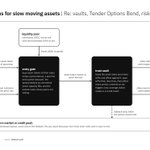
tl dr: i'm building a TOB (Tender Options Bond) inspired redemption-financing layer for vaults holding illiquid assets.
motivation: we have seen how things went south for projects like @AlturaDeFi. below proposed system makes sure this might never happen again but ofcourse with a real price of "adoption of scalable bond markets onchain". (may seem futuristic but the future is v near)
onchain bonds hold about 17.5 billion dollars against a 160.7 trillion dollar bond market, and most of it is treasury bill funds with almost no duration. tokenized munis total 31.6 dollars across three products, in a market that issued 587.3 billion last year. long bonds, private credit and CLOs come next, and each one hits the same wall at the exit.
slow assets get three kinds of exit today. a buffer that drains in hours, a queue that pays the first out as loans repay, or a market maker quote at a discount to NAV. the leaver pays or waits. stacking a junior tranche on top changes nothing while its risk has no definition.
munis faced this decades ago. auction rate securities cleared exits only when new bidders arrived, and nobody was committed to buy. on 13 february 2008 more than 85 percent of a 330 billion dollar market failed, and holders were stuck in long dated paper.
variable rate demand obligations kept working through the same year. a holder tenders at par with seven days notice, the weekly rate resets until buyers take the bonds, and a bank stands committed behind it. in september 2008 that rate went from 1.79 to 7.96 percent in about two weeks. the rate did the clearing and holders still left at par.
tender option bonds put the same exit on bonds someone else issued. a trust splits long fixed rate bonds into a floater that tenders at par and a residual that keeps the spread. issuance passed 140 billion dollars in 2007. the original issuer never took part, the trust became the new issuer.
the price of liquidity moves into the coupon. the leaver gets par, stayers earn a higher rate, and one rate covers every unit in the window, so there is nothing to race for. the residual sells that liquidity and earns the spread. at a 6 percent bond, a 4 percent floater and 80 percent leverage it makes about 12 percent after fees, and breaks even at a 7 percent floater. that is junior risk with a number on it.
solvers are the remarketing agent here, bidding to place tendered units at the lowest rate. they discover price, they do not create cash. the order that works is auction first, committed liquidity second, and the underlying bonds handed to holders only when the credit itself breaks.
@bondifinance bond tokens are the natural collateral. each is backed one to one by a real corporate bond. bondi is doing real innovation with tokenization of all types of bond baskets. a trust over them gives stablecoin holders a weekly par asset and yield buyers a levered spread.
@centrifuge already ships the plumbing. JAAA and JTRSY hold about 934 million dollars in ERC7540 vaults, and ERC8161 lets a pending redemption change hands before it settles. instant exits through Liquid Lane are priced as a market maker discount. a reset rate clears the same claim at par.
@maplefinance holds over a billion dollars in syrupUSDC on loans whose cash returns when borrowers repay, not when lenders ask. a weekly par put backed by a residual turns that timing gap into a rate instead of a place in a queue.
@MidasRWA is one step away. its staked liquidity pool is already senior, capped at 10 percent of TVL and paid a fixed instant fee. put a remarketing auction in front of it, let the rate move with flow, and the pool becomes the second line instead of the first.
none of these parts is new onchain. i just think it will be a final breakthrough with culmination of special bonds onchain and existing tech which is tested across entire defi.
Also i think this system will be the real usecase of ERC7540 async requests, solver auctions, committed pools and tranches all run today, just never inside one vault.
building it.
adiii retweeted

Every financial product has its own requirements, but much of the infrastructure needed to operate a vault is the same.
Which parts can be shared, and which need custom logic?
This technical breakdown explores how the VDK draws that line and where there's room to build.

recently got a chance to do a high level review of @centrifuge's newly launched VDK infrastructure.
congrats to @offerijns and team.
it is undoubtedly one of the most transparent architecture around vaults today imo.
these are my perspectives about the kit ( a must read for all vault enthusiats, builders and teams)
centrifuge’s vault development kit, VDK, turns launching an onchain fund into configuring one. one immutable vault, five plugin slots fixed at deployment, one compliance hook on the share token, and a hub that settles async requests. it is still a preview under audit, so read this as the documented design.
each vault serves one position, a pool, share class and asset on a spoke chain. a position can hold several vaults, called variants, all issuing the same share token, like one fund with counters at different branches handing out the same certificate. a vault’s configuration never changes, so new plugin logic means a new variant, while terms like fees and reserve size still move from the hub.
vaults run up to two lanes. the async lane follows ERC 7540, where assets or shares lock in a request, the hub settles and the investor claims. the instant lane follows ERC 4626, executing at the oracle price within the instant policy’s capacity, net of its spread. partial fills are native, which is how gates, carryover, side pockets and capital calls work without new vault code.
every chain feeds one order book on the hub, the hub sets one price for every fill, and shares move between chains by burn and mint. a batching policy sends one message per window, per side, per vault however many investors joined, one group ticket instead of a ticket per passenger. gates, swing pricing and tranche priority are judged across all chains at once.
builders write only the one or two plugins that make their product different. one contract can fill several slots, and plugins read live vault state, so a rule like redeem at most 5 percent of net asset value per day needs no new parameter. product logic on the hub lives in wrapper managers outside the order book engine, so a wrapper bug cannot corrupt its accounting.
integrators get one interface across every vault, but each vault is dual mode per investor and per side. with nothing pending or claimable, the two argument deposit, mint, withdraw and redeem trade instantly. with anything pending or claimable, the same calls claim. retry a claim that already landed and it trades on the instant lane instead, with no revert.
investors get no cancel function on the vault. by default only the pool manager cancels, and in a shared bucket a cancellation scales every contributor down. where the request policy allows it, ERC 8161 lets a pending request change hands, so a queued position becomes transferable.
compliance runs through one ShareTokenHook with four presets. ten vault operations reach it as role checks, since they have no enforced transfer leg or the transfer hook would miss a party. each check carries the value in assets and shares, so a custom hook can cap a position without its own price, and while the price is invalid a limit refuses rather than passes.
the execution policy bounding the pool manager is optional, and without it every hub action is instant. with it, out of bounds fills and price moves are delayed, not refused, and the first price update per share class is unbounded. a faulty role hook can block every vault of the share class.
a 30 day notice on daily windows keeps 31 buckets open per side, 31 order tickets in a drawer until a keeper calls the flush for each. maxReserve caps on sibling vaults share one escrow balance, so they do not add up. the Basin route reads zero capacity with no error if its setup is incomplete.
for founders, the open ground is in the docs. the order book has no aggregate view of pending orders, so swing pricing lives in a wrapper. a tranche waterfall binds only if its wrapper is the sole fill path. business day calendars, rolling flow limits and request for quote books are left to custom plugins. that is where the next centrifuge products get built.
recently got a chance to do a high level review of @centrifuge's newly launched VDK infrastructure.
congrats to @offerijns and team.
it is undoubtedly one of the most transparent architecture around vaults today imo.
these are my perspectives about the kit ( a must read for all vault enthusiats, builders and teams)
centrifuge’s vault development kit, VDK, turns launching an onchain fund into configuring one. one immutable vault, five plugin slots fixed at deployment, one compliance hook on the share token, and a hub that settles async requests. it is still a preview under audit, so read this as the documented design.
each vault serves one position, a pool, share class and asset on a spoke chain. a position can hold several vaults, called variants, all issuing the same share token, like one fund with counters at different branches handing out the same certificate. a vault’s configuration never changes, so new plugin logic means a new variant, while terms like fees and reserve size still move from the hub.
vaults run up to two lanes. the async lane follows ERC 7540, where assets or shares lock in a request, the hub settles and the investor claims. the instant lane follows ERC 4626, executing at the oracle price within the instant policy’s capacity, net of its spread. partial fills are native, which is how gates, carryover, side pockets and capital calls work without new vault code.
every chain feeds one order book on the hub, the hub sets one price for every fill, and shares move between chains by burn and mint. a batching policy sends one message per window, per side, per vault however many investors joined, one group ticket instead of a ticket per passenger. gates, swing pricing and tranche priority are judged across all chains at once.
builders write only the one or two plugins that make their product different. one contract can fill several slots, and plugins read live vault state, so a rule like redeem at most 5 percent of net asset value per day needs no new parameter. product logic on the hub lives in wrapper managers outside the order book engine, so a wrapper bug cannot corrupt its accounting.
integrators get one interface across every vault, but each vault is dual mode per investor and per side. with nothing pending or claimable, the two argument deposit, mint, withdraw and redeem trade instantly. with anything pending or claimable, the same calls claim. retry a claim that already landed and it trades on the instant lane instead, with no revert.
investors get no cancel function on the vault. by default only the pool manager cancels, and in a shared bucket a cancellation scales every contributor down. where the request policy allows it, ERC 8161 lets a pending request change hands, so a queued position becomes transferable.
compliance runs through one ShareTokenHook with four presets. ten vault operations reach it as role checks, since they have no enforced transfer leg or the transfer hook would miss a party. each check carries the value in assets and shares, so a custom hook can cap a position without its own price, and while the price is invalid a limit refuses rather than passes.
the execution policy bounding the pool manager is optional, and without it every hub action is instant. with it, out of bounds fills and price moves are delayed, not refused, and the first price update per share class is unbounded. a faulty role hook can block every vault of the share class.
a 30 day notice on daily windows keeps 31 buckets open per side, 31 order tickets in a drawer until a keeper calls the flush for each. maxReserve caps on sibling vaults share one escrow balance, so they do not add up. the Basin route reads zero capacity with no error if its setup is incomplete.
for founders, the open ground is in the docs. the order book has no aggregate view of pending orders, so swing pricing lives in a wrapper. a tranche waterfall binds only if its wrapper is the sole fill path. business day calendars, rolling flow limits and request for quote books are left to custom plugins. that is where the next centrifuge products get built.

onchain vaults are taking off.
at first they look quite simple and pro rata functioning, but the whole lot universe unlocks when you actually start building around em as a infra!
i'm seeing almost all major projects actively building vaults around businesses, asset classes and curation.

Br0, onchain vaults are taking off. It's time to study them seriously.
Here are 3 reports on vaults, all published this week. Just deep dive into these 3 reports to understand vaults.
1. Understanding Onchain Vaults by @SteakhouseFi and @block_stories
2. The State of Onchain Vaults by @Two_Prime
3. Building a Sustainable Vault Economy by @SentoraHQ
blockstories.io/vault-report
twoprime.com/resources/insig…
sentora.com/research/reports…

2
10
229

adiii retweeted

Every missed call is a lost patient.
Vakya 📞 is an AI receptionist on a real phone line. Hindi, Marathi, English. Books, reschedules, cancels, with instant WhatsApp + Google Calendar updates.
vakya.ayushchougula.in
Built on @GnaniAi
#GreatIndianAIInternshipChallenge #GnaniAI
had a great chance to grab some time with @stablecoin_p to discuss on @OseroHQ's distribution side.
i would say Osero is still v new and yet to mature but its fascinating to see how it can serve the ecosystem in many ways.
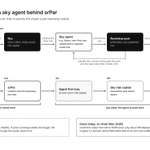
a @SkyEcosystem agent holding a 100M credit line and its own first loss capital: I found the exact par backstop for my Tender Option based redemption infra
in february 2008 roughly $330B of auction rate paper froze within weeks. the underlying assets were mostly fine, the auctions simply failed, and nobody was obliged to buy at par, so holders sat on penalty coupons for months and some for years. most tender option floaters backed by a bank liquidity facility kept getting par through the same tape while residual holders took the pain. the difference was never the collateral. it was a name standing behind the put.
onchain credit is walking into the same setup. @stablecoin_p showed at DAYS singapore that RWA collateral on morpho went from about 35M to nearly 1B in twelve months, curated vaults grew about as fast as plain lending shrank, and earn programs are pushing further out the curve into looped private credit. slower collateral now sits behind faster money every month, and almost none of it has a committed buyer at par.
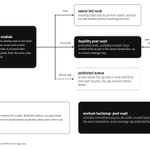
my tender option based redemption vault was designed around that missing seat. srPar holders tender, standing senior bids clear most of it, and a prefunded pool buys whatever is left at par up to a published cap, earning the reset rate while it holds. the question every curator asks is whose balance sheet sits in that pool. the cleanest answer we found already lives inside @SkyEcosystem.
a sky agent borrows USDS at the base rate, deploys it, keeps the spread, and posts its own capital as the first loss layer before sky’s own risk capital ever takes a hit. in his neobank talk piotr pitches that waterfall as junior, mezzanine, senior and a side pocket. read it like a credit desk would and an agent is already a junior tranche with a credit line attached. it knows how to price first loss because it lives there.
@OseroHQ is the live example. incubated by @stablewatchHQ with sky leading its 13.5M round, it holds about 10M USDS as its own loss buffer, and governance raised its credit line from 5M to 100M between july and september. on chain it parked up to 50M in sparklend at roughly its cost of funds, then moved 5M into a @gauntlet_xyz curated USDC vault on morpho earning about 5.7 percent. cheap patient capital, mostly undrawn, looking for a job that pays better than parking.
a backstop seat is that job. the agent commits a capped, prefunded pool. on quiet weeks it earns a standby fee plus a slice of the entry gate discount whenever it warehouses a seller. on stressed weeks it buys srPar at par, holds paper whose rate has reset higher, and sells back when bids return. it gets paid the most exactly when it is used, which is the opposite of how most yield behaves.
from the outside the shape is a chain where USDS holders fund sky, sky extends credit to the agent, the agent commits the cap and the cap pays par on tender. from the inside it is a loss order. our jrResi burns first at 30 to 35 percent of the trust, then srPar pro rata including the backstop, then the agent’s own capital, then sky’s risk capital, and only then a USDS holder. the agent is junior at home and senior with us, and a USDS holder ends up behind two separate first loss layers.
that nesting is the real alpha. a basel style framework should charge a capped, junior protected, par backed exposure far less capital than the raw credit fund underneath it, which means more of that 100M line can work per dollar of agent capital. and it stays a liquidity facility, not a guarantee. if junior coverage breaks the trigger, the obligation switches off and the trust unwinds through the issuer, senior first.
two rules keep it honest. the published cap equals prefunded capital, because onchain rate limits make on call promises soft and a backstop you cannot see is just a narrative. and every number lives on a dashboard, cap used, fills, coverage and junior capacity. the plumbing already exists too. osero onboarded its gauntlet vault through an ERC 4626 adapter, a forum scope, a risk review and a governance spell with rate limits, the same path a backstop pool would take.

5
143
a @SkyEcosystem agent holding a 100M credit line and its own first loss capital: I found the exact par backstop for my Tender Option based redemption infra
in february 2008 roughly $330B of auction rate paper froze within weeks. the underlying assets were mostly fine, the auctions simply failed, and nobody was obliged to buy at par, so holders sat on penalty coupons for months and some for years. most tender option floaters backed by a bank liquidity facility kept getting par through the same tape while residual holders took the pain. the difference was never the collateral. it was a name standing behind the put.
onchain credit is walking into the same setup. @stablecoin_p showed at DAYS singapore that RWA collateral on morpho went from about 35M to nearly 1B in twelve months, curated vaults grew about as fast as plain lending shrank, and earn programs are pushing further out the curve into looped private credit. slower collateral now sits behind faster money every month, and almost none of it has a committed buyer at par.
my tender option based redemption vault was designed around that missing seat. srPar holders tender, standing senior bids clear most of it, and a prefunded pool buys whatever is left at par up to a published cap, earning the reset rate while it holds. the question every curator asks is whose balance sheet sits in that pool. the cleanest answer we found already lives inside @SkyEcosystem.
a sky agent borrows USDS at the base rate, deploys it, keeps the spread, and posts its own capital as the first loss layer before sky’s own risk capital ever takes a hit. in his neobank talk piotr pitches that waterfall as junior, mezzanine, senior and a side pocket. read it like a credit desk would and an agent is already a junior tranche with a credit line attached. it knows how to price first loss because it lives there.
@OseroHQ is the live example. incubated by @stablewatchHQ with sky leading its 13.5M round, it holds about 10M USDS as its own loss buffer, and governance raised its credit line from 5M to 100M between july and september. on chain it parked up to 50M in sparklend at roughly its cost of funds, then moved 5M into a @gauntlet_xyz curated USDC vault on morpho earning about 5.7 percent. cheap patient capital, mostly undrawn, looking for a job that pays better than parking.
a backstop seat is that job. the agent commits a capped, prefunded pool. on quiet weeks it earns a standby fee plus a slice of the entry gate discount whenever it warehouses a seller. on stressed weeks it buys srPar at par, holds paper whose rate has reset higher, and sells back when bids return. it gets paid the most exactly when it is used, which is the opposite of how most yield behaves.
from the outside the shape is a chain where USDS holders fund sky, sky extends credit to the agent, the agent commits the cap and the cap pays par on tender. from the inside it is a loss order. our jrResi burns first at 30 to 35 percent of the trust, then srPar pro rata including the backstop, then the agent’s own capital, then sky’s risk capital, and only then a USDS holder. the agent is junior at home and senior with us, and a USDS holder ends up behind two separate first loss layers.
that nesting is the real alpha. a basel style framework should charge a capped, junior protected, par backed exposure far less capital than the raw credit fund underneath it, which means more of that 100M line can work per dollar of agent capital. and it stays a liquidity facility, not a guarantee. if junior coverage breaks the trigger, the obligation switches off and the trust unwinds through the issuer, senior first.
two rules keep it honest. the published cap equals prefunded capital, because onchain rate limits make on call promises soft and a backstop you cannot see is just a narrative. and every number lives on a dashboard, cap used, fills, coverage and junior capacity. the plumbing already exists too. osero onboarded its gauntlet vault through an ERC 4626 adapter, a forum scope, a risk review and a governance spell with rate limits, the same path a backstop pool would take.
srPar turns slow yield into collateral that lending and fixed rate markets can actually use
srPar is the product i am excited for! thought i should cover the last research part on this before moving forward with making to actual model public
every lending market prices collateral the same way underneath the risk memos. the real question is how much of the borrowed asset it can recover, and how fast, while a position is being liquidated. that one number decides the LTV, the liquidation bonus and whether the asset gets listed at all. slow assets fail it by construction, which is why the largest RWA tokens live in permissioned corners with whitelisted liquidators and heavy oracle discounts.
look at how curators already reason. @maplefinance syrupUSDC got a 90 percent LTV and a 92 percent liquidation threshold in aave’s stablecoin emode because withdrawals clear in a median of about three and a half minutes, with roughly $34M of unallocated cash sitting behind them. mGLO is listed at a 91.5 percent LLTV on morpho only after the oracle shaves 6 percent off NAV to price in a monthly redemption cycle. PT-reUSD looked just as solid until a $320k trade moved its pool and liquidated $36M in fourteen minutes. the exit route is the collateral.
srPar is built around that route. it is the senior claim the trust issues when it buys a slow asset from someone who wants out, and it carries a demand feature. the holder can tender it at par plus accrued on short notice. a tender goes to standing senior bids first, then to a prefunded pool up to a published cap. the coupon resets weekly to whatever keeps the price at par, so stress shows up in the rate long before it can touch the mark.
here is how that plays out. alice holds $1M of a credit fund that prices monthly and pays redemptions five weeks later, and she needs dollars this week. she sells into the gate and receives about $994k today. the trust keeps the fund units, issues $700k of srPar and $300k of junior against them, and the pool that fronted her cash is repaid as both slices find buyers. the issuer never sees a redemption request.
bob runs a stablecoin treasury. he buys that $700k of srPar at par because it pays a floating rate a little above t bills and he can call his principal back on demand. he does not leave it idle either. he posts it as collateral on a midnight fixed rate book and borrows USDC for ninety days at a known rate. his collateral earns, his liability is termed out, and his exit is contractual.
three weeks later the fund marks down 2 percent and a wave of tenders arrives. the junior eats the markdown, so senior coverage barely moves. standing bids absorb most of the paper, the pool buys the rest at par, and the weekly rate steps up until fresh buyers come back. when his loan rolls off, bob tenders on a tuesday and is paid par plus accrued. if his position had needed liquidating instead, the liquidator would have tendered his srPar for par rather than dumping it into a thin pool.
that last sentence is the whole collateral thesis. a lending market can list srPar near the top of its LTV range because the liquidation path is written into the asset, and the haircut mostly comes down to how much of the cap is already used. once one venue accepts it, that venue becomes a fresh source of senior bids. more tenders clear without touching the pool, spreads tighten for the next alice, and more srPar gets issued. that loop is how the system scales, not the junior and not the gate.
the timing works. okx began accepting blackrock’s BUIDL as derivatives margin in april with standard chartered holding it off exchange, binance already takes tokenized treasuries in its off exchange collateral program, and the CFTC pilot lets futures brokers accept tokenized treasuries and money fund shares as margin. yield bearing collateral is becoming normal. what is still missing is collateral that pays the yield of slow credit with the exit profile of a money fund.
fixed rate is where it compounds. more than 95 percent of the roughly $25B of active onchain loans were still variable with no maturity at the start of this year, and midnight is the loudest push yet to change that. term lenders care about one thing above everything else, collateral that does not gap before maturity. srPar hands @Morpho midnight books, @term_labs auctions and @pendle_fi markets a base asset whose worst case is a queue rather than a cliff. a PT on srPar is simply fixed rate par paper backed by slow credit.
stablecoin balance sheets are drifting the same way. @ethena put $250M into a tokenized AAA CLO fund in june and is moving $1B of USDe backing into a secured credit facility. reserves are rotating into credit, and they still need to be par stable and callable. tender option floaters filled exactly that slot for tax exempt money funds for two decades, because the demand feature let a fund treat thirty year paper as seven day paper.
none of this comes free. the put is only as strong as the cap and the capital behind it, so coverage, fills and junior capacity get published live, and curators should haircut srPar against those numbers rather than against a narrative. a market that lists it blind is making the same mistake as one that listed PTs on pool depth alone.
why jrResi doesn’t directly compete with looping here
the obvious objection to a junior tranche on slow collateral is that it looks like a loop with extra steps. a keyring unwind position on mGLOBAL and a jrResi slice on mGLOBAL both hold levered exposure to the same fasanara receivables book, priced off the same monthly NAV and sitting behind the same redemption gate. the exposure overlaps. the product does not.
keyring’s unwind is a financing rail. a user decides to lever up, the manager borrows from an euler debt vault against a pending subscription, and the position sits on the user’s own subaccount with a health factor attached. supply follows borrower demand and lender liquidity. jrResi is the subordinated layer of an exit. it only exists when someone sells out of a slow asset and the trust needs first loss capital to fund that sale.
that difference shows up in the terms. a loop subscribes at or above NAV, while jrResi is issued below fair value because the seller is paying for immediacy. a loop picks its own leverage up to the market cap, while jrResi is fixed by its attachment point at roughly 3x on a 30 to 35 percent tranche. a loop is liquidated when health drops below one. jrResi is marked to NAV and resolved through an orderly wind down, without recourse, margin calls or an auction discount.
the two feed each other. a looper unwinding on @KeyringNetwork is exit flow for the trust, and lenders in @eulerfinance debt vaults looking for paper that behaves like par are natural srPar buyers. keyring builds the entry. we underwrite the exit.
the junior book is the binding constraint, so we are building it deliberately instead of waiting for yield tourists. we take the first tranche ourselves alongside a sponsor from the issuer side. for issuers like @MidasRWA and @re, a junior stake on their own paper can be cheaper than parking idle redemption buffers. curators already underwriting this collateral come next, with first loss sleeves on risk they have priced, the way @SteakhouseFi, @gauntlet_xyz and @mevcapital curate mF-ONE and @Re7Labs and @kpk_io run permissioned markets on euler.
committed capital is the third layer. vault networks like @symbioticfi and tail underwriters like @Corkprotocol can commit term capital to the junior or pool layer and get paid for standby rather than turnover. burned loopers arrive last, once the book has a stress cycle behind it and they can see carry without liquidation risk in the actual fills.
what makes it investable is plain. isolation per asset, triggers on a bounded NAV feed with a grace window, a published cap on the srPar reset and penalty rates, a reserve funded from fees beneath the junior, and vintage accounting so late buyers do not inherit earlier marks. fills, coverage and junior capacity are published live.
why jrResi doesn’t directly compete with looping here
the obvious objection to a junior tranche on slow collateral is that it looks like a loop with extra steps. a keyring unwind position on mGLOBAL and a jrResi slice on mGLOBAL both hold levered exposure to the same fasanara receivables book, priced off the same monthly NAV and sitting behind the same redemption gate. the exposure overlaps. the product does not.
keyring’s unwind is a financing rail. a user decides to lever up, the manager borrows from an euler debt vault against a pending subscription, and the position sits on the user’s own subaccount with a health factor attached. supply follows borrower demand and lender liquidity. jrResi is the subordinated layer of an exit. it only exists when someone sells out of a slow asset and the trust needs first loss capital to fund that sale.
that difference shows up in the terms. a loop subscribes at or above NAV, while jrResi is issued below fair value because the seller is paying for immediacy. a loop picks its own leverage up to the market cap, while jrResi is fixed by its attachment point at roughly 3x on a 30 to 35 percent tranche. a loop is liquidated when health drops below one. jrResi is marked to NAV and resolved through an orderly wind down, without recourse, margin calls or an auction discount.
the two feed each other. a looper unwinding on @KeyringNetwork is exit flow for the trust, and lenders in @eulerfinance debt vaults looking for paper that behaves like par are natural srPar buyers. keyring builds the entry. we underwrite the exit.
the junior book is the binding constraint, so we are building it deliberately instead of waiting for yield tourists. we take the first tranche ourselves alongside a sponsor from the issuer side. for issuers like @MidasRWA and @re, a junior stake on their own paper can be cheaper than parking idle redemption buffers. curators already underwriting this collateral come next, with first loss sleeves on risk they have priced, the way @SteakhouseFi, @gauntlet_xyz and @mevcapital curate mF-ONE and @Re7Labs and @kpk_io run permissioned markets on euler.
committed capital is the third layer. vault networks like @symbioticfi and tail underwriters like @Corkprotocol can commit term capital to the junior or pool layer and get paid for standby rather than turnover. burned loopers arrive last, once the book has a stress cycle behind it and they can see carry without liquidation risk in the actual fills.
what makes it investable is plain. isolation per asset, triggers on a bounded NAV feed with a grace window, a published cap on the srPar reset and penalty rates, a reserve funded from fees beneath the junior, and vintage accounting so late buyers do not inherit earlier marks. fills, coverage and junior capacity are published live.
i think this can be exceptional if scaled properly with right team and close the gaps eventually.
@KeyringNetwork @eulerfinance @MidasRWA @centrifuge @SteakhouseFi

i think this can be exceptional if scaled properly with right team and close the gaps eventually.
@KeyringNetwork @eulerfinance @MidasRWA @centrifuge @SteakhouseFi
DAS and Token2049 will be the only conferences that will matter. and i dont think that's biased opinion at all. its fact that value has been drawn from other significant conferences over last few years.
never attended a single crypto event but recently got a chance to attend the mumbai one. dont think will be attending it tho.
tbh i dont see much of my fav folks attending it too.
guess no one cares about chain / ecosystem native events these days as you said, financial and ai overlap effect.

Not sure what they expected hosting it in Mumbai, generational L.
Pretty wild though, this is the first year in crypto I can remember where there wasn't a major Ethereum based conference everyone went to.
Obviously I'm biased here, but I think within 1-2 years the only major "crypto" conferences will be DAS and Token2049.
We're in a world where no one cares what chain it's built on, the ecosystem conferences of the past will get smaller and smaller.
On a final note, I think crypto companies are sleeping on tech and SF based conferences.
It's well understood that crypto is merging with finance, but there's also a lot of overlap with AI.
Big opportunity for enterprising teams who can get to this market first.
1
177
$16B of onchain assets can’t exit on time. Everyone's building an exit capital but we need no normal pool but an entire infra.
i think before putting the arithmatic model, its more obvious to study simple pmf stats for a tender option based vault like infra around redemptions which i am building. checkout, this is v straight forward reasoning on why this can be interesting.
every vault and credit fund onchain promises an exit. very few have anyone committed to stand behind it.
the numbers are plain. superstate’s USTB keeps an instant buffer of about 1% of supply. maple’s syrupUSDC holds about 3% in idle cash. midas’s mGLOBAL instant vault covers about 9% of NAV and caps daily exits.
and buffers drain first. 3jane’s reserves fell to the low six figures for a week in april. aave’s stablecoin pools ran dry during the rsETH episode. a morpho market sat at 100% utilization with $18M trapped inside.
the teams building exit liquidity know this. midas raised $50M and launched its own facility. grove committed up to $1B a day, mostly for t-bill funds. symbiotic and redstone shipped RFQ and solver lanes. almost none of them publish fills.
the one dedicated exit vault with public numbers holds about $204k, down from a $1.2M peak. its LPs earned roughly cash rates. that isn’t a design flaw, it’s a pricing one. exit capital paid like cash leaves like cash.
i think the fix is structural, and it’s forty years old. tradfi kept long munis liquid through tender option bonds. a trust held the asset, a floater could be handed back at par, a residual took first loss, and a liquidity provider stood behind the put. floater holders never took a loss across more than $1 trillion of these deals.
onchain, the same split pays each kind of capital for the risk it actually wants. the senior gets par on short notice at a near-cash rate. the junior gets levered carry, often 12 to 30%, and that carry is the product, not a fee. a prefunded pool only covers the gap resale doesn’t. the issuer’s queue or the asset’s maturity becomes the trust’s unwind, not the holder’s problem.
i mapped every slow-exiting asset onchain against this. about $16B exits slowly or behind a gate. about $0.75B fits cleanly today, and about $2B fits with a thicker junior, an issuer whitelist or a bounded oracle. most of it is gated credit.
everything that fits unwinds one of two ways. nav-gated assets wait for an issuer window: credit funds, insurance tranches, queued vaults. maturity assets wait for a date: principal tokens and fixed term credit. one spine, two adapters.
the hard part isn’t the code. it’s capital that stays when it’s needed. so commitments lock for a term, the pool’s fee rises as coverage thins, sellers can’t front-run a NAV markdown, a fee-funded reserve sits below the junior, and capacity and fills are published live.
if you run a gated credit fund, an insurance tranche, a queued vault, a PT market or a fixed term book, your holders already pay for speed. instant fees run 0.5 to 2%. liquidators are assumed to buy 10% under NAV. quarterly windows fill a fraction of what’s asked.
this layer is open infrastructure. you keep your compliance, plug in the adapter for your shape, and your exits stop depending on your own idle cash.
DYOR. dms are always open if anyone's building around this.
2
129
another banger.
been following @vadymnx's work and his few articles were one of the early motivations for me to start posting around this niche.
seems like that decision changed my trajectory for good.
recently been busy talking to lots of big defi, rwa folks that deal w vaults, risk, credit, bonds, options and what not! bullish already the way products are built. its like the whole paradigm has shifted to a new level. this isn't giving me any crypto vibe at all.
also, i see many non crypto natives are truly trying to build not just tokenized wrappers but real products onchain. which directly answers to most of the questions and clears the air around tokenization's moat.
its just getting started ngl.
more to come onchain!


3
204
have a taste or don't have a taste
be open to collab or don't be open to collab
be driven or don't be driven
go niche or don't go niche
thats the differentiator imo.

very weird thing happening rn
technical people are sad, they think their skills are now useless
non-technical people are desperately wishing they were more technical so they could use agents better
3
154
adiii retweeted

mapped some RWA tokens by how much of their supply is posted as collateral against how much instant liquidity is available
“posted” = the token is locked in a lending market and the holder borrows stablecoins against it. if the loan turns bad, the lender can sell it
the two are closely linked. a high % posted means that when NAV falls, unwinding triggers a wave of redemptions, and a lack of exit liquidity turns that into bad debt
a low % posted means holders can simply keep holding the yield-bearing token, so far fewer redemptions are triggered
ethereum:0x056b269eb1f75477a8666ae8c7fe01b64dd55ecc and $siUSD are the benchmark here
USD3: 59% of supply posted, but instant exit covers ~0.5x of the debt ($25M withdraw limit + $2M Curve vs $54M debt)
siUSD (infiniFi, a yield aggregator): 40% posted, ~0.8x cover ($13M liquid reserve vs $16M debt)
both are heavily used as collateral and still have a real chunk of debt that can exit at once. that’s the shape to look for. neither is risk free, the exit pools are shared by every holder
syrupUSDG and PRIME are in the danger zone
syrupUSDG: ~99% posted, $233M debt vs ~$17M of idle cash (0.07x)
PRIME: 61% posted (up to 87%), $263M debt vs ~$19M of DEX depth (0.07x)
at 0.07x only ~7 cents of every $1 of debt can leave instantly. the rest relies on queues, new deposits or the issuer. syrup redemptions have cleared fast so far (median ~3 min), but that comes from new deposits and repayments, not cash on hand
ONyc (56% posted, 0.04x) and PST (55%, ~0x) sit in the same zone. ~$700M of known debt in total
long thread below 👇

had a conversation w @ali_sarp from @bondifinance recently.
bullish on the primitive they've been building for all sorts of strategies on top.
lots of work coming to bonds onchain in coming future! 🗽
2
6
280
adiii retweeted

Lately I’ve been reading ERC-7540 redemption queues onchain just to see how async vaults behave once real money is in them.
So, “async” mostly isn’t slow. Most of the money asking to leave sits in vaults that pay within a day. the real waiting lives in a handful of slow funds with weekly or monthly cycles.
Stress days didn’t look like I expected either. when a big chunk of a vault asked to leave at once, payouts usually came faster, not slower. The people actually stuck waiting aren’t the whales, it’s small holders in slow funds.
Stated terms and real behaviour don’t always match. for some funds the wait you measure looks nothing like what the docs say.
ERC-8161 now lets a pending request change hands, which in theory opens a secondary market for the queue. in practice almost nobody supports it yet
Something that I am focusing a lot is on the fact that fund tokens already back loans and if one gets liquidated, the liquidator is left holding a token that only pays out later. NAV tells you what it’s worth if you wait. nothing tells you what it’s worth if you need out today
Still digging. Curious if anyone running these vaults sees the same
pretty confident that this will become one of the cleanest warehousing solution around vaults infra today.
been working on the model for a while and seems perfect already.
will be making it public soon!
the backstop is the product: why funded vaults in TOB-based redemption infra beat bank promises for slow assets
this is not just limited to TOB-based redemption infra i am currently building but overall onchain finance products primarily based on vaults
in tradfi short term munis, every par put rests on a bank SBPA or LOC, an unfunded promise on the bank’s balance sheet. when remarketing fails, the bank funds par from its own liquidity and takes the paper as bank bonds at penalty rates with a five year term out. in the week to September 22 2008, tax exempt money funds pulled $29 billion and the SIFMA index ran from 1.79 to 7.96 percent in three weeks as tenders hit dealers.
the run was on the backstop, not the asset. investors doubted whether the banks behind the puts could fund draws. facilities seldom ran past three years against 10 to 30 year paper, so every backstop carried renewal risk, and specialist providers cut about $90 billion of support by a third by 2011. per Morgan Stanley, floaters never took a loss across $1 trillion of TOBs. the structure held. confidence in the liquidity provider did not.
onchain slow assets face the same gap today with no backstop at all. tokenized credit, fixed term lending positions, private credit pools and RWA funds with redemption windows all exit through queues that depend on idle cash or the issuer’s settlement. tokenized bonds are one instance of many. the asset class differs, but the missing piece is the same: nobody is committed to pay par when holders want out together.
a funded vault fills that role. LPs deposit USDC into an ERC 4626 style pool that commits to buy unsold senior claims at par. the cash is prefunded and auditable at every block, tenders settle in the same transaction, the commitment term is coded rather than renegotiated, and the pool steps back only through triggers written in advance.
efficiency comes from routing, not leverage. tenders hit standing senior bids first, and the vault only covers the gap, sized to stress rather than 100 percent. a pool holding 20 of 75 million in senior claims carries about 27 percent coverage, close to five weeks of the worst week of 2008 at that pace. above the cap, tenders queue in a published order the way interval funds ration repurchases in 5 to 25 percent windows.
failure still carries a cost. pool held senior claims accrue a penalty rate paid by the first loss tranche, the same discipline bank bonds imposed, without a fire sale of the underlying. Wei and Yue price a liquidity backstop at about 14.5 basis points a year from the 2008 runs. tradfi proved a committed put keeps slow assets liquid. onchain removes the one thing that broke it, the solvency of whoever wrote the put.

1
4
177
an async redemption queue is admitting it has no backstop. tradfi solved this for slow assets decades ago with a committed buyer at par.
in 2008 those buyers were banks, and the run was on their promise, not the asset.
tax exempt money funds pulled $29 billion in one week as tenders hit dealers.
onchain that buyer can be a vault with prefunded capital and a published coverage cap. a liquidity backstop was worth about 14.5 basis points a year through the 2008 runs.
vaults compete on yield today, the next ones will compete on who stands behind exits.
the backstop is the product: why funded vaults in TOB-based redemption infra beat bank promises for slow assets
this is not just limited to TOB-based redemption infra i am currently building but overall onchain finance products primarily based on vaults
in tradfi short term munis, every par put rests on a bank SBPA or LOC, an unfunded promise on the bank’s balance sheet. when remarketing fails, the bank funds par from its own liquidity and takes the paper as bank bonds at penalty rates with a five year term out. in the week to September 22 2008, tax exempt money funds pulled $29 billion and the SIFMA index ran from 1.79 to 7.96 percent in three weeks as tenders hit dealers.
the run was on the backstop, not the asset. investors doubted whether the banks behind the puts could fund draws. facilities seldom ran past three years against 10 to 30 year paper, so every backstop carried renewal risk, and specialist providers cut about $90 billion of support by a third by 2011. per Morgan Stanley, floaters never took a loss across $1 trillion of TOBs. the structure held. confidence in the liquidity provider did not.
onchain slow assets face the same gap today with no backstop at all. tokenized credit, fixed term lending positions, private credit pools and RWA funds with redemption windows all exit through queues that depend on idle cash or the issuer’s settlement. tokenized bonds are one instance of many. the asset class differs, but the missing piece is the same: nobody is committed to pay par when holders want out together.
a funded vault fills that role. LPs deposit USDC into an ERC 4626 style pool that commits to buy unsold senior claims at par. the cash is prefunded and auditable at every block, tenders settle in the same transaction, the commitment term is coded rather than renegotiated, and the pool steps back only through triggers written in advance.
efficiency comes from routing, not leverage. tenders hit standing senior bids first, and the vault only covers the gap, sized to stress rather than 100 percent. a pool holding 20 of 75 million in senior claims carries about 27 percent coverage, close to five weeks of the worst week of 2008 at that pace. above the cap, tenders queue in a published order the way interval funds ration repurchases in 5 to 25 percent windows.
failure still carries a cost. pool held senior claims accrue a penalty rate paid by the first loss tranche, the same discipline bank bonds imposed, without a fire sale of the underlying. Wei and Yue price a liquidity backstop at about 14.5 basis points a year from the 2008 runs. tradfi proved a committed put keeps slow assets liquid. onchain removes the one thing that broke it, the solvency of whoever wrote the put.
1
5
164