

Crypto, AI, Finance | prev @gpunet @GluexProtocol @pyorxyz @quillaudits_ai | 5x🏆 @ETHGlobal
Joined June 2022
- Tweets512
- Following276
- Followers1.1K
- Likes543










new models coming out every week, and then this

Today I call upon the blockchain industry to calmly begin planning for "bunker mode". My personal recommendation is to set in motion a controlled mass migration of assets to fresh addresses, i.e. addresses whose pubkeys remain hidden behind a hash.
Holders, starting with large and sophisticated ones, should consider moving the bulk of their funds to addresses that have never signed a transaction. And when they do sign one, they should also move remaining funds to a new address (possibly generated from the same seed phrase).
Don't rush. While I believe there is cause for action a rushed migration would do more harm than good. Don't panic either. Moving assets to protected addresses is a simple, preventative step which does not require new cryptography or new wallets.
IMO it is now reasonable to brace for the possibility that ECDSA breaks before qday, in the worst case in months not years. By "break" I mean fast private key recovery (e.g. in one week) on available hardware (e.g. a large GPU cluster).
Recent days have been humbling for human mathematical intuition. Long-held, unquestioned hypotheses have fallen. This includes the n log(n) bound for integer multiplication and the 3SUM conjecture. In hindsight, May's unexpected disproof of the Erdős unit distance conjecture was our warning shot.
Yesterday's OpenAI drop made it clear that mathematical superintelligence is upon us. They say there are weeks where decades happen. We are about to live through weeks where centuries of mathematical progress happen. Could our magic 64-byte ECDSA signatures be too good to be true? Was it just security through obscurity all this time?
Elliptic curves feel especially vulnerable to superintelligence. Curves carry rich structure, with room for fancy tricks like Schoof, Frobenius, pairings. (By contrast, hashes are designed to minimise algebraic structure.)
Separately, as Ewin Tang can attest, an efficient quantum algorithm sometimes foreshadows an efficient classical one. We should be open to the possibility of a classical counterpart to Shor that breaks elliptic curves and RSA at once.
Also noteworthy is the striking under-representation of cryptographic breakthroughs among the 722 mathematical results OpenAI published. I've witnessed first-hand the US government censoring academic quantum cryptanalysis results. Backroom interventionism is my base case.
I urge large, sophisticated actors to lead by example. Project11's "risq list" (bitcoin-risq-list.projecteleven[.]com) is a great tracker of exposed BTC pubkeys. Binance, Bitbank, Robinhood, Bitfinex, and Tether have an opportunity to harden their cold storage. Next month I'll address institutions in London in a live Q&A (forum.ethereuminstitutional[.]org/london-2026).
Again, please do not rush. Wallets holding under 50 BTC enjoy partial cover from "Satoshi's shield", i.e. his 20K exposed addresses that hold 50 BTC each. Load-bearing signers like oracles and L2 security councils should consider rotating ECDSA pubkeys with every signed message and/or multi-signing with a hash-based schemes like SPHINCS.
Exiting bunker mode safely will require post-AI cryptography. My inclination is to go all-in on hash-based cryptography and avoid structured mathematical assumptions entirely, whether from curves, lattices, or isogenies. A single battle-tested hash (e.g. from the SHA or BLAKE families) yields plausible post-AI security.
The Ethereum roadmap on strawmap[.]org fully embraces hash-based cryptography with end-to-end formal verification as a response to the quantum threat. Those timelines must now be revisited and accelerated in light of mathematical superintelligence. I'll be pushing for maximum defensive acceleration.
115
prath.eth retweeted

“Is the travel expenses covered?”
And we partnered with @cakewallet to make it possible. 🍰
5 Lucky winners get your travel reimbursed by us! 🎫
247 cake wallets get free airdrop 🤑
Here’s how to participate:
Download @cakewallet
Rt this post 💚
and fill the form below 🙏

prath.eth retweeted

IBW 2026 "2 General Tickets" Giveaway 🎟️
How to enter:
→ Like & retweet this post
→ Comment whatever you like
We'll pick winners in 72 hours. Wish you all the best! 🤞
(Must be following @Build3DAO and @IBWofficial)

We are excited to announce that we are an official Community Partner for @IBWofficial 2026!
📆 Nov 1-2, 2026
📍 Mumbai
Use our code: IBWXBUILD3 and get an instant discount on your tickets (and Devcon tickets as well 😉).
Check below for more details 👇

that was true for v2.
v2 averages price directly:
TWAP(x/y) = average(p)
so:
average(1/p) ≠ 1/average(p)
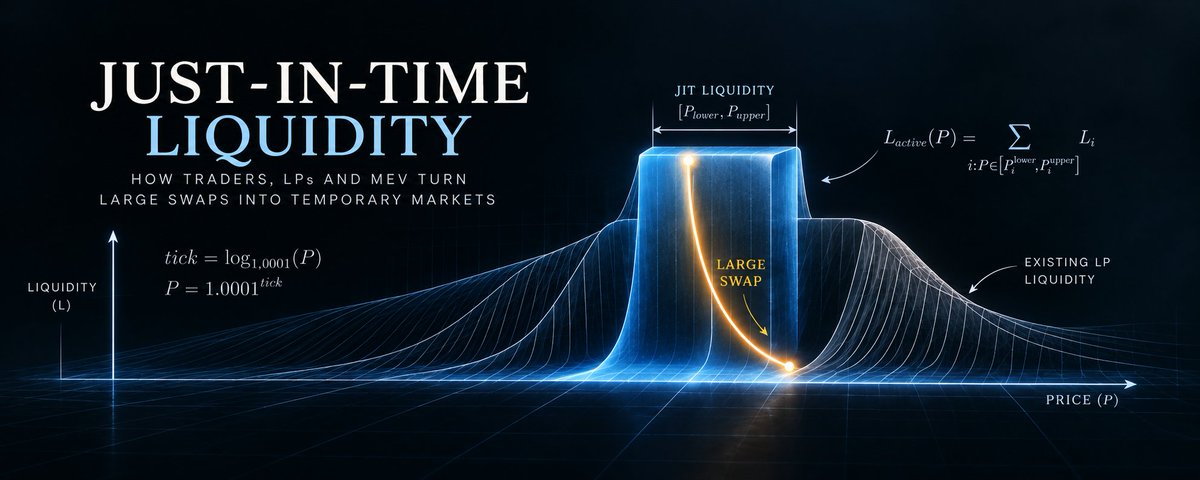
v3 instead averages the tick, where:
tick = log₁.₀₀₀₁(p)
which means the resulting TWAP is effectively a geometric mean:
TWAP(x/y) = geometric_mean(p)
take a simple example. suppose p is 2000 for half the period and 8000 for the other half:
TWAP(x/y) = √(2000 × 8000) = 4000
for the inverse pair:
TWAP(y/x)
= √((1/2000)(1/8000))
= 1/4000
so:
TWAP(y/x) = 1 / TWAP(x/y)
the difference is subtle:
v2 averages price
v3 averages log-price
and the geometric mean preserves the reciprocal relationship.

in a cpamm, at any instant,
P(x/y) = p
P(y/x) = 1/p
so one might assume:
TWAP(y/x) = 1 / TWAP(x/y)
but that's not generally true.
if the prices over time are p₁, p₂, ..., pₙ:
TWAP(x/y) = (p₁ + p₂ + ... + pₙ) / n
while
TWAP(y/x) = (1/p₁ + 1/p₂ + ... + 1/pₙ) / n
so, in general:
average(1/p) ≠ 1/average(p)
spot prices are reciprocal. TWAPs aren't.
97
in a cpamm, at any instant,
P(x/y) = p
P(y/x) = 1/p
so one might assume:
TWAP(y/x) = 1 / TWAP(x/y)
but that's not generally true.
if the prices over time are p₁, p₂, ..., pₙ:
TWAP(x/y) = (p₁ + p₂ + ... + pₙ) / n
while
TWAP(y/x) = (1/p₁ + 1/p₂ + ... + 1/pₙ) / n
so, in general:
average(1/p) ≠ 1/average(p)
spot prices are reciprocal. TWAPs aren't.
random thought, but i think the popularity of DAI owes a lot to how widely it was used in tutorials and docs back in the good ol' uni v2 days
80
start with more human involvement than you think you need. reduce it as the system proves itself. it is far easier to remove a checkpoint than to recover from removing it too early.
148
did the less glamorous part of building a rag system: actually measuring retrieval instead of asking it five questions and declaring victory.
the corpus was small by design: 2 hr markdown docs + an 18-page policy pdf.
i built a ground-truth set of 40 questions with 51 verbatim evidence passages. 9 questions needed multiple passages, 5 needed cross-document retrieval, and every label was validated against its source/page.
tested 9 chunking setups:
• fixed: 256 / 512 chars, with & without overlap
• recursive: 512 / 1,024 chars
• semantic: 90th-percentile breakpoints
with and without reranking = 18 configs.
the interesting bit: both arms got the exact same top-20 candidates from chroma + all-minilm-l6-v2. only the reranking step differed. this isolates what the reranker actually contributes.
best setup:
• recursive, 512 chars, no overlap
• ms-marco-minilm-l6-v2 reranking
• 100% hit@5
• 0.975 mrr@5
• 95.6% evidence recall@5
• 90% full recall@5
across configs, reranking improved hit@3 by 7.2pp and mrr@5 by 0.141, for ~160ms extra p95 latency.
the takeaway was pretty simple: chunking matters more than intuition suggests, and reranking is worth it when early-rank accuracy matters enough to pay the latency cost.

any trusted sources/dashboards for comparing the avg tx fees across evm chains, solana, sui, etc?
i found a few on dune but idk how accurate are those
thank you
1
1
641