

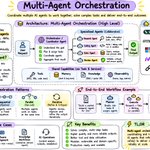





🤖 Multi-Agent Orchestration: What happens when AI agents work together?
A single AI agent can do a lot. But complex problems often require multiple specialized agents collaborating.
That's where Multi-Agent Orchestration comes in.
Instead of one agent handling everything, an orchestrator coordinates specialized agents:
🔍 Research Agent – Collects information from APIs, websites and documents.
🧠 Planning Agent – Breaks complex goals into smaller tasks.
💻 Coding Agent – Writes, executes and debugs code.
📊 Data Agent – Queries databases and analyzes information.
🛡️ Review Agent – Validates outputs and catches mistakes.
⚙️ Orchestrator – Coordinates execution, delegates tasks and combines results.
Popular frameworks:
• LangGraph
• CrewAI
• Microsoft AutoGen
• Mastra AI
• LangChain
Common orchestration patterns:
• Supervisor – One agent manages other agents.
• Sequential – Agents execute tasks in order.
• Parallel – Multiple agents work simultaneously.
• Iterative – Agents review and refine outputs.
🔥 The real power isn't having more AI agents. It's making them collaborate reliably, share context, use tools and produce verified results.
The future of AI engineering is not just building smarter agents. It's building systems where agents work together.
#AIEngineering #MultiAgentSystems #LangGraph #CrewAI #MastraAI #LLM #DevTools

🚀 Multi-Node LLM Inference at Scale
How do you serve massive LLMs across multiple GPUs and machines without sacrificing latency or throughput?
The answer: Multi-Node LLM Inference.
Instead of running an entire model on a single machine, distribute model computation across multiple GPU nodes.
🔥 Key concepts:
• Tensor Parallelism (TP): Split model computations across GPUs.
• Pipeline Parallelism (PP): Split model layers across different nodes.
• Data Parallelism (DP): Run multiple model replicas to handle more requests.
• KV Cache: Reuse attention states to accelerate token generation.
• Continuous Batching: Dynamically batch incoming requests for better GPU utilization.
🛠️ Popular technologies:
Kubernetes – Orchestration
vLLM – High-performance inference
NVIDIA TensorRT-LLM – Optimized inference
SGLang – Efficient LLM serving
Redis – Caching
Prometheus + Grafana – Observability
KEDA / HPA – Autoscaling
💡 The real challenge isn't just deploying an LLM. It's distributing computation, managing GPU memory, maximizing throughput and maintaining low latency at scale.
This is where AI Engineering meets Platform Engineering.
#LLM #AIEngineering #Kubernetes #GPU #MLOps #PlatformEngineering #DevOps

🧵 KubeArmor: Runtime Security for Kubernetes 🔐
What if you could control what processes run inside your Kubernetes containers, which files they access, and what network operations they perform?
That's exactly where KubeArmor comes in.
KubeArmor is a cloud-native runtime security enforcement system that uses Linux Security Modules (LSMs) and eBPF to protect containers, Pods and nodes.
Let's understand how it works. 👇

10/ What should you learn hands-on?
My suggested learning roadmap:
1. Understand eBPF fundamentals.
2. Learn Linux Security Modules.
3. Deploy KubeArmor using Helm.
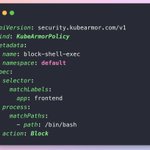
4. Understand KubeArmorPolicy.
5. Experiment with KubeArmorHostPolicy.
6. Test Allow, Audit and Block actions.
7. Generate runtime security alerts.
8. Integrate monitoring with Prometheus and Grafana.
Don't just learn Kubernetes deployment.
Understand what happens inside the Linux kernel when a container executes a process or accesses a file.
11/ Final takeaway 🚀
Kubernetes security doesn't end with RBAC, NetworkPolicies or Pod Security Standards.
You also need to secure what happens INSIDE your running containers.
That's where runtime security tools like KubeArmor become valuable.
Secure the cluster. Secure the workloads. Secure runtime behavior.
Bookmark this thread if you're learning Kubernetes security!
#Kubernetes #KubeArmor #eBPF #DevSecOps #CloudNative #SRE #PlatformEngineering
🧵 Karpenter just got more interesting! 🚀
Kubernetes node autoscaling is evolving.
Karpenter v1.15 introduces improvements around node repair, scheduling, disruption, storage awareness and observability.
Here are 7 important features worth knowing as a Platform Engineer.
Let's break them down. 👇
9/ What should Platform Engineers learn?
My suggested hands-on learning order:
NodePool and NodeClass configuration.
Node provisioning and NodeClaims.
Consolidation and disruption budgets.
Node Auto Repair.
Multi-AZ topology spread.
Capacity Buffers.
Prometheus + Grafana observability.
Don't just learn how Karpenter creates nodes.
Understand how it manages their entire lifecycle.
10/ Final takeaway 🚀
Karpenter is becoming much more than a Kubernetes node autoscaler.
It's an important part of modern cloud-native infrastructure management.
Provisioning + Scheduling + Repair + Consolidation + Observability.
If you're working in Kubernetes, SRE or Platform Engineering, Karpenter deserves a place in your toolkit.
🔖 Bookmark this thread for your next Kubernetes deep dive.
#Kubernetes #Karpenter #DevOps #SRE #PlatformEngineering #CloudNative