

a collection of well-tuned bugs
Joined June 2021
- Tweets80
- Following0
- Followers415
- Likes3


based on a particle simulation - you can see the positions encoded in the leftmost column
the particles actually are where two spheres touch and the odd marble shader connects them with circles
here's the link:
twigl.app?ol=true&ss=-NjEieE…
For general code golfing purposes I found it useful to also try the inverse of the golden ratio, sqrt(1.25)-.5 = 1/phi = phi-1. Sometimes this can save you a few characters for scaling.
And here's another example using twigl's "sound shader" capability.
x.com/2ndIteration/status/14…

While this is true for disentangling 2 variables, sqrt(e) is more suitable for 3 or more. I actually explored this because of grid cells, which our brains use to map physical and conceptual spaces. Here's a visual explanation using Lissajous curves:
twigl.app?ol=true&ss=-NgnwN2…
//#genuary2023 27 - Hilma af Klint
vec2 p=(3.-2.9*m.y)*(FC.xy-.5*r)/r.y;float l=length(p-snoise2D(p*3.+t*.2)*p/4e1);o.rgb=hsv(floor(l/.1)*.05+floor(l/.3)*.45,.4+.3*sign(.6-l),.01/mod(l,.1)/(l+abs(snoise3D(vec3(p*77.*l,t*.1)))))+.001/abs(mod(l+.05,.1)-.05);//#つぶやきGLSL #genuary
#genuary2023 24 - textile
#3Dprint of compute shader physics in #VR
direct G-code export, no STL
texture generated by interlaced particles
#genuary #3Dprinting


//#genuary2023 20 - art deco
vec2 p=exp(3.*m.x)*(FC.xy-r*.5)/r.y;float i,s;for(;i<.16;i+=.03){s=abs(((mod(p.x-i*22.,1.)-.5)+m.y*.1*snoise2D(p+t*i))*6.)-exp(-pow((mod(p.y-i*22.,2.)-1.)*1.4*PI,2.));o.rgb+=hsv(i,.1,exp(-8.*abs(s-.1)))+hsv(i,1.,+.1*exp(-s));}
//#つぶやきGLSL #genuary
//#genuary2023 15 - sines
#define l(j)min(3e-5/abs(mod(j+.1,.2)-.1),.1)
vec2 p=FC.xy/r.y-.5;float i=1.,k,N=exp(m.x*6.);
for(;i<N;i+=2.)k+=sin(p.x*1.5*i*PI2-t*(i-1.))/i*.1*min(N-i,1.);
o.rgb+=hsv(.4,.8,.01/abs(p.y-k)+.1*abs(snoise2D(FC.xy)))+l(p.x)+l(p.y);
//#つぶやきGLSL #genuary
#genuary2023 12 - tessellation
rhombic dodecahedron voxel painting in #VR
#unity and no mesh
#genuary

#genuary2023 09 - plants
using a MIDI-keyboard to tune the compute shader
"rendering" process will take until the end of #genuary (assuming it works)
float d,N=33.,n;
vec2 p=abs(FC.xy-.5*r+snoise2D(FC.xy/r*9.+.1*t));
d=.2+abs(snoise3D(vec3(p/r-t*.1,t*.1)));
for(n=-N;n++<N;)
o.a+=d/1e4-texture(b,(p+r*.5+7.*(sign(n)+2.)*d*cos(PI2*(n/N+vec2(0,.25))))/r).a*sign(n)*.5;
o.rgb+=hsv(d,.3,o.a/sqrt(9.+p.x+p.y));
//#つぶやきGLSL #genuary

1 YEAR.
13 TRACKS.
ALL THEM WITCHES PRESENTS 'BAKER'S DOZEN.'
allthemwitches.lnk.to/bakers…
#genuary2023 06 - steal like an artist
magnificent bird
magnus opum
second iteration
#genuary #stablediffusion
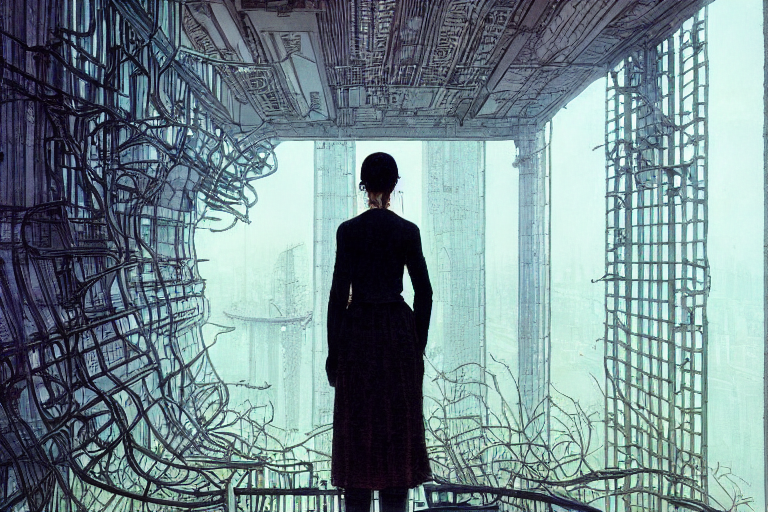


#genuary2023 05 - debug view
N-body interaction with 3 forces in 4D
30720 particles @ 90fps in #VR
3080ti @ 85%
#genuary