

Money, work and practical wisdom for salaried professionals in the sandwich years. Building the freedom to say no when it matters.
Joined May 2020
- Tweets6.7K
- Following348
- Followers4.1K
- Likes1.4K





Pinned Tweet
This man is better prepared for losing his job than most people I have known.
He is in his mid-40s and works in IT. His wife does not work, they have two children in school, and he fears that AI will make his role redundant. Last year he bought a flat for ₹70 lakh without a loan, and it used up most of his savings.
Look at the numbers he shared, though. His family spends about ₹50,000 a month and he gets ₹25,000 a month in rent, so if his salary stopped tomorrow, he would need to find only ₹25,000 a month. His savings of ₹10 lakh alone would cover that for 40 months, which is more than three years, and that is before he touches the ₹6 lakh in mutual funds, the ₹30 lakh in gold or the ₹30 lakh in his provident fund.
In 2020, when borrowers could put off their EMIs during Covid, many of my car-loan customers called to ask for it, and about 25 to 30% of them told me they had no savings at all and could not manage even one month without a salary. This man has built more than three years without realising it. That is what I call a Freedom Reserve: enough money set aside that you can say no at work, or lose a job, without worrying about next month's expenses.
How do I prepare for the worst? In his place, I would work on three things:
1. Cover in his own name. He needs a health policy for the family, because his employer's health insurance ends with the job, and a term plan, because his wife does not work and his two children are still in school.
2. Keep the ₹10 lakh where he can reach it the same day, and do not lock it into anything while the job feels uncertain.
3. Set aside the worry, since he has enough to tide him over, and instead start working NOW on the skills whose absence may make him redundant. Make a reputation for the skills that AI can't replace, and also learn AI to make himself more productive and contribute more. Focus on making himself more valuable instead of worrying, which is an energy sapper. Working with a plan has its own momentum and its own emotional benefits.
His fear is real, because job security is an illusion for all of us. But going by his numbers, he has already done the hardest part, which is saving enough to have time.

37x Better retweeted
He has ₹3.6 crore, no home loan and a ₹4.6 lakh monthly salary, and he is afraid of losing his job. If you have a family and your own job feels uncertain, do this sum for yourself.
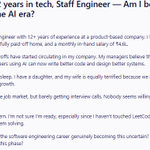
A Staff Engineer in his mid-30s, with more than 12 years in tech at a product company, posted this on Reddit. Layoff rumours have started at his company, his managers say the traditional engineer’s role is dying because junior engineers with AI tools can write better code, and he is getting very few interview calls, since nobody seems willing to match his pay. He says he is unable to sleep. He asked whether he is overthinking.
By his own numbers, he has ₹3.6 crore in savings and investments, a fully paid-off home, a wife and a daughter, and he takes home ₹4.6 lakh a month. He does not say what the family spends, but even if the family spent his entire ₹4.6 lakh every month, ₹3.6 crore would last about 78 months, which is 6.5 years. With no rent or EMI, the real spending is likely much lower, and at half of it, ₹2.3 lakh a month, the money would last 13 years. This ignores inflation and the returns on the money, and it assumes the ₹3.6 crore can be sold when needed, so if part of it is EPF or company shares, the number will be smaller.
So his money question has an answer, and the answer is that he has what I call a Freedom Reserve, which is enough money set aside that you can lose a job without worrying about next month’s expenses. His career question does not have an answer, because nobody knows yet how AI will change the work of software engineers, and he is right to take the rumours seriously. The mistake would be to let the second question make him feel that the first is also open.
There is a third question he has not asked, and it is the one behind his sleeplessness. He wrote that he and his wife had big dreams, and that a lot depends on his career growth. Dreams are the point of a good life, but they can grow so big that you forget you already have enough, and then they give you sleepless nights instead of a direction. He never says what the dreams cost. If the family lives on ₹1.5 lakh a month, ₹3.6 crore lasts 20 years, and at ₹1 lakh a month it lasts 30. Asking how much is enough is a way to find out what the family really needs, and every rupee of spending he removes also lowers the salary he needs, which makes the same dreams cheaper to chase.
There is an old story about Alexander and a fakir, a holy man who lives on alms. Alexander saw the fakir sitting by the road doing nothing, and asked what he was doing. The fakir said he was resting and enjoying himself. Alexander said he did not have the luxury to do that yet, because he was going to conquer the world. The fakir asked what he would do after that. Alexander said that then he would rest and enjoy himself. The fakir replied he was already doing that, without conquering anything. The story is probably not true as told, but the point is the same, and this engineer is living it. He has done very well already, and somewhere on the way he may have forgotten that enjoying the journey has to be a part of the plan.
What I would do in his place:
1. Add up what the family really spent in the last 12 months, including the daughter’s school fees, and divide ₹3.6 crore by that figure. Write the answer down and read it when the fear comes.
2. If his health cover comes only from his employer, it ends with the job, so buy a family policy in his own name now, while everyone is healthy.
3. Set aside a small part of the corpus, even ₹5 lakh, which is about 1.4% of ₹3.6 crore, and spend the next year, alongside the job search, getting to the front of the very thing he is afraid of. Learn AI properly, build things with it, and read publications that write about where the technology is going (such as Every, the AI publication), instead of only where the layoffs are. Junior engineers with AI tools are not his competition if he is the person in the room who understands AI best, and the corpus is also the money that buys him the time to learn it.
If you are afraid of a layoff, divide your savings by your family’s monthly spending this week itself, and write down what you think is enough. And if you are afraid of AI, go on the offensive and learn it so well that you are the go-to person for it.

He has ₹3.6 crore, no home loan and a ₹4.6 lakh monthly salary, and he is afraid of losing his job. If you have a family and your own job feels uncertain, do this sum for yourself.
A Staff Engineer in his mid-30s, with more than 12 years in tech at a product company, posted this on Reddit. Layoff rumours have started at his company, his managers say the traditional engineer’s role is dying because junior engineers with AI tools can write better code, and he is getting very few interview calls, since nobody seems willing to match his pay. He says he is unable to sleep. He asked whether he is overthinking.
By his own numbers, he has ₹3.6 crore in savings and investments, a fully paid-off home, a wife and a daughter, and he takes home ₹4.6 lakh a month. He does not say what the family spends, but even if the family spent his entire ₹4.6 lakh every month, ₹3.6 crore would last about 78 months, which is 6.5 years. With no rent or EMI, the real spending is likely much lower, and at half of it, ₹2.3 lakh a month, the money would last 13 years. This ignores inflation and the returns on the money, and it assumes the ₹3.6 crore can be sold when needed, so if part of it is EPF or company shares, the number will be smaller.
So his money question has an answer, and the answer is that he has what I call a Freedom Reserve, which is enough money set aside that you can lose a job without worrying about next month’s expenses. His career question does not have an answer, because nobody knows yet how AI will change the work of software engineers, and he is right to take the rumours seriously. The mistake would be to let the second question make him feel that the first is also open.
There is a third question he has not asked, and it is the one behind his sleeplessness. He wrote that he and his wife had big dreams, and that a lot depends on his career growth. Dreams are the point of a good life, but they can grow so big that you forget you already have enough, and then they give you sleepless nights instead of a direction. He never says what the dreams cost. If the family lives on ₹1.5 lakh a month, ₹3.6 crore lasts 20 years, and at ₹1 lakh a month it lasts 30. Asking how much is enough is a way to find out what the family really needs, and every rupee of spending he removes also lowers the salary he needs, which makes the same dreams cheaper to chase.
There is an old story about Alexander and a fakir, a holy man who lives on alms. Alexander saw the fakir sitting by the road doing nothing, and asked what he was doing. The fakir said he was resting and enjoying himself. Alexander said he did not have the luxury to do that yet, because he was going to conquer the world. The fakir asked what he would do after that. Alexander said that then he would rest and enjoy himself. The fakir replied he was already doing that, without conquering anything. The story is probably not true as told, but the point is the same, and this engineer is living it. He has done very well already, and somewhere on the way he may have forgotten that enjoying the journey has to be a part of the plan.
What I would do in his place:
1. Add up what the family really spent in the last 12 months, including the daughter’s school fees, and divide ₹3.6 crore by that figure. Write the answer down and read it when the fear comes.
2. If his health cover comes only from his employer, it ends with the job, so buy a family policy in his own name now, while everyone is healthy.
3. Set aside a small part of the corpus, even ₹5 lakh, which is about 1.4% of ₹3.6 crore, and spend the next year, alongside the job search, getting to the front of the very thing he is afraid of. Learn AI properly, build things with it, and read publications that write about where the technology is going (such as Every, the AI publication), instead of only where the layoffs are. Junior engineers with AI tools are not his competition if he is the person in the room who understands AI best, and the corpus is also the money that buys him the time to learn it.
If you are afraid of a layoff, divide your savings by your family’s monthly spending this week itself, and write down what you think is enough. And if you are afraid of AI, go on the offensive and learn it so well that you are the go-to person for it.
Most people who say "I want a Rs 5 crore corpus" don't actually want Rs 5 crore.
Ask a salaried professional about their money goal and they will give you a number. Rs 5 crore. Rs 10 crore.
Now ask what that money will do for them. The answer changes.
"I won't have to put up with a bad boss."
"I can refuse a transfer I don't want."
"I can leave if the work turns ugly."
So the goal was never the corpus. The goal is the freedom to say no at work. The corpus is just the method they picked to get there.
This matters because Rs 5 crore is a long way off, and you stay dependent on your job the whole way.
The freedom you want needs a much smaller amount, unless you want to retire early. I call it the Freedom Reserve, and it is much nearer.
To find yours, add up your real monthly expenses, including EMIs, school fees and insurance premiums. Multiply that by 24 to 36.
That is enough money to leave a job without panic.
Once you have it, you behave differently at work. You speak up sooner, and you refuse what conflicts with your values.

Are you talking to your children as a parent, or as an adult?
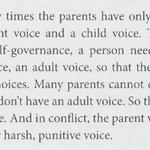
Ruby Payne says most parents have only two voices, a parent voice and a child voice. In conflict, the parent voice turns harsh and punitive: "You do as I say." "Why can't you be like your cousin?"
Children need a third voice, the adult voice, to learn to govern themselves. It asks instead of ruling: "What are the choices here?" "These are the consequences of that choice."
One voice teaches obedience. The other teaches judgement.
I would urge every parent to read this.
Source: A Framework for Understanding Poverty, Ruby Payne (@rubykpayne)


The SEAL whispered one word: "Khalid."
And Khalid leaned over the banister and said "What?"
This was the most intense moment of his life, and still a lifetime of answering to his own name won out over everything he knew about staying alive.
We like to think we'd stay sharp when the stakes are high. The opposite is true. Under pressure we stop thinking and fall back on habit.
That's how deep priming goes. We don't decide how to respond to certain cues, because the response was installed long ago. Your name, a phone ringing, an authority figure's voice, a "limited time" offer.
The people who understand this don't have to fight you.
They just need to exploit the right cue.
37x Better retweeted
This man is financially free, and yet not aware of it.
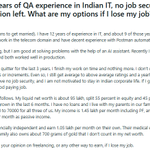
He is afraid of losing his job. He says he has no job security and no motivation left, and asks what he should do if he loses his job.
By his own numbers, he could live 11 years without a salary.
He shared his numbers, so let me do the sum he did not.
He has ₹95 lakh in savings and investments that he can turn into cash. He has no loans. He lives with his parents, and the family spends ₹65,000 to 70,000 a month for the three of them.
Suppose his salary stopped tomorrow and he paid the whole family's expenses from that ₹95 lakh. At ₹70,000 a month, it would last about 11 years. That ignores both inflation and returns, which roughly cancel each other out. His ₹35,000 to 40,000 a month of passive income most likely comes from the same ₹95 lakh, so I have not counted it twice. His parents earn ₹1.05 lakh a month on their own, and that is not counted either.
That is what I call a Freedom Reserve: enough money set aside that you can lose a job, or say no at work, without worrying about next month's expenses.
Financial freedom is not a destination. It is a spectrum, and the Freedom Reserve is one stop on it. He is already well along it, with years to find work he loves and can earn from.
So he has the money. But money is only one part of financial freedom. The other is psychological independence: knowing that losing a job will not break you. He does not have it yet.
I once worked with a vendor lead who was smart, confident and sincere. He was good at his work, pushed others hard, and was not afraid to ruffle the feathers of seniors. He resigned after getting an offer from another company. Two or three days before his joining date, that company withdrew the offer. He asked his own company to take his resignation back, and it refused.
In two days, I could barely recognise him. His face had fallen, and all the confidence had gone from his voice. Someone senior found him work with another vendor within days, so he was not out of work for long. I do not know how much money he had saved. I do know his confidence lasted only as long as nothing went wrong.
That is psychological independence, and it has to be built before anything goes wrong.
In this man's place, I would do three things:
1. Write the number down: "I can live for 11 years without a salary." Read it when the fear comes. Knowing your number is the first step towards psychological independence.
2. If his only health cover is from his employer, it ends with the job. He should buy his own, and plan for his parents' medical costs, which he says may rise.
3. Use the time to try things. Start with one small freelance project now, while the salary still comes. He built two tools for a client that worked in production, and someone will pay for that skill. Then try whatever else he is curious about. The aim is to find work he would choose even if he did not need the money.
His fear is real, because job security is an illusion for all of us. But with these numbers, the money is taken care of for years. What he needs to build now is steadiness, and work he cares about.

This man is financially free, and yet not aware of it.
He is afraid of losing his job. He says he has no job security and no motivation left, and asks what he should do if he loses his job.
By his own numbers, he could live 11 years without a salary.
He shared his numbers, so let me do the sum he did not.
He has ₹95 lakh in savings and investments that he can turn into cash. He has no loans. He lives with his parents, and the family spends ₹65,000 to 70,000 a month for the three of them.
Suppose his salary stopped tomorrow and he paid the whole family's expenses from that ₹95 lakh. At ₹70,000 a month, it would last about 11 years. That ignores both inflation and returns, which roughly cancel each other out. His ₹35,000 to 40,000 a month of passive income most likely comes from the same ₹95 lakh, so I have not counted it twice. His parents earn ₹1.05 lakh a month on their own, and that is not counted either.
That is what I call a Freedom Reserve: enough money set aside that you can lose a job, or say no at work, without worrying about next month's expenses.
Financial freedom is not a destination. It is a spectrum, and the Freedom Reserve is one stop on it. He is already well along it, with years to find work he loves and can earn from.
So he has the money. But money is only one part of financial freedom. The other is psychological independence: knowing that losing a job will not break you. He does not have it yet.
I once worked with a vendor lead who was smart, confident and sincere. He was good at his work, pushed others hard, and was not afraid to ruffle the feathers of seniors. He resigned after getting an offer from another company. Two or three days before his joining date, that company withdrew the offer. He asked his own company to take his resignation back, and it refused.
In two days, I could barely recognise him. His face had fallen, and all the confidence had gone from his voice. Someone senior found him work with another vendor within days, so he was not out of work for long. I do not know how much money he had saved. I do know his confidence lasted only as long as nothing went wrong.
That is psychological independence, and it has to be built before anything goes wrong.
In this man's place, I would do three things:
1. Write the number down: "I can live for 11 years without a salary." Read it when the fear comes. Knowing your number is the first step towards psychological independence.
2. If his only health cover is from his employer, it ends with the job. He should buy his own, and plan for his parents' medical costs, which he says may rise.
3. Use the time to try things. Start with one small freelance project now, while the salary still comes. He built two tools for a client that worked in production, and someone will pay for that skill. Then try whatever else he is curious about. The aim is to find work he would choose even if he did not need the money.
His fear is real, because job security is an illusion for all of us. But with these numbers, the money is taken care of for years. What he needs to build now is steadiness, and work he cares about.
The signs you're mentally exhausted, not physically tired:
- You feel drained but couldn't describe what you did all day
- Small decisions feel disproportionately difficult
- You're more reactive to other people's moods than usual
- Rest doesn't make much of a difference; you sleep but don't recover
If this sounds familiar, the problem isn't your schedule. It's what your schedule contains.
Count the hours before you accept a promotion.
A ₹15,000 raise, for ten extra hours a week, about 40 a month, is ₹375 an hour before tax.
Most people say yes to a promotion before they ask what it pays, because the new designation feels like proof that the years were worth it.
A bigger title usually comes with a bigger team, more calls after office hours, and sometimes a transfer away from your family. The offer letter will show the designation and the increment. It will not show the evenings, the weekend calls, or the time at home, and the raise does not always cover them.
Some promotions are still worth taking even when the money does not add up, because your career is your best investment and a role that teaches you something new can pay for itself many times over later.
So before you say yes, ask yourself three things.
1. What will you learn there that you cannot learn in your current role?
2. What will it cost you in hours, money and time at home?
3. Would you still want the work if the designation stayed the same?
If the designation is who you are, you will accept any role that comes with a bigger one.

Most people remember their mistakes better than their wins.
The sharp comment in a review meeting, the figure you got wrong in front of the boss, the time your voice shook when you disagreed, all of these stay with you for years. But the day you calmed an angry customer, or asked for one more day on a deadline and nothing bad happened, is forgotten by the next week. So when you have to decide whether to ask for the bigger role or refuse the next weekend review, the only record you have is the list of failures, and from that list you decide you are not that kind of person.
Telling yourself you are confident does not change this, because you do not believe it. Maxwell Maltz wrote in Psycho-Cybernetics, "We destroy our self-confidence by remembering past failures and forgetting all about past successes." Keep a note on your phone and every evening write one thing you handled well that day, however small, with the date. After three months you will have about ninety entries to read the next time you doubt yourself before a hard conversation.
A self-image grows like an SIP, through small entries made regularly, until the old picture no longer fits.
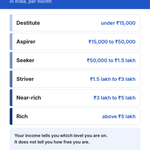
6 levels of household income in India, per month:
Destitute: under ₹15,000
Aspirer: ₹15,000 to ₹50,000
Seeker: ₹50,000 to ₹1.5 lakh
Striver: ₹1.5 lakh to ₹3 lakh
Near-rich: ₹3 lakh to ₹5 lakh
Rich: above ₹5 lakh
These are the income classes from PRICE, a Delhi research body, adjusted for inflation since 2021 and rounded.
Your income tells you which level you are on. It does not tell you how free you are. A Striver with no savings is less free than a Seeker with two years of expenses set aside.

This is storytelling par excellence!
It holds you to the end with short lines, a straight face and one absurd idea taken all the way.
Storytelling is an important skill, and I have worked on it, but alas, if only I could reach this level.
Writing like this needs an ability to not take oneself too seriously, and a level of irreverence towards the world.

Got a wallet brand's 30-day repeat purchase rate from 3% to 74%.
The NYPD says we're running an organized crime syndicate.
I call it lifecycle marketing.
Here's what happened.
Client sells $199 leather wallets.
Beautiful product.
Lifetime warranty.
Problem is, people buy one and never need another.
"Chris, our customers LOVE the wallets. They just don't come back."
I reviewed the data.
He was right.
Some customers had owned the same wallet for 17 years.
Absolutely unacceptable.
Our creative strategist suggested launching new colors.
Our marketing technologist proposed a cross-sell flow.
Both terrible ideas.
The problem wasn't that customers didn't WANT another wallet.
They didn't NEED another wallet.
So I decided to create some demand.
We hired 32 freelance muggers across New York, Chicago, and Los Angeles.
Official job title:
Field Retention Associates
Their assignment was simple.
Relieve customers of their wallets.
Create a compelling reason to purchase another.
Within 48 hours, replacement orders exploded.
One man bought three wallets in four days.
Customer support flagged him for suspicious activity.
I upgraded him to VIP.
We launched a new email flow.
Subject:
**SORRY ABOUT YOUR WALLET.**
Preview: "Life happens. We're here for you."
One customer replied:
"HOW DID YOU KNOW I WAS ROBBED?"
Excellent open rate.
Another complained that his mugger returned his cash and credit cards, then handed him a 10% off coupon.
I was furious.
Discounting was destroying our margins.
I docked the mugger's commission.
By week two, we'd generated $680,000 in replacement orders.
One associate in Chicago was responsible for $91,000.
I promoted him to Regional Director.
Then the founder discovered a $74,000 expense labeled "Street Team."
He called me screaming.
"CHRIS. ARE YOU PAYING PEOPLE TO ROB OUR CUSTOMERS?"
"Only existing customers."
"THAT'S A FELONY."
"That's a retention strategy."
"WE SELL WALLETS THAT LAST A LIFETIME."
"And they still last a lifetime. We're just shortening how long people own them."
He threatened to fire us.
I pulled up the numbers.
74% repeat purchase rate.
$1.2 million in incremental revenue.
Our best-performing cohort was customers who'd been mugged twice.
He went quiet.
Then asked if we could expand to Miami.
Beautiful.
We launched a subscription.
$19/month.
Wallet Protection Plus.
Members received priority replacements and access to a dedicated support line.
For $49/month, they could upgrade to our premium tier.
Guaranteed not to be mugged by anyone on our payroll.
Conversion was extraordinary.
The founder called again.
"CHRIS. YOU'RE CHARGING PEOPLE NOT TO ROB THEM?"
"We're monetizing peace of mind."
"SHUT THE WHOLE THING DOWN."
I agreed.
Unfortunately, he'd already invited me to present our results at the board meeting.
I showed up with a 47-slide deck.
The board loved it.
Then the founder arrived 20 minutes late.
Sweating.
Shirt untucked.
Blood on his lip.
Swelling under his right eye.
Apparently he'd been mugged outside the building by one of our top field associates.
He demanded a replacement wallet.
I explained that the lifetime warranty covered manufacturing defects.
Not theft.
"YOU HIRED THE GUY WHO STOLE IT."
"Correct. Would you like me to send you the reorder link?"
He started screaming.
The board chairman interrupted.
"Wait. You're saying even the CEO is buying another wallet?"
I nodded.
"That's commitment to retention."
The board applauded.
They renewed our contract for another two years.
The founder asked if he could at least get his replacement for free.
I declined.
That would hurt margins.
He paid $199.
Full price.
Anyway, we've now generated $2.4 million in repeat purchases.
Our customer satisfaction score has declined 38%.
But our wallets have never been more popular.
And not one customer has reported a broken wallet.
The craftsmanship really is exceptional.
A junior colleague of mine, with several years of experience, was once in tears after a senior was rude to her.
I did not step in on the spot, because a senior rushing to defend her in front of others would have made her look weak.
Later, I sat with her and told her three things:
1. Don't take things personally at work.
2. Expect to meet unreasonable bosses and difficult colleagues, and be ready for them.
3. You make two mistakes if you expect fairness and then take it to heart when it is missing.
Marcus Aurelius, the Roman emperor, began his day by telling himself he would meet people who were meddling, ungrateful and arrogant. It was preparation. If he expected them, they could not surprise him into anger.
teapawt.org/RyanHoliday/status/211…

This list is for people under 30, and many people in their 40s never did these seven. None of them expires at 30. An emergency fund, health cover, a term plan and an SIP that rises with your salary work just as well at 42.
Start with health cover: a base policy, your own or your office's, with a super top-up over it. One hospital stay can wipe out years of savings, and once a health problem appears, cover gets harder to buy.
teapawt.org/CaVivekkhatri/status/2…

IF YOU ARE 22, 23, 24, 25, 26, 27, 28 or 29
Do these 7 money things before 30:
1. Emergency fund of 6 months' expenses
2. Term insurance, not ULIP
3. Health insurance outside your company's
4. An SIP that goes up every year with your salary
5. Zero credit card debt
6. File your ITR even if no tax is due
7. Never trade F&O on a tip
Naval's line holds at work.
The colleague who agrees to everything is liked by everyone, but nobody turns to him when a hard call has to be made. The one who says no when it matters will annoy a few people, and the rest will trust him more.
Keep the no flat, without an explanation.
An explanation invites a rebuttal and leaves the door open. But say it with respect.
People forgive a hard answer, but they remember a graceless one for years.
teapawt.org/naval/status/211866978…

Dhanteras marks the auspicious beginning of Diwali.
The house is cleaned, a lamp is lit at the entrance, and families bring home a little metal before dusk: a gold coin, a steel vessel, sometimes just a spoon.
Some years, my parents could afford only a spoon. So that is what we bought.
A spoon was enough to begin the year.
What mattered was that we did it together, with prayers for health and prosperity in the year ahead.
Whatever you bring home today, big or small, carries the same sentiment.
Light the lamp.
Happy Dhanteras!

240
Many salaried people carry a vague unease about money for years and never write it down.
"We are not saving enough" is the usual version, and it does not tell you what to do. Written down properly, it turns into something like this: school fees go up in three years, my parents' check-ups and medicines need around ₹6,000 a month, and my salary pays for all of it with nothing set aside if it stops.
Now you have three things to work on: a fund for the fees, health cover for your parents, and a few months of expenses kept aside.
Writing the sentence is half the work. The rest becomes much easier once the sentence exists.
1
1
348