

associate professor of economics @UCIrvine | international trade, labor markets, and some macro | 🇲🇽
Irvine, CA
Joined November 2018
- Tweets155
- Following187
- Followers753
- Likes1.5K




Pinned Tweet
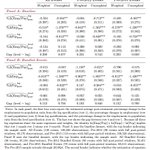
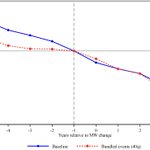
What do diff-in-diff event-study designs really tell us about the employment effects of min wages?
My new paper with @NeumarkEcon tackles this using the stacked design of Cengiz-@arindube-@attilalindner-@benzipperer and the related LP-DiD design in Dube-Lindner’s HLE chapter. 🧵

Professor from Mexico who had the enormous fortune of getting into a PhD program at Berkeley, who learned from the best economists, and who saw his TA and RA work as part of his training. Also someone who learned about tradeoffs.

Does this guy realize he's getting a Harvard PhD education for free (tuition is 60k per year at Harvard, and most PhD students don't pay it)? Does this guy realize the extensive margin effect of these strikes? At UCI, PhD enrollment fell 30.3% from F22 to F23 after the strike.


Know what doesn't replicate? DLR's original 1990–2006 elasticity of 0.016, from QCEW data covering only 26.75% of potential county pairs, becomes a significant -0.166 with far more complete county-pair CBP data (98.65% coverage). DLR's original null finding is indefensible.

From the paper: "... estimates in Clemens et al. (2025) ... lie near the centers of the distributions of standard synthetic control and synthetic difference-in-differences estimates... By contrast, the estimates in Dube (2026) described as “preferred” lie in their upper tails."


Antonio Rodriguez retweeted

For those interested in actually learning about this literature, read more: papers.ssrn.com/sol3/papers.…
'Nuff said.
For those interested in actually learning about this literature, here is the working paper version: nber.org/papers/w32878
2/2

Antonio Rodriguez retweeted
People still cite the discredited studies finding no job loss from the #minimumwage all the time.

Ha sido muy divertido trabajar en este paper con @NeumarkEcon. Por si andan por @elcolmex mañana, Sep 2, a las 5pm.


I’m very proud of you, Santi. The BCCR is fortunate to have you. You are an excellent economist and an even better person. I wish you a lot of success both in and outside of economics.

Happy to share that I’ve completed my PhD in Economics at UC Irvine.
Deeply grateful to @4ntonioR and @NeumarkEcon, whose mentorship shaped my work and the researcher I hope to be.
Excited to return to Costa Rica as a Research Economist at the Central Bank.


“Hoy estamos en el sitio 14 con una trayectoria en ascenso brutal.”
Este neposeñor sería un gran comediante, si la realidad no fuera tan trágica.

El banco de inversión @GoldmanSachs proyecta que para 2075 México será la DÉCIMA potencia económica mundial, superando a Reino Unido, Japón, Francia, Canadá e Italia.
Hoy estamos en el sitio 14 con una trayectoria en ascenso brutal.
¿Qué cambió? La política económica. La economía moral de la Cuarta Transformación sigue demostrando que combatiendo la corrupción, aumentando el salario mínimo, fortaleciendo el mercado interno y poniendo en primer lugar a la gente humilde y a la gente pobre no frena el crecimiento: lo impulsa.
Lo que inició Andrés Manuel López Obrador hoy lo consolida la presidenta Claudia Sheinbaum: Récord de inversión extranjera, un SuperHiperMegaPeso fuerte, el desempleo en mínimos históricos y millones de mexicanos saliendo de la pobreza.
El futuro de México no se decreta desde Nueva York, pero desde ahí ya lo reconocen. 🇲🇽📈🚀🌎🌍🌏😎.
#Economía #México #4T @lopezobrador_ @Claudiashein.


Muy buena reflexión. De lo mejor que he leído acerca de las recientes controversias en el mundial.

Dos jugadas de este Mundial me dejaron pensando en algo que trasciende el resultado: cuánto tensiona el reglamento del fútbol principios que, fuera de la cancha, damos por intocables.
La primera fue la anulación de un gol de Egipto ante Argentina. El VAR se retrotrajo a una falta cometida en el origen de la jugada, varios segundos y muchos metros antes de la definición, para borrar el tanto. En este caso la decisión pudo ser correcta: el contacto existió. Pero el principio que la habilita inquieta. Si un gol, el hecho más definitivo del juego, el que hace estallar un estadio y un país, puede deshacerse retrocediendo a una fase previa cuya frontera es interpretativa, entonces ningún gol es del todo firme hasta que alguien, desde una cabina, decide hasta dónde mirar hacia atrás. La certeza, ese bien que en el derecho protegemos como sagrado, queda supeditada a una apreciación elástica sobre dónde empieza una jugada.
Hay un viejo aforismo jurídico que parece darle la razón al videoarbitraje: causa causae est causa causati, la causa de la causa es causa de lo causado. Si la falta originó la jugada, y la jugada terminó en gol, ¿no es la falta, al final, causa del gol? Suena impecable, pero tiene trampa. El propio derecho que acuñó la máxima aprendió pronto a ponerle freno: sin límites, todo termina siendo causa de todo, y habría que sentar en el banquillo también a quien fabricó el arma, y al que le vendió el acero. Por eso la doctrina se queda en la causa próxima y no persigue la cadena hacia atrás hasta el infinito; el aforismo se agota en una o dos iteraciones, no en varias jugadas y muchos metros de distancia. El VAR, en este caso, sí la persiguió. Retrocedió pases y metros como si el hilo causal no tuviera que cortarse nunca. Toma el aforismo, pero se olvida de su límite.
La segunda es más antigua, pero igual de incómoda: la sanción que trasciende al infractor. Una expulsión que no solo se paga en el partido donde se comete la falta, sino en el siguiente. Y como el fútbol es una empresa colectiva, el castigo, formalmente individual, lo termina cumpliendo todo un equipo, una afición, casi un país. En 1998, Zidane fue expulsado en la fase de grupos y su ausencia dejó a Francia al borde de la eliminación ante Paraguay, salvada apenas por un gol de oro. La falta fue de uno; el precio estuvo a punto de pagarlo una nación entera.
Conviene recordar que esta norma no es de derecho divino. Las tarjetas nacieron apenas en 1970, y la propia FIFA acaba de reformar en 2026 el castigo por acumulación, precisamente para que los seleccionados no se pierdan partidos decisivos. Es decir: la institución ya admitió que el diseño podía ser injusto. Solo que la reforma se quedó a medias, porque atacó la acumulación de amarillas pero dejó intacta la raíz: que una pena recaiga sobre quienes no cometieron la falta.
Naturalmente no pido un fútbol sin reglas ni sin tecnología. Pido, apenas, que reparemos en la paradoja. En el torneo que más se acerca a lo que Shankly llamaba, con ironía, algo más importante que la vida y la muerte, dos de sus normas: la falta de certeza del gol por actos futbolísticamente lejanos y la pena que trasciende al infractor, chocan de frente con nociones de justicia que en cualquier otro ámbito nos parecerían inaceptables.
El fútbol se toma licencias que el derecho no se tomaría. Vale la pena, al menos, pensarlas.
An important omission on my part, @jondr44. The attached figure shows in panel (d) the log emp path with the extended pre-period without overlapping events. In the end, I think this is the one to focus on. The top plots correspond to yours, with small...
teapawt.org/jondr44/status/2066995…


Antonio Rodriguez retweeted
The pre-trend Jon shows in his thread when extending the pre-period is due to the overlap in CDLZ’s events. Once you avoid this problem, the clear pre-trend disappears. Jon’s figure is panel (b), but the reliable one is panel (d).

A few thoughts on this interesting new minimum wage paper by @NeumarkEcon and @4ntonioR renalyzing the QJE paper by @arindube-@attilalindner-@benzipperer, which relates to one of my favorite topics: event-studies and parallel trends! 1/
Attila, CDLZ's null is fragile along more than one dimension. A crucial example: restaurant MW effects are strongly negative even when using the flawed emp/pop variable. I hope your response will tackle this outcome from your own exact design.
teapawt.org/attilalindner/status/2…

