

National nonprofit organization working to ensure fair outcomes for critical #healthcare issues. Our special projects @anthem_watch, @statecarenet.
United States
Joined February 2020
- Tweets2.4K
- Following2.3K
- Followers1.1K
- Likes4.2K



Action for Health retweeted

Join us on @DRsLoungePod 9pm EST with guests @DrBruggeman & @DutchRojas to discuss the No Surprises Act
Live on @X !
@LorenAdler @brian_blase are welcome to join !

We're now in week 8 of the regular season.
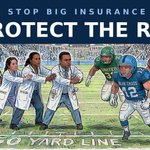
Whether you're rooting for the Panthers or Packers on Thursday, or the Bills or Ravens on Sunday, one thing is clear: Big Insurance is coming for the independent arbitrators that decide NSA claims.
These IDREs are neutral referees. It's the large health plans that are playing dirty.
Any attempt to sack them must be rejected.

Today, @Paragon_Inst hosted a virtual discussion on "fixing" the No Surprises Act.
Paragon admits health insurers face no consequences for paying federal arbitration awards late.
And now Anthem faces new lawsuits over unpaid IDR awards. Congress doesn’t need to gut federal IDR. It needs to pass the bipartisan No Surprises Act Enforcement Act.

Action for Health retweeted

@ElevanceHealth and @UHC do not actually PAY the IDR awards as mandated by the NSA. The award numbers cited by @LorenAdler @brian_blase @Paragon_Inst @lawsonhmansell @sarahkliff @sangerkatz are completely irrelevant and fake. These people lie for a living. beckersasc.com/legal/anthem-…
Action for Health retweeted

These letters to the WaPo Editors are well stated:
"The No Surprises Act is supposed to protect patients. Here’s how it hurts providers.
Reforming the No Surprise Act and AI standards, in readers' eyes.
October 22, 2026 at 4:29 p.m. EDT Yesterday at 4:29 p.m. EDT
Jackson Hammond and Brian Blase’s Oct. 18 op-ed, “A $17 billion surprise bill for Americans,” argued the No Surprises Act’s arbitration system is driving up health care costs, but they missed the root cause driving disputes.
I am a practicing emergency physician, and I’ve never met a colleague who said they view arbitration as a business model. But it becomes necessary when insurers terminate network contracts to make lowball payment offers to physicians who treat patients in emergencies, regardless of their ability to pay.
The op-ed, which detailed the new Paragon Health Institute analysis, argued that independent arbitrators side with providers in roughly 85 percent of disputes. But that statistic deserves context. In one study, which was backed by the Americans for Fair Health Care coalition, insurers’ qualifying payment amounts were set at $0 in more than 20,000 disputes, and in almost 1,000 others, they were set at less than $1.
Meanwhile, more than 20 percent of the time, insurers delayed paying arbitration awards or failed to participate, leaving physicians waiting to be paid for care they had already provided.
Paragon argues that physicians use arbitration to demand higher rates. My organization, TeamHealth, has seen awards below what insurers paid for the same services in 2019.
Health care systems would rather work under fair, stable in-network agreements, but persistent underpayments make it harder to recruit and retain clinicians and negotiate sustainable contracts, contributing to narrower networks and reduced access to emergency care.
Congress should preserve the No Surprises Act’s patient protections, require insurers to comply with arbitration decisions and address the payment practices that make arbitration necessary.
Jody Crane, Richmond
The writer is the chief medical officer for TeamHealth."
Letter #2:
"Every single day in America, someone experiences a life-threatening event that requires an air ambulance to keep them alive and get them to a hospital that can provide the appropriate level of care. Teams of dedicated medics, nurses and pilots are on duty 24/7 to respond to emergencies. But these services are critically undervalued by health insurance companies.
As important as the No Surprises Act is for protecting patients, it lacks the enforcement mechanisms needed to ensure emergency care providers are reimbursed.
Unfortunately, a growing number of payers are refusing to pay the outstanding claims that independent arbitrators have determined they owe — decisions which are legally binding and must be paid within 30 days. To date, insurers owe my company, PHI Health, more than $50 million in unpaid independent dispute resolution awards for emergency care already delivered.
This enormous burden has forced us to suspend operations at one base in rural California and threatens the future of air ambulance services. Insurers’ failure to respect the law could eventually leave many communities without air medical services, a situation Congress hardly intended.
The No Surprises Act needs more teeth to ensure that insurance companies follow the law and that claims owed are paid promptly.
Paul Julander, Tempe
The writer is co-president of PHI Health."
Today, we released a new joint policy paper with the Emergency Air Rescue Alliance on health plan design, third-party administrator incentives, and the federal Independent Dispute Resolution process.
In "The Skinny Solution Gained Weight," we dive into how narrow insurance networks were sold to employers as savings, and why the bill came back as arbitration.
Employers and providers are not on opposite sides of this current debate. They are both downstream of health plans’ intentional design. Reform that begins by asking what the initial payment in federal IDR should have been will do more for employer affordability than any congressional proposal to benchmark IDR payments or eliminate IDR altogether. Fanning the notion that providers are abusing the bipartisan process that Congress created six years ago should have no place on legislators’ menus.
In a new op-ed for @CrainsNewYork today, our President Christopher Sheeron explains how health insurance plans are driving healthcare costs.
He also argues that Albany’s removal of Medicaid Managed Care disputes from the state's IDR process deserves scrutiny. Undoing this budget failure will keep patients—rather than health insurers’ financial incentives—at the center of Albany’s healthcare policy.
crainsnewyork.com/opinion/co…

Action for Health retweeted

At STAT Summit, Auchincloss said Dems should make insurers the villain in the health care system, not biotech.

Action for Health retweeted

Insurers caused 9 of every 10 defaults in federal arbitration in 2025. They offered $1 or less 278,807 times. Half the time, they offered their own artificially low number or less.
Now Representative Pallone's bill would let them skip the arbitrator altogether.
Keep the referee.
Read more here: indemed.org/keep-the-referee
@IndeMedAction

Action for Health retweeted

Does the Brookings Institution Board of Trustees meet every month to find a way to lower its income? Calls its donors to see if they can donate less next year than the year before?
Why should healthcare cost less every year when the healthcare customers’ employers not seeking the same goal? My bank, my IT/cloud provider, Telecom provider, insurance provider are not lowering their rates every year.

Action for Health retweeted
Rep. Pallone (D-NJ) has issued his new bill to reform the #NoSurprisesAct and let me count my top 3-4 reasons why it is a trainwreck for physicians and hospitals (and wait until you see #4):
1. IDR would be eliminated in favor federal rate setting at the "qualifying payment amount" (QPA or initial payment determined by the health plan).
There is no recognition here that the federal district and appellate courts (TMA I, II, III and IV plus 2 appellate court decisions, so 6-0 for the TMA) have found issues with the administration of the QPA and recently that the QPA rules should be void and have no legal effect due to health plans' inclusion of ghost rates and other QPA manipulations (TMA III US Court of Appeals for the Fifth Circuit, Aug. '26).
The Rep. includes the CPI-U adjustment in his bill which is laughable as the current law requires it and few if any plans actually comply with the requirement. One reason--no real audits of the QPA (see #4 below).
Why? The current CPI-U is +28% from a 2019 baseline.
2. No other factors would be considered in final payment--just blatant federal rate setting.
NSA requires acuity of the Pt, prior contract rates, qualifications of the clinicians and one can use the Transparency in Coverage (TiC) data which shows market rates among other factors for the IDRE to consider--none of that for Mr. Pallone.
Ask your colleagues in CA and MI how they like state based rate setting for applicable OON claims?
3. Another laughable provision--payment w/in 30 days but no interest or penalties--and yes that is in the current NSA.
As I have cited so many times here, the data is overwhelming that the plans are in systemic non-compliance with payment. Why would they comply in the future without enforcement, penalties or interest?
4. My favorite--no judicial review of the QPA. The plans have the ultimate and unquestionable power to set the QPA and never be questioned by any physician or hospital in court.
Oh, CMS can audit and that's true today. 4+ years ago CMS announced they were conducting over 20 audits, one has been announced in that time and the plan was out of compliance with setting the QPA.
To the physician and supporting community--time to get ready to become active again to preserve and enhance the NSA.
If that bill above becomes law, independent practice as we know will largely cease for groups actually accepting insurance and patient access to care will greatly suffer.
democrats-energycommerce.hou…


Action for Health retweeted

No Surprises Act: Another federal court rejects an insurer’s attempt to relitigate IDR eligibility. @AnthemBCBS v. AGS Health was dismissed WITH PREJUDICE. The court held NSA judicial review limits cover eligibility not just the payment amount.
@DOGE @RobertKennedyJr @DrOz @realDonaldTrump
@RepRaulRuizMD @DrKimSchrier @RepHerbConaway @herbconaway @MaxineDexterMD @Morrison4MN @RepBera @RepMMM @RepMarkGreen @RepGregMurphy @RepRonnyJackson @RepJohnJoyce @RepNealDunn @RepAndyHarrisMD @RichforGA @RepDesJarlais @SenJohnBarrasso @SenBillCassidy @RogerMarshallMD @DrRandPaul @MikeKennedyUT @BobOnderMO
@RepRaulRuizMD @DrKimSchrier
@RepHerbConaway
@MaxineDexterMD @Morrison4MN
@RepBera
@GOPDoctors
litigationtracker.law.george…
Our President Christopher Sheeron was honored last week to moderate a panel on choosing the right AI partner in a new clinical era at @physicianhosp's annual Leadership Summit in Napa Valley.

Action for Health retweeted
It's back to school season. Millions of students are cracking open new textbooks this month — so it's a good time for the rest of us to sharpen our pencils too.
✅Today's class: IDR 101.
1. When an out-of-network physician and a health plan can't agree on payment, who settles it? Meet the independent arbitrator, and learn how the No Surprises Act's Independent Dispute Resolution process actually works.
2. Here's the first thing to know: most payment disputes between providers and insurers are settled in the informal process, before an arbitrator is ever involved. And there's a reason the system is built that way.
3. Federal IDR is winner-take-all. Once a dispute reaches arbitration, the certified entity must pick one side's final offer or the other — it cannot land on a blended figure and it cannot split the difference. That design is deliberate. The No Surprises Act forces both sides to carry real risk into arbitration, which is meant to push them toward agreement earlier, during the mandatory 30-business-day Open Negotiation Period that comes first.
4. The takeaway is simple: your leverage is highest before arbitration begins. A reasonable number agreed during Open Negotiation is certain. A number left to an arbitrator is not.
Learn more about the IDR from IndeMed:
indemed.org/IDR-101/

Action for Health retweeted

Disruption no longer unfolds over years. It happens in months and even weeks.
These five physician-led healthcare leaders are at the front of all of it.
Grateful to have them with us at PHA's 2026 Leadership Summit these next few days to explore where healthcare is headed.

Action for Health retweeted

The Greedy Health Insurers are full force to protect profits by misleading employers, government officials and even think tanks. It’s simple. Pay providers a reasonable rate for caring for patients and stop the Obstruct, Deny and Delay to protect profits. axios.com/2026/09/17/surpris…

Action for Health retweeted
The House is planning to return next week. HR 4710 (the bill referenced below) could be on the docket for "mark up" by the Ways and Means health sub-committee.
Congress Is Returning. Act Now on the No Surprises Act Enforcement Act. votervoice.net/Shares/BpzzuA…
