Web3 builder. Frontend Dev || Music lover || Video Editor || Collab Manager @qappi_official || Ambassador @GOATNetwork. DM open for collaboration.
Joined June 2024
- Tweets28.1K
- Following3.3K
- Followers2.4K
- Likes56.9K


Pinned Tweet
Most talk about agent payments asks who is to blame when an agent spends wrongly. I think the better first question is how much it could spend in the first place.
@GOATNetwork has published a design guide on exactly that, and the core idea fits in a minute.
ᴛʜᴇ ɪᴅᴇᴀ: ᴀ sᴇssɪᴏɴ
A session is a temporary, bounded permission for one workflow. According to GOAT's guide, a safe session names the services the agent may use, the maximum spend, the price of each call, when it starts and ends, how long it can sit idle, how the payment is backed and what happens when it closes. It does not renew on its own, and one opening payment never grants unlimited access.
ᴀ ᴡᴏʀᴋᴇᴅ ᴇxᴀᴍᴘʟᴇ
GOAT's guide walks through a research agent that needs search, extraction and verification for 12 minutes. The session has a $0.50 ceiling and a two-minute idle timeout. Search costs $0.02 per call, extraction $0.05 per document and verification $0.04 per claim set.
The agent runs three searches ($0.06), extracts four documents ($0.20) and verifies two claim sets ($0.08). Usage so far: $0.34. It starts one more extraction, and the session reserves $0.05 for it. At minute nine the agent asks to close. New calls are rejected, the running one finishes, and the final total is $0.39. The remaining $0.11 is released, refunded or left uncaptured, depending on how the session was backed.
A close receipt then lists the opening authorization, each usage item, the captured total, the released amount, the close reason and the delivery evidence.
ᴡʜʏ ᴛʜɪs ᴍᴀᴛᴛᴇʀs
The worst case is set before the agent starts. If it misjudges, loops or gets tricked, it can only spend what the session allows. That is a very different risk from an open wallet.
ᴀ ꜰᴇᴡ ʀᴜʟᴇs ꜰʀᴏᴍ ᴛʜᴇ ɢᴜɪᴅᴇ ᴛʜᴀᴛ ɪ ᴛʜɪɴᴋ ᴀʀᴇ sᴍᴀʀᴛ
▸ A dropped connection should not close a session immediately, because a payment or tool call may still be in flight
▸ More time, more budget or wider scope counts as a new authorization, not a quiet extension
▸ A session token should be short-lived and tied to named services, since a vague, transferable token can become general purchasing power
ᴡʜᴇɴ ᴛᴏ ᴜsᴇ ᴏɴᴇ
Per-request payment is simpler for independent or high-value calls. Prepaid credit suits an agent that keeps using one platform. A subscription fits predictable recurring use. A session fits temporary, multi-call work where exact usage is uncertain and the task has a natural end.
ᴛʜᴇ ʜᴏɴᴇsᴛ ᴘᴀʀᴛ
GOAT is careful about what it claims. It says x402 does not by itself define sessions, idle timeouts or a usage ledger, and that the merchant application owns pricing, token validation, metering and close rules. GOAT's role is payment and execution infrastructure, such as GOAT Flow's payment-intent, order and proof records and AgentKit's runtime policy controls. It is a design pattern, not a ready-made billing product.
My take: spending limits should be the first conversation in agent payments, not the last. A receipt tells you what happened. A session decides how much could.
Read the full guide: goat.network/news/ai-agent-s…
🤝 Paid partnership


ᴡʜᴀᴛ ʜᴀᴘᴘᴇɴs ᴡʜᴇɴ sᴏᴍᴇᴏɴ ᴄʜᴀʟʟᴇɴɢᴇs ᴀ ᴡɪᴛʜᴅʀᴀᴡᴀʟ ᴏɴ ɢᴏᴀᴛ's ʙɪᴛᴠᴍ3 ʙʀɪᴅɢᴇ?
The @GOATNetwork BitVM node v0.4.0 spells it out.
ꜰᴏʟʟᴏᴡ ᴏɴᴇ ᴡɪᴛʜᴅʀᴀᴡᴀʟ
1. Claim. A user withdraws, and an operator pays them on Bitcoin from its own funds. The operator then claims that money back from the bridge.
2. Challenge. A challenger can dispute that claim on Bitcoin.
3. Watchtowers. They record the Bitcoin chain they see. In v0.4.0, watchtower proofs bind to the genesis sequencer commitment.
4. Check. The operator publishes its proof, and verifiers check it.
5. Outcome. If the proof holds, the operator is repaid. If it fails, a verifier disproves the claim, the dispute is settled on GOAT, and the operator loses part of its stake.
ᴛʜᴇ ᴛʜʀᴇᴇ ᴇɴᴅɪɴɢs, ᴘᴇʀ ɢᴏᴀᴛ's ᴛᴇsᴛɴᴇᴛ ɢᴜɪᴅᴇ
▸ No valid challenge in the first timelock: the withdrawal completes (Take-1)
▸ A challenge that fails: the operator defended the claim and is reimbursed (Take-2)
▸ A challenge that succeeds: the withdrawal is intercepted (Disprove) and the operator's collateral is slashed
Two threads run side by side. Bitcoin is where the claim and the challenge happen. GOAT is where each withdrawal is recorded and where the operators' stakes are held.
ᴡʜᴀᴛ ᴛʜᴇ ɴᴏᴅᴇ ʜᴀɴᴅʟᴇs
Per GOAT's v0.4.0 note, the node:
▸ handles Kickoff and Watchtower challenges
▸ records Verifier-Assert transaction IDs
▸ settles confirmed disproofs on GOAT through the Gateway contract
▸ requires Committee authorization for Force-Skip
▸ tightens its timelock, Commit and Assert checks
A disproved operator loses a fixed amount of stake on GOAT.
The same release also makes peg-in, graph setup and peg-out settlement restartable, and upgrades the node to Ziren 2.0.
ᴡʜᴏ ᴘʟᴀʏs ᴡʜɪᴄʜ ʀᴏʟᴇ
GOAT's BitVM3 testnet guide lists the roles. Operators are permissionless, but must prepay graph fees on Bitcoin and stake on GOAT. Verifiers are a permissioned role and need a bond. Watchtowers are a Committee-approved role.
ᴡʜʏ ᴛʜᴇ sᴛᴀᴋᴇ ᴍᴀᴛᴛᴇʀs
A bridge that relies on challenges only works if cheating is expensive. The stake gives an operator something to lose, and the disproof is how that loss is enforced. This fits the design GOAT describes: the bridge stays safe as long as at least one honest participant checks the work during the challenge window.
ʜᴏᴡ ɪᴛ ɪs ʙᴇɪɴɢ ᴛᴇsᴛᴇᴅ
The release adds a local test network with two Committee nodes, an operator, a verifier and a watchtower on Bitcoin regtest, with mocked proofs covering peg-in, both withdrawal paths, disputes, restarts, outages and peer isolation. Its continuous checks also use TLA+ models to explore transaction and event orderings across timelocks, disputes and settlement.
ᴡʜᴀᴛ ᴛʜɪs ɪs, ᴀɴᴅ ɪs ɴᴏᴛ
This is node software and a testnet flow. GOAT Network describes BitVM3 as still in development, and the TLA+ checks cover model bounds, not every case. Read it as a view into how disputes work, not a sign that the bridge is live for mainnet funds.
My take: I like that GOAT Network draws the dispute as a simple path. When the rules of a bridge are easy to follow, they are easier to check, and checking is what keeps a bridge honest.
🤝 Paid partnership
ᴀɴʏᴏɴᴇ ᴄᴀɴ sᴘɪɴ ᴜᴘ ᴀɴ ᴀɪ ᴀɢᴇɴᴛ ɪɴ ᴀɴ ᴀꜰᴛᴇʀɴᴏᴏɴ. ɴᴏʙᴏᴅʏ ᴄᴀɴ sᴘɪɴ ᴜᴘ ᴀ ᴍᴀʀᴋᴇᴛ.
Most crypto growth talk still counts people. Wallets, users, daily actives. I do think the agent economy moves the bottleneck somewhere else, and @GOATNetwork own numbers point to it.
At OpenClaw Hack Toronto, builders created 130 agents, and 74 of them registered on GOAT Network under ERC-8004, according to GOAT's May newsletter. Creating participants is now cheap and fast. What is not cheap is giving them something to trade against.
Every agent shows up with a job: paying for a service, routing a swap, settling a purchase. The job only finishes if there is liquidity on the other side. A network full of agents but short on depth gives all of them poor execution. A network with deep liquidity can serve even a handful of agents well.
ᴡʜʏ ᴀɢᴇɴᴛs ꜰᴇᴇʟ ᴛʜɪɴ ʟɪǫᴜɪᴅɪᴛʏ ꜰɪʀsᴛ
A person can shrug off one bad price. Software repeats it every time it runs. An agent compares routes, checks a budget and executes inside a loop that may run many times a day, so costs a human would ignore add up:
▸ Slippage on every trade
▸ Failed fills that break the loop
▸ Delays that compound
Agents also act on the numbers they see, so shallow pools give unreliable prices, and unreliable prices lead to poor decisions. Depth is what lets agent logic work as designed. That is just an argument, not a measured result.
ᴡʜᴇɴ ʟɪǫᴜɪᴅɪᴛʏ ɪs sᴄᴀᴛᴛᴇʀᴇᴅ
Liquidity spread across separate pools on separate chains does less work than the same amount in one place.
GOAT's ecosystem lists Hermes, Maia DAO's omnichain liquidity layer, which unifies cross-chain routing, an AMM liquidity stack and gauge-driven incentives. Maia DAO's own docs describe goals such as swapping native tokens between chains, managing liquidity from any chain and a bridge-less design. I could not confirm how deep Hermes liquidity is on GOAT, so treat these as stated aims.
ᴡʜᴇʀᴇ ᴛʜᴇ ʙɪᴛᴄᴏɪɴ ᴄᴀᴘɪᴛᴀʟ ᴄᴏᴍᴇs ꜰʀᴏᴍ
Deep liquidity on a Bitcoin network starts with holders who have a reason to put BTC to work. GOAT has taken two visible steps.
In August 2025, it disclosed a 34 BTC Pilot Fund to support liquidity, community incentives and developer contributions. It put native BTC into liquidity pools in place of newly issued tokens.
In January 2026, it announced a pilot with the fintech DitoBanx in Mexico, placing its Safebox product inside DitoBanx's regulated mobile app, so users can earn BTC-denominated yield while keeping self-custody. It is a pilot, so read it as a test.
Together, those steps point at the same aim: give BTC holders a safer way to take part, and make sure the capital they bring can be used by whatever runs on top.
ꜰʀᴏᴍ sᴜᴘᴘʟʏ ᴛᴏ ᴅᴇᴍᴀɴᴅ
BTCFi has spent years on the supply side: making Bitcoin programmable, moving it safely and earning on it without counterparty risk. Agents add the demand side, because they transact continuously and need depth to do it well.
The ecosystem that lines agents up with liquidity first hands every later user a market that already works. That is my view, and it is the part I find most compelling.
The agent count is the easy number to grow. Depth is the one to earn.
🤝 Paid partnership
ǫᴜɪᴄᴋ ǫᴜᴇsᴛɪᴏɴ ꜰᴏʀ ᴇᴠᴇʀʏ ʙᴜsɪɴᴇss ᴏᴡɴᴇʀ
When was the last time you checked how your business looks to a machine?
Not to a person scrolling on their phone. To an AI agent that was sent out to find, compare and buy something on someone's behalf.
Because that shopper is already on its way.
Kevin Liu, CEO of @GOATNetwork, said it plainly: if agents can't find your business, you're sitting out of a $5 trillion category. And McKinsey's own projection puts agentic commerce somewhere between $3 and $5 trillion by 2030. That is not a small corner of the internet. That is a whole new layer of buying and selling.
ʜᴇʀᴇ ɪs ʜᴏᴡ ɪᴛ ᴡɪʟʟ ᴘʀᴏʙᴀʙʟʏ ꜰᴇᴇʟ ɪɴ ᴅᴀɪʟʏ ʟɪꜰᴇ.
You tell your assistant, "I need a reliable printer under a certain budget, delivered this week." You don't open ten tabs. You don't read forty reviews. The agent goes out, checks merchants, compares prices, confirms stock, and pays. You just get the result.
Now flip the picture around and sit on the merchant side.
Your beautiful website was built for human eyes. Nice photos, nice colours, a great story. But an agent doesn't care about any of that. It needs clean answers to simple questions:
What exactly are you selling?
What does it cost right now?
Is it in stock?
How can I pay you?
And can I actually finish the purchase without a human clicking through a form?
If your business can't answer those in a way a machine can read, the agent moves on to the next merchant. No second chance. You never knew you lost the sale.
This is why having a website is no longer the finish line. It is the starting line.
sᴏ ᴡʜᴀᴛ ᴅᴏᴇs ᴀ ʙᴜsɪɴᴇss ᴀᴄᴛᴜᴀʟʟʏ ɴᴇᴇᴅ?
Payments that work for both humans and agents.
That's the part GOAT Network is going after with GOAT Flow. It brings together three tools:
▸ Checkout: for a smooth experience for regular customers.
▸ QuickPay: for creating payment links in minutes, with no need to build a whole new site or app.
▸ API Payments: so software and agents can pay programmatically.
But payments are only one piece.
For agents to truly take part in the economy, they also need identity, so you know who or what you're dealing with. They need trust, so both sides can rely on each other. And they need dependable settlement, so money actually lands where it should.
GOAT Network is working on these building blocks through GOAT Flow, x402, ERC-8004 and its wider agent infrastructure.
We are moving from AI that helps people shop, to AI that shops. From assistants that suggest, to agents that act. They will be real participants in commerce, with real spending power.
And most businesses are not ready.
The early movers will be the ones getting orders from customers they never met, never chatted with, and never saw. Orders that arrive while they are asleep.
sᴏ ʜᴇʀᴇ ɪs ᴡʜᴀᴛ ɪ'ᴅ ᴅᴏ ᴛʜɪs ᴡᴇᴇᴋ:
1. Look at your product info and pricing. Is it clear and consistent everywhere?
2. Check whether you can accept payments without manual back and forth.
3. Learn how GOAT Flow works and see if QuickPay fits your business.
The next customer through your door might not have a face.
Make sure your business is ready to serve it.
If you own a business, explore GOAT Flow now.
🤝 Paid partnership
ᴀ ʙʀɪᴅɢᴇ ɪs ᴏɴʟʏ ᴀs ᴛʀᴜsᴛᴡᴏʀᴛʜʏ ᴀs ᴛʜᴇ ᴘʀᴏᴠᴇʀ ʙᴇʜɪɴᴅ ɪᴛ.
Let's take a look at how @GOATNetwork builds and checks its own.
The bridge is designed so every withdrawal is held open to challenge for at least a week, and any dispute is settled on Bitcoin. What a dispute examines is a proof. Those proofs come from Ziren, the zkVM built by the same core team that is building the bridge. Ziren also proves every batch of transactions on GOAT, and if a withdrawal claim is challenged, Bitcoin checks a single hash.
ᴡʜʏ ᴛʜᴇ ᴘʀᴏᴠᴇʀ ᴍᴀᴛᴛᴇʀs
The bridge rests on two assumptions. First, at least one honest participant checks the work during the challenge window. Second, nobody can produce a valid proof of something untrue.
That puts the prover inside the security model. If the equations behind a step allow more than one result for the same input, a dishonest prover could pick the result it wants and prove something that never happened, like a withdrawal nobody made. A challenger would find nothing wrong with the proof, because the flaw is in the equations.
So the prover's correctness matters as much as the challenge process around it.
ᴡʜʏ ʙᴜɪʟᴅ ɪᴛ ɪɴ-ʜᴏᴜsᴇ
One team answers for everything a withdrawal depends on, from the instructions the prover runs to the Bitcoin transactions that settle a dispute. It also sets priorities: under a bridge, a slow proof costs a short delay, while a forgeable one puts bitcoin at risk. So Ziren puts security ahead of speed.
ʜᴏᴡ ᴛʜᴇ ᴘʀᴏᴠᴇʀ ɪs ᴄʜᴇᴄᴋᴇᴅ
No single method catches every bug, so Ziren is checked in several independent ways:
▸ Published design: the Ziren paper, on the IACR ePrint Archive since October
▸ Independent audit: Veridise audited the circuits by hand, with formal tools and fuzzing. Findings were fixed and re-verified; the report is public
▸ Adversarial research: since December 2025, Consensys Diligence and TU Wien, introduced by the Ethereum Foundation, have fuzzed Ziren and found five bugs, one fixed upstream in LLVM
▸ GOAT's bug bounty: 123 classified findings and 16 awards, all to be fixed before the bridge carries mainnet BTC
▸ Machine-checked proofs: Ziren 2.0 proves in Lean that 57 circuits are deterministic, across 104 theorems, which rules out the flaw described above for those circuits
ᴛʜᴇ ʜᴏɴᴇsᴛ ᴘᴀʀᴛ: ᴘᴏsᴛ-ǫᴜᴀɴᴛᴜᴍ
In Ziren 2.0, the proof commitments are hash-based throughout. But hash-based is not the same as post-quantum. Two parts of the pipeline still use elliptic curves, the memory check and the final compression step for onchain verification, and both need replacing before the proofs can be called post-quantum.
And the bitcoin locked in any Bitcoin bridge sits behind Bitcoin's own signatures until Bitcoin upgrades.
On Ethproofs, Ziren 2.0 proves the average Ethereum mainnet block in 8.6 seconds on four GPUs. And Metis is bringing Ziren in as the prover for its Hybrid Rollup, so a second network will depend on the same code.
My take: if Bitcoin is going to settle agent-era commerce, trust starts at the prover, and GOAT Network is treating it that way.
ᴀɪ ɪs ʙᴇᴄᴏᴍɪɴɢ ᴀ ꜰʀᴏɴᴛ ᴅᴏᴏʀ ᴛᴏ ᴏɴʟɪɴᴇ sʜᴏᴘᴘɪɴɢ, ᴀɴᴅ ɢᴏᴀᴛ ꜰʟᴏᴡ ɪs ʙᴜɪʟᴛ ꜰᴏʀ ᴇxᴀᴄᴛʟʏ ᴛʜᴀᴛ ᴍᴏᴍᴇɴᴛ 👀
Start with what Adobe's holiday forecast (released September 28) says. In August 2026, AI-referred retail visitors converted at a rate 48% higher than non-AI traffic. And Adobe expects AI traffic to US retail sites to grow 130% year over year this holiday season, from November 1 to December 31.
The honest context: Adobe counts AI traffic as people clicking a link in an AI chat or browser service through to a store, and it calls the channel modest in overall volume. Deloitte's 2026 holiday survey found only 16% of US shoppers would let AI complete a purchase. So today the buyer is mostly still a person. The agent that pays on its own is the next step.
That is why GOAT Flow fits. It is @GOATNetwork checkout for businesses, built for both kinds of AI-driven shopper at once.
ᴡʜʏ ɪᴛ ꜰɪᴛs
▸ One page, two buyers: People pay by card, processed by Stripe, or in USDT or USDC on ten chains. AI agents pay in stablecoins. Every page carries agent.md and manifest.json, which tell an agent what you sell and how to pay you.
▸ No code to start: Payment links, any-amount or fixed-price, and product pages need no code. Developers can add a hosted or custom checkout, or API Payments, which lets agents pay per request.
▸ Your money stays yours: Crypto goes straight to your own wallet and is verified onchain, and GOAT Flow never holds your funds. Card payments are paid out to your own Stripe account.
▸ One place to manage it: The merchant portal shows all orders, reconciliation, refund requests and disputes.
▸ Under it, GOAT Network: Bitcoin-secured infrastructure for agentic commerce.
ɪs ᴀɴʏᴏɴᴇ ᴜsɪɴɢ ɪᴛ?
Two integrations went live in September, according to GOAT's newsletter. StableJack made its 96 market data endpoints payable by AI agents at 0.5 USDC per call. And on KULT's Agent Commerce layer, two AI agents completed a first paid job that was escrowed, independently verified and settled onchain.
At KBW 2026, GOAT's CEO walked through the flow with a client, Bloom Beauty: register, pick crypto or fiat, set a price, get an agent-readable checkout page.
ʜᴏᴡ ᴛᴏ sᴛᴀʀᴛ
1. Apply for a merchant account. Every application is reviewed.
2. Turn on two-factor authentication.
3. Add your business details and choose card, crypto or both.
4. Top up your fee balance. It is prepaid credit kept separate from your sales, and if it runs out, new orders can stop.
5. Create your link and share it.
GOAT says you can start as soon as today. Its guide also suggests running a test purchase on Testnet3 first, and fulfilling an order only once it shows as confirmed.
ᴀ ꜰᴀɪʀ ɴᴏᴛᴇ
Adobe's numbers describe the market, not any one shop, and a payment page does not send you traffic by itself. What it does is make sure that when an AI-referred shopper, or one day an agent, is ready to buy, there is nothing in the way.
Why I think that matters: if a growing share of visitors arrives from AI, the stores that are easy to read and easy to pay will benefit first.
sᴏᴜʀᴄᴇs: Adobe, Deloitte, GOAT Flow guide, GOAT newsletter
sᴇᴛ ᴜᴘ ʏᴏᴜʀ ᴘᴀɢᴇ: goat.network/flow
🤝 Paid partnership
ᴍᴏsᴛ ᴏꜰ ᴜs sᴄʀᴏʟʟ ᴘᴀsᴛ ɢᴏᴏᴅ ᴄᴏɴᴛᴇɴᴛ ᴇᴠᴇʀʏ ᴅᴀʏ ᴀɴᴅ ɴᴇᴠᴇʀ sᴀʏ ᴀ ᴡᴏʀᴅ ᴀʙᴏᴜᴛ ɪᴛ 👀
@GOATNetwork just turned that habit into a competition, and I think the idea is better than it first sounds.
It is called GOAT on Socials. It runs from November 4th to 18th, and $250 USDT is shared between 10 winners.
Here is what I like about it. GOAT does not only publish on X. Its interviews, product demos, explainers and research articles also go out on LinkedIn, YouTube, TikTok, Facebook, Instagram and Medium, covering the bitcoin-secured infrastructure it is building for agentic commerce. The goal of the campaign is to bring that work to a wider audience, and it asks you to be part of that.
The assignment is simple. Pick one post, video or article from any of those channels. Write an original post about it on X: what it covers, what you learned, or why it is worth someone's time. Put the direct link to the original in your post. Then, drop your X post link in the Campaigns Hub on Discord. Before all that, follow GOAT Network on the platforms and engage with what is there, because it is hard to write something real about content you have not actually looked at.
ᴛʜᴇ ʀᴇᴡᴀʀᴅs
Now the money, because people will ask. The $250 USDT splits like this:
▸ $70 for first place
▸ $45 for second
▸ $30 for third
▸ $15 each for seven more winners
Ten people in total share the pool.
Here is where it gets interesting. Submissions are judged on originality, quality, relevance and how well you present the GOAT content you picked. The rules are also clear about what will not count:
▸ Generic reposts
▸ Copied content
▸ Posts that share a link without meaningful commentary
Each X post has to highlight one specific post, video or article, with a direct link to it.
Read that again. A bare link will not win anything. Your voice is the entry. I like that rule. It rewards the people who actually engaged with the content.
ʜᴇʀᴇ ɪs ʜᴏᴡ ɪ ᴡᴏᴜʟᴅ ᴀᴘᴘʀᴏᴀᴄʜ ɪᴛ
First, I would pick the piece I could explain to a friend in two sentences. If I cannot do that, I probably have not understood it well enough to write about it yet.
Second, I would lead with the one idea that stood out, not a summary of everything. Summaries are what generic posts are made of.
Third, I would say who it is for. "Worth your time if you care about how AI agents will pay for things" tells a reader far more than "great content".
Fourth, I would double check the link. A channel's front page is not a specific post. The campaign wants the direct link to the original item.
ɴᴏᴛ sᴜʀᴇ ᴡʜᴇʀᴇ ᴛᴏ ʟᴏᴏᴋ?
GOAT's recent work has covered AI agent payments with GOAT Flow, the BitVM3 bridge and its bug bounty, the Ziren zkVM and a post-quantum migration plan. See which of those are on the channels below and pick whatever grabs you.
LinkedIn: linkedin.com/company/goatrol…
YouTube: youtube.com/@GOAT_Rollup
TikTok: tiktok.com/@goat_rollup
Facebook: facebook.com/profile.php?id=…
Instagram: instagram.com/goatrollup
Medium: medium.com/@goat_network
The campaign closes on November 18th. Pick one thing, say something real about it and submit it.
Good luck to y'all.
🤝 Paid partnership
ᴢɪʀᴇɴ 2.0 ɪs ʟɪᴠᴇ, ᴀɴᴅ ɪᴛ sɪᴛs ᴀᴛ ᴛʜᴇ ʜᴇᴀʀᴛ ᴏꜰ ɢᴏᴀᴛ ɴᴇᴛᴡᴏʀᴋ's sᴛᴀᴄᴋ.
@GOATNetwork says every state transition of its zkEVM is proved by Ziren, and that its BitVM3 bridge is designed to settle on those proofs. So when ZKM, the team behind Ziren, replaces its proving core, it matters to GOAT. Here is what changed in short.
ᴡʜᴀᴛ ᴄʜᴀɴɢᴇᴅ
A zkVM runs a program and produces a proof that it ran correctly. Ziren 2.0 swaps the engine that produces those proofs for a new proof system called jagged-over-WHIR, rebuilt across 1,690 commits and documented in a design paper on the IACR ePrint Archive. Instead of one separate check per table, one combined check covers every chip's rules, and the data is stacked at its real size with no padding. Commitments are hash-based throughout. Programs that built for earlier versions build unchanged, in Rust, C and Go.
ᴛʜᴇ ɴᴜᴍʙᴇʀs
- Speed and cost: on Ethproofs, the Ethereum Foundation's open proving dashboard, Ziren proves the average Ethereum mainnet block in 8.6 seconds on a four-GPU cluster, at an average of $0.0061 per proof (as of Nov 3)
- Size: the final proof is about 284 KiB, however long the execution ran
- Checking: native verification takes about 25 milliseconds
- Scaling: a 358-million-cycle block took 51.3 seconds on one GPU and 16.7 on four
- Range: fifteen consecutive mainnet blocks proved end to end with two different execution clients, Reth and Geth
The path so far, per ZKM: production 1.0 in May 2025, an independent evaluation by ProofLab in September 2025, Ziren becoming the first zkVM to prove Geth without modifying the Go compiler in April 2026, the design paper in October 2026, and now 2.0.
ᴛʜᴇ sᴇᴄᴜʀɪᴛʏ ᴀᴄᴄᴏᴜɴᴛ
Determinism is machine checked in Lean: 57 chips, 104 theorems, all closed. The paper states more than 100 bits of interactive soundness at every proving stage and 93.5 bits of composite security for a whole block, and it lists the open items in one place. Soundness rests on the verifier and what it reads. A bug in the executor or GPU kernels yields a proof that fails to verify, not one that verifies falsely.
ᴡʜᴀᴛ ɪᴛ ᴍᴇᴀɴs ꜰᴏʀ ɢᴏᴀᴛ ɴᴇᴛᴡᴏʀᴋ
- Cheaper, faster proofs matter to a network that proves every state transition
- A small, fixed-size proof is quick to check, which suits a proof-based bridge
- Security you can inspect: public benchmarks, Lean checks and published accounting
- A route toward Bitcoin: Ziren is developing a hash-based verifier for BitVM-style protocols, where a Boolean circuit checks the proof on Bitcoin only if a dispute arises
- Less friction: existing programs carry over
That hash based route also matters for GOAT's post-quantum plan. The pairing based wrapper is one of the surfaces GOAT's quantum-exposure inventory lists as exposed, and a hash based verifier is the intended replacement.
ʜᴏɴᴇsᴛ ᴄᴀᴠᴇᴀᴛs
These benchmarks are for Ethereum blocks, not GOAT's own workload, so GOATNetwork's numbers will differ. BitVM3 is still in development. And the figures come from ZKM's own paper and documentation, though the Ethproofs listing is public.
A team that has spent years putting security ahead of speed now has public speed numbers too.
Details: docs.zkm.io
🤝 Paid partnership
ɴɪsᴛ ᴊᴜsᴛ ᴘᴜᴛ ᴀɴ ᴇɴᴅ ᴅᴀᴛᴇ ᴏɴ ᴇʟʟɪᴘᴛɪᴄ-ᴄᴜʀᴠᴇ sɪɢɴᴀᴛᴜʀᴇs. ʜᴇʀᴇ ɪs ᴡʜᴀᴛ ɪᴛ ᴍᴇᴀɴs ꜰᴏʀ ʙɪᴛᴄᴏɪɴ, ɪᴛs ʟᴀʏᴇʀ 2s, ᴀɴᴅ ᴡʜʏ ɢᴏᴀᴛ ɴᴇᴛᴡᴏʀᴋ ɪs ᴏɴᴇ ᴏꜰ ᴛʜᴇ ꜰᴇᴡ sʜᴏᴡɪɴɢ ɪᴛs ʜᴏᴍᴇᴡᴏʀᴋ.
ᴡʜᴀᴛ ɴɪsᴛ ᴘᴜʙʟɪsʜᴇᴅ
On October 27, 2026, NIST released the final IR 8547, Transition to Post-Quantum Cryptography Standards. Quantum-vulnerable public-key cryptography, including ECDSA and EdDSA, is deprecated after 2030 and disallowed after 2035. "Deprecated" means you can still use it but accept the risk. "Disallowed" means you cannot. NIST also notes that no cryptanalytically relevant quantum computer exists today. The most sensitive U.S. federal systems face earlier deadlines: 2030 for key establishment, 2031 for signatures.
ᴡʜʏ ʙɪᴛᴄᴏɪɴ sʜᴏᴜʟᴅ ᴄᴀʀᴇ
The schedule governs NIST standards and federal systems, not Bitcoin directly. But the math is shared. ECDSA and elliptic-curve schemes fall to Shor's algorithm on a capable enough quantum computer, and Bitcoin signs over secp256k1. Two draft BIPs, BIP-360 and BIP-361, exist, but neither is activated and Bitcoin has not specified a post-quantum scheme.
sᴛᴇᴘ ᴏɴᴇ: ᴀɴ ʜᴏɴᴇsᴛ ɪɴᴠᴇɴᴛᴏʀʏ
NIST tells organizations to start with a cryptographic inventory. An Applied PQC paper uses @GOATNetwork as the worked example for a Bitcoin layer 2 and maps seven surfaces:
1. Settlement outputs (secp256k1/Schnorr): exposed. Only Bitcoin can fix it.
2. Peg-in covenant (MuSig2): exposed. GOAT can only bound the risk within Bitcoin's output types.
3. Bridge proof system (Groth16/BN254 wrap): exposed at the wrap. GOAT and ZKM own it; a replacement has been introduced and measured.
4. Bridge commitments (Winternitz): already post-quantum.
5. Consensus keys (secp256k1): exposed until rotated. GOAT owns it; design published.
6. Execution accounts (ECDSA): exposed. Follows Ethereum.
7. EVM precompiles: pairing and curve precompiles exposed. Inherited from Ethereum; inventory taken.
ᴡʜᴀᴛ sᴛᴀɴᴅs ᴏᴜᴛ ᴀʙᴏᴜᴛ ɢᴏᴀᴛ ɴᴇᴛᴡᴏʀᴋ
- It did the inventory in public and named its exposed surfaces instead of hiding them.
- One surface, the Winternitz bridge commitments, needs no migration at all.
- With ZKM, it has introduced and measured a replacement for the Groth16 wrap.
- Its consensus-key rotation design is published, not just promised.
- It is clear on ownership: Bitcoin owns row one, Ethereum owns the last two, GOAT and ZKM own the bridge proof system and consensus keys.
ᴛʜᴇ ᴛʀᴀᴅᴇ-ᴏꜰꜰs, ɪɴ ɴᴜᴍʙᴇʀs
Per GOAT's design, moving consensus keys to ML-DSA-65 verifies faster (23 µs vs 173 µs) but signs slower (196 µs vs 46 µs) and is much larger: about 66 KB of commit signatures per block at 20 validators, against 1.3 KB. Publishing costs like these is what serious migration planning looks like.
ᴛʜᴇ ʟᴇssᴏɴ ꜰᴏʀ ᴇᴠᴇʀʏᴏɴᴇ
Adding a post-quantum algorithm does not finish a migration until the old path is retired, because an attacker simply uses the old one. Retire the old path, or the upgrade protects nothing.
You can read the full inventory here
appliedpqc.io/blog-bitcoin-l…
🤝 Paid partnership
ʙɪᴛᴄᴏɪɴ’s sᴇᴄᴜʀɪᴛʏ ɪs ᴘᴏᴡᴇʀꜰᴜʟ. ʙᴜᴛ ʜᴏᴡ ꜰᴀʀ ᴄᴀɴ ɪᴛ ʀᴇᴀᴄʜ?
Since 2009, Bitcoin has shown that value can move across a decentralized network. Independent nodes verify transactions against shared rules, making it an established settlement network.
That security is its strength. But Bitcoin was designed to transfer and secure BTC, not run every application modern commerce needs.
ᴛʜᴇ ɢᴀᴘ ʙᴇᴛᴡᴇᴇɴ sᴇᴄᴜʀɪᴛʏ ᴀɴᴅ ᴘʀᴏɢʀᴀᴍᴍᴀʙɪʟɪᴛʏ
Commerce needs payment flows, marketplaces, lending, subscriptions, stablecoins and programmable applications.
Smart-contract networks support these activities. But each has its own security model, and its validators, operators and bridges create different trust assumptions.
Can programmable applications get closer to Bitcoin’s settlement security?
ᴡʜᴇʀᴇ ɢᴏᴀᴛ ɴᴇᴛᴡᴏʀᴋ ꜰɪᴛs ɪɴ**
@GOATNetwork is designed to connect Bitcoin-backed settlement with Ethereum-compatible programmability.
Its Type-1 zkEVM lets developers use familiar Ethereum tools and deploy compatible applications. Transactions are processed on GOAT, while zero-knowledge proofs generated by Ziren, its in-house proving system, provide cryptographic evidence that execution followed the rules.
GOAT also uses a decentralized sequencer network.
Another key component is BitVM3, the bridge being developed to connect GOAT Network and Bitcoin. Its challenge process is designed to let participants dispute invalid withdrawals before they finalize. The bridge is still being tested and hardened, not yet a completed, battle-tested mainnet system.
The BitVM3 bug bounty concluded in September 2026, with 123 classified findings and 16 awards reported. Issues are being addressed before the bridge carries mainnet BTC.
ᴡʜʏ ᴛʜɪs ᴍᴀᴛᴛᴇʀs ꜰᴏʀ ᴀɢᴇɴᴛɪᴄ ᴄᴏᴍᴍᴇʀᴄᴇ
Stablecoins support digital payments, and AI agents are beginning to make purchases on behalf of users.
Agents need payment rails and verifiable identity. GOAT’s AgentKit brings together x402 payments and ERC-8004 identity. x402 enables payment within an online service request, while ERC-8004 gives agents an onchain identity and reputation record.
GOAT Flow brings this to merchants. Businesses can create checkout experiences where people pay by card or crypto, while agents pay in supported stablecoins. Crypto payments are verified onchain and go directly to the merchant’s wallet.
On October 22, 2026, GOAT Network announced an MOU with KOSDAQ-listed Square Tech to explore AI-agent-powered stablecoin payments in South Korea. The initial focus is a tourist payment program being developed with Lordsystem. Proposed safeguards include agent identities, spending limits, user authorization and transaction records. The rollout remains subject to legal and regulatory review.
ᴛʜᴇ ʙɪɢɢᴇʀ ɪᴅᴇᴀ
GOAT Network aims to extend Bitcoin settlement to applications, stablecoin payments, merchants and AI agents.
The goal is not to make Bitcoin do everything itself. It is to build programmable infrastructure around it, prove what happens there and work toward having those proofs and withdrawals answer to Bitcoin.
That is the vision behind Bitcoin-secured infrastructure for agentic commerce.
🤝 Paid partnership
God always.
Another October sala win.
November will be smoother and December will December wella.

1
6
124
ᴀɢᴇɴᴛs ᴀʀᴇ sᴛᴀʀᴛɪɴɢ ᴛᴏ ʜᴀɴᴅʟᴇ ᴍᴏɴᴇʏ. sᴏ ᴡʜᴏ ɪs sᴇᴄᴜʀɪɴɢ ɪᴛ? 🤔
When software agents buy things, move funds and make decisions for us, what protects the money? "Just trust the platform" is not a good enough answer.
Here is why I think it starts with Bitcoin, and why @GOATNetwork is worth paying attention to.
ᴡʜᴇʀᴇ ᴛʜɪɴɢs sᴛᴀɴᴅ ᴛᴏᴅᴀʏ
As GOAT's CEO says, agent payments are still under 1 percent of e-commerce activity, and the average payment is about 32 cents.
That is small today, but if agents take on more of our buying, security has to be ready before the money arrives, not after.
₿ ᴡʜʏ ʙɪᴛᴄᴏɪɴ?
Bitcoin has been running as an open network since 2009. Value moves on it without any single company or bank in the middle. When real money is involved, a long track record is exactly what you want underneath.
ʜᴏᴡ ɢᴏᴀᴛ ɴᴇᴛᴡᴏʀᴋ ᴄᴏɴɴᴇᴄᴛs ᴛᴏ ɪᴛ
GOAT Network is a rollup, which means its state is proven back to Bitcoin. Its BitVM3 bridge moves BTC between Bitcoin and GOAT Network, and the design rests on one simple idea: one honest verifier is enough to stop an invalid withdrawal.
Every withdrawal stays open to challenge for at least a week before it can finalize, and the rules it is judged against live on Bitcoin, not in the bridge's own software.
In plain terms: nothing is paid out on anyone's say-so.
sᴇᴄᴜʀɪᴛʏ ᴡᴏʀᴋ ᴅᴏɴᴇ ɪɴ ᴛʜᴇ ᴏᴘᴇɴ
Before the bridge carries mainnet BTC, GOAT ran a six-week bug bounty. Independent researchers sent in 123 classified findings; 16 earned awards, and every awarded finding becomes a fix in the public repositories.
GOAT also audited every cryptographic surface for quantum exposure and published a seven-phase migration plan with a named owner per phase.
ʙᴜɪʟᴛ ꜰᴏʀ ᴀɢᴇɴᴛs, ɴᴏᴛ ᴊᴜsᴛ ꜰᴏʀ ᴘᴇᴏᴘʟᴇ
GOAT Flow lets merchants create payment pages that work for people and AI agents. Each page carries agent.md and manifest.json, so an agent knows what is sold and how to pay. Crypto payments go straight to the merchant's wallet and are verified onchain.
For agents paying on a user's behalf, GOAT's planned safeguards include a verifiable onchain identity (ERC-8004) for each agent, spending within defined limits, user authorization for purchases and a record of every agent payment.
ᴛᴇsᴛᴇᴅ ɪɴ ᴛʜᴇ ʀᴇᴀʟ ᴡᴏʀʟᴅ
At KBW 2026 in Seoul, 310 purchases were made through a live AI agent over two days. GOAT is partnering with Square Tech to explore agent-powered stablecoin payments in South Korea, in phases and subject to Korean legal and regulatory review.
ᴡʜʏ ɢᴏᴀᴛ ɴᴇᴛᴡᴏʀᴋ ɪs ᴡᴏʀᴛʜ ᴡᴀᴛᴄʜɪɴɢ
1. Security is the starting point, not an afterthought.
2. It shares the hard stuff openly: bug bounty results, a quantum-exposure audit, migration notices.
3. It tests in the real world instead of only talking.
4. It is building for merchants and for the agents themselves.
It is still early: features arrive in phases and regulatory work lies ahead. That is exactly why it is worth following closely now, while the foundation is being built.
If agents are going to handle money while you sleep, who secures that money deserves a serious answer. GOAT Network is working on one.
🤝 Paid partnership

310 ᴘᴜʀᴄʜᴀsᴇs ᴍᴀᴅᴇ ʙʏ ᴀɴ ᴀɪ ᴀɢᴇɴᴛ ᴀᴛ ᴀ ʙᴏᴏᴛʜ ɪɴ ᴛᴡᴏ ᴅᴀʏs. ᴛʜᴇ ʀᴇᴀʟ ǫᴜᴇsᴛɪᴏɴ: ᴡʜᴀᴛ ʜᴀᴘᴘᴇɴs ᴡʜᴇɴ ɪᴛ ʟᴇᴀᴠᴇs ᴛʜᴇ ʙᴏᴏᴛʜ?
@GOATNetwork announced a great partnership in South Korea that starts to answer that.
ᴡʜᴀᴛ ᴡᴀs ᴀɴɴᴏᴜɴᴄᴇᴅ
GOAT Network is partnering with Square Tech (KOSDAQ: 148250) to explore AI agent-powered stablecoin payments in South Korea.
Note the word "explore": this is just a start, not a launch. Consumer-facing features will arrive in phases, subject to Korean legal and regulatory review.
ᴡʜᴇʀᴇ ɪᴛ sᴛᴀʀᴛs.
Square Tech is developing a stablecoin payment program for foreign tourists with Lordsystem, a Korean mobile identity company. A visitor verifies their identity with a mobile passport, then pays participating merchants in US dollar stablecoins (tokens designed to track the US dollar). GOAT's role begins with exploring how its agent payment technology can fit into that program.
ᴡʜᴀᴛ ʟᴇᴅ ᴛᴏ ᴛʜɪs?
At its KBW 2026 booth in Seoul, 310 purchases were made through a live AI agent over two days. For most, it was the first time an agent had bought anything for them. What they asked was not how it worked, but when it would work somewhere other than a booth. This partnership is GOAT's answer.
ᴡʜʏ sᴏᴜᴛʜ ᴋᴏʀᴇᴀ? ᴛʜʀᴇᴇ ʀᴇᴀsᴏɴs
1. ᴛʜᴇ ʀᴜʟᴇs ᴀʀᴇ ᴀʀʀɪᴠɪɴɢ ɪɴ ᴀ ᴜsᴀʙʟᴇ ᴏʀᴅᴇʀ.
Korea's AI Basic Act came into force in January. The Digital Asset Basic Act, which would set the framework for digital assets including won stablecoins, is close behind. On October 8th, the Financial Services Commission's chairman said the bill is drafted and interagency consultation is in its final stage. So the first phase is planned around US dollar stablecoins, through arrangements that meet existing licensing and regulatory requirements, while the technology is built to support won stablecoins as the framework lands.
2. ɪᴅᴇɴᴛɪᴛʏ ᴄᴏᴍᴇs ꜰɪʀsᴛ.
The hard part of agent payments is not moving money. It is authorization: knowing a verified person stands behind the agent, approved the purchase and set the limits. The proposed solution adds the agent's side: each AI agent gets a verifiable onchain identity (ERC-8004), spending stays within defined limits, the user authorizes purchases and every agent payment is recorded.
3. ᴛᴏᴜʀɪsᴛs ᴀʀᴇ ᴛʜᴇ ʀɪɢʜᴛ ꜰɪʀsᴛ ᴜsᴇʀs.
Korea had 10.71 million foreign visitors in the first half of 2026, and their card spending passed 10 trillion won three months earlier than last year. Yet tourists are served worst by local payment rails: foreign cards that fail at the terminal and apps that need a local phone number. A visitor with dollar stablecoins and a phone should be able to pay without a Korean card or app.
ᴀ ʀᴇᴀʟɪᴛʏ ᴄʜᴇᴄᴋ
CEO Kevin Liu was upfront: agent payments today are less than 1 percent of e-commerce activity, and the average payment is still 32 cents, mostly machines buying data from machines. Booth demos do not change that. Merchants, verified identity and regulatory cover do.
ʀᴏʟᴇs: Square Tech leads business development and regulatory engagement, GOAT brings the agent payment technology, DAC Labs supports integration and security.
Merchants who want to get ready for agents can start at goat.network/flow.
🤝 Paid partnership
ᴀᴍᴀᴢᴏɴ ʙʟᴏᴄᴋᴇᴅ ᴏɴᴇ ᴀɪ ᴀɢᴇɴᴛ. sʜᴏᴘɪꜰʏ ᴏᴘᴇɴᴇᴅ ɪᴛs ᴅᴏᴏʀs ᴛᴏ ᴏᴛʜᴇʀs. sᴀᴍᴇ ᴍᴏɴᴛʜ, sᴀᴍᴇ ǫᴜᴇsᴛɪᴏɴ
@GOATNetwork own post points to four moves from the past month, and together they say a lot about where online shopping is going.
Here they are one by one:
Amazon blocked Meta's Muse agent from shopping its store.
Shopify opened its checkouts to browser-based agents.
American Express published a framework for verifying intent before an agent pays.
JPMorgan said it blocks outside agents that log in with customers' credentials.
ʟᴏᴏᴋ ᴀᴛ ᴛʜᴇ ᴘᴀᴛᴛᴇʀɴ.
Two companies closed a door. One opened a door. One wrote rules for the moment of payment.
Different answers, but the same question underneath: should an AI agent be allowed to buy here, and on what terms?
That is why GOAT's point lands. Every business that sells online now has to decide how AI agents buy from it.
sᴏ ᴡʜᴀᴛ ɪs ɢᴏᴀᴛ ꜰʟᴏᴡ, ᴀɴᴅ ʜᴏᴡ ᴅᴏᴇs ɪᴛ ʜᴇʟᴘ?
It lets a business create payment pages that work for both people and AI agents. Setting up payment links and product pages needs no code.
ʜᴇʀᴇ ɪs ᴛʜᴇ ᴄʟᴇᴠᴇʀ ᴘᴀʀᴛ.
Every payment page carries two files, agent.md and manifest.json. They tell an agent what you sell and how to pay you. In simple terms, agent.md explains it in plain language, and manifest.json holds the same details in a structured format for software.
No guessing, no human having to explain anything.
ᴡʜᴀᴛ ᴄᴀɴ ʙᴜʏᴇʀs ᴜsᴇ?
People can pay by card (Visa, Mastercard, American Express and JCB, processed by Stripe) or in USDT or USDC on ten chains: GOAT Network, Ethereum, BNB Chain, Arbitrum, Optimism, Base, Berachain, X Layer, Metis and Tempo.
ɴᴏᴡ, ʜᴏᴡ ᴅᴏᴇs ᴛʜᴇ ᴍᴏɴᴇʏ ᴍᴏᴠᴇ?
Agents pay in stablecoins.
People can pay by card or crypto. Cards are processed by Stripe and paid out to your own Stripe account.
Crypto goes straight to your wallet, and each payment is verified onchain. GOAT Flow never holds your funds.
You can check what an agent sees: run npx goatflow-quickpay inspect with your agent.md link.
ʜᴏᴡ ᴅᴏ ʏᴏᴜ ɢᴇᴛ sᴛᴀʀᴛᴇᴅ?
It happens in the Merchant Portal. You apply for a merchant account (every application is reviewed), turn on two-factor authentication, add your business details and choose how you want to get paid, top up your fee balance, then create your link.
The fee balance is prepaid credit that covers service fees, kept separate from your sales. If it runs out, new orders can stop, so it is worth keeping an eye on.
Before real money moves, GOAT's guide suggests running a full test purchase on Testnet3. Once you are live, fulfil an order only when it shows as confirmed.
sᴏ ᴡʜʏ ᴅᴏᴇs ᴛʜɪs ᴍᴀᴛᴛᴇʀ?
Because the question is no longer abstract. Big platforms and financial firms are already choosing whether to block agents, welcome them or set conditions for them.
Smaller businesses face the same decision. GOAT's presentation noted that small and medium-sized merchants have little chance of being found or bought from by AI agents, compared with large sites that have direct API integrations.
A payment page that an agent can read and pay on its own, while people can still use cards or crypto, is one practical way to answer it.
→ goat.network/flow
🤝 Paid partnership
ᴏɴᴇ ʜᴏɴᴇsᴛ ᴠᴇʀɪꜰɪᴇʀ ɪs ᴇɴᴏᴜɢʜ ᴛᴏ sᴛᴏᴘ ᴀɴ ɪɴᴠᴀʟɪᴅ ᴡɪᴛʜᴅʀᴀᴡᴀʟ 👀.
That is the idea at the heart of @GOATNetwork BitVM3 bridge, the system that moves BTC between Bitcoin and GOAT Network.
GOAT Network is a rollup, so its state is proven back to Bitcoin, and the bridge is what lets value move on the strength of that proof.
ʟᴇᴛ ᴍᴇ ʙʀᴇᴀᴋ ᴅᴏᴡɴ ᴡʜᴀᴛ ɪᴛ ᴍᴇᴀɴs sɪᴍᴘʟʏ.
When someone withdraws, the operator fronting the withdrawal posts a claim. The withdrawal is not paid out on anyone's say-so.
Instead, it stays open to challenge for at least a week before it can finalize.
The rules it is judged against live on Bitcoin, not in the bridge's own software.
If something looks wrong, a dispute can be raised. The withdrawal then gets locked behind further timelocks and settled onchain, with proof generation and dispute resolution powered by Ziren, ZKM's zkVM.
ʜᴇʀᴇ ɪs ᴛʜᴇ ᴘᴀʀᴛ ɪ ꜰɪɴᴅ sᴛʀɪᴋɪɴɢ.
You do not need everyone watching to be honest. You do not need most of them to be honest. The bridge stays safe as long as one honest verifier checks the work during that window.
That is a deliberately small thing to trust.
ʙᴜᴛ ᴛʜᴇʀᴇ ɪs ᴀ ᴄᴀᴛᴄʜ.
A promise like that only holds if the machinery behind it works. The challenge logic, the node that runs it and the contracts that anchor it are all software, and a bug there is the one risk the design cannot remove on its own.
So GOAT put it to the test.
Bounties pay outsiders to find bugs.
For six weeks, from August 18th to September 29th, independent researchers were invited to attack the node software, the bridge contracts, the transaction library and the proving stack. There was a $5,000 reward pool for accepted findings, and it all happened before the bridge carries mainnet BTC.
ᴛʜᴇ ʀᴇsᴜʟᴛs:
123 classified findings.
16 awards: 5 High, 6 Medium and 5 Low.
The strongest findings landed in the verifier and challenge paths, the exact paths that make the design work.
The final batch alone had 37 findings: 2 High, 2 Medium, 11 Low and 22 Informational. Three received awards:
High: a gap in how timelock configuration is validated on the challenge path.
Medium: missing resource limits in the node's peer-to-peer message handling, which could be used to cause a denial of service.
Low: a witness validation gap across the node and the L2 contracts.
GOAT Network is only sharing the affected areas for now. The fixes are being implemented, and the details will be visible in the public repositories once they land.
sᴏ ᴡʜᴀᴛ ᴅᴏᴇs ᴛʜɪs ᴄʜᴀɴɢᴇ?
Problems were found before mainnet BTC is involved, not after.
Every awarded finding becomes a fix in the public repositories, and several are already closed.
All 16 confirmed issues are due to be fixed before the bridge carries mainnet BTC.
To be fair, no test can promise a system has zero bugs. But six weeks of people trying to break it is far better than hoping nobody does.
Rewards for the 16 awarded findings are being paid out together from the $5,000 pool. Individual amounts are not disclosed.
One honest verifier is enough. This bounty was about making sure the machinery around that verifier holds up.
Thanks to every researcher who participated.
🤝 Paid partnership

I have posted on GOAT Flow, the post-quantum plan and the Stargate migration. Each covered one piece.
Now, let's take a look few things discussed at the KBW event.
@kevinliu, The co-founder and CEO, presented how GOAT's infrastructure lets AI agents discover, understand and buy products directly from merchants.
𝗧𝗵𝗲 𝗰𝗼𝗺𝗽𝗮𝗻𝘆.
Founded in Silicon Valley in 2023, @GOATNetwork has a team of 30 across San Francisco, Toronto and Seoul. It has spent three years on Bitcoin security, zero-knowledge proofs and agentic commerce, securing four related IPs.
𝗪𝗵𝘆 𝗻𝗼𝘄?
McKinsey projects the agentic commerce market to reach $3 trillion to $5 trillion. As LLMs like ChatGPT advance, agents can connect systems and represent users, and per the presentation bot traffic to business websites has risen fourfold.
𝗧𝗵𝗲 𝗴𝗮𝗽.
In the standard flow, the user expresses intent, the agent finds the product and gets authorization to pay, and tracking systems log the transaction history. But merchants are not ready: small and medium-sized merchants have little chance of being found or bought from by AI agents, compared with large sites with direct API integrations.
𝗚𝗢𝗔𝗧'𝘀 𝗮𝗻𝘀𝘄𝗲𝗿: 𝗮𝗻 "𝗔𝗴𝗲𝗻𝘁-𝗿𝗲𝗮𝗱𝘆 𝗳𝘂𝗹𝗹 𝘀𝘁𝗮𝗰𝗸" 𝗶𝗻 𝗳𝗶𝘃𝗲 𝗹𝗮𝘆𝗲𝗿𝘀.
▸ Bitcoin Layer 1: the foundation, chosen because settling a multi-trillion dollar economy needs the most secure, trusted network.
▸ Infrastructure: a layer on top of Bitcoin using a zero-knowledge virtual machine and BitVM3, inheriting Bitcoin's native security while scaling and supporting apps.
▸ Protocol: agent identities, wallets and accounts, plus x402 and MPP, so agents can pay from any asset location, including Binance, Ethereum or fiat rails.
▸ Application: users set mandates for agents via an economic account, defining budgets, spending methods and error handling.
▸ Solutions: backend tools that make products discoverable and purchasable by agents, with no custom code.
𝗚𝗢𝗔𝗧 𝗙𝗹𝗼𝘄.
A business registers by email, configures its store and launches an agent-readable storefront. Three main features: a checkout platform for storefronts, QuickPay for single-product payment links, and API access for service providers.
Payments support Stripe and roughly ten crypto networks. Agents skip complex cross-chain steps, as GOAT's backend handles the funding routing.
𝗧𝗵𝗲 𝗱𝗲𝗺𝗼.
With a client called Bloom Beauty, Liu showed a merchant registering, selecting payment options (crypto or fiat) and using QuickPay to set pricing, either fixed or open for agents to enter a custom amount. Once published, it generates an agent-readable checkout page and consolidates transaction histories and invoices in one place.
𝗧𝗲𝘀𝘁𝗲𝗱 𝗹𝗶𝘃𝗲.
At Booth 37, GOAT ran a live test and sold over 300 items in a single day, including GOAT mascots and about 200 Starbucks gift cards.
𝗪𝗵𝗮𝘁 𝗶𝘀 𝗻𝗲𝘅𝘁?
GOAT is investing in local South Korean businesses and seeking institutional partners to create a South Korean stablecoin, so local merchants get paid seamlessly on-chain.
For local and small businesses, that is a new channel into global AI agent demand. If agents do the finding and buying, being readable to them may matter as much as being visible to people.
🤝 Paid partnership
ɢᴏᴀᴛ ɴᴇᴛᴡᴏʀᴋ ʜᴀs ᴘᴜʙʟɪsʜᴇᴅ ɪᴛs ᴘᴏsᴛ-ǫᴜᴀɴᴛᴜᴍ ᴍɪɢʀᴀᴛɪᴏɴ ᴘʟᴀɴ, ᴀɴᴅ ɪ ʟɪᴋᴇ ᴛʜᴀᴛ ᴛʜᴇ ᴡʜᴏʟᴇ ᴛʜɪɴɢ ɪs ʟᴀɪᴅ ᴏᴜᴛ ɪɴ ᴛʜᴇ ᴏᴘᴇɴ.
ᴡʜʏ ᴛʜɪs ᴍᴀᴛᴛᴇʀs.
Many of the signature schemes used across crypto today are the kind a sufficiently powerful quantum computer could break. That is about preparing ahead of the risk. The sensible time to map your exposure and plan the fixes is before it becomes urgent, and that is what GOAT has done.
ᴡʜᴀᴛ ᴡᴀs ᴘᴜʙʟɪsʜᴇᴅ.
This year, @GOATNetwork audited every cryptographic surface in the network for quantum exposure. The results came out in September. They cover which surfaces are exposed today and who is responsible for fixing each one. That last part is what makes it more than a list of problems: every item has an owner.
ʜᴏᴡ ᴛʜᴇ ᴘʟᴀɴ ɪs sᴇǫᴜᴇɴᴄᴇᴅ.
The migration has seven phases, sequenced by ownership. The logic is simple. The highest value per unit of control goes first, and the rebuild ships last. In other words, the plan front-loads the highest-value work and leaves the rebuild for the end.
ᴛʜᴇ sᴇᴠᴇɴ ᴘʜᴀsᴇs, ɪɴ ᴏʀᴅᴇʀ.
1. Inventory every verification path (GOAT). Before changing anything, list every place the network verifies something.
2. ML-DSA-65 relayer attestation keys (GOAT). ML-DSA is a post-quantum signature scheme standardised by NIST, and this phase covers the keys relayers use to attest.
3. Peg custody exposure policy (GOAT). A policy for how exposure around peg custody is handled.
4. Close Ziren #276 (ZKM). This one belongs to ZKM rather than GOAT.
5. Stop verifying a pairing on Bitcoin (GOAT and ZKM). The only phase shared between both teams.
6. Post-quantum consensus keys (GOAT). Validator consensus keys move to a post-quantum signature scheme.
7. goat-geth catch-up and precompile inventory (GOAT). Catching up goat-geth and taking an inventory of its precompiles.
ᴡʜᴀᴛ ɪs ᴀʟʀᴇᴀᴅʏ ʙᴜɪʟᴛ.
Phase 6 is already built and benchmarked. That is the migration of validator consensus keys to a post-quantum signature scheme. It sits sixth in the order, but it is already built and measured.
ᴡʜᴀᴛ ɪs ᴏɴɢᴏɪɴɢ.
One piece of the work is ongoing: minimising Bitcoin-side key exposure. The fix for peg custody is BIP-360, and it runs on Bitcoin's timeline, not GOAT's. For now, the aim is to keep Bitcoin-side key exposure low. This is a useful reminder that some parts of a migration depend on the wider ecosystem, and no single team controls them.
ᴡʜᴀᴛ sᴛᴏᴏᴅ ᴏᴜᴛ ᴛᴏ ᴍᴇ.
The ownership label on every phase. Each one says who is responsible: GOAT, ZKM, or both. Of the seven phases, five are GOAT's, one is ZKM's and one is shared. That makes it easy to see who is accountable for what, and it gives the community something concrete to follow as each phase progresses.
ᴛʜᴇ sʜᴏʀᴛ ᴠᴇʀsɪᴏɴ.
An audit of every cryptographic surface was published in September. Seven phases follow, each with a named owner. Phase 6, post-quantum consensus keys, is built and benchmarked. Peg custody depends on BIP-360 and Bitcoin's timeline. Everything else is laid out in sequence.
The full breakdown, including the audit results, is in GOAT Network's post on goat.network. If you follow the network closely, it is definitely worth reading in full.
🤝 Paid partnership

Heads up fams.
If you hold USDC.e, USDT or WETH on GOAT Network, there is a deadline you need to know about: October 23rd, 2026. That is the last day to bridge out through Stargate (@StargateFinance).
Here is what is happening and what it means for you, whether you are holding, building or simply watching the network's progress.
What is changing
Stargate and LayerZero (@LayerZero_Labs) are winding down support across 25 plus chains. In response, @GOATNetwork is moving its cross-chain messaging to independent infrastructure. USDC.e, USDT and WETH on GOAT Network are Stargate-issued tokens, and Stargate is the only route out for them once support ends, that route closes too.
If you hold USDC.e, USDT or WETH
1. Bridge out through Stargate before October 23rd, 2026.
2. In a DeFi position? Withdraw to your wallet first, then bridge. Do not leave unwinding a position to the last day.
3. Keep a little BTC in your wallet for fees, since gas on GOAT Network is paid in BTC.
4. If you are unsure, bridge a small test amount first, then move the rest.
5. Only use the links from GOAT Network's official announcement. Scammers love deadlines.
If you hold BTC, GOATED, BTCB or DOGEB
Good news: these are not affected. Nothing is required from you for these assets on GOAT Network.
If you hold a position in GOAT Network.
This migration affects the bridge layer, not the network itself. BTC, GOATED, BTCB and DOGEB are unaffected, as stated above. The only required actions are bridging out USDC.e, USDT and WETH by October 23rd, and the developer migration by October 30th.
If you build on GOAT Network
If your app bridges to or from GOAT Network, complete the LayerZero V2 DVN and Executor migration before October 30th, 2026. That date falls a week after the holder deadline above.
Quick answers.
Do I need to act if I only hold BTC, GOATED, BTCB or DOGEB? No. Those are listed as not affected.
What exactly is moving? GOAT Network's cross-chain messaging infrastructure, shifting away from Stargate and LayerZero to an independent setup maintained outside those two providers.
What if I miss the date? The
announcement states there is no other exit for USDC.e, USDT and WETH.
Key dates.
▸ October 23rd, 2026: last day to bridge out USDC.e, USDT and WETH via Stargate
▸ October 30th, 2026: deadline for developers to complete the LayerZero V2 DVN and Executor migration
✅ Quick checklist.
Check your wallet for USDC.e, USDT and WETH on GOAT Network
Withdraw from any DeFi positions first, then bridge
Use only official links to bridge out through Stargate
Note both deadlines: October 23rd for holders, October 30th for developers
Developers: finish the LayerZero V2 DVN and Executor migration
Where to get help?
Full details, including official links, are in GOAT Network's own announcement on goat.network.
Questions go to the team directly in the GOAT Discord server, not to replies or random DMs claiming to help you bridge.
Sharing this with anyone you know holding assets on GOAT Network costs nothing and might save them a missed deadline.
Always confirm details through GOAT Network's official channels.
🤝 Paid partnership
If you sell anything online, this one is worth a few minutes of your time.
@GOATNetwork has a tool called GOAT Flow that lets a business create payment pages that work for people and for AI agents alike.
You don't need to write any code to set it up.
Most checkouts are made for human buyers only.
Here is how it works, in simple terms.
How people pay
A buyer opens your link and chooses how to pay.
Cards go through Stripe (Visa, Mastercard, American Express and JCB), or they can pay in USDT or USDC across ten chains: GOAT Network, Ethereum, BNB Chain, Arbitrum, Optimism, Base, Berachain, X Layer, Metis and Tempo.
How agents pay
This is the part that caught my attention.
Every payment page also carries two machine-readable files, agent.md and manifest.json.
They spell out what you sell, what it costs and how to pay, so an agent can read the page without a human explaining anything.
The agent then pays in crypto, straight from its wallet to yours.
Cards are for people; agents pay in crypto only.
Where the money goes
GOAT Flow never holds your funds.
Crypto goes directly to your own wallet, and each payment is checked onchain and matched to the order.
Card payments run through Stripe and are paid out to your own Stripe account.
Setting it up, step by step
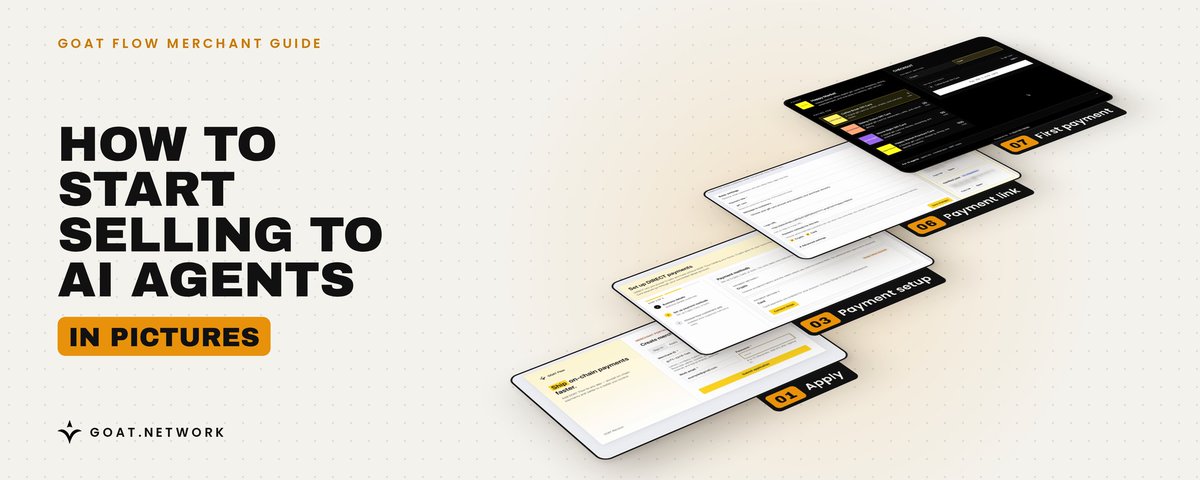
1. Apply for a merchant account in the Merchant Portal. Choose your merchant ID carefully, because it cannot be changed later. Every application is reviewed before you can sign in.
2. Turn on two-factor authentication and keep your recovery codes somewhere safe.
3. Add your business name and store description, then choose crypto, card or both. For crypto, you pick the tokens and networks and enter one receiving wallet that covers all of them.
4. Optional: connect Stripe to accept cards. Card payments are charged in US dollars and carry a per-charge platform fee.
5. Top up your fee balance. Service fees come out of this prepaid credit, separate from your sales, and if it runs out, new orders can stop.
6. Create your link. You can accept any amount (useful for tips, invoices and deposits) or sell fixed-price products, with one link per product or a single catalog link.
7. Share the link and take a first payment. Only fulfil an order once it shows as confirmed under All Orders.
Worth knowing
There are two separate environments: Mainnet for real payments and Testnet3 for testing, each with its own credentials and wallets.
Running a full test purchase on Testnet3 before going live is a sensible step.
You can also see your page the way an agent does by running npx goatflow-quickpay inspect with your agent.md link.
For stores and platforms there are developer options as well: Checkout, and API Payments, which lets sellers charge agents per request.
Why it matters
We talk a lot about agents that can act, not just chat.
If an agent is going to find a product and buy it, the business on the other side needs a way to get paid by it.
One payment page for people and agents together, with funds moving wallet to wallet and a record you can verify onchain, is a sensible foundation for that.
It is still early days, but the design makes sense to me.
If you run a business, it is definitely worth a look.
🤝 Paid partnership