Aquaculture Environment Interactions (AEI) is a multidisciplinary journal for primary research studies on environmental sustainability of aquaculture.

Oldendorf (Luhe), Deutschland
Joined August 2016
#Modelling and expert judgement were combined to estimate how #SalmonLice affect young wild #Salmon. Assumptions about #Migration timing and #Tolerance have large effects on modelled effects but limited impact on overall uncertainty. bit.ly/aei00533
18
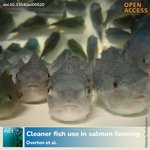
Can you see the #louse? Neither can the #cleanerfish. A new study shows that smaller, more transparent #salmonlice on the head are more likely to survive cleaner fish predation. bit.ly/aei00530
7
Pond water quality changes drive microbial and parasitic infections in smallholder fish farms in Kenya. Insights for better fish health and sustainable aquaculture. bit.ly/aei00524
6
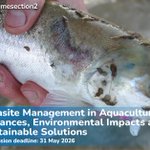
New submission deadline for the virtual AEI Theme Section. See bit.ly/aei_themesection2 for further details
9
As burrowing #shrimp increases difficulties for #shellfishaquaculture, an exploratory investigation of biological control methods found a shrimp parasite does not affect burrowing abilities but reveals a relationship with migrating #sturgeon. bit.ly/aei00523
5
The rise and fall of #cleanerfish in Norwegian #salmon farms: from promising solution to cautionary tale. bit.ly/aei00520
4
This new #AEI #ThemeSection will collate original research articles, reviews, and perspectives that advance our understanding of parasite–host–environment dynamics in aquaculture systems and promote sustainable management strategies. Further details at bit.ly/aei_themesection2
13
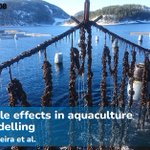
Comparing fjord- and farm-scale models for #mussel #aquaculture in Norway’s #Hardangerfjord. At low stocking densities, the modelling approach becomes less relevant, but at high densities, spatial resolution and scale matter! bit.ly/aei00508
6
A new study from #Hardangerfjord shows temperature increase, #aquaculture, and reduced underwater light affect #primaryproduction differently. Even with more #fishfarming, the risk of #eutrophication remains low, except in very local areas. bit.ly/aei_17_235
10
New study: #Compost #worms turn #aquaculture #sludge from #catfish and #trout farms into nutrient-rich compost and potential animal feed ingredients—paving the way for a circular economy in aquaculture! bit.ly/aei_17_137
16
‼️‼️‼️ We are currently experiencing technical issues that may be affecting general access to our Inter-Research website. We are working to resolve them as soon as possible. ‼️‼️‼️
1
12
▶️ The website is now working again ✔️
5
Check out our most recent article, offering new insight into improving the monitoring of #FishAquaculture's impact on the seafloor in Norway. bit.ly/aei_16_267
21
First experimental proof showing how long after detachment lion's mane #jellyfish #cnidocysts in #tentacles can catch prey and thus potentially harm aquaculture fish (ca. 3.5 wk) allowing for a hypothetical risk assessment. bit.ly/aei_16_263
70
Do #mussel and #seaweed farms provide fish habitats? Results from camera and fishing surveys in UK farms suggest that farms could create new feeding grounds for fish of commercial and ecological importance. bit.ly/aei_16_145
12
The tropical Blacklip Rock #Oyster is exceptional for bioremediation. Super-fast filtration rates and removes nitrogen, phosphorus, total suspended solids, chl a. Great potential for prawn waste-water bioremediation and #ReefCredits. bit.ly/aei_16_133
13
#Seagrass, on-bottom #oysteraquaculture, suspended oyster aquaculture, and bare mudflat create a habitat mosaic in Willapa Bay, WA. All habitat types are used by fish and mobile invertebrates, but with varying community assemblages. bit.ly/aei_15_307
30
Over half of the farmed Atlantic salmon from a wild spawning population caught in an upstream migration trap in the River Etne, Norway, in the period 2014–2018 were mature. bit.ly/AEI_15_271
37
Exciting news! First paper from Lobster Grower 2 published. As part of LG2, our researchers investigated the impact of sea-based container culture (SBCC) of lobsters on the local ecology of the study site in St Austell Bay, Cornwall. Read more about it! bit.ly/aei_15_215
23
Models for salmon growth, feed supply, fecal production and sedimentation can be used for performance-based management of salmon farms to determine if regulatory standards for benthic impacts due to waste deposition are maintained. bit.ly/aei_14_309
32