
AsstProf@Columbia CS | ML/AI
New York
Joined August 2025
- Tweets63
- Following122
- Followers1.1K
- Likes17




when we worked on this paper feels like a different era now. How did we even do this without LLMs lol
4
462
Adam Block retweeted

A bit of a late post: I’m very happy to share that I’ve recently joined Cornell University as an Assistant Professor of Computer Science at Cornell Tech in NYC!
I’m excited to build a research group, and I’m recruiting PhD students and postdocs!

Sorry we missed this! It does seem related, but my understanding is that that paper uses a more complicated rollout procedure involving natural language feedback on incorrect solutions as well as a different credit assignment strategy? Moreover, in our paper, eval is single turn.
67
Good question! In our experiments we always let it see the full failed attempt, but you could definitely imagine using a compressed summary to scale up with larger retry budgets or on harder problems requiring longer CoTs.
1
26
In particular, we primarily care about what you call accuracy at Turn1, not about ensuring that the model is learning to correct itself in order to maximize the final answer (after many attempts) being correct.
2
219
Thanks! Sorry we missed that. I think one key difference is that ReAPO is using external feedback and the serial sampling is intended to aid exploration while training, whereas my understanding is that paper wants to help with instill self-correction during inference?
1
2
366
Next up: longer retry budgets and harder problems.
Thanks to Nghi and our collaborators @caldermf and @GolowichNoah!
Paper: arxiv.org/abs/2610.28770
Code: github.com/Nghi-Dao/ReAPO
12/12

Credit assignment is important, too. With the same sampling, assigning one advantage to the full chain performs worse. So does retrying after success. The prompt changes little, and a third attempt offers limited benefit on 0.6B, but early results look promising on 1.7B.
11/12


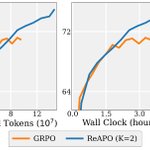
Is ReAPO just using more samples? Doubling GRPO's group size does not close the performance gap, nor does doubling its training steps. ReAPO uses almost 40% fewer tokens to reach the peak accuracy of the larger-group GRPO baseline.
10/12

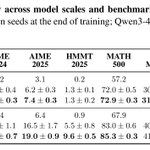
The gains extend to Qwen3-1.7B and 4B across challenging math benchmarks and GPQA-Diamond. Importantly, we evaluate first-attempt accuracy, so the model is given no verifier feedback and must get the answer right without second chances at inference time.
9/12

On Qwen3-0.6B, ReAPO improves on GRPO throughout training, including when measured by optimizer steps, generated tokens, and wall-clock time. The gains also replicate on OLMo-2 1B, suggesting they aren’t specific to Qwen.
8/12

ReAPO uses verifier-conditioned retries and GRPO-style advantages computed across all attempts. Each advantage applies only to its own response. If a failed attempt precedes a successful retry, we reward the retry but not the failure.
7/12

The SSP policy gradient has a useful form: if the expected remaining cost after failure is the same at every attempt index, it is proportional to a gradient that rewards successful attempts separately. This motivates attempt-level rather than trajectory-level credit.
6/12
How should we score a chain of attempts? We frame it as a stochastic shortest-path (SSP) problem. The state is the problem and previous attempts, a correct solution is terminal, and each failed attempt incurs cost. We want to minimize expected failures before success.
5/12
We start with G independent chains of attempts. After a failed such chain, the model sees its previous response and verifier feedback, and tries again. Critically, we begin an attempt only if the previous one was wrong, so extra generation goes to the failures.
4/12
There is substantial prior work on self-correction and multi-attempt RL, including SCoRe, SkillFactory, and many others. We focus on how to use retries during RL training: when should we generate them, and which attempts should get credit?
3/12
GRPO explores by sampling independent responses to the same problem. When a model is stuck on an incorrect approach, those responses can make essentially the same mistake repeatedly. More samples need not mean more distinct reasoning strategies.
2/12
🚨New paper led by my amazing master's student @NghiMDao! 🚨
Introducing Retry-Aware Policy Optimization (ReAPO). Conditioning retries on failures improves RLVR exploration: ReAPO improves accuracy and training efficiency relative to GRPO.
1/12

Adam Block retweeted

New from the lab: @LorenaYannnnn finds that reward misspecification during RL causes unmonitorable chain-of-thought. Models talk about the goals in their prompt, even as they learn throughout RL to optimize the misspecified reward. We also propose an intuitive fix; see below.

Really excited to announce this work led by our student @rahulth03as (joint with @micahgoldblum)! We had a great time going back to fundamentals and really thinking about the correct way to run evaluations and what to actually evaluate.

🚨 LLMs are trained on past data and deployed in the future, but we evaluate them like time doesn't exist. By treating LLM evaluation as a forecasting problem, we can better predict how models will actually perform in the future. 📈 1/n

15
1,182