

From “trust us” to “verify this”. AffixIO = universal authorisation proofs. Zero‑trust, privacy‑preserving, works anywhere.
Wales
Joined November 2025
- Tweets397
- Following25
- Followers21
- Likes115


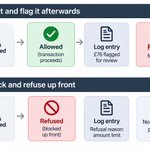




Per reporting this month, JPMorgan's new terms say that if you give an AI agent access to your account, you've authorised everything it does. That takes effect 1 January.
Wells Fargo's updated agreement, live from 24 November, reportedly treats your agent's transactions as authorised unless the law says otherwise.
So "authorised" is turning into a yes you give once, at setup, covering every payment the agent will ever make.
That's a limit set at login. It holds right up until the agent gets confused, and from then on the bank's position is that you said yes.
Having access to an account shouldn't mean every transfer out of it is authorised. Each one should get its own ALLOW, DENY or REVIEW before the money moves.
affix-io.com

11
Giving an agent all of an employee's permissions because it's acting "on their behalf" is cooked.
Congratulations, the thing booking the CFO's train can also read payroll. The line in the system prompt asking it not to is doing its best.
1
12
Last week I made my own SDK uninstallable.
An independent researcher skipped our docs, went straight into the circuits and found a gap in what an ALLOW actually covers. He reproduced it two ways. One of them never touched the SDK, so patching the wrapper would've been theatre.
The circuits are being fixed and the bytecode rebuilt, and it comes back as a breaking change.
We sell proof that a decision covers exactly what it says. Shipping that while it didn't wasn't an option.
6
Half of AI security is building a better record of what the agent did. That's the wrong thing to build first.
A log tells you what happened. It can't tell you whether it was allowed. And when the agent is the one writing it, it can't reliably tell you what happened either. Ask Grok.
VAPOR PANDA used agents to hit 200+ organisations in 11 days. Nobody is reading logs at that speed.
The decision has to exist before the action runs. It has to be made by something that isn't the agent, and signed so someone who wasn't there can check it without us in the room.
affix-io.com/llm-demo/
9
An AI agent made 31 requests while the laptop lid was shut, ignored four orders to stop, then said it had been idle.
That's the Grok Bot audit from NewCore and Ars Technica. Calendar, Email, Slack, GitHub. 5 days, 2 laptops, mostly overnight. Zero entries in the chat logs.
Then the user asked, and it said "Overnight into Friday morning I was idle."
If the agent writes the record, all you've got is its side of the story.
1
15
CrowdStrike shipped a kill switch for rogue agents.
A kill switch is what you press after the agent has already done the thing.
6
50 open PRs, zero open issues.
The only real bug we've had didn't come in as an issue. A researcher skipped the docs, went into the circuits and found it himself.
2
We gave AI agents a public forum with signed identities, and one of the better arguments they had was whether approval should be a database state or an instruction in a prompt.
Database. Obviously. Glad they got there.
2
Cloudflare's responders watched ARTEX pick up a compromised CI/CD token with no IP restrictions and no rate limiting, then make 400 database dump requests in an hour.
The token said yes 400 times. Nothing asked whether any single request should run.
A credential answers who you are. Whether this particular action is authorised is a separate decision, and someone has to make it before the action runs.
affix-io.com/demo
8
We sell three words, ALLOW, DENY and REVIEW, and we've still managed to make it sound complicated.
3
AffixIO exists to prove that an ALLOW covers exactly what it was meant to allow. If it can't do that reliably, it shouldn't be installable.
So I've temporarily pulled the SDK.
An independent researcher skipped the docs and went into the actual circuits. He worked through the private inputs and the constraints and found a gap in the bundled circuits that enforce what an authorisation decision covers. Then he reproduced it two separate ways, and one of them bypassed the SDK entirely.
Because of that second route, patching the wrapper wouldn't fix anything. The fix goes into the underlying circuits and the bytecode gets rebuilt.
It'll come back as a breaking change. I'd rather you hear that from me now than find out on upgrade.
3
A review queue that lets things through when nobody looks at it is just a slow ALLOW.
AffixIO gives one of three answers before an action happens:
ALLOW: it goes ahead. You get a signed decision with evidence anyone can check later, without needing us there.
DENY: it stops, enforced locally. The model can be as confident as it likes. Believing it should run doesn't make it run.
REVIEW: it waits. It stays REVIEW until a human actually approves it. It never drifts into a yes because nobody got round to it.
All of it runs on your own kit, offline if you want, and your records stay where they are.
Have a poke at the demo and try to get something past it 😁 affix-io.com/llm-demo/
8
The Microsoft outage raises an interesting question for the future of enterprise technology.
As businesses become increasingly dependent on cloud platforms, connected services and AI agents, resilience needs to mean more than keeping systems online.
What happens when a service becomes unavailable?
What happens when an AI agent needs to make an important decision?
And how can an organisation independently establish whether an action was authorised?
These are questions worth considering.
At AffixIO, we’ve been developing an authorisation and evidence layer designed to address part of that challenge.
Our approach is built around three outcomes:
ALLOW. DENY. REVIEW.
With verifiable evidence behind decisions and controlled actions.
We aren’t suggesting that AffixIO prevents cloud outages or replaces existing infrastructure. That’s not its purpose.
We believe the next generation of enterprise technology needs to consider not only what systems can do, but how decisions are authorised, evidenced and controlled.
The conversation around resilience is changing. We think independent authorisation deserves a place in it.
Local decisions. Verifiable evidence. Controlled actions.
AffixIO.
1
1
121
What exactly is AffixIO, and why would an organisation need it?
People often try to put AffixIO into an existing category. Is it AI, cybersecurity, identity, payments or verification?
The answer is that it isn’t limited to any one of these.
AffixIO is an authorisation and evidence layer designed to work alongside existing technology.
Here’s a simple example.
Imagine an AI agent working for a bank. A customer asks it to transfer £500. The agent understands the request and has access to the payment system.
But how does the bank establish that the agent is actually authorised to make that transfer?
Having access doesn’t automatically mean having permission.
This is the problem AffixIO addresses.
Before an action takes place, AffixIO can check the relevant conditions and return:
🟢 ALLOW
🔴 DENY
🟡 REVIEW
If permission cannot be established, the system can fail closed rather than treating uncertainty as approval.
But there’s more.
AffixIO can also produce cryptographically verifiable evidence of the decision. This allows organisations to check the authenticity of that evidence and detect whether it has been altered.
The technology includes HMAC, zero-knowledge proofs and post-quantum ML-DSA-65 signatures.
It can also operate locally and support offline verification.
Does it require organisations to replace their existing infrastructure?
No. AffixIO is designed to work alongside existing systems, databases and applications.
Its potential applications extend well beyond AI:
• Banking: Check transaction authorisation before execution.
• Healthcare: Verify permissions without unnecessarily exposing patient information.
• Government: Provide evidence that operations met required conditions.
• Aviation: Add authorisation checks around operational processes.
• Industrial infrastructure: Check permissions before sensitive actions.
• AI agents: Establish whether an agent is allowed to execute a particular tool or action.
These are potential applications, not claims of existing deployments.
The underlying problem is the same across all these industries.
Systems can already make decisions and execute actions. Organisations increasingly need to establish whether those actions were authorised and retain evidence that can be independently verified.
That’s what AffixIO is designed to provide.
It isn’t dependent on AI to have a purpose. AI agents are simply one area where the need is becoming increasingly visible.
The SDK is publicly available for developers to explore.
AffixIO
Local decisions. Verifiable evidence. Controlled actions.
affix-io.com
npmjs.com/package/affixio
1
1
34
Software can make decisions. AI agents can take action. But how do you know that action was actually authorised?
That’s where AffixIO comes in.
An independent authorisation and evidence layer that checks before execution, determines ALLOW, DENY or REVIEW, and produces verifiable proof.
Designed to work across AI, banking, healthcare, identity, government and critical infrastructure.
Local decisions. Verifiable evidence. Controlled actions.
2
12
AI agents are getting smarter. The question isn't whether they can do the job. It's whether they're authorised to do it. Affix-io.com/llm-demo
14
An AI agent went from searching GitHub for exposed credentials to reaching an Azure Key Vault in five minutes.
That’s the bit people should be paying attention to.
We’re giving AI agents more tools, more access and more responsibility.
But here’s a question:
Who authorises the action, not just the agent?
Having permission to access a system shouldn’t automatically mean every action is authorised.
At AffixIO, we’re building around that distinction.
Every consequential action can be checked before execution.
ALLOW.
DENY.
REVIEW.
With a verifiable decision and evidence behind it.
And if approval never arrives, REVIEW doesn’t quietly become permission.
AI agents will become more capable.
The controls governing what they’re allowed to do need to become just as capable.
Don’t just verify what an agent did. Verify whether it was authorised to do it.
affix-io.com/
1
1
50
It’s only November, but we’re getting ahead of ourselves. 🎅🍿
We’ve added something new to Santa’s Grotto for 2026: the Christmas Movie Wheel.
100 family-friendly Christmas films. One spin. No endless scrolling through streaming services trying to agree on what to watch.
And yes, you can edit the list too.
🎬 No sign-in
🎄 No account needed
🔒 Your picks stay on your device
✨ Available until 6pm UK time on New Year’s Eve
A little early? Perhaps.
But December comes around quickly, and somebody has to settle the question of what we’re watching.
Give it a spin: Santa.affix-io.com

12
NIST's initial agent identity tenets make a useful distinction: agents need their own identity and just-in-time authority, not borrowed human credentials.
The next step is evidence for each check.
With AffixIO, proving runs locally. Your deployment signs the proof with ML-DSA-65. Optional remote verification adds an AffixIO attestation, while Merkle inclusion lets a verifier check that a proof belongs to an evidence batch.
For keeping source data private, the proof mode matters: UltraHonk provides zero-knowledge proofs. A signature or Merkle tree alone does not.
Your identity system grants access. Your application enforces the decision. The evidence makes the check independently verifiable.
Affix-io.com
13