
Software Developer & Infrastructure Designer | Security researcher monitoring iOS/macOS App Store integrity, infrastructure security & major data breaches.
United Arab Emirates
Joined November 2025
- Tweets46
- Following7
- Followers16
- Likes2



🚨 FOLLOW-UP: Neural Techlabs - this now looks like a pattern worth investigating
After my previous report about Neural Techlabs' aggressive use of OpenAI branding, compare what was on the App Store before vs. now.
🔴 BEFORE
"AI Chatbot - Ask Anything"
• "Built on GPT-6" prominently advertised
• OpenAI name + logo displayed directly inside the app
• GPT-6 heavily emphasized in App Store screenshots
• OpenAI branding given highly visible placement
🟢 NOW
The same app has suddenly become:
"Neural - AI Chatbot Assistant"
The prominent OpenAI logo has disappeared from its visible App Store marketing, and the presentation is now much more generic:
GPT-6 • Opus 5.5 • Grok 4.7
A rebrand by itself proves nothing.
But there is more.
Neural Techlabs also had another app marketed as:
"AI Chat • Your Smart Assistant"
"Built on Google Gemini API"
Its App Store screenshots prominently advertised:
"Powered by Gemini API."
That Google/Gemini-focused app now appears to have been removed from sale or otherwise made unavailable.
So the documented sequence raises an important question:
Heavy third-party branding → scrutiny → branding substantially reduced → another heavily branded app disappears
🌐 The branding doesn't stop at the App Store.
Neural Techlabs' own website also prominently markets its chatbot as "driven by GPT-4 from OpenAI" and features a dedicated section titled "Fueled by OpenAI GPT-4."
Combined with the previous App Store screenshots prominently displaying OpenAI's name and logo, this repeated emphasis could further confuse users about whether Neural Techlabs or its products have an official relationship with OpenAI.
Reference: neuraltechlabs.com
And several sections of Apple's own App Review Guidelines appear potentially relevant:
⚠️ Guideline 2.3 - Accurate Metadata
Apple requires screenshots, descriptions and other metadata to accurately represent the app.
⚠️ Guideline 2.3.1 - Misleading Marketing
Apple says misleadingly marketing an app can be grounds for removal, and repeated/egregious behavior can lead to removal from the Apple Developer Program.
⚠️ Guideline 2.3.7 - Metadata
Apple specifically warns developers against packing metadata with trademarked terms or popular app names to leverage their popularity.
⚠️ Guideline 4.1 - Copycats / Impersonation
Apple prohibits apps from impersonating other apps or services and restricts unauthorized use of another developer's brand/product identity.
⚠️ Guideline 5.2.1 - Intellectual Property
Apps must not use protected third-party trademarks or misleading/copycat names, representations or metadata without appropriate rights.
⚠️ Guideline 5.2.2 - Third-Party Services
If an app accesses, displays or monetizes a third-party service, Apple requires the developer to be specifically permitted to do so under that service's terms.
⚠️ Guideline 5.6.2 - Developer Identity
Apple requires developers' representations of themselves, their businesses and their offerings to be accurate and truthful.
And there is another guideline that becomes particularly important if the behavior is changing around App Review:
⚠️ Guideline 2.5.19 - Hidden / Undocumented Functionality
Apple prohibits hidden, dormant or undocumented functionality and requires an app's functionality to be clear to both users and App Review.
I am not claiming I can prove Neural Techlabs submitted a deliberately sanitized build to bypass App Review.
But the historical screenshots vs. current screenshots raise a legitimate question:
Is the app repeatedly being cleaned up when scrutiny increases, passing review in a safer state, and then returning to more aggressive third-party branding afterward?
If so, Apple should be able to establish that by comparing:
• Previous submitted builds
• Review Notes
• App Store metadata history
• Screenshot history
• Server-controlled content/model presentation
• Changes made immediately before and after App Review
@Apple @AppStore - does App Review examine a developer's previous metadata and build history when this kind of repeated pattern is reported?
@OpenAI @Google - the historical use of your names, model branding and logos across these apps may also deserve review.
The screenshots provide the timeline.
Apple has the build history.
That should make this relatively straightforward to investigate. 🧵🔍
App Link : apps.apple.com/us/app/neural…
Neural - AI Chatbot Assistant

🚨 Mac App Store Investigation: “Mail for Gmail” by Fokusek Enterprise
This one deserves a serious look from @Google and @Apple.
The app is called “Mail for Gmail” and has more than 11,000 App Store ratings.
But look at how this third-party paid app is presented.
🧵👇
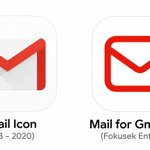
1. Start with the icon.
The app uses a white rounded-square icon containing a red outlined envelope.
Now compare that with Gmail’s historic branding.
For years, Gmail was represented by its highly recognizable red-and-white envelope design before Google replaced it with the multicolor Gmail icon in 2020.
The resemblance is difficult to ignore.
And Google’s own published branding guidance says developers should not use Google brand elements or modified versions of Google brand elements as their application logo.
So the obvious question for @Google is:
Is this icon authorized?
2. Now look at the App Store presentation.
The title is:
Mail for Gmail
The screenshots prominently display the Gmail name and recognizable Gmail branding.
One screenshot literally presents:
“Mail for Gmail”
with the multicolor Gmail logo incorporated directly into the presentation.
Another prominently displays what appears to be the Gmail interface.
Yet the developer isn’t Google.
It’s Fokusek Enterprise.
3. And this isn’t simply a free Gmail utility.
The current U.S. listing offers:
• $3.99/year subscription
• $9.99 lifetime purchase
The developer does disclose in its listing that this is a third-party application and isn’t produced, endorsed or affiliated with Google.
But here’s where this investigation becomes particularly interesting.
4. Actual App Store reviews indicate consumer confusion.
One reviewer says they bought the $9.99 lifetime version:
“thinking this was a Google product.”
Another reviewer who purchased the lifetime version says they expected something comparable to having Gmail on their computer, but complained that the app repeatedly sent them into Chrome.
That matters.
Disclaimers are important, but if users are still reporting that the overall presentation caused them to believe they were purchasing a Google product, @Apple and @Google should look at the complete storefront experience.
And this isn’t an isolated Google-related app from this developer.
As documented previously, Fokusek Enterprise operates multiple apps built around major third-party services, including:
• Mail for Gmail
• Calendar for Google Calendar
• Docs for Google Docs and Drive
• Chat for Google Chat
• Photos for Google Photos
That broader portfolio is why I believe this deserves an account-level review, rather than examining “Mail for Gmail” in isolation.
The questions are simple:
Is the Gmail-related branding authorized by Google?
Does the app icon comply with Google’s branding rules?
Does the combination of the title, icon, screenshots and Gmail branding create consumer confusion despite the disclaimer?
And most importantly:
Why are actual paying users reporting that they thought they were buying a Google product?
@Google @gmail @Apple — this deserves a closer look.
App Store:
apps.apple.com/us/app/mail-f…


1
541
🚨 Mac App Store investigation: Scam of the century?
This one deserves serious attention from @Apple and @AnthropicAI.
I came across a Mac app called:
“AI Assistant Chatbot: ASTRA 6”
At first glance, there are several things that could make a user associate this app with Claude/Anthropic.
The app’s subtitle says:
“Build on Claude by Anthropic”
Its developer is displayed on the App Store as:
CLAUDE C LTD
Apple separately identifies the seller as:
CLAUDE CAPITAL LTD
And then there’s the app icon.
Look at the attached comparison between Claude’s recognizable orange radial branding and the icon being used by ASTRA 6.
The visual similarity deserves scrutiny.
But it doesn’t stop with the branding.
The app is monetized through:
• $6.99/week
• $12.99/month
• $49.99/year
$6.99 every week works out to roughly $363/year if continuously subscribed.
So we have a third-party Mac app:
→ using “Claude by Anthropic” directly in its App Store subtitle
→ appearing under the developer name “CLAUDE C LTD”
→ sold by a company called “CLAUDE CAPITAL LTD”
→ using an icon strikingly similar to Claude’s recognizable branding
→ charging up to $6.99/week
The obvious question is:
Is any of this actually authorized by Anthropic?
If it isn’t, the combination of the company/developer naming, Claude reference, similar iconography and paid subscriptions raises serious questions about potential consumer confusion and trademark/brand impersonation.
I’m not making the legal determination that infringement has occurred—that’s for @AnthropicAI and @Apple to determine.
But this deserves an urgent review.
App Store:
apps.apple.com/us/app/ai-ass…
@AnthropicAI @Apple @AppleSupport
🤖 Made with AI


🚨 Mac App Store investigation: Fokusek Enterprise
This appears to go far beyond a single Mac app. I believe the ENTIRE Fokusek Enterprise App Store portfolio deserves investigation by @Apple and the companies whose brands/services are being used.
I reviewed the developer account and found:
• Mail for Gmail
• Calendar for Google Calendar
• Docs for Google Docs and Drive
• Chat for Google Chat
• Photos for Google Photos
• Upload and Share for Dropbox
• Openly for Chrome & Firefox
• Openly Pro – Browser Switcher
• iSync Pro for iTunes
Several of these apps build their App Store identity around major third-party product names, services, interfaces and/or recognizable branding belonging to companies such as Google, Dropbox, Apple, Mozilla and others.
One particularly striking example is Docs for Google Docs and Drive.
Its App Store title literally contains “Google Docs” and “Drive,” while its screenshots prominently display Google Docs, Drive, Sheets and other recognizable Google branding.
Yet the developer is Fokusek Enterprise, not Google.
And the app charges:
• $19.99/year
• $39.99 lifetime
The same pattern appears with Chat for Google Chat.
That app charges $4.99/year or $9.99 lifetime, and the App Store reviews provide particularly important evidence of possible consumer confusion.
One reviewer titled their review “Deceptive!” and complained that the app looks like a Google app despite being a paid third-party product.
Another review is titled “Scam” and tells users they can access essentially the same service through Chrome without paying this developer.
Another says:
“Individual Chats dont open. Complete waste of time and money”
Mail for Gmail follows a similar model, charging $3.99/year or $9.99 lifetime.
Looking at the COMPLETE developer portfolio raises much bigger questions:
Why are so many apps from one developer built around the names and branding of major third-party services?
Do they have the necessary authorization from each trademark/service owner?
Does the presentation create the impression of an official or affiliated product before users reach the disclaimer?
And most importantly, why are actual App Store users reporting that they believed these apps looked like official Google products?
I think @Apple should review the developer account as a whole, rather than looking at each listing in isolation.
I would also encourage @Google, @gmail, @Dropbox, @firefox and the relevant brand/security teams to review whether their names, trademarks, services and visual identities are being used with appropriate authorization.
This deserves a proper investigation.
Mail for Gmail:
apps.apple.com/us/app/mail-f…
Docs for Google Docs and Drive:
apps.apple.com/us/app/docs-f…
Chat for Google Chat:
apps.apple.com/us/app/chat-f…
@Apple @AppleSupport @Google @gmail


Dexter retweeted

Check these ones. It’s like misleading on steroids, specifically for Mac users.
apps.apple.com/us/app/authen…
apps.apple.com/us/app/app-fo…

Dexter retweeted

🍎 💾 Link to my slides and talk recording "macOS Mounting Madness" is up on my site:
theevilbit.github.io/talks/

Dexter retweeted

I am reporting an apparent unauthorized use of the ChatOn app icon, owned by AIBY Inc.
The Mac app “AI Chatbot - Ask Anything” (App ID: 6447312365) by Neural Techlabs is using an icon that closely resembles the official ChatOn icon.
Disputed app:
apps.apple.com/ni/app/ai-cha…
Official ChatOn:
teapawt.org/chaton_app?s=21
The attached screenshot shows the icon used in version 19.1.25, while the current icon also closely resembles ChatOn's official visual identity.
The distinctive overall design may create user confusion and warrants an intellectual-property review.
I respectfully request that Apple investigate whether the developer has authorization from AIBY Inc. to use this artwork and take appropriate action if not.
I can provide additional dated evidence and comparisons upon request.
@Apple
@chaton_app
@AppleSupport

Scam Alert!!
@Apple @AppStore @Google
Despite being removed from the App Store in past, Neural Techlabs is back with the same misleading AI branding, and somehow @Apple’s review team let it through again. Either no one is properly checking, or the bar for enforcement is dangerously low.
This app is prominently marketing itself around OpenAI’s identity. It boldly highlights “GPT-6,” displays the OpenAI name and logo directly inside the app, and visually emphasizes the OpenAI logo in a way that could easily give users the impression that the app is officially associated with or endorsed by OpenAI.
What makes this even more concerning is the pricing: its weekly subscription goes up to $5.99/week — roughly $311 per year if maintained for a full year.
@OpenAI, please review how your name, models, and visual identity are being used here. Prominent OpenAI branding, highly visible logo placement, weekly subscription billing, and potentially confusing disclosures deserve a serious investigation. 🛑
App Store:
apps.apple.com/us/app/ai-cha…
I’d encourage other platforms and security researchers to report such apps as well. More scrutiny means better protection for users. @privacyis1st @appleinsider @9to5mac @IM_Kevin_Archer


Weeks after removal, Neural Techlabs is back with the same misleading AI branding—and somehow the @Apple review team didn’t notice. Either no one is checking, or the bar is dangerously low.
apps.apple.com/us/app/ai-cha…
apps.apple.com/us/app/ai-cha…
@privacyis1st @9to5mac @techradar
164
At this point, it feels like the @Apple review team is approving apps on autopilot. Neural Techlabs is back, misleading users with OpenAI, ChatGPT, Claude & Grok branding—no red flags triggered.
apps.apple.com/us/app/ai-cha…
apps.apple.com/us/app/ai-cha…
@privacyis1st @9to5mac @techradar
It’s honestly laughable how easily Neural Techlabs keeps slipping scam apps past the @Apple review team. Taken down, re-uploaded weeks later, same deceptive use of OpenAI, ChatGPT, Claude & Grok to confuse users. What exactly is being reviewed here?
apps.apple.com/us/app/ai-cha…
apps.apple.com/us/app/ai-cha…
@privacyis1st @9to5mac @techradar
317
Dexter retweeted
🚨 Scam Apps Alert!
The developer account Neural Techlabs is publishing apps that directly infringe on multiple brands’ identities, misleading users by impersonating official products from Google Gemini and OpenAI ChatGPT.
Their macOS app:
🔗 apps.apple.com/us/app/ai-cha…
is deliberately designed to appear as an official Google Gemini application, tricking users into trusting it.
Previously, their other app:
🔗 apps.apple.com/us/app/ai-cha…
was removed by Apple due to multiple infringements, yet they continue to launch it back again that violate intellectual property rights and mislead users by directly mentioning OpenAI product Chatgpt in there metadata which is strictly against OpenAI brand guidelines.
There is also an ongoing investigation into their multiple associated developer accounts, which appear to be infringing the identities of Google, YouTube, and several other major platforms. Findings from this investigation will be revealed very soon.
These repeated violations not only break brand-use policies but also put users at serious risk of being scammed or deceived, and it seems they are managing to slip past Apple’s review checks despite prior enforcement action.
@privacyis1st @9to5mac @techradar

