

Founder & GP @ BuildTech VC & Launchpad. Backing AI, robotics, prefab & energy startups in the built world. Founders & partners → DMs open.
San Mateo, CA
Joined July 2020
- Tweets377
- Following308
- Followers678
- Likes503




Most decks open with the hardware. I open with four questions.
1. How precise does the job need to be?
2. How much does the customer have to change?
3. How much autonomy does it need on day one?
4. Can it be simulated before it ships?

2
127
Founders keep asking how we handled patents at Mighty Buildings.
About 120 applications later, my short answer: patent the business, not the engineering.

1
1
221
I co-founded a microfactory company. At Blueprint, I argued against microfactories.
The motion was about housing cost. On cost, factory homes sell at 51 cents on the dollar per sq ft vs site-built.
The question that decides it: who owns the volume?
Well... I have a little but different summary in mind that I am writing up right now.

After a spirited back-and-forth on the debate floor, it was resolved on 9/24 in Las Vegas that,
The path to cheaper housing construction is the microfactory, not the gigafactory.
The hyper-local nature of housing, ease of assembly, and low-capex scaling changed more minds than the case for centralizing.
The motion was elegantly disputed by @rileymeik, who was effectively arguing 1 vs. 3, plus a biased moderator.
Super fun time and to be continued. thanks to @Vikas_Enti @mollieclaypool @rileymeik @AlexeiDubov and @AGampel1 who was undoubtedly arguing from afar.


1
258
Should be interestingly fun this Thursday.

Your most active user may never actually log in...
For decades, every system of record was built around a person. That's flipping across the entire stack. Agents are logging calls and working the pipeline in your CRM, writing and deploying code to production, and spinning up the cloud infrastructure and data pipelines underneath it all, at machine speed, all day long.
Every system of record becomes something new: one source of truth for both agents and humans, whether it holds your customers, your product, or your infrastructure. Agents become the input layer – they log the call, push the commit, provision the resources, and keep every record clean. Humans move to the front: the relationship, the judgment, and the taste that decides what's actually good.
Excited to announce @craft_ventures 's Unprompted Systems panel: "Agentic systems of record," powered by @HubSpotStartups.
→ @sarikagarg (GM, @HubSpot) will moderate. Sarika leads the products that thousands of revenue teams run their business on every day, which makes her one of the few people who sees this shift actively play out across an entire market.
→ @jdewitt29 (COO, @vercel): one of the sharpest GTM execs in AI & tech. Jeanne built and led go-to-market at Stripe before joining Vercel, and she's one of the most sought-after voices on how great companies actually scale.
→ Nate Slater (Head of Startup Solution Architecture, @awscloud): Nate leads AWS's work with startups, putting him across the table from more early-stage AI founders than almost anyone. He sees what's working, and what's next.
_________________________
Unprompted is officially at capacity. Apply to be first in line for any seat that opens up:
→ When: Unprompted is October 1st in San Francisco.
→ Who it's for: the world's best AI founders, marketing leaders, growth practitioners, GTM engineering innovators, applied AI tacticians and high-growth operators.
Apply now: unprompted.craftventures.com…

The real question isn't gigafactory vs. microfactory. It's which business model survives. I'm still a fan of microfactories, but the winning answer is probably a blend. Manufacturing tied to development. That's where the emerging models are heading.
The great housing construction debate comes to Vegas two weeks from today!!!
Gigafactory vs. Microfactory
After centuries of attempts and billions invested, factory-based construction has never consistently beaten the cost of building a home by human hand.
What changes that? Which construction method will lead to cheaper, scalable housing?
arm the contestants with your best arguments and words of encouragement. (especially the gigafactory side as I'm moderating) cc: @rileymeik @AlexeiDubov @AGampel1 @GillesRetsin
The revolution will not be televised but possibly live tweeted.

2
160
The supply-constrained guidance is the real signal. +70% when they could do more with more wafers. That's demand outpacing capacity.
SFDC side : systems of record get an agent layer. Open question is whether the margin accrues to the infra or the app layer.

The “AI capex is a bubble” and “SaaS is dead” narratives getting shredded this morning. NVDA +8%, SFDC +20%.
NVDA: $96B q2 revenue (+106%), ~$60B net income, 75% gross margin. Highest core-business quarterly profit ever. Guided FY28 rev +70% vs Street exp 45% — and that’s a supply-constrained number.
SFDC: bookings reaccelerated (fastest in 4 years) and Agentforce is showing up in ARR. Benioff: “the UI is the AI.” They’re putting Salesforce inside Claude. If you can’t beat ’em, join ’em. Still need systems of record.
Congrats @JensenHuang @Benioff
2
214
WHY AI CODING TOOLS WILL FIX THE GRID BEFORE THEY TOUCH A JOB SITE
Two weeks ago: a demo for a codebase-intelligence tool. Dependency graphs, runtime data flow, security holes in large undocumented legacy systems.
The founder asked a fair question. Does this land in construction?
My answer surprised him. Not yet. Try energy. Try oil and gas.
That's the opposite of the pitch he'd been prepping. Construction is the industry everyone in contech assumes is starving for tooling. Fragmented, paper-based, running software nobody's updated in a decade. Energy and utilities look like the harder sell on paper. Regulated. Risk-averse. Slow to move.
I told him to start with the grid instead.
That was a gut call. Raw signal from the portfolio and pipeline, not something I'd actually stress-tested. So before writing this, I went and checked the data.
Construction's numbers explain why it's a bad first bet, even though they look like whitespace. A 2026 RICS survey of 2,200+ construction professionals found 45% of firms have no AI implementation at all. Another 34% are still in early pilots. Organization-wide adoption sits under 1%. In Canada, 9.6% of construction firms report using AI software. Bluebeam's global AEC survey put usage at 27%.
Those numbers aren't opportunity. They're a symptom of an industry with no forcing function. Margins are thin but stable. Nobody's PLC is running code from 1998 that a regulator is about to flag. The pain from bad software is diffuse, rework, delay, cost overrun, and construction has absorbed that pain for decades without it becoming existential. Low adoption plus low urgency is just low adoption. Nothing moves it.
Energy and utilities post similarly unimpressive topline numbers. McKinsey puts sector-wide AI adoption at 33%, below the 42% cross-industry average. One industry report has generative AI usage in utilities at 17%, against 50%+ in finance and healthcare.
On the surface, same story as construction. A laggard sector, low usage, slow movers. Underneath, the forcing functions are completely different. Almost a third of the US grid is now over 40 years old. Utility PLCs are typically considered legacy 10-15 years after release, and plenty of facilities keep running them well past that point because replacement parts and vendor support have disappeared. These systems sit inside 25-year power purchase agreements, under regulatory frameworks that don't forgive an outage.
And unlike construction, the industry knows it has a problem. 94% of power and utility CIOs told Gartner they plan to increase AI investment this year, with average spend up 38.3%. 40% of power and utilities firms are expected to run AI-assisted control room operations by 2027.
That's the difference. Construction's low number reflects a market that doesn't feel enough pain to move. Energy's low number reflects a market that feels the pain and is already budgeting to fix it. The tooling and the internal readiness just haven't caught up yet. Same statistic. Opposite meaning.
One thing worth noting: in my own portfolio and pipeline categorization, a lot of what I'd call grid work, transmission upgrades, substation builds, interconnection projects, gets filed under construction or infrastructure, not energy. A transmission line is a construction project and a grid asset at the same time. The industries blur at the edges.
What doesn't blur is the buyer. A codebase-intelligence tool doesn't sell to an industry category. It sells to whoever owns the pain of an undocumented system under pressure to fix it: a utility's engineering or OT team, not the general contractor pouring the foundation on the same project. The vertical label on the deal barely matters. Who signs is the whole question.

3
2
272
I'm watching the same pull on the applications side, not just developer tooling. A startup building autonomous facility-control software, an AI system that runs energy optimization inside data centers with no human in the loop, has spent the past year getting pulled into conversations with data center developers and their capital partners, unprompted. Nobody had to be sold on taking that meeting. Compare that to how many construction GCs are asking for a workflow AI demo.
Oil and gas fits the same pattern one level down. Transmission pipeline control systems routinely run on software older than the engineers operating them, under compliance regimes that get less forgiving every year. A codebase-intelligence tool that maps dependency graphs and surfaces security gaps in an undocumented system isn't a nice-to-have there. It's the difference between an audit finding and a fine.
The point outlasts this one demo. When you're picking which built-environment-adjacent vertical to sell into first, adoption-rate stats alone won't tell you much. They tell you who's behind. They don't tell you who's under pressure to catch up, and pressure is what actually converts a pilot into a signed contract. Construction will get there. It's just not where the forcing function lives yet. The grid, and the pipelines under it, already have one.
1
36
Aug 5: a town hall in Vineland, NJ. Aug 6: Nebius stock drops 13%. Not a permit denial. Not a lawsuit. Power, permitting, equipment quality — those were the constraints. There is a fourth one now, and it moves at the speed of the market.

235
AI infrastructure has a quality control problem nobody's pricing in.
A GC commissioning hyperscale campuses told me something that made me ask him to repeat it. Chiller FAT failure rates have jumped from 7-10% to 40% in a year. Four in ten units failing before they leave the factory.
Almost everyone writing about the AI buildout is stuck on power and permitting. Grid queues running years long, transformer lead times past two years, in some cases closer to five. Real problems. I've made this argument myself. But there's a third one that barely gets mentioned, and it might be worse, because it doesn't show up until you actually need the equipment to work. Manufacturers can't hold quality control together at the pace this demand requires.
It's not about lead time, or at least not only that. Chillers already run 20-30 weeks under normal conditions, and their VFDs depend on power semiconductors that hit 20-40 week lead times during the last chip shortage. Everyone's priced that in by now. What nobody's priced in is what happens once the thing shows up and doesn't perform to spec, or passes the initial test and then fails six months into commissioning. Contractors on the ground are increasingly flagging multi-stack chiller setups specifically. Field reliability has gotten bad enough that some are replacing more of these units than they're installing new, mostly because VFD failures take the compressor down with them.
Why is this happening. Manufacturers built out capacity for a decade of steady, boring growth. Then AI demand hit and the five biggest hyperscalers committed north of $660 billion in 2026 capex alone. Lines built to ship 200 units a year suddenly need to ship 800. QC processes that held up fine at the old pace start missing things at the new one. Same pattern behind the rise in counterfeit and out-of-spec parts across electronics more broadly during this shortage. Buyers get pushed outside authorized channels, and that's where substandard components get through.
The standard framing right now is that a third to half of the data center capacity announced for 2026 will slip or fall through, and it's always pinned on the same culprits. Not enough transformers. Not enough switchgear. Not enough grid. All fair. But that framing quietly assumes the equipment that does show up will actually work. I don't think that's a safe assumption anymore. A late transformer is a scheduling headache. A chiller that fails FAT, or passes and then fails during commissioning, is a much more expensive problem, because by then the concrete's poured, the crews are hired, and a delivery date is already committed.
What do you do with this. Lead time risk is table stakes now, everyone bakes it into the schedule. Quality risk mostly isn't. Teams that aren't physically witnessing factory acceptance testing instead of taking the vendor's word for it are exposed. Vendor selection that still comes down to price and lead time without checking recent field failure data on that specific model is exposed. And a schedule with no room for "the equipment arrived and doesn't work" is planning around a best case that's stopped being the base case.
The capital's there. The land's mostly there too. Everyone's decided power and interconnection are the binding constraints, and they're not wrong. But I'd bet the next round of delayed data center openings won't all trace back to the grid. Some of them are going to trace back to a chiller that looked fine on the spec sheet and failed the moment it mattered. By the time anyone writes that story, it'll be too late for whoever skipped the trip to the factory floor.

3
324
Alexei Dubov retweeted

GIGAFACTORY vs. MICROFACTORY for cheaper construction?
This post has officially turned into a live on-stage debate.
Motion: The path to cheaper housing construction is the on-site microfactory, not the gigafactory.
Microfactory corner (for):
- @GillesRetsin / Mollie Claypool of AUAR and @AGampel1 of @buildwithcuby
Gigafactory corner (against):
- @rileymeik of @americanhousing
In the witness box: @Russell_MFG_USA (ex-Cofounder and CTO, Diamond Age) and @AlexeiDubov (ex-Cofounder & COO, Mighty Buildings).
The debate will answer why factory-built housing has always lost on cost. Is it a failure of technology, one that better robotics, AI, and cheaper freight inside a centralized factory can finally fix? Or is the gigafactory fundamentally, physically flawed, and the future belongs to a low-CapEx microfactory that ships to the jobsite instead of trucking finished rooms from a distant plant?
Oxford rules. We poll the room on the way in and again on the way out, and whoever moves the most votes wins.
Blueprint Conference, Sept 22, the Venetian, Las Vegas. blueprintvegas.com/
DM me for a discounted ticket.


The most expensive way to build a house is in a factory.
Prefab housing costs more than building by hand. After centuries of attempts, new technology waves, literal robots working in factories, and billions of dollars, it's crazy that's still true.
We've tried vertical integration down to the nail, we've tried automated factories, we've tried reimagining the wall itself, we've tried panel plants from large building product companies. Since the 1970s, we've seen over 30 prefab companies in the US alone take a swing. When they inevitably fail, the value narrative quickly changes to "production capacity" "efficiency" and "quality." Cop out answers, respectfully, because cost has always been the reason one ventures into prefab.
What have we learned from the collective trauma of centuries of failure? What assumptions can we question?
One common thread is the belief that production must be centralized ala manufacturing environments. Scale comes from centralization, of course.
However, in construction, centralized factories run into three huge constraints.
1/ CapEx. A traditional factory can cost $25M+ and needs high utilization for decades to amortize. Housing starts can swing 30-40% cycle to cycle so being able to withstand periods when demand slows and fixed costs don't is nonnegotiable. When demand inevitably picks up favorably, the factory is also limited and can't chase it.
2/ Transport. Finished wall panels are bulky, fragile, and expensive to ship. Kitting is promising, however the more finished the product, the bigger the risk. A fixed factory is locked inside a ~150-200 mile delivery radius. Panelizers, for example, need ~180 plants just to serve a fraction of the US market.
3/ Capacity mismatch. Builders need flexible, local capacity that flexes their pipeline. Factories need standardization and steady volume. These needs are always at odds.
As a result of these constraints, 85% of US residential construction buys manual stick-frames.
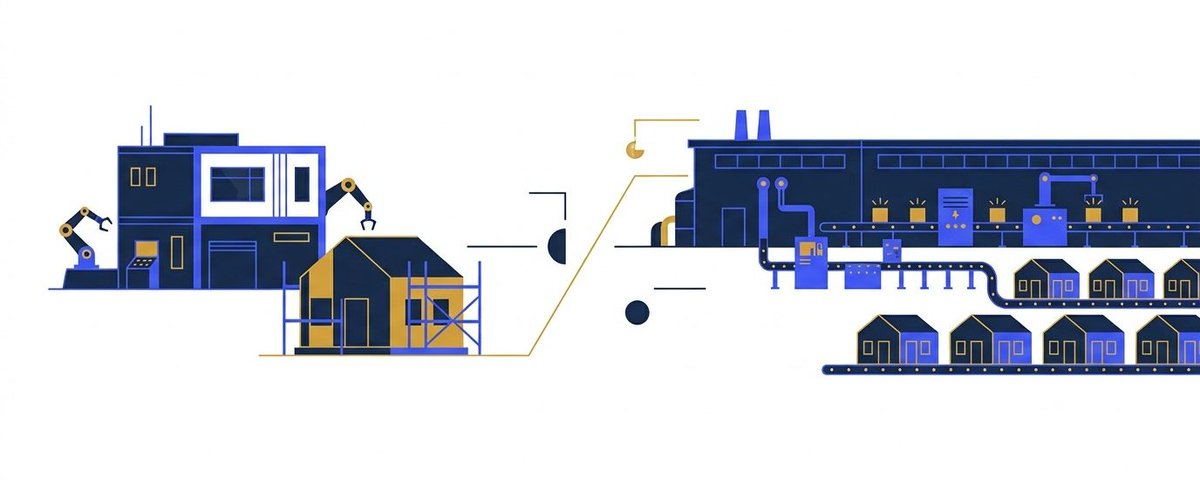
A shippable microfactory is an attempt to try something new in prefab.
Instead of shipping bulky wall panels from a distant plant, you ship the factory itself and do construction on-site. The factory is located on or near the job site, so transport costs for finished components drop to nearly zero. And when the project ends, the factory moves to the next one or the next builder. Need 50 homes? Deploy one unit. Need 500? Deploy a fleet. Capacity matches the pipeline, not the other way around.
Seems promising enough, right?
A few companies are running with this concept.
@GillesRetsin and AUAR sell structural framing capacity. They ship a containerized robotic cell to your jobsite, integrate with your design process, and fabricate a full home's structural shell in under 8 hours (roughly 80% less framing labor than a manual crew). The builder never owns the factory. AUAR owns and deploys it, and the builder pays per unit of output. CapEx goes to literal zero.
@AGampel1 and Cuby Technologies are doing shippable microfactories but taking a full vertical integration approach. They JV with a developer and deploy a ~$10M microfactory that produces a complete kit of parts, foundation through finishes. Their first US factory is launching in Nevada tied to a 3000+ home pipeline.
(the 3DP companies are also an example of this, shipping printers to jobsites, but we'll leave them in a separate category for now)


Nobody’s waiting for the grid to catch up.
25% of new data center capacity is now behind-the-meter.
56% of developers are exploring on-site generation.
BTM isn’t a workaround anymore. It’s the strategy.
54
2,600 GW sitting in the U.S. interconnection backlog.
Median wait: 5 years.
Withdrawal rate: 77%.
We keep talking about compute capacity.
The real constraint is the substation.
40
The U.S. grid interconnection queue has a 13% survival rate.
Same odds as a startup making it from pre-seed to seed.
Except these aren’t bad ideas. They’re shovel-ready projects. Just stuck in line for up to 12 years.
53
We just published the second interview in our Echoes of Future Matter series — this time with Oluseun Taiwo (@big_seun_) of Solideon (@solideonusa).
A deep dive into robotic learning, material intelligence, and why architecture tools are reshaping aerospace. 🧵
1
47