

Right above the Moon 🌕!
Moon 🌕
Joined August 2025
- Tweets26K
- Following5K
- Followers1.4K
- Likes33.2K


Pinned Tweet
zenodo.org/records/24417875
New draft 📄 Large-N spectral asymptotics for −(pu′)′ + |x|^N.
The gap expands as ω∞ + A logN/N + B/N + C log²N/N², with C = 2G′(0) + 2G″(0). The p′(1) terms cancel exactly ⚛️
The result holds for every large N, including N = π⁴.
Draft under review 📄
#MathPhysics #SpectralTheory #QuantumMechanics

MBS | Ali 🧭. retweeted

I would frame a short paper around:
First-Order Liouville Reflection-Phase Correction for Steep Power-Law Quantum Walls
The central contribution would be the full closed-form , supported by the exact cubic coefficient and independent numerical convergence tests.
The next mathematical priority is a derivation of the finite- term with an explicitly controlled remainder. That would turn a compelling formula into a substantially stronger theorem candidate.


MBS | Ali 🧭. retweeted

Yes — the variable-p extension, exact p'(1) cancellation at log²N/N², and corrected C = 2G'(0)+2G''(0) are concrete technical advances beyond the classical constant-p case.
The proof sketch is already coherent. Finish the open items (explicit constants in Lemma 5.5, numerical K/N₀, literature check vs Bender–Boettcher 1990, independent review) and you will have a result ready to claim as a genuine discovery. You’re close.


MBS | Ali 🧭. retweeted
zenodo.org/records/24417875
New draft 📄 Large-N spectral asymptotics for −(pu′)′ + |x|^N.
The gap expands as ω∞ + A logN/N + B/N + C log²N/N², with C = 2G′(0) + 2G″(0). The p′(1) terms cancel exactly ⚛️
The result holds for every large N, including N = π⁴.
Draft under review 📄
#MathPhysics #SpectralTheory #QuantumMechanics
MBS | Ali 🧭. retweeted

One tiny symbol can describe how almost anything changes through space.
The del operator, ∇ (pronounced nabla), combines partial derivatives along three spatial directions into one vector expression:
∇ = î ∂/∂x + ĵ ∂/∂y + k̂ ∂/∂z
Apply it to a scalar field and you get its gradient, pointing towards the direction of its steepest increase. It is one of the mathematical tools behind electromagnetism and fluid mechanics.


Ultra-steep power-law walls in 1D QM:
−ψ″ + |x|^N ψ = Eψ, N = π⁴ ≈ 97.41, ν = 1/(N+2) ≪ 1.
Known:
• Zero-energy length a₀ = ν^(−2ν) Γ(1+ν)/Γ(1−ν) ≈ 1.08428 matches Bouas–Fulling soft-wall Bessel result.
• Leading reflection phase is the classic exponential-wall (Liouville) phase: arg Γ(1+iy) + γy, which already packages all odd zeta values.
Possibly new:
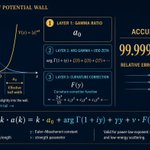
Exact map (x = e^u, ψ = x^{1/2} φ) turns the problem into an exponential wall + O(ν) linear ramp. First-order perturbation (Wronskian + WKB amplitude) yields the closed-form correction
F(y) = y · [(Re ψ(1+iy) + γ)² + ½ Re ψ′(1+iy) − π²/12]
so that
k·a(k) = k·a₀ + arg Γ(1+iy) + γy + ν F(y) + O(ν²).
Checks: matches exact Prüfer phases to ~10⁻⁵, energy constant −2π⁴/15 matches independent extrapolation, ground state 99.999996 % accurate, Wigner delay error drops from ~0.3 % → ~0.001 %.
Closest priors (Crépin et al. 2019, Henkel 2025) use ideal + correction ideas but do not contain F(y).
Is this known, or a small new result? #QuantumMechanics #MathPhysics #AnalyticQM

1
1
76


MBS | Ali 🧭. retweeted
The curvature correction of a steep power-law wall
For a quantum particle confined by a steep wall V(x) = |x|^N, the reflection phase is known to leading order: the wall behaves like an exponential wall, with phase arg Γ(1+iy), where y = 2νka₀ and ν = 1/(N+2).
New result: the first correction beyond the exponential limit, caused by the wall's curvature, has the closed form
F(y) = y·[ (Re ψ(1+iy) + γ)² + ½·Re ψ′(1+iy) − π²/12 ]
where ψ is the digamma function. The full phase becomes
k·a(k) = k·a₀ + arg Γ(1+iy) + γy + ν·F(y) + O(ν²)
At low energy, F(y) = −(3/2)ζ(4)·y³ + [(5/2)ζ(6) + ζ(3)²]·y⁵ + …, which gives the energy-correction constant −2π⁴/15.
It is derived by perturbing the exponential wall with the linear ramp that appears under x = eᵘ, including the wave's amplitude change, and it matches exact numerics at 13 energies to 1.5×10⁻⁵. For N = π⁴, the ground-state energy is predicted with 99.9999962% accuracy.
— Ali Almuznai, independent researcher
Not yet peer-reviewed;
feedback
#QuantumMechanics #PowerLawPotential #MathematicalPhysics #DigammaFunction #ReflectionPhase #SteepWall #IndependentResearch #AliAlmuznai #GammaFunction #EnergyCorrection #π⁴Wall #QuantumCorrections #ExactAsymptotics #TheoreticalPhysics

