







$ASTS
Doubt it'll help the stock price, but at this point I'll try anything. 😂
Neither Republicans nor Democrats can be happy with these tantrums. Everybody is losing $$$.
He's either long puts, trying to fight the Fed by crashing the market so they can't raise rates in December, or both.
And fighting the Fed this way might actually work. Lower energy and copper prices could eventually filter through into the inflation data, giving the Fed even less reason to hike.
After that, he'll eat his TACOs, get his pacifier, play with his favorite BlackLift rocket and take a nice long nap.
Mission accomplished. No rate hikes. No new tariffs. 🍼🌮

4
413
$ASTS
MOMENTUM FACTOR IS UNFORTUNATELY NOT HELPING IN THE INTERMEDIATE TERM IF STOCK PRICE RECOVERS.
One factor that explained the persistent selling pressure in $ASTS over recent months is the deterioration in its momentum factor.
Institutional momentum strategies don't necessarily care about fundamentals, valuations, or future catalysts. They care about relative price performance.
One proxy measure is 12–1 month momentum: the stock's return over the previous 12 months, excluding the most recent month.
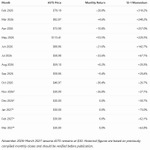
Look at the table to see how ASTS's momentum has deteriorated.
Here's what stands out.
ASTS's momentum peaked above +300% in February. By August, it had collapsed to approximately +20%. By October, it was negative.
That deterioration potentially created systematic selling pressure as long-only momentum strategies reduced exposure, while some long-short strategies may have begun treating $ASTS as a short candidate.
But here's the more important part.
Even if ASTS stabilizes at $30 through March 2027, its 12–1 momentum could deteriorate to −73% by January
Why?
Because the calculation is backward-looking.
The exceptionally strong prices from early 2026 remain in the comparison window.
And even if $ASTS begins recovering, the most recent month's performance is excluded from the standard 12–1 calculation.
This means the stock can stabilize, or even rally, while its intermediate-term momentum remains deeply negative.
Institutional momentum funds generally rebalance monthly, quarterly, or semiannually, depending on their methodology. Consequently, renewed buying from these strategies may lag a recovery in the share price.
My interpretation:
Part of the selling pressure in ASTS was systematic rather than fundamentally driven.
And importantly, a bottom in the share price does not automatically mean the return of institutional momentum buying.
The fundamentals can improve. The stock can stabilize. The price can even recover.
But the momentum factor may take considerably longer to catch up.

$ASTS
The Macro Setup for 2027
In my previous post, The Perfect Storm for ASTS, I explained why I believe ASTS is well positioned heading into 2027, provided the macro environment stabilizes.
Here, I want to explain why I think that stabilization could be closer than many investors expect.
Before getting into the macro picture, there's another important consideration: the composition of ASTS's investor base may have changed significantly.
After months of relentless selling pressure, leveraged and short-term investors have likely been forced to reduce or exit positions. Those still holding may increasingly represent investors with longer investment horizons and stronger conviction in the underlying business.
That doesn't mean all leverage has disappeared or that selling pressure is exhausted. But if much of the speculative positioning has already been unwound, ASTS could be starting from a healthier foundation.
And that matters when the tide eventually turns.
1. The market has entered an extreme risk-off environment
Look beyond ASTS.
Recent market commentary suggests that investors have reduced technology exposure at one of the fastest rates in more than two decades. Meanwhile, quality stocks have reportedly experienced one of their strongest relative runs over a comparable period.
To me, this looks increasingly like a market positioning for an economic slowdown.
Investors have moved away from long-duration growth, high-beta names and companies whose valuations depend heavily on future earnings.
They're moving toward established businesses, visible cash flows and perceived safety.
In other words, the market is increasingly trading as though a recession is coming.
And ASTS is almost the perfect example of what investors currently don't want to own: a capital-intensive, high-growth company with enormous potential, but with much of its expected cash flow still in the future.
That doesn't mean the market is right about ASTS. It means ASTS is particularly vulnerable to the current positioning environment.
We've seen extraordinary declines across many growth companies, including businesses operating in completely different industries.
That tells me something important.
This isn't just about individual companies disappointing investors. It's also about investors no longer wanting to own a particular type of risk.
And when positioning becomes this one-sided, the eventual reversal can be powerful.
2. The Fed may be the final catalyst for another leg lower
The December Federal Reserve meeting is approaching, and the market is still wrestling with the direction of monetary policy.
I believe that investors are positioning defensively ahead of the meeting and can envision another 5% decline in SPY and QQQ heading into the Fed meeting.
Not because I necessarily expect a severe recession, but because positioning, uncertainty and momentum can push markets beyond what the underlying fundamentals justify.
And we shouldn't underestimate tax-loss harvesting.
After the extraordinary declines across speculative growth stocks, year-end selling can reinforce an already weak market.
Investors who have been waiting to realize losses may be adding to the pressure, while potential buyers have little incentive to rush in before the selling subsides.
But the important question isn't necessarily how much further we can fall.
It's what happens after the selling pressure begins to exhaust itself.
3. Energy prices may be telling a very different inflation story
This is where things get interesting.
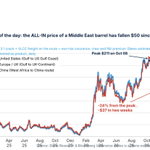
Look at the accompanying chart from Stano Research and Bloomberg showing the estimated all-in delivered cost of Middle Eastern crude oil.
The all-in price peaked around $211 per barrel on October 8 and subsequently declined toward $160.
That's a roughly $50 decline in little more than a month.
And according to the chart, approximately $37 of that decline occurred within two weeks.
That's substantial.
Of course, the delivered cost of crude oil isn't the same thing as the gasoline prices consumers pay or the energy component of CPI. Freight, insurance and geopolitical risk premiums can reverse quickly.
But the direction matters.
If lower crude and refined-product costs persist and flow through to consumer energy prices, they could contribute to lower headline inflation in the coming months.
Core inflation, wages and services prices will still matter enormously to the Fed. Lower energy prices alone won't determine monetary policy.
Nevertheless, the potential disinflationary impulse shouldn't be ignored.
That raises an interesting possibility:
What if the market is positioning for an inflation problem just as some of the underlying inflation pressures are beginning to ease?
By early 2027, the inflation picture could look materially different.
And if that reduces the need for additional Fed tightening, or eventually opens the door to a less restrictive policy stance, the market could begin reassessing its recession expectations.
The irony would be that investors spent the final months of 2026 pricing in deteriorating conditions just as some of the pressures driving those concerns were beginning to reverse.
4. The setup I'm watching: one final selloff, then a rotation
If the market continues selling off from here, I see two possible paths.
Scenario A: Another 5% decline into the Fed meeting, followed by a year-end reversal
This is my preferred scenario if the market continues lower.
The market keeps selling into the December Fed meeting. Positioning becomes even more defensive, tax-loss selling accelerates, and sentiment deteriorates further.
Then, as inflation expectations improve and the Fed meeting passes, investors begin looking ahead to 2027.
The market starts rotating out of crowded defensive and quality trades and back toward growth opportunities that have already experienced severe valuation compression.
A Santa Claus rally could become the beginning of a broader recovery.
Importantly, this wouldn't necessarily require an immediate return to aggressive monetary easing.
Sometimes all the market needs is for the outlook to stop getting worse.
If investors become convinced that inflation is moving in the right direction and that additional tightening is becoming less likely, the willingness to own risk could improve substantially.
And after such an extreme rotation away from growth, even a modest change in positioning could have an outsized impact.
Scenario B: The selloff accelerates into a different regime
If SPY and QQQ break down decisively and economic concerns intensify, we may be dealing with something more serious than a normal correction.
In that scenario, I would watch QQQ's 200-week moving average, currently around the 500 area on my chart.
That would imply approximately a 23% downside from the reference level I'm using.
That's not my base case, but it's a risk I wouldn't ignore.
The distinction is important.
A final positioning-driven selloff is very different from a sustained deterioration in the economic outlook.
In the second scenario, ASTS would likely remain under considerable pressure regardless of its company-specific progress.
High-growth companies with substantial future capital requirements are particularly vulnerable when liquidity tightens and investors become increasingly risk-averse.
Macro matters, even when the long-term business thesis remains intact.
5. Why the timing could be particularly favorable for ASTS
This is where the macro picture and the company-specific story potentially come together.
Imagine the following sequence.
The broader market sells off further into December.
Growth-stock positioning becomes even more depressed. Investors become increasingly unwilling to look beyond near-term uncertainty.
Tax-loss harvesting adds to the pressure.
Then the Fed meeting passes.
Energy-driven inflation pressures begin showing up more clearly in subsequent economic data.
The market starts looking ahead rather than backward.
And at roughly the same time, ASTS potentially begins delivering a series of tangible milestones:
- Additional BlueBird satellite shipments.
- More confirmed launch dates and successful deployments.
- Progress toward commercial service and beta testing.
- Potential developments involving T-Mobile and other MNO partners.
- Further government and sovereign opportunities.
Suddenly, ASTS could benefit from three forces at once.
First, a broader market rotation back toward high-growth opportunities.
After an extended period of defensive positioning, investors begin looking for companies with substantial long-term growth potential.
Second, company-specific execution milestones that reduce uncertainty.
Every successful launch, deployment, commercial test and operational milestone provides additional evidence that ASTS is progressing toward its business objectives.
Third, a potentially healthier investor base.
If much of the forced deleveraging and speculative selling has already occurred, incremental demand may encounter less selling pressure than it did during the downturn.
That's a potentially powerful combination.
And importantly, it would be a very different setup from a stock rising purely on enthusiasm or speculation.
It would be a potential recovery supported by improving market conditions, measurable business progress and a change in investor positioning.
None of those developments is guaranteed, and the timing may not align perfectly.
But I think the possibility deserves serious consideration.
6. Final thoughts
I don't know whether we've seen the bottom in ASTS or the broader market.
And I wouldn't be surprised if the market inflicts more pain before the December Fed meeting.
But as I mentioned before I believe we're approaching an interesting potential inflection point.
The market has spent months reducing exposure to risk, rotating into perceived safety and discounting future growth.
Meanwhile, ASTS has an opportunity to enter 2027 with a more committed investor base and a series of tangible operational catalysts ahead.
If inflation pressures ease, the Fed becomes less restrictive and capital starts rotating back toward growth, ASTS could benefit from a powerful combination of improving market sentiment and company-specific execution.
Of course, none of this works as envisioned if the economy deteriorates substantially or ASTS fails to deliver on its operational milestones.
Those risks are real.
But that's the distinction I'm making.
The market is focused on the risks of the next few months. I'm focused on the opportunities of the next several years.
And if the macro environment finally turns while ASTS begins delivering on its promises, the recovery could be just as powerful as the selloff has been painful.

4
31
3,926
$ASTS
Market will always find maximum pain level, and then some more.
1
15
1,146


Trading algos are having a busy day:
- Jensen willing to come to the rescue again.
- Rumors of a potential cyberattack at the NSA.
- Inflation pressures easing as crude oil and gasoline -crack spreads collapse since October.
- And the rotation into supposedly “quality” stocks seems to have run its course (basically pricing recession).
AI fears, geopolitical uncertainty, macro headlines, momentum unwinds, and sector rotations. Every narrative gets traded, amplified, and replaced by the next one.
So what now?
At some point, the market runs out of reasons to sell what everyone has already sold, and out of buyers for what everyone has already bought.
It's either sell everything or it's rotation back into opportunity.

BARCLAYS:
The shift to “quality” stocks is now “better than anything witnessed during 2021 or 2022, or even ‘mild’ recessionary periods .. You have to basically go back to deep economic contractions in 2008 or 2020 to find runs that extended longer than today in the near term.”

2
268
Reading a lot about how $ASTS is trading at these levels and how it's supposedly all management's fault.
Missing guidance deserves criticism. BUT missing a timeline and failing to build a business are two very different things.
The value of a company ultimately depends on what it builds and the economics it achieves, not simply how accurately its CEO predicted the timeline.
My view? A substantial majority of this decline, perhaps as much as 75%, is driven by capital flows and broader market forces rather than deteriorating ASTS fundamentals or missed guidance.
See my earlier post: "THE PERFECT STORM FOR ASTS."
1
46
2,355
$ASTS
THE PERFECT STORM FOR ASTS (AND THE SPACE/GROWTH SECTOR). BUT...
I've been thinking about the extraordinary selling pressure in ASTS. Several factors have converged to create what I believe is a perfect storm.
1. Blue Origin pad explosion (May 28)
Increased uncertainty around New Glenn launch capacity and ASTS's satellite deployment timeline.
2. SpaceX IPO (June 12)
Before SPCX went public, investors looking for exposure to the space economy had limited choices. Arguably, ASTS and RKLB together offered one of the closest publicly traded alternatives to SpaceX.
Suddenly, investors could buy SpaceX directly. The scarcity premium may have diminished, and capital had a new destination.
3. AI continues to absorb capital
AI has attracted enormous investment flows, competing with space and other emerging growth sectors for capital.
4. Growth stocks underperform the broader market amid a more restrictive interest-rate outlook
My analysis of IWF (Growth ETF) versus SPY shows significant deterioration in growth stocks relative to the broader market. (See charts.)
More importantly, ASTS's correlation with this growth factor has increased substantially, suggesting broader market forces are playing an increasingly important role in its price action.
5. Short interest increases significantly
ASTS short interest rose from approximately 52.4M shares in mid-May to 67.5M by late October, an increase of nearly 29%.
Not all of this represents outright bearish positioning, but it adds another dimension to the supply-demand imbalance.
6. Positioning amplifies the decline
Leveraged investors, momentum strategies, ETF rebalancing, and potential tax-loss selling can create additional pressure as prices fall.
7. Further SpaceX launch delays
Additional SpaceX launch delays and uncertainty surrounding available launch capacity have reinforced concerns about ASTS's deployment schedule and the timing of commercial revenues.
8. Institutional buyers aren't yet ready to absorb the selling
This may be the most overlooked factor.
Despite its substantial market capitalization, ASTS is still transitioning from development to commercial operations.
Many institutional investors remain constrained by investment mandates, risk limits, and the absence of established recurring revenues and proven unit economics.
Even those who believe in the long-term opportunity may not yet be willing to allocate meaningful additional capital.
My estimate is that roughly 20 million shares have been involved in ownership rotation since the decline began and may still need to find a stable, long-term home.
With many potential institutional buyers waiting for commercial validation, the imbalance between available supply and committed long-term demand could be substantial.
And when natural buyers are limited, the impact of selling can become disproportionate.
BUT... HERE'S WHERE IT GETS INTERESTING.
I believe this entire dynamic could change remarkably quickly as we move into Q1 2027.
What distinguishes ASTS from many other high-growth companies is the potentially enormous unlocking of value that lies immediately ahead.
Years of technological development, spectrum access, MNO partnerships, manufacturing investment, and infrastructure preparation have brought the company to the doorstep of commercial service.
We can see the promised land (launch agreements covering 100+ BlueBirds secured).
The question is no longer simply whether the technology can work. It's increasingly about how quickly ASTS can deploy enough BlueBirds, scale commercial operations, and demonstrate the economics of its business model.
Securing launch capacity for more than 100 satellites is an important achievement. But successful deployment, commercial activation, and ultimately recurring revenues are the milestones that will unlock that potential.
Every additional satellite successfully deployed brings the company closer to a more predictable operating and revenue profile.
And the commercial ecosystem continues to expand.
The potential addition of T-Mobile and Deutsche Telekom is particularly interesting.
Beyond the existing relationships with AT&T, Verizon, Vodafone, Rakuten, and numerous other MNOs, these operators could further expand ASTS's addressable subscriber base and strengthen its position as a global direct-to-device infrastructure provider.
More importantly, the strategic significance goes beyond the number of subscribers.
As additional major MNOs embrace ASTS's technology, the commercial opportunity becomes broader, the potential revenue base more diversified, and the business model increasingly credible.
The transition from signing partnerships to activating commercial services is where that potential begins to translate into actual revenue.
And that matters enormously for institutional investors.
The very investors who may be reluctant to allocate significant capital today could become much more comfortable as commercial service begins, recurring revenues become visible, and execution risk declines.
And then there's the possibility of additional strategic investors.
META is particularly interesting.
Meta representatives have visited ASTS, and Abel hinted at another 3 billion devices during the BlackLift presentation.
Google is already a strategic investor in ASTS.
Could Meta eventually follow a similar path?
Nothing has been announced, and a commercial relationship doesn't automatically translate into an equity investment. But the strategic rationale is certainly worth considering.
A Meta investment, if it materialized, could provide much more than additional capital. It could expand ASTS's commercial ecosystem and potentially accelerate broader institutional interest.
That's when the shareholder base could begin to change and re-ratings happen.
From investors financing a development-stage opportunity to institutions investing in an emerging commercial business.
And this is where I see the potential asymmetry in future capital flows.
The selling pressures have been building for months, while the commercial milestones that could attract an entirely new class of institutional investors are still ahead of us.
If ASTS successfully transitions into commercial operations, it won't simply be a question of existing shareholders becoming more optimistic.
An entirely new pool of institutional capital could begin considering the company investable.
And that potential change in the shareholder base could be just as important for the stock as the commercial revenue itself.
If the macroeconomic environment stabilizes, the combination of improving fundamentals, expanding MNO relationships, growing institutional demand, potential strategic investment, and reversing capital flows could be powerful.
I'm not suggesting everything will happen overnight or that execution risks have disappeared.
But I do believe ASTS is approaching an inflection point unlike that of many other growth companies.
The same stock that has suffered from a perfect storm of selling pressure could eventually benefit from a perfect storm of improving fundamentals and expanding investor demand.


$ASTS
(Playing around with some numbers, trying to make sense of it all)
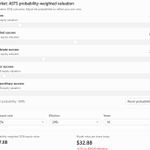
Based on a simple probability-weighted valuation model, I arrive at a fair value of approximately $87 per share today. (My "conservative" assumptions: ASTS probability-weighted valuation)
My assumptions:
1. 2036 probability-weighted equity valuation: ~$126 billion
2. Time horizon: 10 years
3. Discount rate: 12%
4.Additional share dilution: 20%
This incorporates a range of outcomes, from failure to extraordinary success, each assigned its own probability.
The result? ~$87 per share today, versus ~$34.50 in the market.
Of course, the valuation is only as good as the assumptions and probabilities behind it.
But I believe the market is significantly underestimating the probability of ASTS becoming a major global connectivity player. (Market: ASTS probability-weighted valuation table)
The opportunity is enormous. The risks are real. The asymmetry is what makes it interesting.


2
8
1,201
$ASTS
MY BIGGEST PRESENTATION TAKEAWAYS 🚀
1. THE TRILLION-DOLLAR OPPORTUNITY
Finally, Abel is talking about trillions of dollars when describing the addressable opportunity. This is the scale of the vision I've wanted management to communicate.
2. THE META REFERENCE
Particularly interesting. Another potential way to reach 3 billion customers beyond the traditional MNO model. The implications could be enormous.
3. GOVERNMENT
Huge opportunity, not just in terms of potential revenues, but also strategic importance, funding and government support.
4. LAUNCH CAPACITY
I believe management overestimated future third-party launch availability and is now adapting. Part of the reason may be that they didn't anticipate the explosive growth in demand for their own satellites as well as others that need launching.
5. BLACKLIFT: THE OPPORTUNITY AND THE RISK
BlackLift could ultimately become one of AST's greatest competitive advantages, dramatically reducing launch costs while giving the company control over deployment schedules.
But there's a paradox.
The very thing that could make ASTS almost impossible to compete with could also become its biggest vulnerability if execution falls short.
I'm more excited about the long-term opportunity than ever, but I'm also increasingly convinced that BlackLift execution is now one of the most important variables in the entire investment thesis.
With 100+ satellites covered by existing launch agreements, AST has a potential path toward global commercial service without BlackLift.
But to capture a meaningful share of that trillion-dollar opportunity, expand and continuously replenish a much larger constellation, independent, reliable and cost-efficient launch capacity is essential.
That's why BlackLift matters so much.
Let's go, BlackLift! 🚀
1
21
1,544
$ASTS
DAVID VS. GOLIATH 🚀
The CEO of $ASTS, Starlink Mobile's biggest technological competitor and one of the most strategically important partners for mobile network operators worldwide, comes to NYC to tell his story.
A company potentially reshaping the future of global connectivity.
And CNBC gives Abel a 5:00 AM slot when this story arguably deserves prime-time coverage.
Then even that gets canceled.
Think about that.
At least we are done waiting and taking control where we can. Abel talked about the gigantic opportunity that's there right in front of us. It's pretty clear that BlackLift has to be a success and with production sorted out this is now their number one priority. Let's go BlackLift!!
Btw I have enormous respect for what Elon has achieved, but he's not going to help AST succeed. With DPAS he's forced to launch us faster than he would have liked.

1
16
959
$ASTS
Did Abel just say having access to 3bln devices PLUS another 3 bln? META?
8
572
$ASTS
It seems Jensen's rocket has managed multiple launches in rapid succession across different parts of the world. 🚀
What kind of DPAS priority rating does this guy have?
Poor Abel can't even get through a BlackLift presentation without another launch stealing the spotlight. 😂
9
1,352
1/n
$ASTS
COMMUNICATION MATTERS, CONNECTIVITY EVEN MORE
I wrote this thread a couple of weeks ago, but it’s relevant for tomorrow I think.
I hope Abel takes the opportunity tomorrow to not only talk about BlackLift, but clearly articulates the size of the opportunity they are building toward, and that this message is heard loud and clear also by the MNO's. (This is also why I invested in AST.)
Because there is a striking difference between how Elon Musk communicates the future of connectivity and how U.S. MNO CEOs communicate satellite D2D.
The MNOs aren't dismissing D2D.
THE PROBLEM IS THAT THE OVERALL MESSAGE IS MUDDLED AT BEST.
2
7
782
9/n
And if we're talking about billions of additional intelligent endpoints, simply reaching them isn't enough.
CAPACITY MATTERS.
AST's spectrum strategy combines partner MNO spectrum with MSS spectrum, targeting ~100 MHz of spectrum access in the U.S. and 60+ MHz globally on a market-by-market basis.
Why is that important?
Because the opportunity could evolve from: “Can I get a signal here?”
to: “Can the network support billions of connected people + machines?”
COVERAGE SOLVES GEOGRAPHY. CAPACITY SOLVES SCALE.
AST's own 2026 materials already identify additional applications including IoT and AI edge compute. The pieces of a much larger TAM are starting to appear.
1
47
10/10
Now put it together.
AST doesn't need to own: The AI model. The cloud. The robot. The autonomous vehicle. The terrestrial network. Or even the end customer.
It just needs to become: THE SPACE-BASED CONNECTIVITY LAYER BETWEEN THEM.
And this brings me back to where I started.
I THINK THIS MESSAGE SHOULD BE COMMUNICATED LOUD AND CLEAR
(And tomorrow is a great platform)
Not simply: “We can eliminate dead zones.”
But: “WE ARE BUILDING THE CONNECTIVITY LAYER THAT CAN EXTEND THE EXISTING MOBILE NETWORK INTO A WORLD OF BILLIONS OF PEOPLE + INTELLIGENT MACHINES.”
That's a very different message. And potentially a very different TAM.
Because the question isn't simply: How many people live outside terrestrial coverage?
The bigger question is: HOW MANY PEOPLE + MACHINES NEED CONNECTIVITY EVERYWHERE?
2
41