

The leading ancient Indus civilization (3500-1700 BCE) website since 1995.
San Francisco
Joined June 2009
- Tweets2K
- Following98
- Followers8.4K
- Likes1.4K






"We must remember that cultures do not get shaped in isolation. Every culture is partially shaped by the other cultures it encounters and what it imbibes from them, and how it responds to the initially unfamiliar. We in our histories have tended to focus on just one identity, but in effect we have to look at migrations, contacts, interactions-both complementary and hostile. We have to be ready to concede where another may have helped shape us, even if we wish that this did not happen. We have to be willing to grant that there was often a mutually beneficial exchange of ideas," says Dr. Romila Thapar (p. 180), in this succinct, engaging conversation with writer Namit Aurora.
Speaking of History by Romila Thapar and Namit Arora deals with so many of the important and controversial issues being debated today about Indian's history. This simple paragraph is as good a summary of the intelligent and sophisticated approach to history that is a hallmark of Dr. Thapar's career. While the ancient Indus civilization is not mentioned much, it is also provides a fine lens through which we should try and understand that civilization: not merely as a monolithic, solely indigenous civilization or culture ("one identity'), but a multi-faceted, changing, complex one with pieces in conversation with another just like cultures today. And one that developed in relationship both to other cultures around it (to the west, east and north), and the various cultures (Amri, Kulli, Ahar Banas, etc.) within and next to it. Much harder to fathom than simplifications.
So many controversies are dealt with calmly in the back and forth format, from India-Aryan migration, to Buddhist, Muslim and other phases, being a "Marxist historian," and the way that British colonial history infects modern Indian history and politics all too much. Having grown of age during this transition from colonial rule, Dr. Thapar is well able to articulate a continuing malady. Arora's questions (see his recommended video Indians - A Brief History of a Civilization: Ep 1 - The Harappans) and explanations are those of a well-informed interlocutor.
Cont. at harappa.com/content/speaking…

Do the many female figurines at Indus sites justify the belief that the worship of a "mother Goddess" was prevalent then? One of India's most distinguished archaeologists, the late Dr. Shereen Ratnagar (1944-2026), offers a contrary viewpoint in this deeply informed, multi-faceted analysis of these figurines. She starts by noting that they are not nearly as prevalent as people may assume, but rather "as the exclusive–or near-exclusive–product of the activities of just two cities, Harappa and Mohenjo-daro" (p. 19). She also considers the important point made by Sharri R. Clark in her recent book The Social Lives of Figurines – Recontextualizing the Third–Millennium–BC Terracotta Figurines from Harappa that there is no solid evidence –other than preconceptions– that Indus female figurines are thought of as "Mother Goddesses," and picks up the thread of others who have also suggested more prosaic uses for these figurines. Ratnagar regards this labelling of objects as "cultic" objects [e.g. "Mother Goddesses"] as "a simplistic solution to the complex task of archaeological interpretation" (p. 9).
Review continued at harappa.com/content/magic-im…

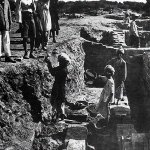
One of the least appreciated things in ancient Indus archaeology is the fine photography done by early expeditions and their unknown Indian photographers. This is from Daya Ram Sahni's early Harappa excavations, before we really knew about the ancient Indus civilization. Note how perfectly the lines and trench is arranged, the bricks in the foreground across the (much later) mosque remnant in the top right, the tree on the top left asserting balance to the entire image. From our 49 slide series from 1923-24: Unearthing the Mysteries of Harappa: harappa.com/category/slide-y…

Indus Cylinder Seals. "The cylinder seals of Mesopotamia constitute her most original art," wrote the scholar Henri Frankfort, and much the same has been said about the very different square stamp seals used by the ancient Indus civilization. Cylinder seals are "small, barrel-shaped stone object[s] with a hole down the center, rolled on clay when soft to indicate ownership or to authenticate a document . . . used chiefly in Mesopotamia from the late 4th to the 1st millennium BCE." Many of the handful of cylinder seals found at ancient Indus sites, or Mesopotamian ones with ancient Indus themes are collected below.
1. Impression of a Harappan cylinder seal from Kalibangan (K-65). "Two warriors, distinguished by the hair worn in a divided bun at the back of the head, are spearing each other, while they are both being held by the hand by a goddess wearing a head-dress with a long pendant (comparable to the ones decorated with cowry shells and turquoise that are worn by the women of Ladakh and Chitral), bangles on the arms, and a skirt. Next to the combat scene (where space appears to have prevented the depiction of those details), her body merges with that of the tiger (later the Hindu goddess of war) and her head-dress is elaborated with animal horns and a tree branch," writes Asko Parpola in Deciphering the Indus Script, p. 253.
Cont. at harappa.com/blog/indus-cylin…


Excavations at Chanhu-daro 1935-36 by Ernest Mackay. We re-publish this report from the Annual Report of the Smithsonian Institution, 1937 by the Field Director at the site and previously major excavator at Mohenjo-daro. With all Plates and close-ups from the article.
EXCAVATIONS AT CHANHU-DARO BY THE AMERICAN SCHOOL OF INDIC AND IRANIAN STUDIES AND THE MUSEUM OF FINE ARTS, BOSTON:SEASON 1935-361
By ERNEST MACKAY, Field Director
The Museum of Fine Arts, Boston, now possesses a remarkable and widely representative collection of objects from the ancient Indus Valley, the only such collection outside India. Not only is the culture of Harappa and Mohenjo-daro well represented at Chanhu-daro in the Nawabshah District of Sind (Fig. 1 [map]), the site at which this collection was unearthed, but there were also found the seal-amulets and pottery of a people who occupied the site fairly soon after it had been deserted by the Harappa people, objects which it will be seen differ radically from those left by their predecessors.
The mounds of Chanhu-daro were selected for the preliminary investigations of the first American archeological expedition to India on account of important finds made there during a survey of the ancient sites of Sind by the Archeological Department of the Government of India in the winter season 1929-30. Mr. N. G. Majumdar, who dug three trial trenches there, showed that Chanhu-daro had been occupied by the same race that built the cities of Mohenjo-daro and Harappa some 5,000 years ago. He also found some slight evidence of the presence of a later civilization which can now be named the “Jhukar culture”, in accordance with the convenient practice in Egypt and Mesopotamia of naming a culture after the site where traces of it were first found. The so-called Indus Valley civilization should be renamed the“Harappa culture”, for further excavations in the great river valley will undoubtedly reveal the remains of yet other ancient cultures.
Chanhu-daro is some 12 miles east of the present bed of the Indus, about 80 miles SSE. of Mohenjo-daro. Its three mounds comprise an area of 9 acres, but the little city was considerably more extensive in ancient times and the alluvium deposited in the course of 5,000 years or more now covers the lower parts of the mounds. Mound I is 22.2 feet high, and some 1,500 square feet in area, and the rather larger Mound II, 23.5 feet high and about 3,850 square feet in extent, is separated from it to the NE. by a gap some 150 feet wide. (pl.1) During the period of the Harappa culture, Mounds I and II were one, through which a devastating flood ultimately cut its way, bringing to a close the longest and most important chapter of the history of the little city. Mound II was reoccupied later for two brief periods, as we shall shortly see. The third mound (III), which stands a few feet high and is only some 500 square feet in extent, lies close to the NW. of Mound II, of which it is certain that it once formed a part; the rainstorms which have separated this little mound from its neighbor have left their marks as deep furrows and ravines which scar the sides of all three mounds.
As Mound II was the largest and highest mound and therefore likely to contain the most interesting material, it was selected for our principal excavations. Its upper portion was systematically removed, layer by layer, the debris being dumped on ground that had already been examined by means of trenching. On the summit of the mound were one or two graves of early Muhammedan date. Below these very late remains, a few pieces were found, mostly intact, of a very interesting dark gray, polished, hand-made ware with incised geometric decoration (pl. 2, fig. 1). The exact date of this ware is at present a matter of surmise, but in shape and technique it is entirely dlifferent from anything produced by the two cultures whose remains we found beneath it. I am inclined to think that this gray, hand-made pottery was made by a primitive people who were the last to occupy the site and that only very briefly and in small numbers – and who may have been a race allied to the Bhils, of whom there is a settlement close to Chanhu-daro; these Bhils, however, have lost most of their ancient customs and primitive way of living.
Cont. at harappa.com/content/excavati…


HARAPPA God's City of Civilisation, written by Kancha Ilaiah Shepherd and illustrated by Priti Gulati Cox is an imaginative, beautifully illustrated, and ethically motivated fiction about what life in ancient times may have been like. Written by a leading social justice activist and intellectual tied to Dalit-Bahujan politics, the story frames the Indus civilization as the work of pastoralists and producing groups. Its descriptions of how innovations came about, by accident or cleverness, and then spread from village to village are a persuasive way of imagining how societies, if not civilization, developed. Certainly there was time—many thousands of years in the Indus Valley and surrounding areas—for new ideas and practices to germinate, spread, and take root.
The focus on animals, and on the close interactions that would have developed between them and humans, is a welcome change from the usual emphasis on agriculture and creates rich opportunities for storytelling.
The author eschews the usual social categories like caste and religion, which is refreshing, especially since we know so little about what people believed so long ago, let alone what they called their religion. That said, traditional male and female roles are largely maintained, and one is struck by how harshly young animals are taken from their mothers; possibly this was how animal husbandry developed, or not. One might also question the use of names like Harappa and Mohenjo for characters. They do evoke something for us today, though I’m not sure it works. The story also ends somewhat abruptly, something the narrative frame acknowledges explicitly when it resolves the battle between the indigenous inhabitants and the “aliens” (presumably Aryans), as the author calls them.
The Epilogue summarizes the story’s hopeful motivation: “As the Western world claims that they are the descendants of Abraham, we are the descendants of Harappa and Maisamma. We are descendants of both father and mother, not just father alone. Many Kathammas [the storyteller] will write, not just tell stories of our ancestors of this land and its civilisation and culture. That will again make India a nation that will lead the world in so many spheres, as the city civilisation and culture of Harappa did in ancient times.”
The illustrations are excellent and feel authentic to the material culture as we know or suspect it from the limited evidence we have today. As a visionary story to expand children’s ideas of how early society may have come together around animals and the earth, Harappa: God’s City of Civilisation is a compelling work.
144 more ancient Indus book reviews at harappa.com/books2

On Thursday at 5 pm California time, my documentary on Mohenjo-daro will be showing followed by a discussion moderated by Dr. Munis Faruqui at the University of California, Berkeley. The event will also be live streamed on the Institute for South Asian Studies page: facebook.com/ISASatUCBerkele…
Below is their announcement for the event:
Mohenjo Daro: Unsealing an Ancient Indus City
Join us for a screening of Mohenjo-daro: Unsealing an Ancient Indus City, a documentary that explores one of the world’s greatest lost civilizations — the Indus Valley Civilization – through the eyes of Omar Khan, the founder of Harappa.com.
Screening with filmmaker, Omar Khan present.
Event moderated by Munis D. Faruqui, Director, Institute for South Asia Studies; Director, Global, International & Area Studies (GIAS); Sarah Kailath Chair of India Studies; Professor, South & Southeast Asian Studies, UC Berkeley.
DATE: Thu, October 22, 2026
TIME: 5-6:30 pm PST
VENUE: 10 Stephens Hall
LIVESTREAM: On FB at ISASatUCBerkeley
————–
ABOUT THE FILM
Omar Khan walks through the nearly five thousand year old city of Mohenjo-daro, discusses recent speculations about the Great Bath and the so-called Stupa mound, and raises many unanswered questions about this Bronze Age civilization while sharing recent perspectives and information.
High quality graphics, countless actual Indus seals, pottery and sculptures photographed by leading archaeologists like Drs. Jonathan Mark Kenoyer and Richard H. Meadow; new photography and rare archival images from the earliest excavators; a handful of key recreations of the Great Bath and Stupa-Mound; the voices and music of Sindh from premiere music studio Lahooti Live Sessions. Featuring interviews with leading scholars, this film is ideal for students, educators, and anyone curious about the ancient world and the Indus civilization, the original urban civilization which some 2 billion people can claim descent from in modern India, Pakistan and Bangladesh.
The documentary is divided into five chapters: 1. The Story, 2. The City, 3. The Citadel, 4. The Writing and 5. The Future.
Includes the voices and opinions of Dr. Ahmad Hasan Dani, Dr. Romila Thapar, Dr. Shereen Ratnagar, Dr. Ghulam Mustafa Shar, Iravatham Mahadevan, Sheikh Javid Ali Sindhi, Irshad Ali Solangi and Mohammad Ilyas.
Running time 37 minutes. See film here: youtu.be/BxyxVgAMM_4
15th Bangalore Shorts Film Festival | Best Documentary | 2026
9th South Asian Short Film Festival - Kolkata | 2026
See less

Finding the Priest King. A workman handing over the Priest King at the time of excavations in I, Block 2 of DK-B Area during the John Marshal led 1925-26 excavations at Mohenjo-daro.
Possehl writes "many classic Harappan style artifacts came to light at this time, including the so-called Priest King which emerged from Dikshit's excavations in DK-B Area, in a building that the excavators thought may have been a hammam or hot bath." (Gregory, Possehl, Indus Age, p. 75)


Map of the First Excavations at Harappa. Madho Sarop Vats version of the mounds and trenches at Harappa where excavators worked from 1921-1940. Preamble to our 1,000 slide deep dive launching next week. He wrote:
"As already stated, the principal mounds form a rough parallelogram. designated AB, E, and the one occupied by the present town are higher and larger than Mounds F, D and the Thana Mound.1 The contours2 of the town mound and of Mounds F and D do not follow each other so quickly as those of the remaining three. On the other hand, the Cemetery H and Area G, lying as they do almost on the level of surrounding fields, are hardly noticeable. How these various parts were inter-connected, one with the other, is difiicult to say since up till now excavations have been confined, principally to Mound F, and to parts of Mound AB, Areas J, G, and the Cemetery H. Nevertheless, it may be inferred that, when the valley was occupied by a continuous series of buildings there must have existed a public thoroughfare aligned, perhaps as at present, from east to west, and another one taking ofi from it and going south from between the Thana and Mound E towards Area G. At present, however, this is nothing more than a surmise. With the shrinkage and successive occupation of the mounds the level of the ancient thoroughfares has also risen. For instance, the level of the Workmen’s Quarters in the southern part of Trench IV in Mound F is lower than that of the present thoroughfare which passes along their south border, but it is possible that it might be lying on some building contemporary with the Workmen’s Quarters beneath which, again, there are the remains of four earlier strata."
Continued at harappa.com/slide/prehistori…

It’s around 2300 BCE. A family from Chanhu-daro in Sindh, not far from Mohenjo-daro, is a few generations into life in a Sumerian city. They no longer speak quite the way their great-great-grandparents did. Their seals look a little different from the ones back home. They hold a bit of land, they work in a temple, perhaps one of them keeps a granary in order. They still have a closely guarded way of making long carnelian beads from the quartz that comes in ships from Lothal every few months. When the clerks of Lagash wrote them down, they still wrote down that they came from Meluhha. What does it mean to remain a foreigner for centuries, in a place you have more or less made your own?
That is the question underlying Dr. Massimo Vidale’s 2004 paper, “Growing in a Foreign World,” first delivered at the Melammu Symposium in Ravenna, Italy. Ever since C.J. Gadd published a handful of Indian-style seals from the ancient city of Ur in Mesopotamia back in 1932 [Images A–C], scholars have been finding scraps of evidence for Indus people living in Mesopotamian cities: a seal here, a bead there, a name in a tablet. Dr. Vidale’s great service is to sit down in front of these bits of evidence and ask directly: which of these things do we actually know, and which have we simply come to assume? Even the title of his own paper, he admits, takes for granted something that only the texts from Lagash really support, that there were “villages” of Meluhhans between 2400 and 2200 BCE at all.
The paper works through the textual evidence for Meluhhan traders, translators and communities in Mesopotamia during the Akkadian (2350–2150 BCE) and Ur III (2100–2000 BCE) periods, around the height of the ancient Indus civilization. Vidale then turns to the archaeological side: round steatite seals carved with Indus signs and a single recurring bull, long barrel carnelian beads found in the Royal Cemetery of Ur, and the cheaper etched carnelian beads that appear to spread after Sargon’s rise around 2334 BCE, when he boasted about ships from Meluhha in his harbors. From there Vidale builds an argument about how an immigrant Indus trading community may have adapted, over several centuries, to a changing and often unfriendly political landscape.
Dr. Vidale also begins his paper with a question and a conjectural response that represent the whole approach of this important summary of Indus traces in Mesopotamia: why has not a single incontrovertible Mesopotamian trace been found in ancient Indus cities? He writes: “it is hardly possible that such absence is casual. On the basis of the present evidence, it is more likely that, although we have ascertained that Indian groups travelled, traded and settled in the west, Sumerians did not travel directly to the coasts and plains of the Indus, nor they settled – at least in substantial groups – in the Indus cities. Another possible interpretation is that an ideological attitude prevented Indus traders and travellers from importing objects produced abroad and using them at home. The temptation, at this point, is to refer to the historical and contemporary brahmanical attitude according to which the outer world is considered impure and potentially polluting at a socio-ritual level. Perhaps similar ideas were at play 5000 years ago as well. But although this might appear a reasonable assumption, as you see we have shifted (almost inadvertently) from facts to a conjecture” (pp. 261–62). This ability to self-reflect and question the ease with which we often presume things is one of Vidale’s strengths and allows him to separate fact from assumptions around what we know of the ancient Indus presence in Mesopotamia.
Cont. at harappa.com/content/growing-…
Images:
1. left: Shu-ilishu's Cylinder seal showing Indus language interpreter sitting on lap of Mesopotamian figure.
1. right: Two possible Indus figures on Shu-ilishu's Cylinder seal.
2: Impression of an Indus-style cylinder seal of unknown Near Eastern origin in the Musee du Louvre, Paris. One of the two anthropomorphic figures carved on this seal wears the horns of water buffalo while sitting on a throne with hoofed legs, surrounded by snakes, fishes and water buffaloes.


"Copper and bronze did not appear at Mundigak before the sixth level, in the form of a long pin with a flattened head pierced by a hole. The layers that followed—still all dwelling houses—showed the continuation of a well-established way of life with the same type of buildings and very little modification," writes Sylvia Matheson in her memoir about the Mundigak excavations, Time off to Dig (1961, p. 100). "The painted pottery improved considerably at this level and became abundant from the eighth level upwards. From the very beginning the pottery had been buff, and in the seventh level, side by side with naturalistic designs of leaves and so on, appeared pottery with a stepped motif, distinctive of the Quetta-ware. In the eighth level came the first signs of a “brandy balloon”— buff or rose-tan goblets exactly the same shape as present-day brandy glasses, a type of pottery that developed in the next two layers till the goblets were found in all sizes, some painted with ibexes and some with the leaves of the wild fig tree."
These pipal leaf goblets and many other remarkable objects from Mundigak in Afghanistan (c. 4500 BCE-2400 BCE) @ the Guimet in Paris are described in a 33-slide section with commentary by scholars and archaelogists at harappa.com/slideshows/mundi…


LOTHAL: A reimagining of life in Lothal 4,000 years ago, satellite images of the town in context of today's landscape, and the discoverer, S. R. Rao's drawings of the town plan, bead factory and warehouse. "While exploring the Sabarmati estuary an ancient mound presently known as Lothal was discovered in November, 1954," wrote S. R. Rao. "The excavation conducted here during the following seven years has brought to light the existence of a flourishing port-city of the Indus Civilization with an excellent brick-built dock and nearly laid-out streets. One comes across at Lothal the same regimentation in town planning, the same sophisticated system of public sanitation, the use of the same types of metal tools and lithic implements, the adoption of the same pictographic writing ons tone-cut seals ad the prevalence of the same artistic traditions as are noticed in the Indus cities. But underlying this homogeneity certain regional variations sufficiently indicative of originality of ideas are becoming increasingly clear from the excavations at Lothal, Rangpur and other Harappan sites in Kathiawar." (S.R. Rao, Lothal and the Indus Civilization, 1973, p. 2).
See also A Walk Through Lothal harappa.com/slideshows/walk-…


In our continuing effort to draw attention to the many contributions of Indian archaeologists to the re-discovery of the ancient Indus civilization, we are glad to publish another profile of a major early excavator and scholar:
A Living Legacy: Rao Bahadur Kashinath Narayan Dikshit by Dr. Veena Mandrekar
Rao Bahadur Kashinath Narayan Dikshit (1889-1946) was at the helm of Archaeological Survey of India (ASI) as Director-General during a pivotal time in history, just as tremendous changes taking place across the globe and in his homeland. His tenure as Director-General (1937-1944) corresponded with the years preceding the war, through the war years and just prior to Independence. This was a period of considerable politics in the Science of Archaeology, keenly felt at the personal level. His wife, Yashodabai, was aware of the emotional effects of the politics on her husband about which she wrote in her diary without going into much detail.
K. N. Dikshit touched the history of India at various points in time as he moved regularly between the Eastern and Western Archaeology Circles and participated at excavations at the sites of Taxila, Mohenjodaro, Harappa, Sirkap, Sakar in (now) Pakistan with Pataliputra, Kumrahar, Lucknow, Sanchi, Ahichchhatra in India and Paharpur in (now) Bangladesh. Many of these are now designated as World Heritage Sites which tourists visit from across the globe.
Rao Bahadur K. N. Dikshit is best known for his work in Mohenjo Daro. In the words of the renowned archaeologist Jonathan Mark Kenoyer: "Rao Bahadur K. N. Dikshit made numerous contributions to the archaeology of South Asia throughout his long career. He is most highly regarded for the careful excavation of a very large area at Mohenjodaro that has a designation of DK (after his name). The area called DK-G is an area west of a large north-south street, that included multi-roomed buildings with courtyards, wells, drains and smaller side streets that provide a unique perspective of urban planning and architecture of the Indus Civilization. Excavations of this and other parts of DK area produced a large number of artifacts including pottery, terracotta figurines, inscribed steatite seals and other inscribed objects that continue to be studied by scholars today. In his report on this part of the Mohenjo Daro excavations, Dikshit provided very concise documentation and interpretations of the artifacts. In a 1939 lecture he is one of the first to emphasize that although there are some burials found at Harappa, most of the people of the Indus were probably cremated (Dikshit 1939). He also states very clearly that the Indus script was indigenous and not from outside the region. These points have now been confirmed through many subsequent excavations and research.”
Cont. at harappa.com/content/kashinat…

Excavated by the Harappa Archaeological Research Project in 1993, this large corbelled drain was built in the middle of an abandoned gateway at Harappa to dispose of rainwater and sewage. It gives some sense of the magnitude of these Indus cities and the infrastructure that was built to support some of the largest cities on earth some four thousand years ago.
Part of our Around the Indus in 90 Slides series by Dr. Mark Kenoyer at harappa.com/slideshows/aroun…

A survey article by the dean of Indus script scholarship, Dr. Asko Parpola and published in Seals and Sealing in the Ancient World (Cambridge, 2018), is an excellent, detailed summary of the wide range of the information that we have on the Indus script. As always with Parpola, he puts this writing system in the context of other writing systems in Western and Central Asia at the time.
A few key quotes from the paper worth highlighting:
A few key quotes from the paper worth highlighting:
"The round “Gulf”-type Indus seal (2100–2000 BCE) is rare in the Greater Indus Valley; four come from Mohenjo-daro. Lothal in Gujarat is rather exceptional among the excavated Indus sites in having many very poorly made Indus seals, predominantly of terracotta, and mostly containing just script or geometrical motifs. That they represent the very latest Mature Harappan phase is suggested by the “Dilmun” seal from Lothal, datable to 2000–1900 BCE." (p. 136)
"Mohenjo-daro covers at least 100 hectares, and its excavated area of 10 hectares is the largest among all Indus sites. It has also yielded the greatest number of Indus seals, just over 1,500 in all. Unfortunately the real stratigraphy of the site was not properly recorded in the early mass excavations, but in his Mohenjo-daro project initiated in the 1970s Michael Jansen has tried to reconstruct it." (p. 138)
"Among Franke-Vogt’s main conclusions is that the absolute predominance of the “unicorn” bull motif in the seals and their random distribution does not support interpretations that see in the iconographic motifs guild marks, totems of kin groups, or caste emblems. The absence of clear local distributions rather suggests rank and status distinctions and a hierarchical division of the society. The extreme poverty of finds in the “citadel” (excepting the L area and the Great Bath) likewise makes it unlikely that it served as the residence of the elite or as the administrative center." (p. 140)
"In any case, it is remarkable that the Indus seals have been found scattered all over habitation sites, while elsewhere seals were often buried with their owners. (Cf. Parpola 1997: 49–50.)" (p. 141)
Above: The famous “Proto-Shiva” seal M-304A from Mohenjo-daro. Photo Erja Lahdenperä, courtesy National Museum of India.
More and the article at harappa.com/content/indus-se…
Read the article at researchportal.helsinki.fi/e…

We enjoy highlighting artistic contributions that build upon ancient Indus themes and artifacts, most recently in bring Faiz Ahmad Faiz's poem The Unicorn and the Dancing Girl to our audience. This mew poem is by Sehba Sarwar, an award-winning poet, novelist and activist from Pakistan living in Los Angeles, inspired by the four thousand year old figurine.
you live within us
mohenjodaro’s girl
you live within us
mohenjodaro’s girl
four inches tall
you tell the truth
of women’s
strength
& resistance
body bare
with attitude
hand on hip
lips curled
one arm
wrapped
in bangles
beads between
breasts
below rises
your lotus
—you don’t
need
to conceal
your core
you stand
forty-five
hundred
years old
they say
you are 15
& call you
the dancing
girl
Cont. at harappa.com/blog/you-live-wi…

A perfectly cut unicorn seal with a sign right above the horn. The seal was found in ancient Kish, Iraq, during excavations between 1922 and 1933 by the Oxford-Field Museum (Chicago) Expedition. The year is given at approximately 2000 BCE, when craftsmanship in seal manufacture was probably at its height.
This artifact is one of many unicorn seals from the Indus Valley : harappa.com/content/4-unicor…

First and Central Block, Mohenjo-daro, 1928-31. It can be breathtaking to contemplate the density of life that once was Mohenjo-daro, reconstructed in this map of one area, DK Area, G. Section, Southern Portion.
The excavator Ernest J.H. Mackay wrote: "Late III Phase (Pl. XIX [above]). Average level: – 9.9 ft. – A few walls only remained of House I, and it will be noticed that Fore Lane had been closed in by continuing the east wall of House I right across it to the northern wall of Block I on the opposite side.
"Of House II nothing whatever was left save the well. The brick-robbing which took place upon the return of the population after evacuation of the city between this period and the next was particularly thorough here. For some unknown reason, House III seems to have been spared; it still preserved its outward form and the arrangement of its rooms followed the same plan as in the three precious occupations. The house was entered as throughout-out the Intermediate Period at the S.W. corner. All the other unexplained and apparently unnecessary doorways had been wholly or partially bricked up, and in the latter case, evidently served as niches or cupboards. Three very curious holes in the eastern wall of room 66, each some 7.5 incs. high by 8 ins. wide by 1 ft. 11 ins. deep, present a problem. What was their purpose, unless they held the supports of a loom or some other mechanical apparatus?
"Of House IV again, practically nothing was found except the well and some remains of outer walls. A small square pavement at the level – 99 ft. had unaccountably escaped the general destruction, and its original edging still remained along two of its sides." (p. 113)
". . . it seems reasonable to surmise that the people who reoccupied the city after it had been deserted for some considerable period came in groups of families who lived together for their mutual protection and shared a common well. But the destruction of walls subsequent to the final abandonment of the city and the consequent disappearance of the doorways makes it impossible to be dogmatic about the histories of the various houses at the time and their relationships with one another." (p. 115)
From E.J.H. Mackay, Further Excavations at Mohenjo-daro (Volume I)

Mehrgarh Wheel Amulet Analysis Yields Many Secrets. One of the most exciting discoveries of the year: a detailed, full-field photoluminescence study of a 6,000 year old copper "wheel" amulet from Mehrgarh in Balochistan has opened the door to many new facts about this period of history. This study by Ipanema, the European center for the study of ancient materials, believes that this is the oldest known example of the "lost wax" casting technique, one of the most important innovations in the history of metallurgy.
In this method of metal casting, a mold is made with wax, then covered in clay and baked until the wax melts out and the clay forms a hard mold. Then molten metal is poured into this cavity and cooled until it hardens. When the mold is broken open, a perfect metal model of the original wax structure remains. In this example from Mehrgarh, the form is also one of the oldest known ancient Indus signs, possibly of a wheel, but certainly of a six-spoked circular object.
Over the millennia, lost-wax casting has been used to produce innumerable artefacts, including daily use items like knives, water vessels, utensils, tools, as well as high-value and symbolic items such as jewellery, religious figurines, and metal statues of gods, kings and heroes.The article states that "The technique helped societies transition from the Stone Age to the ages of copper and bronze and gave rise to new and powerful types of culture." Over thousands of years we find many excellent examples of this method of casting in different metals from different parts of the world, such as the bronze Buddha at Tōdai-ji temple in Japan, the Benin Bronzes from West Africa, the Dhokra metal ware from Orissa, the Chola Brones and Faberge eggs from Russia. Within the Harappan Phase of the Indus Valley Civilization, the Dancing Girl of Mohenjodaro is probably the most famous example of lost wax metal casting.
In linking the development of technological innovations between Mehrgarh and the mature Harappan phase, a different article on the metal technologies of the Indus Valley, Jonathon Kenoyer writes that "the evidence from Mehrgarh and other early sites demonstrates that the pyrotechnological and metallurgical innovations of the Neolithic and Chalcolithic set the technological background for the metallurgical traditions of the Harappan Phase….the origin and development of copper metal technology occurred in conjunction with developments in other technologies."This example of attempting to work with pure copper, a metal that is hard to acquire and corrodes more easily than an alloy, demonstrates that the people of Mehrgarh were innovating with new substances and technologies.
An excellent descriptive video accompanies the story, which concludes: "In terms of beauty or sophistication, the amulet cannot rival its more famous successors. But [Mathieu] Thoury [the lead investigator] finds it impressive in other ways. Not only did the amulet's creators use a new casting technique, they also opted to craft the amulet entirely from copper — a rare and unusual choice, since pure copper is hard to acquire and corrodes more easily than an alloy.
'It is not the most beautiful object, but still it holds so much history,” he said. “It shows how the metalworkers at the time were so innovative and wanted to optimize and improve the technique.'"
More and link to video at harappa.com/blog/mehrgarh-wh…


