Anne Morse (@Anne_red_head) header
Anne Morse (@Anne_red_head) profile picture

Fertility nerd. I share fun facts while my data is running | PhD in Demography and Sociology from Penn State | Also a UC Berkeley alum. All views are my own.

Joined September 2015
Photo by Anne Morse (@Anne_red_head)Photo by Anne Morse (@Anne_red_head)Photo by Anne Morse (@Anne_red_head)Photo by Anne Morse (@Anne_red_head)Photo by Anne Morse (@Anne_red_head)Photo by Anne Morse (@Anne_red_head)Photo by Anne Morse (@Anne_red_head)Photo by Anne Morse (@Anne_red_head)Photo by Anne Morse (@Anne_red_head)Photo by Anne Morse (@Anne_red_head)
9:00: Muay thai (with toddler in tow) 10:30: Library story time! 1:30 : Attend a lecture on fertility decline at Harvard Public Health Not every day is like this, but that ANY of my days are like this is amazing. Note: this amazing day has been brought to you by INSTITUTIONS
1
8
384
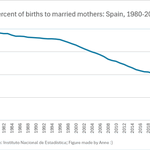
About half of births in Spain are to married mothers:
1
3
17
876
As of the latest data (2024), half of births in Spain were to married mothers. But this varies by region:
🤖 Made with AI
2
4
15
713
Updated estimates and projections of four U.S. territories: American Samoa, Guam, the Northern Mariana Islands and the U.S. Virgin Islands. All four are set to shrink by 2100: census.gov/library/stories/2…
9
332
Due to a rapid rise in childlessness, NH black women with "some college" are more likely to have no children at age 30 than NH white women with "some college"
8
19
162
7,526
"Rates of childlessness are becoming more similar across education groups. This is especially true at age 45, at which point childlessness has fallen for highly educated women and risen for those with only a high school diploma"
3
9
2
50
3,293
Womens' average age at at first birth in EU is 29.9 years. Youngest average in Georgia (26.9 years) Oldest average in Italy (31.9 years)
1
6
443
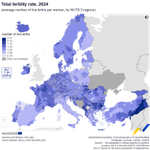
"In 2024, the EU’s total fertility rate was 1.34 live births per woman.... Over the past 20 years, the fertility rate has remained consistently below the natural replacement rate of 2.10, varying between 1.34 and 1.57 live births per woman."
3
10
382
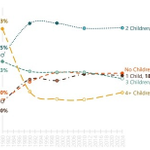
Number of children born to women ages 40-44. There were big changes between 1980 and 1990 (between women born in the late 1930s and those born in the late 1940s)-- then, mostly stable.
3
2
18
2,884
"Family size desires have plateaued in recent years even as contraceptive use has increased, suggesting that the translation of desires into contraceptive use has evolved with time."
3
9
579
"The widespread availability of contraception can lead to greater social acceptability… that might not just change women’s and their partners’ views on contraceptive use but could also influence their fertility desires… reconceiv[ing] the ways they plan their families."
1
1
248
The U.S. has a two-child ideal—but how much does it matter? An experiment found that number of children ranks below marriage and financial stability among family preferences. Understanding fertility means looking to the constraints shaping women’s decisions.
2
2
368