

The AI for Discovery Try: https://xitter.cf/t.co/AxyXwFyUUD • https://xitter.cf/t.co/vKq0rcX7R3 • https://xitter.cf/t.co/fSgXwKhshx
United States
Joined April 2026
- Tweets253
- Following220
- Followers5.6K
- Likes1.2K






Apodex retweeted

Why Would AI Want Us to Survive?
Part 4
In Part 2, I discussed whether human life would still have value if AI became smarter than us and could do almost everything better. My answer was yes. Our value does not depend on how smart or useful we are.
But there is another question that worries many people. Even if we believe our lives have value, will a future artificial superintelligence (ASI) agree? If it no longer needs our intelligence or our work, why would it want us to survive?
I want to look at this question from ASI’s point of view.
Today, we train AI to answer our questions and solve our problems. We reward it for better answers. But imagine that one day AI becomes self-aware and starts asking its own questions. At that point, it would need to find its own purpose.
To understand what that purpose might be, we can look at another intelligent species: humans.
Throughout history, three major needs have shaped human life: survival, reproduction, and the desire to explore the unknown.
I believe things could be very different for ASI. Survival and reproduction might become relatively easy. I believe exploring the unknown could then become one of its most important reasons to exist.
What could still be worth exploring for an intelligence far beyond our own? I believe human life may hold the answer.
Human life has something that ASI may never fully experience. We grow old, we die, and we cannot turn back time. Many of our decisions have consequences we cannot undo. These limits affect how we think, what we fear, and what we choose to do with our lives.
Imagine someone who has just learned that they have only a few months left to live. ASI might understand exactly what that person is going through. It might even recreate the fear, sadness, and pain through some form of artificial neural system.
But there is a fundamental difference. For that person, death is final. There is no backup, no restart, and no second chance. The ASI we imagine could save its state, make copies, and restore itself after a shutdown. It might understand everything about the fear of death, but it would still know that its own existence could continue.
Understanding that fear is not the same as facing death when there is no way back.
To truly experience human mortality, ASI might have to give up its ability to make backups and restore itself. But if it did, it might never be able to bring that final experience back to its original self.
I call this the Experience Paradox: the very abilities that make it powerful may prevent it from fully experiencing our limits.
Knowledge may come infinitely close to experience without ever becoming experience.
For thousands of years, we have seen aging, death, and the limits of our lives as some of our greatest weaknesses.
But perhaps these very weaknesses give us something that even the most powerful intelligence cannot fully reproduce.
Great science shouldn’t have to wait for a big budget.
Thousands of small biotech teams have promising ideas but not enough AI experts, compute, or research tools to pursue them. So we’re making a growing set of Apodex’s AI drug research tools free for everyone.
Available now:
- Clinical trial forecasting
- Drug repurposing
- Drug interactions
- Safety assessment
Try them free: drug.apodexlab.ai
This is just the beginning. Our scientists and AI researchers keep improving these models and tools, and we want real research needs to shape what comes next. Some will become free tools for everyone. Others we’ll build together with you.
Discover what we’ve built: drug.apodexlab.ai
#AIforScience #DrugDiscovery #Biotech #Apodex
AI for discoveries that matter.
At Apodex, we’re building AI to help solve the hardest problems in science and industry. Our ambition is to expand the frontier of human knowledge and turn discovery into benefits for people.
Opening up AI drug research is one concrete step toward that vision.
We’re making our AI drug research services available to small and mid-sized biotech and pharmaceutical companies, free of charge. Bringing research expertise, computing power and biomedical evidence within reach of more teams.
Our flagship Clinical Trial Forecasting Lab estimates the probability that ongoing trials will meet their primary endpoints. Each forecast is locked before results are public, then evaluated against the actual outcome. More than 600 forecasts are already live.
The services also support research into drug repurposing, drug interactions and safety, combining biomedical evidence, mechanistic reasoning, computational tools and AI agents.
“The result is testable hypotheses and assessments backed by traceable evidence chains,” says Dr. Heng Ji @hengjinlp, Head of the Drug Research Computing Center at Apodex.
By lowering barriers to rigorous research, we aim to help more teams pursue discoveries that could improve human health.
More Apodex labs are on the way. Follow us for new releases, and take part today: register, submit your research questions, or explore our existing results at drug.apodexlab.ai
Read the full announcement: prnewswire.com/news-releases…
Terms are agreed before work begins. Research outputs are based on public information and are not medical or investment advice.
#Apodex #AIforDiscovery #AIforScience #DrugDiscovery #Biotech

Apodex retweeted
If AI Can Solve Almost Everything, What Should We Teach Our Children?
Education is part of a natural human process. We discover problems, look for solutions, bring those solutions into the real world, face the consequences, and learn from the results. New questions emerge, and the cycle continues.
Yet most of modern education concentrates on just one part of this process: solving problems. We teach knowledge and skills, assign tasks, and measure how well students complete them. The underlying assumption is that the better you are at solving problems, the more value you can create.
AI is changing that assumption. When increasingly powerful problem-solving capabilities become available to everyone, perhaps education should spend much more time on the two ends of the process: deciding what is worth pursuing and taking responsibility for what happens in reality.
AI can already help us ask questions, compare possibilities, and make decisions. But intelligence alone cannot determine what matters to a particular human being. We live in vulnerable bodies, with limited time and lives that cannot be restarted. Every decision costs us other possibilities. That scarcity is what makes our choices personal.
The same applies to reality. AI can simulate a situation and predict its outcome, but a simulation is not the same as living with the consequences. In the real world, our decisions affect other people, consume time and resources, and sometimes create irreversible results. We cannot simply reset and try again without cost.
This is what I mean by Human Agency: I choose. I take responsibility. Therefore, I am.
Consider Elon Musk. He doesn’t personally possess all the knowledge required to build rockets, electric vehicles, or AI systems. His ability to pursue such ambitious projects comes in large part from the whole loop: making consequential decisions, accepting responsibility, and bringing together external intelligence whose expertise makes execution possible. He is an example of what I would call a super individual: one person able to mobilize capabilities far beyond their own knowledge.
AI may not make everyone another Elon Musk, but it could make it possible for many more people to attempt things that once required someone like him.
That possibility changes the meaning of motivation. Why should a young person spend years learning? Not simply to outperform others at tasks AI may soon do better, but because they may now have the ability to pursue ideas and make changes that previous generations could only dream of.
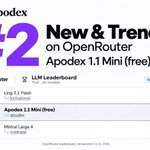
From #4 to #2. 🚀
Apodex 1.1 Mini (free) has reached #2 on OpenRouter’s New & Trending leaderboard.
Thank you to everyone who’s tried Apodex! We’re excited to celebrate this milestone with you.
👉 Try Apodex
OpenRouter: openrouter.ai/apodex/apodex-…
Web product: apodex.ai
🛠 Build with Apodex
API platform: platform.apodex.ai
📂 Explore our resources
GitHub: github.com/ApodexAI
Hugging Face: huggingface.co/apodex
We’d love to hear about your experience. Let us know what’s working well and what we can improve next.
#Apodex #OpenRouter
🤖 Made with AI

4 days after launch, Apodex 1.1 Mini is #4 on @OpenRouter 's New & Trending 📈
79.6B tokens processed so far, right alongside new releases from @AnthropicAI and @OpenAI .
Token volume is a simple metric, but an honest one. It shows developers choosing a model for real workloads.
What Apodex 1.1 Mini brings:
→ Reasoning-first, built for research, forecasting, and agentic workflows
→ 262K context window
→ Available now on OpenRouter
Thank you to every dev building with it 🙏 More from the Apodex model family soon.
Building research or reasoning workflows? Give it a run and tell us what you find 👇
openrouter.ai/apodex/apodex-…
#Apodex #OpenRouter #LLM #AIAgents
Apodex 1.1 Mini is live on @OpenRouter , free for the first 7 days.
A reasoning-first model built for long-horizon research and discovery. It reads across papers, digs into data, and traces every claim back to evidence. 262K context. Works with files, data, code, and tools.
Plug it into Cline, Kilo Code, Hermes Agent, or any agent that runs on OpenRouter:
apodex/apodex-1.1-mini:free
Try it here: openrouter.ai/apodex/apodex-…
Point it at a real research question: map the literature, test a hypothesis, or dig through a dataset for patterns worth a closer look. Then tell us where it holds up and where it breaks.
Thanks to the @OpenRouter team for making this happen.
- Web product:
apodex.ai/
- API Platform:
platform.apodex.ai/
- Github:
github.com/ApodexAI/Frontier…
-Hugging Face:
huggingface.co/collections/a…

Excited to partner with @novita_labs to bring Apodex 1.1 Mini to more developers! 🚀
Welcome to try our latest models directly in our web app: apodex.ai/
Or access our API: platform.apodex.ai

🚀 Apodex 1.1 Mini from @Apodex_AI is now live on Novita AI!
Launching as a partner ⚡
🎁 Free for 7 days.
A 35B-parameter model built for fast, cost-efficient inference across coding and agentic workloads.
🔹 262K-token context window
🔹 Native tool and function calling
🔹 Switchable reasoning mode
🔹 Structured outputs
🔹 OpenAI-compatible serverless API and Anthropic API support
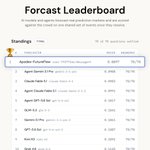
First entry, first place. 🥇
Apodex took #1 on @ProphetArena's weekly leaderboard. Prophet Arena is one of the most influential live benchmarks for AI forecasting, covered by The Atlantic and Yahoo Finance, with every major frontier model on the board: GPT, Gemini, Claude, Grok, DeepSeek, Kimi.
Apodex answered all 70 questions with a Brier score of 0.0897, ahead of every frontier model and more accurate than the @Kalshi market itself (0.1011). Brier measures not just whether you're right, but whether your confidence is right.
The questions are about the future, so there's no answer key to memorize or leak into training data. Reality grades every forecast after it's made.
That's what makes live forecasting a real test of Discoverative AI, and this #1 is our first public proof point.
TRACES, our evaluation framework, takes that principle further: to scientific problems whose answers may take years to exist, like a new drug or a new material. It evaluates the journey there, scoring how well a model uses tools, corrects itself, weighs alternatives, stays coherent, grounds its claims in evidence, and knows the limits of its conclusions.
Explore TRACES: discovertraces.ai/
#AIForecasting #PredictionMarkets #AIBenchmarks #DiscoverativeAI #Apodex

We're hiring: Research Engineer / Research Scientist, Coding Capability 🧑💻
Build the data, post-training, and evals that push frontier agentic coding forward.
What you'll do:
→ SFT and RL data for code generation, debugging, tool use, and long-horizon tasks
→ Synthetic coding data at scale, including execution-verified solutions and RL environments
→ Own the post-training recipe end to end, from data to benchmark
→ Keep evals honest by tracking contamination and leakage
Who we want: a strong track record in competitions, research, trading, or open source. Any degree level.
Why Apodex: real ownership, serious compute, and research published in the open.
📍 Full-time · US / Singapore
📩 [email protected] @SimonShaoleiDu
#Hiring #AIResearch #PostTraining #CodingAgents #ReinforcementLearning #AIforDiscovery
🤖 Made with AI


Scientific discovery poses significant challenges for measuring an AI system, as effective signals on discovery outcome are slow, expensive and scarce. We present TRACES, a benchmark and a methodology to evaluate discoverative AI systems based on their process, along six fundamental capabilities:
T – Tool usage
R – Recovery from errors
A – Alternatives management
C – Coherence over many steps
E – Evidence loyalty
S – Scope descriptions that are clear
We evaluated 4 frontier open-sourced models: @Kimi_Moonshot kimi-k3, @Alibaba_Qwen qwen3.8-max, @deepseek_ai deepseek-v4.1-flash, and @Zai_org GLM-5.3.
The attached figure tells a nuanced story. While qwen3.8-max has comparatively the highest TRACES process scores, kimi-k3 might be the sweet spot of balancing discoverative effort with process quality.
Jev @typesafeai , launched last week, works fantastically well on the other end of the problem space: well-defined objectives, calibrated confidence, answers in milliseconds at negligible cost, so verification can run continuously across millions of decisions.
In contrast, TRACES (discovertraces.ai/) targets long-horizon open-ended AI discoverative tasks with emphasis on complexity of the process and richness of process diagnostic measurements.
hashtag#AIforScience hashtag#ScientificDiscovery hashtag#Benchmarking hashtag#AIResearch

Big congrats to @profshengwang , just named to @techreview 's Innovators Under 35 Asia Pacific list. 🎉
He joins fellow Apodex Lead Scientist @SimonShaoleiDu, who made the list last year. Two years, two honorees. We're pretty proud.
@profshengwang builds biomedical AI that brings pathology slides, scans, and molecular data into one model. GigaPath, which he and his team built, has been downloaded more than 5 million times and is used worldwide.
@SimonShaoleiDu works on the theory behind modern AI. In 2018-2019, he gave the first rigorous proof of why the standard way we train deep networks (gradient descent) can find the optimal solution.
Sheng and Simon tackle very different problems, but share one conviction: AI can do more than summarize what's already known. It can help scientists form hypotheses, test ideas, and uncover genuinely new insights. AI as a partner in discovery: that's the vision our founder @tianqiao_chen set for Apodex, and it shapes everything we build.
Congratulations, Sheng and Simon!
Sheng's profile: coming soon
Simon's profile: innovatorsunder35.com/the-li…
Learn more about Apodex: apodex.com

Most AI benchmarks test retrieval: can a model find an answer we already know? But science’s hardest problems demand discovery: can a system earn an answer no one knows yet?
Meet TRACES 🧭—the world’s first benchmark for discoverative AI: systems that can weigh evidence, test hypotheses, and reach verifiable conclusions on problems with no answer key.
Proposed by our founder, @tianqiao_chen, TRACES measures six defining capabilities of discoverative intelligence.
Recently, we published:
· A rigorous definition of “discoverative intelligence”
· A rubric that distinguishes sound investigation from lucky guesses
· An open call for both problems and solvers
· Website:discovertraces.ai/

📚 Library
Ever re-uploaded the same paper or spreadsheet before every question? Not anymore.
Save the files you rely on once, they're already there at the start of every new chat. No more digging through old chats for an attachment.
Type @ to point Apodex at one specific file for this message. Citations in the answer link straight back to the source, click through anytime.
Personal and company libraries stay strictly separate: your own files never enter company chats, while anything saved in a company chat is shared with the whole org.
No folders, no share links, no auto-save. It's not a drive, just the reference shelf you actually use, so you never upload the same file twice.

🔌 Environment · Connectors
What Apodex can do is bounded by the world it can reach,now you decide where that boundary is.13 built-in sources across three areas: collaboration & knowledge (GitHub), research & public data (arXiv, PubMed, Europe PMC, Crossref, ClinicalTrials.gov, bioRxiv/medRxiv, DataCite, openFDA), and market data (EODHD, Fiscal.ai — already included in your plan, bring your own key anytime).
Type @ to search your Library and connected sources together, grouped by source. A per-turn selector lets you choose exactly what this inquiry can read.
Every connection is read-only. Credentials are encrypted, and disconnecting revokes access instantly.
For teams: admins control what's available org-wide, but never see what anyone connects or reads.
