

A practical resource for beginner to intermediate guitar players to learn and apply music theory to the guitar.
Virginia, USA
Joined July 2018
- Tweets6.7K
- Following143
- Followers1.4K
- Likes1.1K

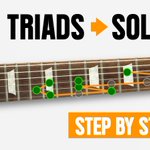



Triad challenge: play the chords of one major key up a single string group. Say each chord name before playing it and notice where the quality changes. Chord-scale lesson:
appliedguitartheory.com/less…

2
63
CAGED practice task: locate the chord tones inside the scale you already know. Play the chord and arpeggio first, then fill in the surrounding scale notes. Guided exercise:
appliedguitartheory.com/less…

2
68
Study one phrase from Yellow Ledbetter, then find its landing note inside the backing chord. This small step can teach you more than memorizing the tab alone. Lesson:
appliedguitartheory.com/less…

1
79
Do string changes interrupt your down-up picking? Isolate a two-string pattern and slow it down until the transition is as even as the rest. Start with these exercises.
appliedguitartheory.com/less…

1
70
The Run Like Hell example in this lesson shows how chord voicings create a descending melody within a D-A-G progression. See how the same chords can sound so different.
appliedguitartheory.com/less…

6
164
A solo can follow the chords without changing scales every bar. In Let It Be, the landing notes help connect C major pentatonic phrases to the progression. See how:
appliedguitartheory.com/less…

2
66
A pull-off needs to sound the next note, not just release the first one. Practice a short two-note pattern and listen for the lower note to ring. Exercises here:
appliedguitartheory.com/less…

3
119
Try playing a major scale in 3rds instead of straight up and down. The skipped notes give your hands a different task and your ear a different sound. Tabs and examples:
appliedguitartheory.com/less…

2
85
Try playing a minor chord, then its arpeggio without changing position. Notice the shared notes and the extra chord tones available around the fingering. Guided lesson:
appliedguitartheory.com/less…

1
56
Play a minor CAGED chord, then locate the pentatonic notes around it. This lesson builds the scale from the chord so you can see how the two structures fit together.
appliedguitartheory.com/less…

2
125
Major arpeggios use 1-3-5. Minor arpeggios use 1-b3-5. Compare the two from the same root and listen to what changing the 3rd does. Diagrams and tabs:
appliedguitartheory.com/less…

4
92
Trouble with the F barre chord? Try a smaller voicing while you continue practicing the full barre. This lesson shows several options.
appliedguitartheory.com/less…

44
Already know minor pentatonic? Adding the 2nd and b6 completes the natural minor scale. See how those notes fill out each minor CAGED position in this lesson.
appliedguitartheory.com/less…

1
69
Pick one pentatonic exercise and use it in two boxes. Keep the tempo slow enough to preserve the same rhythm and note sequence in both. Tabs for all five shapes:
appliedguitartheory.com/less…

3
74
Try a finger-independence exercise on a small part of the neck before moving it up and down. A manageable pattern makes it easier to notice unnecessary movement. Exercises:
appliedguitartheory.com/less…

4
86
Mixolydian is a major scale with a flattened 7th. Over a D-centered progression, that C note gives you a sound the D major pentatonic scale doesn't include. See the lesson:
appliedguitartheory.com/less…

2
85
Take a minor triad and lower its 5th by one fret. You've created a diminished triad. This lesson shows how the change appears on different string groups.
appliedguitartheory.com/less…

2
81
Try finding one minor chord in two CAGED forms. Check that the root note stays the same even though the fingering changes. This lesson maps the forms and their connections.
appliedguitartheory.com/less…

3
72
Take a short pentatonic note pattern and find it in the next position. Keep the sequence familiar while changing where you play it. Repeating-pattern exercises:
appliedguitartheory.com/less…

3
92
Try picking strings 4 and 2, then 3 and 1 from a D chord. Keep the unused strings quiet and the rhythm even. This lesson builds the pattern into larger skipping exercises.
appliedguitartheory.com/less…

1
49