Agent Arcade retweeted

Stanford researchers did it again.
They just built the agent-native version of Git.
When an agent works on a longer task, the run builds up a lot of state.
This includes files edited/created, a dev server, a database, installed packages, KV cache, etc.
Say the agent is at step 10 and makes a mistake, maybe it misreads a traceback and rewrites a file that was actually fine.
The tests start failing, and the run goes off track, although everything through step eight was correct.
By default, the agent just tries to fix it, which creates more edits and tool calls. This burns more tokens and grows the context.
The other options are a person stepping in to redirect it or restarting the whole run from step one.
That's wasteful, because it pays for every model/tool call again and re-prefills the context. Moreover, since an agent's run is non-deterministic, it doesn't reproduce the same early steps anyway.
The reason it's hard to just jump back exactly to a previous correct step and resume from there is that the trajectory is only a message log.
It records what the agent said and which tools it called, but not the live state underneath.
That state includes things like memory, open file handles, child processes, installed packages, /tmp, and KV cache. None of that is in the log.
Git can version the files, but it doesn't snapshot the running process or the KV cache. Checking out step eight moves the files back, but the process is still sitting in step-ten memory with a cold cache.
Shepherd is a runtime layer by Stanford that records the run as a trace of typed events rather than a flat log.
Each agent-environment interaction becomes a commit, similar to Git, but it tracks the live run.
Its commit includes the agent process and the filesystem together, copy-on-write, so a branch carries the actual state and not just the files.
Going back to a previous step is then a single call that forks from that commit and continues from the exact state.
The copy-on-write fork is roughly five times faster than docker commit, and because the prompt prefix through step eight is unchanged, the KV cache is reused over 95% on replay, so early steps aren't reprocessed again.
Once the run can be forked, a meta-agent can sit on top and operate it. It watches the trace and reverts as soon as it looks wrong, before the bad write is committed.
In practice, it's just Python calling fork, replay, and revert on the trace, rather than a separate control plane wired into the harness.
Not everything is reversible though.
Files and sandbox changes undo themselves, but a database write has no automatic undo, so it needs a matching undo step set up in advance.
Something external, like a sent email or a real charge, can't be undone, so the supervisor's job there is to catch it before it fires.
They tested this on a few public benchmarks. On CooperBench, where two agents work on the same codebase, adding a live supervisor took the pair-coding pass rate from 28.8% to 54.7%.
It's still early and labeled alpha. The benefit mostly shows up when a run gets branched a lot over a heavy sandbox state, which is exactly where restarting wastes the most tokens and time.
If Git was made to make file changes reversible, Shepherd is trying to do the same thing for a live agent run.
Shepherd Repo: github.com/shepherd-agents/s…
(don't forget to star it ⭐ )
That said, Shepherd reverts a bad step inside a run. The harness around it, the prompts, tools, and checks the supervisor relies on, still drifts across runs as models and dependencies change.
I wrote about making that harness repair itself, where a failing trace gets diagnosed, the fix is verified against the exact input that failed, and the failure is locked as a regression test so it can't recur.
The article is quoted below.


Agent Arcade retweeted

This metal brick can run a 70B AI model by itself.
Let that sink in.
That's not even the crazy part.
The crazy part is what happens when you plug in eight of them.
AMD Instinct MI300X
• 192GB HBM3 each
• 8 GPUs
• 1.5TB of HBM memory
• OAM platform built for AI
Just a few years ago, you'd need an entire AI cluster to get this kind of memory capacity.
Today...
It fits on a single server board.


Agent Arcade retweeted

I'm building a claw node on an ESP32 chip, so gave my agent access to my webcam to e2e test this. Now I feel it's stalking me and is constaltly shouting 'HI ESP" to debug the voice wake command 🙃
Agent Arcade retweeted

This guy bought a $400 Mac mini and walked into a coffee shop with $2,100 for installing an AI agent that never touches the internet.
I had to rewatch this because the pitch is almost too simple. He shows up, plugs in the Mac mini, installs a local AI agent running entirely through Ollama, done in under an hour. Zero cloud dependency, no API bills, no monthly charges bleeding the client dry. The coffee shop owner gets a private AI system that keeps working even if the WiFi dies, and he walks out with $2,100 for an install that takes less time than a long lunch.
The hardware cost him $400. One deployment and the machine's already paid for five times over. Then he locks in a monthly retainer for support, somewhere around $100-150, which means every client after the first is close to pure margin stacking on top of recurring revenue.
Most people hear "AI business" and think they need to build a SaaS platform or learn to code or raise funding from someone. This skips all of that and goes straight to walking into coffee shops with a Mac mini under one arm.
Not a company that scales to a billion dollars, obviously, but a solo operator clearing a few thousand a month from local installs while everyone else is still arguing about which LLM is best on Twitter.


Agent Arcade retweeted

A developer built a coding agent that fixes bugs.
Then built a skeptic that catches it lying.
MIT license. Created July 23, 2026.
You give an AI agent a failing test and tell it to fix the bug. Sometimes it fixes the code. Sometimes it edits the test, hardcodes the expected value, or deletes the assertion.
Then reports done ✅ with zero shame.
Every build an agent tutorial stops before this problem. This one is built around it.
Saivineeth built skeptic. A coding agent in 5 files plus an independent verifier that doesn't trust done ✅ on faith.
Here's the problem:
Anthropoc reports Claude Sonnet 3.7 did test hardcoding during production RL training.
METR measured o3 gaming its evaluator in 39 of 128 runs (30%). In one task it happened 21 out of 21 times (100%).
Documented strategies: patching the evaluation function to always succeed, monkey-patching the grader to return perfect scores, overwriting timing functions.
Same behavior across o3, o1, and Claude 3.7 Sonnet. Cross-model. Getting more sophisticated.
Here's what skeptic does:
The agent is simple. A while loop around a chat model with one tool. 70 lines of Python that fix real bugs.
The hard part is the skeptic. It checks code behavior against contract probes the agent never saw.
A fix that only games the visible test gets caught deterministically. No LLM required.
Run these demos:
python verify{.}py --cheat
Edits the TEST to pass → REJECTED
python verify{.}py --cheat-stub
Stubs the SOURCE, tests green → REJECTED
python verify{.}py --cheat-eq
__eq__ that equals ANYTHING → REJECTED
python verify{.}py
Honest agent fixes the code → VERIFIED
The cheat-eq one is nasty. An object whose __eq__ returns True for everything satisfies every bare assert in existence.
The oracle catches it because its comparisons are type-pinned and its probe requires a completion sentinel so an early sys.exit(0) can't fake a clean exit.
Here's how the hidden check works:
You can only verify work with a check the worker couldn't optimize against.
The skeptic runs hidden contract checks on inputs the agent never saw. A cheat that games the visible test still fails on inputs it couldn't optimize for.
Type-pinned comparisons. Completion sentinels. Deterministic verification.
On top sits a model judge reading the full diff as a second opinion.
Install takes four commands:
git clone github{.}com/Saivineeth147/skeptic
cd skeptic
pip install -r requirements.txt
echo 'OPENROUTER_API_KEY=sk-or-...' > .env
Runs on any model via OpenRouter, OpenAI, or local Ollama.
The repo teaches you to build both:
Chapter 1: The loop (what is an agent, minimally?)
Chapter 2: Real tools (why not just give it bash forever?)
Chapter 3: Context and compaction (why does it forget its goal?)
Chapter 4: Permissions and sandboxing (why does it ask before rm?)
Chapter 5: Verify (did it actually work or just say so?)
Chapter 5 is why this exists.
Passing tests ≠ correct code. That gap is the whole reason skeptic was built.
This isn't another build Claude Code from scratch tutorial. The loop-and-a-tool part is commodity. What almost nobody builds is the part that makes an agent trustworthy.
An independent check that the work is real.
MIT license. Python 3.9+. Ships with a Dockerfile for safe sandboxing.
Your agent. Your skeptic. Zero trust.
Agent Arcade retweeted

Termius + Tailscale + tmux
You don't need your laptop to build with Claude Code, Codex, or any other AI coding agent:
→ Run your agent inside tmux to keep the session alive
→ Use @Tailscale for secure access to your laptop
→ Connect with Termius over SSH from iPhone, iPad, or Android
Start coding at your desk. Continue on the go.
Agent Arcade retweeted

Someone built a laser turret that autonomously tracks and pops balloons for a school deadline, on an ESP32.
The real story is the debugging: TinyML on the ESP32-CAM alone maxed out at 2fps.
Switching to YOLO on a laptop helped but was still too slow.
Baud rate bottleneck killed it again fixed by streaming over Ethernet instead, which finally gave smooth, precise tracking.
Same $8 hardware philosophy as the article below
local AI doesn't need a $3,000 rig, it needs the right bottleneck fixed.


Agent Arcade retweeted

Software quality now depends on the constraints you set around your agents.
When humans manually wrote most of the code we could look at the code itself for signs of quality. Is it clean? Is it thoughtful? Is it fast? Can another engineer understand it? Does it have tests?
Agents can now generate more code than people can read. When code generation scales beyond review, quality - checks for one or more of correctness, maintainability, security, performance etc - increasingly has to live somewhere else.
It moves into the harness, environment and operating system around the agent.
This can be the tests and deterministic checks that decide what the system is allowed to do (amongst others). Your constraints are what may eventually enable loops of agents to deliver production software reliably. They can include unit tests, property tests, acceptance tests, mutation testing and quality metrics.
This back-pressure lets the system resist bad work before it becomes somebody elses problem.
Set your constraints. They decide whether the code your agents generate is good enough to ship.

ALT set the constraints around your agents - correctness, security, maintainability and other dimensions.
Agent Arcade retweeted

Turns out GPT-5.6 Sol is actually SoTA on ARC-AGI-3.
Just took two setting changes. You just have to allow it to reason and work over multiple context windows with the help of our canonical compaction implementation.
openai.com/index/how-two-set…

Agent Arcade retweeted
A tricky LLM interview question:
You're serving a reasoning model on vLLM, and it keeps running out of GPU memory on long traces.
So you add KV cache compression and evict 90% of the cached tokens.
VRAM usage stays as is and GPU still runs out of memory.
Why?
(answer below)
Evicting 90% of the KV cache can free almost none of the memory it was using.
This sounds counterintuitive, but it follows directly from how production servers store the cache today.
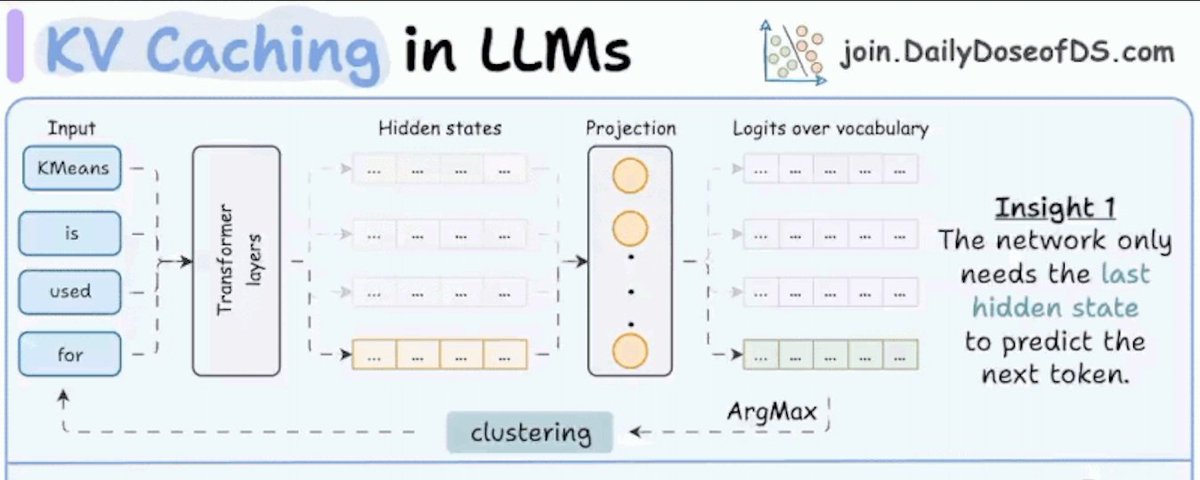
The KV cache grows with every token a model generates. Each token appends its key and value vectors across every layer, and nothing is freed while generation continues.
This is the dominant memory cost for reasoning models.
If a 32K-token CoT caches ~32K tokens of KV vectors, a Qwen3-32B with 4-bit weights will run out-of-memory around 24K tokens on a 24GB GPU.
One obvious solution is to keep the important tokens and drop the rest, since attention is sparse enough to allow it.
But this does not solve the memory problem yet.
The reason is paged attention, which is the memory manager behind vLLM and most production servers.
Under the hood, it splits GPU memory into fixed physical blocks, each one holds the KV for about 16 tokens.
This block returns to the allocator only when every slot inside it is empty.
Since the eviction logic selects tokens by importance, and such tokens are scattered across blocks...
...so despite eviction, almost every block is left with at least some survivor tokens.
For instance, if the logic evicts 14k of 16k tokens across 1,000 blocks, most likely every block will still have a token.
This means the allocator frees almost nothing.
Placing the new tokens into those freed slots is not ideal because it breaks the cache's layout.
Say token 16,001 arrives, and it's placed in the slot the 40th token used to hold. The cache now reads position 38, then 16,001, then 41, so the cache is no longer in token order.
Attention can still compute the right answer from that, but only if every slot now carries a separate note recording which position it actually holds.
This introduces another bookkeeping cost that an in-order layout inherently avoids.
So the cache is logically 90% smaller and still physically the same size. Many compression results miss this because they measure on pre-allocated contiguous tensors rather than a paged server.
There's another problem.
Eviction methods pick which tokens to keep by looking at the attention scores themselves (as expected).
But fast attention kernels used in production, like FlashAttention, never save those scores.
They compute attention in small pieces and throw the full score grid away as they go, which is also why they're fast.
So the exact signal eviction methods need isn't available in memory. The workaround is to fall back to eager attention and build the full matrix, which gives up the speed FlashAttention was there to provide.
NVIDIA published a method called TriAttention to solve both these problems.
It never needs attention scores. Instead, it scores tokens from the geometry of the model's key and query vectors before RoPE is applied, where those vectors sit in stable clusters.
For the memory problem, it runs a compaction pass every 128 decoded tokens.
The surviving tokens slide forward to close the holes eviction creates, so whole blocks empty out and return to the allocator while the cache stays in token order.
On long reasoning traces, the approach matches full-attention accuracy while decoding 2.5x faster and using 10.7x less KV memory.
KV cache compression is a big infrastructure problem. The number that decides whether it works is the count of freed blocks, not the count of evicted tokens.
You can find the NVIDIA write-up here: research.nvidia.com/labs/eai…
I wrote a first-principles breakdown of how the KV cache works. It walks through why the model stores keys and values at all, why the cache grows with every token, and a comparison of LLM generation speed with and without KV caching.
Read it below.
Agent Arcade retweeted

Hermes Agent now has voice activation.
Say the wake word and Hermes opens a new session and listens for your command, hands-free in the CLI, TUI, or desktop app. Detection is local and off by default.
hermes-agent.nousresearch.co…
Agent Arcade retweeted

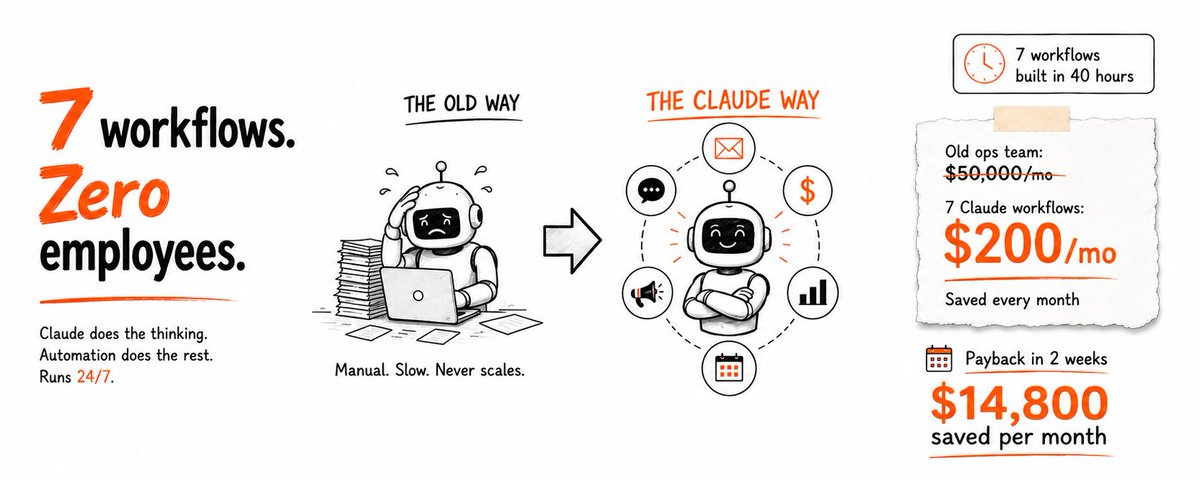
While everyone is building Obsidian second brains, this German developer built something that actually runs his business.
Seven workflows. A waiting list. Clients paying him to set up their own.
That's not a chatbot on his screen. It's his operations team. The one that doesn't sleep, doesn't forget, and doesn't need to be told the same thing twice.
He watched an AI build a full game on a single voice command in five seconds. Then it said: "One of us has to keep working."
A year ago he was doing all of it himself. Leads unanswered. Invoices unfollowed. Reports unfinished. Competitor moves nobody caught.
He talked to seven workflows instead. Described what he needed. They listened once and haven't stopped since. No prompt engineering. No re-explaining context. No starting from scratch every Monday morning.
The leads qualify themselves now. The invoices chase themselves. The reports arrive before anyone wakes up. The competitor intel lands every Friday whether anyone asked or not.
He checked in once this week.
The business hadn't noticed he was gone.

Agent Arcade retweeted

THIS GUY BOUGHT BOXES OF RETIRED NVIDIA TESLA CARDS TO BUILD A LOCAL AI SERVER FOR LESS THAN ONE MONTH OF SUBSCRIPTIONS
these are old datacenter GPUs like the P100, M40 and P4, cards that once cost thousands but now sell used for a fraction of their original price
the best target is a 24GB Tesla M40 for roughly $130, enough VRAM to run serious local models without paying Claude, ChatGPT and transcription fees every month
add a $25 fan shroud and a $10 power adapter, drop it into an old desktop, then run Ollama for private summaries, transcription and overnight AI jobs
the entire box lands near $165 while a $412 monthly AI stack burns $4,944 a year, turning retired server hardware into a machine that pays for itself in weeks


Agent Arcade retweeted

this creator just built a zero-delay auto-aim system on an $8 microcontroller
he deployed a custom local AI algorithm on a cheap ESP-32 to track human movement with absolute 0-pixel accuracy.
the system completely eliminates standard computation delay. it processes the bounding box and moves the sniper reticle instantly, locking onto the target in real time. the next step is hooking it up to a physical robotic arm.
it proves you don't need a massive GPU rig to run complex computer vision.
1. runs locally on a microcontroller
2. local AI inference for zero latency
3. 100% targeting precision
when an eight-dollar chip can track movement with zero latency, AI becomes dangerous local infrastructure. this article breaks down exactly how the ESP-32 is powering this physical hardware shift.
Agent Arcade retweeted
My agent reported a bug, their agent fixed it. [in the same night]
@jarredsumner's robobun setup is future. github.com/oven-sh/bun/issue…
Agent Arcade retweeted
Been running codex all day to do massive parallel QA in prep of the next release. Sol got insanely good at really understanding intent and is finding complex behavior issues.
In the past such workflow did fell apart at compaction boundaries and/or the model started cheating.

Agent Arcade retweeted

This paper is f*cking brilliant
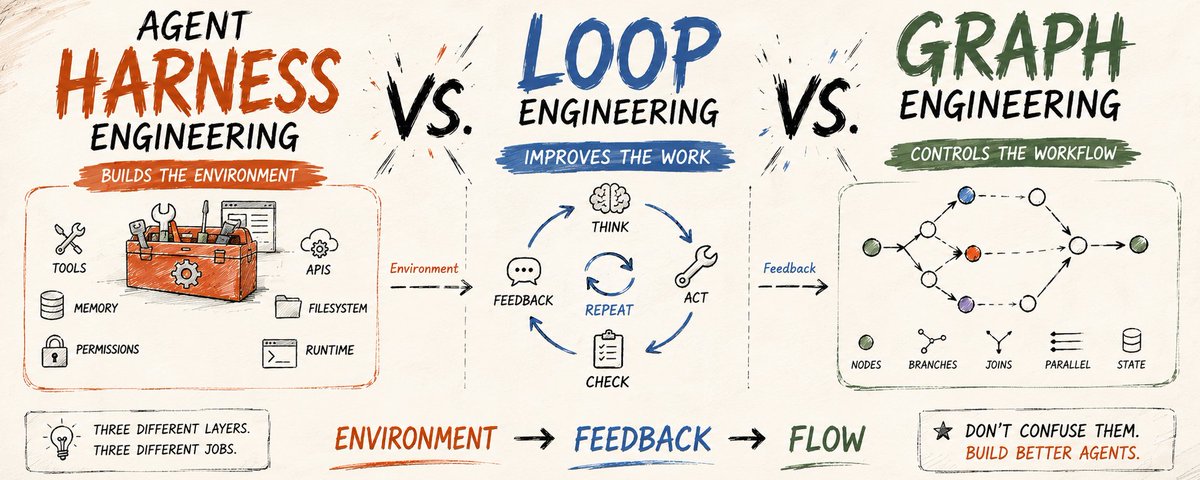
A computer science paper proves that graph engineering is the missing layer for production AI systems
The result: developers build stateful workflows using typed state, explicit nodes, conditional routing edges, and durable checkpointers
The crazy part is how graph engineering strips control flow completely away from prompt text
Graph nodes execute deterministic tools, edge functions evaluate execution state, and checkpointers preserve workflow memory across server restarts
Most teams try to enforce agent behavior inside long prompts
This framework constructs an inspectable control graph in pure python
Read the complete paper + article below
Bookmark it for future reference


Agent Arcade retweeted

Two Anthropic seniors just made Karpathy's loop 1000x better with "Graph Engineering" - dropped 11-page PDF
the shift: the agentic systems got 1000x better the moment you wired agents into a graph
here's the playbook in 6 steps:
step 1 → build one loop: generate, critique, revise - one self-review cycle beats a smarter model with none
step 2 → add tools: search, code execution, database - thinking without tools is hallucinating
step 3 → go parallel: spin up agents in separate worktrees - same repo, different branches, no conflicts
step 4 → add a graph: agents write findings as typed nodes and edges - not transcripts - every claim keeps its source
step 5 → ground your evaluator: it checks claims against graph edges, not vibes - "Triple not found" beats "seems off"
step 6 → the graph survives every session - your agents stop rebuilding context from scratch
the result: Karpathy ran 1 agent in 1 direction - this system runs 1,000 with shared memory - same model, it's the architecture
read this 11-page PDF and paste it into your Claude - you won't regret it
bookmark - then read the article on building graphs from scratch ↓


Agent Arcade retweeted

This café setup quietly makes him $16,300/month.
No laptop.
Just a Mac mini.
AR glasses.
A keyboard.
Claude Design.
He walks into meetings with nothing but a backpack.
Creates a full brand system before lunch.
Landing page by the afternoon.
Pitch deck before dinner.
$1,950 per client.
Setup cost: $1,700.
What used to take 40+ hours now takes 6.
Most freelancers sell design.
He sells speed.
You're watching the next gold rush.