

सत्यान्वेषी | Vedic astrology student | LV 1 Student | Permutations and combinations | लधुपाराशरी विद्यया अमृतम् अश्नुते | वित्तीय ज्योतिष student
Himalaya’s
Joined January 2022
- Tweets12.4K
- Following123
- Followers866
- Likes27.6K




Sunaina 🌞 retweeted

general chit chat and some astrology teapawt.org/i/spaces/1onVogogLZVLp…
Sunaina 🌞 retweeted
Kārttika Pūrṇimā · Tripurāri Pūrṇimā
Tuesday, 24 November 2026
Greetings on Kārttika Pūrṇimā!
On this day, Bhagavān Śiva destroyed Tripura, the three cities of the asuras, with a single arrow. Hence the name Tripurāri Pūrṇimā. In Kāśī, the ghāṭs are illuminated for Deva Dīpāvalī, the Dīpāvalī of the devas.
The month takes its name from Kṛttikā nakṣatra, whose presiding devatā is Agni. When Kārttika Pūrṇimā falls in Kṛttikā, as it does today, it is called Mahākārttikī. The full Moon is also in Vṛṣabha, its sign of exaltation.
The Nārada Purāṇa (Pūrvabhāga 124.57) prescribes the evening observance:
अत्रैव दीपदानेन विधेयस्त्रिपुरोत्सवः ।
निशामुखे द्विजश्रेष्ठ सर्वजीवसुखावहः ॥
"At nightfall, the Tripura festival is to be celebrated through the offering of lamps, bringing happiness to all living beings."
The next verse (124.58) extends the promised merit even to creatures that merely behold the light:
कीटाः पतङ्गा मशकाश्च वृक्षा जले स्थले ये विचरन्ति जीवाः ।
दृष्ट्वा प्रदीपान्नहि तेऽपि जन्मिनः पुनश्च मुक्तिं हि लभन्त एव च ॥
Insects, moths, mosquitoes, trees and creatures dwelling on land or in water are promised freedom from rebirth and liberation upon seeing these lamps.
The same chapter (124.59–61) directs the worship of the six Kṛttikās, Kārttikeya, Khaḍgī, Varuṇa and Agni at moonrise, followed by the offering of lamps outside the home.
The observance for the day is: perform snāna, give dāna according to one's means, worship the prescribed devatās and offer lamps at dusk. Lamps may be placed in homes, temples and along riverbanks, for the happiness of all living beings.

Sunaina 🌞 retweeted

A Fire Swallowed by a Bigger Fire
Mars becomes combust within 17° of the Sun, the widest limit among the five planets.
Two bonfires burn close together, and from a distance only the larger blaze shows. A combust Mars signifies courage and drive spent in someone else's service: a soldier fighting a commander's war, an employee whose hard work is credited to the boss.
Siblings may live in the shadow of the father or an authority. Bhāvas of which Mars is lord for the lagna lose the support of a clear lord.
Combustion is judged separately from conjunction. The conjunction orb between two grahas is the mean of their orbs: Sun 15° and Mars 8° give 11.5°. Within that distance the yuti is live. A Mars 16° from the Sun is combust, and lies outside the live yuti.
Keep the two tests apart and the reading becomes precise.
Within seventeen degrees, Mars burns unseen.

Sunaina 🌞 retweeted

For me it is @VEDANJANAM sir. Greatest of all the teachers i ever had. Always grateful 🙏
Sunaina 🌞 retweeted
Dev Dīpāvalī: The Celebration of Divine Light
Dev Dīpāvalī is tomorrow, it is observed on Kārttika Pūrṇimā, the full moon of the sacred month of Kārttika. Also known as Tripurāri Pūrṇimā, it commemorates Lord Śiva's victory over the demon Tripurāsura. On this day, the Devas themselves are said to have celebrated with lamps, which is why it is called the Dīpāvalī of the Gods.
The Story Behind the Festival
Empowered by a boon, Tripurāsura built three mighty cities and, in his pride, troubled the Devas and the righteous. When they took shelter of Lord Śiva, Tripurāri destroyed all three cities with a single arrow. The Devas rejoiced and offered countless lamps to Lord Hara. Since then, this full moon has been remembered as the day divine light triumphs over pride, adharma and darkness.
The Spiritual Significance
Tripurāsura's three cities can also be understood as the three layers of illusion that bind the soul: ego, attachment and ignorance. Just as Lord Śiva dissolved them in a single moment, sincere surrender at the Lord's feet can dissolve the obstacles within our own hearts.
A Day of Completion
Kārttika Pūrṇimā is also the culmination of Dāmodara Māsa. The vows, lamps, prayers and service of the entire month find their fulfilment today. In the Vaishnava tradition, this is the day to offer a final, heartfelt Deepdaan to Lord Dāmodara and Śrī Rādhārānī, with gratitude for the grace received.
Practices for the Day
Kārttika Snāna: Rise before sunrise and bathe, remembering the holy rivers. Bathing in the Gaṅgā, Yamunā or any sacred river is especially meritorious.
Viṣṇu Pūjā: Worship Lord Viṣṇu, remember Dāmodara, chant the holy names and recite the Dāmodarāṣṭakam.
Śiva Pūjā: Worship Lord Śiva as Tripurāri with water, flowers and humble prayers.
Tulasī Pūjā: Offer water, a lamp and prayers to Tulasī Mahārāṇī, and circumambulate her with devotion.
Dīpa Dāna: At sunset, light lamps at the temple, the Tulasī plant, near sacred water and at the entrance of your home, praying that the light within may also awaken.
Pitṛ Tarpaṇa: Offer water oblations to the Devas, Ṛṣis and ancestors according to family tradition.
Dāna: Give food, clothing, grains or other necessities to those in need.
Sādhu and Vaiṣṇava Sevā: Honour and serve saints and devotees. Their blessings complete every vow.
A Closing Reflection
Light is the symbol of knowledge, purity and the presence of the Divine. Today, let every lamp we light be a prayer: may pride dissolve, may devotion deepen, and may the Lord's light fill our homes and hearts.
On this sacred Kārttika Pūrṇimā, let us remember Tripurāri, worship Nārāyaṇa, honour our ancestors and offer light with love and gratitude.
Har Har Mahādeva. Jai Jai Siyā Rāma 🙏

Sunaina 🌞 retweeted

How does one seek mokṣa, when one is outside the recognised āśramas?
What is the path of surrender outlined by Rāmānuja and Vedānta Deśika?
@VEDANJANAM explores.
brhat.in/dhiti/the-anashrami…

Sunaina 🌞 retweeted
Happy to share Part 2 of the article. Link to part 1 is in the first comment.
Part One of the study examined the Advaita reading on the subject of the Anāśramī and his pathways to mokṣa.
In Part Two @VEDANJANAM explores the Viśiṣṭādvaita opinion on the same.
brhat.in/dhiti/the-anashrami…

Sunaina 🌞 retweeted
Important rule.
Never trust the credit agencies to decide what is good and bad in the market.
Agencies rated subprime mortgage securities AAA until they collapsed in 2007–08.
Enron was still investment grade days before it failed, and Lehman kept an A rating into the week it went bankrupt.
The problem is built into the business: the issuer pays for the rating, so the agency has an inherent conflict of interest.
Downgrades arrive mostly only after the market has already priced the damage.
Ratings still move money. Pension mandates, bank capital rules and collateral thresholds are written around them, so a downgrade forces selling whether it is justified or not.
If you are an institutional reader, you already know that the gap between what a rating says and the forced selling it triggers is often where the trade is.
Sunaina 🌞 retweeted

Sri Subramaniyam Bhujangam - The Divine Grace of Bhagwan Subrahmaṇya
Note- To be recited for getting rid of disease, suffering, issues, pains. Females can recite it for removing marital issues. It also helps in issues of childlessness if recited regularly.
Composed by Ādi Śaṅkarācārya, Śrī Subrahmaṇya Bhujangam is a beautiful Sanskrit hymn dedicated to Sri Subrahmaṇya, also revered as Skanda, Kārttikeya and Murugan. Tradition associates its composition with the sacred shrine of Tiruchendur, where the great Ācārya experienced the divine grace of the Lord.
Through its extraordinary verses, the hymn reveals the beauty, power and compassion of Subrahmaṇya, whose grace is sought for protection, removal of suffering and spiritual progress.
Discover the deeper spiritual meaning of this sacred composition, its traditional significance, and the extraordinary devotion through which Ādi Śaṅkarācārya praises the Lord who protects his devotees and guides them towards liberation.
bvvp.org/library

Sunaina 🌞 retweeted

For the past few days, I’ve been building my dream Mahabharata adaptation.
This isn’t envisioned as another token-casting project. It’s supposed as a true Pan-India web series cast strictly on acting prowess, age, and physical suitability.
This version gives unsung warriors like Susharma, Shalya, Satyaki, and Bhagadatta the backstories and arcs they deserve.
Because the Mahabharata isn’t just five brothers against a hundred cousins. It’s an entire civilisation at war with itself.
PS: This is not a real project. Just an experiment.
Sunaina 🌞 retweeted
Some heavily rely on the way that Jataka Paraijata goes about analyzing charts.
Like in every field in Indian philosophy and sciences, there are many ways of analysis all of which aim to lead to the same goal.
Different algorithms to solve the same problem.
5.
Sunaina 🌞 retweeted
The beauty of BPHS is that every chapter has led to an independent school of astrology.
Laghu Parashari builds on the method taught in some of these chapters and creates a complete predictive system heavily dependent on dashas.
10.
Sunaina 🌞 retweeted
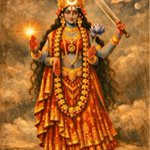
Every living thing, the Sun included, keeps losing part of itself and lives only because something keeps flowing back in. Chinnamastā is the goddess of that loss and renewal, and she is what is left when the renewal stops.
She stands in pratyālīḍha, the archer's stance, holding her own severed head and a kartrī (cleaver). She is naked (digambarā), three-eyed, with a serpent binding her crest-jewel, and red like the japā flower. She joyfully drinks the stream of blood-nectar rising from her own trunk. Under her feet are Kāma (Manobhava), joined with Rati. On her right is Varṇinī, very white, hair loose, holding a knife and a skull. She is born of rajas.
On her left is Ḍākinī, tāmasic, in the same stance, able to devour all the worlds at pralaya.
The stream that goes back into her own mouth is energy kept by the self. The two streams that feed the attendants are energy given away. The attendants embody rajas and tamas: creation, and devouring at pralaya.
We are headless too, and we stay whole only because food keeps arriving to rejoin the head. When that inflow stops, only Chinnamastā is left, and she drains us completely. The same Mahāmāyā sustains the world as Ṣoḍaśī and Bhuvaneśvarī, and at the end she destroys it as Chinnamastā


Sunaina 🌞 retweeted
Is the span of life fixed?
Caraka answers in Vimānasthāna 3. Daiva is the karma of a previous life; puruṣakāra is action in the present.
A strong daiva overpowers a weak puruṣakāra, and a strong puruṣakāra overpowers a weak daiva. Life is fixed (niyata) where both are strong or both weak in matching measure, and unfixed (aniyata) where they differ.
Sunaina 🌞 retweeted
As an Indian, if you have ever been infatuated by Jung or Spinoza, do consider giving Gāṅgeśa Upādhyāya a read.
Sunaina 🌞 retweeted
If you have bad Mars and are running a particularly bothersome Mars MD / AD, do water fast from Sunrise to Sunset on days when the Sun rises in Krittika.
This way you will propitiate lord Subramania and will sail through your difficult period smoothly.
#VedicAstrology #Jyotish
Sunaina 🌞 retweeted
Do the grahas still act on one who has taken up the spiritual path?
Yes. Even after karma is destroyed and prapatti is complete, the body still passes through the pain and pleasure the grahas bring. The bhakta does not interfere with Bhagavān's workings. He accepts what reaches the body as His dispensation.
The grahas are karmaphala-pradātās, but the power is not theirs. Parāśara says whose power it is:
अवताराण्यनेकानि ह्यजस्य परमात्मनः ।
जीवानां कर्मफलदो ग्रहरूपी जनार्दनः ॥
(Bṛhat Pārāśara Horāśāstra 2.3)
"Many are the descents of the unborn Supreme Self. Janārdana, in the form of the grahas, gives living beings the fruit of their karma."
Vedānta agrees. Bhagavān alone gives the fruit of action: फलमत उपपत्तेः (Śrībhāṣya 3.2.37). He dwells within the sun, the moon and the stars as their inner controller, and they are His body (Bṛhadāraṇyaka 3.7.9, 3.7.11). A chart records the prārabdha He has set in motion for this body, and the daśās time its delivery. A spiritual path does not cancel that record.
Nor is there release while living. Rāmānuja rejects jīvanmukti (Śrībhāṣya 1.1.4). Bondage is connection with a body, and release is freedom from it, so to speak of release while embodied is like saying one's mother never had children. The Chāndogya says:
तस्य तावदेव चिरं यावन्न विमोक्ष्येऽथ सम्पत्स्ये ।
(Chāndogya 6.14.2)
"For him the delay lasts only so long as he is not released; then he attains." Rāmānuja reads this as release from karma that has begun to bear fruit (Śrībhāṣya 4.1.19). The Śrutaprakāśikā takes "body" as bodies in general, so the delay may outlast this body.
What changes is the standing of karma. For the knower of Brahman, earlier sins are destroyed and later inadvertent ones do not cling (Brahma Sūtra 4.1.13). Merit is treated alike (4.1.14). Only works already bearing fruit survive (4.1.15), and they are used up by being experienced:
भोगेन त्वितरे क्षपयित्वा सम्पद्यते ।
(Brahma Sūtra 4.1.19)
Sañcita is gone. Prārabdha remains, and the chart shows prārabdha. For the bhakti-yogī it may run across further births.
Prapatti closes that possibility. Deśika writes:
कर्म प्रारब्धकार्यं प्रपदनमहिमध्वस्तशेषं द्विरूपं
भुक्त्वा स्वाभीष्टकाले विशति भगवतः पादमूलं प्रपन्नः ॥
(Nyāsaviṃśati 20)
"Having experienced the twofold karma whose effect has begun, its remainder destroyed by the greatness of surrender, the prapanna enters the root of Bhagavān's feet at the time he desires."
Surrender destroys the sañcita and the prārabdha that would cause another birth. The verse still says bhuktvā, "having experienced." What the Lord keeps for this body, the body undergoes: illness, loss, separation, ease and honour, each in its daśā.
The ārta prapanna cannot bear the delay; for him surrender is swift in fruit, आर्तेष्वाशुफला (Nyāsatilaka), and the Lord ends his embodiment soon after. The dṛpta prapanna lives on until this body falls. The grahas' jurisdiction ends with this body, but until then it is real.
The prapanna does not interfere with that working. In ātmanikṣepa he handed the burden of his protection to the Lord. If he now seeks to remove the pain by his own means, he takes that burden back. So he bears the storm of opposites, द्वन्द्ववात्यां तितिक्षुः (Nyāsaviṃśati 19), keeps his duties, and expiates any wrong done knowingly. Kāmya karma is barred to him. The pain touches the body. It does not touch his standing, since the release is already secured.
A deliberate offence left unexpiated brings the Lord's correction within this life (Rahasyatrayasāra, Aparādhaparihārādhikāra), and the surrender still stands. Tulsidas gives the bhakta's attitude:
होइहि सोइ जो राम रचि राखा ।
को करि तर्क बढ़ावै साखा ॥
(Rāmacaritamānasa, Bālakāṇḍa 52.4)
"What Rāma has ordained will come to pass. Who would argue and lengthen the branches of doubt?"
The seeker not yet surrendered stands elsewhere, and he is not helpless. Kriyamāṇa can subdue prārabdha when it is done as prāyaścitta karma with a saṅkalpa free of any vikalpa. It works through the Lord's pleasure, on which even the continuance of prārabdha rests.
Deśika explains that when karma is said to be destroyed, Bhagavān, pleased, gives up His intent to punish. Effort is a real cause: the Tattvamuktākalāpa (Jīvasara 9) rejects the claim that striving is pointless because events are destined. For this seeker, grace softens prārabdha in answer to sincere expiation. For the prapanna, grace has already cut it down to this body, and he leaves the rest in the Lord's hands.
Tulsidas states the principle:
ग्रह भेषज जल पवन पट पाइ कुजोग सुजोग ।
होहिं कुबस्तु सुबस्तु जग लखहिं सुलच्छन लोग ॥
(Rāmacaritamānasa, Bālakāṇḍa, dohā 7 ka)
Grahas, medicine, water, wind and cloth turn bad or good by the company they keep. The seeker's company is the Lord.
Sunaina 🌞 retweeted
If you noticed, here the lordships of 3rd, 6th and 11th (tri-shad-aaya) have been frowned upon, not the customary 6-8-12(trika) houses.
Detailed commentaries have been written on the same and I will be detailing them as well in my video course on Laghu Parashari.
14.
Sunaina 🌞 retweeted
Shloka 6 translated above itself renders itself to significant detailing with different options emerging for different Lagnas. Here, we start getting into details.
13.