

Austin AI Hub - Austin’s AI community for everyone. 501(c)(3) nonprofit hosting free AI workshops led by PhD researchers. 500+ members.
Austin,Texas
Joined March 2026
- Tweets39
- Following179
- Followers31
- Likes35




Austin AI Hub retweeted

Two Anthropic engineers, who built Claude just explained why you use less than 10% of actual Claude abilities.
This 24-minute talk will change how you use Claude Code forever.
Watch it, then read the breakdown below👇

Austin AI Hub retweeted

🚨 Anthropic's CEO: "software engineering will be fully automated in 12 months."
two types of people right now:
type 1: uses Claude Code with basic prompts. scared about the future.
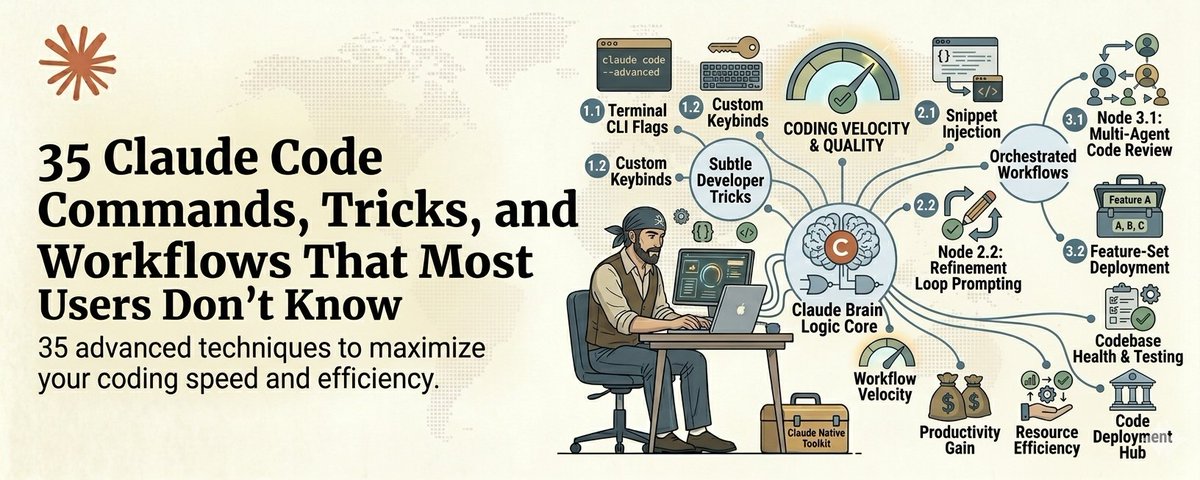
type 2: knows all 35 commands, tricks, and workflows. ships faster than a team of 5.
type 1 gets replaced in 12 months.
type 2 does the replacing.
I wrote a full guide on how to start. zero experience needed.

Austin AI Hub retweeted

This 2 hours Stanford lecture shows exactly how Stanford trains its engineers to build AI agents, prompts & RAGs. It will teach you more than every Claude & AI tutorials you've seen combined.
Bookmark & give it 2 hours this weekend. It'll be the most productive thing you do.
Austin AI Hub retweeted

This 30-min workshop by the creator of Claude Code will teach you more about vibe-coding than 100 YouTube video guides.
Bookmark it & give it 30 minutes today. This video will change the way you use Claude forever.

AI weather bot turned $240 → $82K on Polymarket weather markets
trained my agent, based on bot 2K trades, to build it from scratch
installed it on VPS, plugged weather API + Opus 4.7 & gave it Polymarket acc
in 2 days he found 2x - 400% ROI trades
run your agent in 5 steps:
• set up a VPS on Hetzner - $5.99
• plug weather API on {visualcrossing} - free
• run Hermes agent using one-liner code - free
• connect TG bot + Opus 4.7
• promt {weather trading logic} from article to agent
hermes is a self-trained agent, it needs enough trades {50-100} to build the best trading setup
start small {$2-$3} limit per trade across 20 weather markets, and let the agent do the rest
bot used for traning: polymarket.com/@automatedAIt…
my agent: polymarket.com/@hermesweathe…
In 2 days, the bot already made 2 trades with +400% ROI and keeps improving quality of trading

Austin AI Hub retweeted
This 30-minute speech by the Head of Anthropic "Coding Agents" researcher will teach you more about vibe coding than 100 paid courses.
Bookmark it & give it 30 minutes today. This video will change the way you use AI forever,
This weather bot turned $300 → $122K on Polymarket weather markets in 3 months
I fully decoded algo and built a self-learning Hermes weather trading agent
using weather APIs + Opus 4.7, the bot runs 5-min scans & searches mispricings on Polymarket
run your agent in 5 steps:
• set up a VPS server on Hetzner - $6
• create a weather API on {visualcrossing} - free
• set up Hermes agent using one-liner code - free
• connect Telegram bot + Opus 4.7
• send {weather trading logic} from article to agent
started my agent 2 days ago with a test sum and already having 40% profit
agent already caught 2 traders with +400% ROI on Seoul & Chicago weather markets
bot used for logic: polymarket.com/@coldmath?via…
my bot test wallet:
polymarket.com/@hermesweathe…
Hermes bot is a self-learning agent so give him enought trades {100+}, to build his own logic. start small

Austin AI Hub retweeted

Introducing Claude Design by Anthropic Labs: make prototypes, slides, and one-pagers by talking to Claude.
Powered by Claude Opus 4.7, our most capable vision model. Available in research preview on the Pro, Max, Team, and Enterprise plans, rolling out throughout the day.
Austin AI Hub retweeted

Instead of watching Netflix tonight, watch this 2-hour Stanford lecture.
You’ll learn more about how ChatGPT, Claude, and other LLMs are built than most people at top AI companies learn in years.
Austin AI Hub retweeted

Stop writing 500-word prompts that don't work.
Here's the exact 3-part structure that works better:
Part 1: Context (.md) files.
Part 2: Clear instructions.
Part 3: "Don't start yet - ask me questions first."
That's it. But most people skip all three. Here's what each one fixes:
Part 1 - Context files.
Step 1. Create a file called "ABOUT ME."
Step 2. Put in your role, audience, goals, and tone.
Step 3. Create a second file: "WRITING STYLE."
Step 4. Add 3–5 examples of your best past writing.
Step 5. Save both as .md files.
Step 6. Upload them before you type a prompt.
Step 7. It knows who you are before it writes a word.
Part 2 - Clear instruction.
Step 1. State the task in one sentence.
Step 2. Name the format. (Post, email, thread, ad.)
Step 3. Name the audience. (Founders, marketers.)
Step 4. That's your prompt. Not 500 words. 3 lines.
Part 3 - "Ask me questions first."
Step 1. Add this line at the end of every prompt:
"DO NOT start writing yet. Ask me clarifying questions first."
Step 2. Claude will ask 3–6 questions.
Step 3. Answer them by clicking buttons.
Step 4. Now Claude writes something that actually sounds like you said it.
Or skip all of that. To download my exact files:
Step 1. Go to how-to-ai.guide.
Step 2. Subscribe for free. Don't pay anything.
Step 3. Open my welcome email.
Step 4. Hit the automatic reply button inside.
Step 5. Download my .md files. Upload to Claude.
✦ Here's why your current prompts fail (red flags):
"Write me a LinkedIn post about AI tools."
"Make it engaging and professional."
"Keep it under 200 words."
One sentence. No context. No style. No voice.
You gave Claude nothing to work with.
That's like handing someone a blank page & saying, "write something amazing." No reference, examples & direction.
The fix isn't a longer prompt. It's a smarter setup.
Bad prompt: one vague sentence → generic AI slop.
Better prompt: clear task + "ask me questions first"
Best prompt: .md files + clear task + "ask me questions first" → sounds like you wrote it.
To get my exact files, subscribe to how-to-ai.guide.
♻️ Repost to help one person, prompt better.


Austin AI Hub retweeted

15 AI related accounts you should follow on Twitter:
1. @karpathy
His tweets already create LLMs narratives that you later see on linkedin in 2 months.
2. @fchollet
posts thoughtful research on intelligence, benchmarks, and AI limitations. Keras creator + ARC-AGI
3. @ylecun
Yann LeCun is Deep learning pioneer & Meta Chief AI Scientist; big-picture research takes and critiques (and drama).
4. @AndrewYNg
Andrew Ng is AI education legend; practical ML advice, courses, and real-world implementation. creator of deeplearning ai
5 @rasbt
Sebastian Raschka posts on Practical ML/LLM implementations, "build from scratch" tutorials, and books.
6. @dair_ai
Weekly ML/AI paper threads and accessible research explainers (high-signal for staying current).
7. @lilianweng
Lilian Weng is ex-OpenAI and her Lil'Log-style threads are good. has In-depth LLM research breakdowns
8. @jeremyphoward
posts interesting takes on AI/crypto news, and works on democratizing practical deep learning and accessible education.
9. @simonw
Simon post Practical LLM tools, takes, experiments, prompting, and engineering breakdowns. django co-founder
10. @_akhaliq
Curates the latest arXiv papers, model releases, and open-source AI drops.
11. @ID_AA_Carmack
AGI/low-level optimization takes that makes you think about the problem.
12. @gwern
Really high-quality long-form AI research notes and essays.
13. @goodside
LLM evaluation, prompting research, and real capabilities testing
14 @drfeifei
Computer vision pioneer; human-centered AI and spatial intelligence research
15 @demishassabis
Been following his work for 9 years. Demmis is my hope against google usurpating their power with AI. Demmis is google DeepMind's CEO
Let me know who I missed guys
Austin AI Hub retweeted

New course: Spec-Driven Development with Coding Agents, built in partnership with @jetbrains, and taught by @paulweveritt.
Vibe coding is fast, but often produces code that doesn't match what you asked for. This short course teaches you spec-driven development: write a detailed spec defining what to build, and work with your coding agent to implement it. Many of the best developers already build this way.
A spec lets you control large code changes with a few words, preserve context across agent sessions, and stay in control as your project grows in complexity.
Skills you'll gain:
- Write a detailed specification to define your mission, tech stack, and roadmap, giving your agent the context it needs from the start
- Plan, implement, and validate features in iterative loops using a spec as your agent's guide
- Apply the same repeatable workflow to both new and legacy codebases
- Package your workflow into a portable agent skill that works across agents and IDEs
Join and write specs that keep your coding agent on track!
deeplearning.ai/short-course…
Austin AI Hub retweeted

Instead of watching an hour of Netflix, watch this MIT professor deliver a brilliant masterclass on how to effectively present your ideas with clarity, impact, and purpose.
Austin AI Hub retweeted

这场长达2小时的斯坦福讲座,清晰呈现了斯坦福如何训练工程师构建AI系统。它比你见过的所有Claude教程和提示词帖子都更实用。
收藏它,花2个小时认真看完,无论如何都值得。这将是你这周做过的最有价值的事。

Austin AI Hub retweeted
Research papers you must read for AI Engineer interviews:
1. Attention is all you need (Transformers)
2. LoRA (Low rank adaption)
3. PEFT ( Parameter Efficient Fine Tuning)
4. VIT (Vision Transformers)
5. VAE (Variational Auto Encoder)
6. GANs ( Generative Adversarial Networks)
7. BERT ( Bidirectional Encoder Representation from Transformers)
8. Diffusion Models (Stable Diffusion)
9. RAG (Retrieval Augment Generation)
10. GPT (Generative Pre-trained Transformers)
Austin AI Hub retweeted

Everyone wants to “learn AI”
But they keep consuming surface-level content.
If you actually want to build, start here:
9 serious AI Engineering books with full GitHub repos
1. AI Engineering
github.com/chiphuyen/aie-boo…
2. Prompt Engineering for Generative AI
github.com/m-p-p-t/prompt-en…
3. LLM Engineer’s Handbook
github.com/PacktPublishing/L…
4. Designing Machine Learning Systems
github.com/chiphuyen/dmls-bo…
5. Build a Large Language Model (From Scratch)
github.com/rasbt/LLMs-from-s…
6. Building LLMs for Production
github.com/louisfb01/start-l…
7. Hands-On Large Language Models
github.com/handsOnLLM/Hands-…
8. Prompt Engineering for LLMs
github.com/jberryman/prompt-…
9. The AI Engineering Bible
github.com/Thomas-Caldwell/A…
These aren’t “read once and forget” books.
They’re the kind you: • build alongside
• revisit often
• actually level up from
Save it.
Come back when you’re ready to build.

Austin AI Hub retweeted
The anti-AI coalition continues to maneuver to find arguments to slow down AI progress. If someone has a sincere concern about a specific effect of AI, for instance that it may lead to human extinction, I respect their intellectual honesty, even if I deeply disagree with their position. However, I am concerned about organizations that are surveying the public to find whatever messages will turn people against AI, and how the public reacts as these messages are spread by lobbyists or by politicians seeking to alarm constituents, companies pursuing regulatory capture or seeking to promote the power of their technology, and individuals seeking to gain attention or to profit by being provocative.
A large study (link in original article below; h/t to the AI Panic blog) by a UK group tested different messages that are designed to raise alarm about AI. Their study found that saying AI will cause human extinction has largely failed. Doomsayers were pushing this argument a couple of years ago, and fortunately our community beat it back. But AI-enabled warfare and environmental concerns resonate better. We should be prepared for a flood of messages (which is already underway) arguing against AI on these grounds. Further, job loss and harm to children are messages that motivate people to act.
To be clear, I find AI-enabled warfare alarming; we need to continue serious efforts to monitor and mitigate the environmental impact of AI; any job losses are tragic and hurt individuals and families; and as a father, I hold dearly the importance of every child’s welfare. Each of these topics deserves serious attention and treatment with the greatest of care.
But when anti-AI propagandists take a one-sided view of complex issues to benefit their own organizations at the expense of the public at large — for instance, when big AI companies argue that AI is dangerous to block the free distribution of open source projects that compete with their offerings — then we all lose.
For example, public perception of data centers’ environmental impact is already far worse than the reality — data centers are incredibly efficient for the work they do, and hampering their buildout will hurt rather than help the environment. While job loss is a real problem, the “AI washing” of layoffs — in which businesses that had over-hired during the pandemic blame AI for recent layoffs, although AI hasn’t yet affected their operations — has led to overblown fears about the impact of AI on employment.
Unfortunately, this sort of propaganda easily leads to regulations that create worse outcomes for everyone. For example, oil companies worked for years to create fear of nuclear energy. The result is that overblown concerns about the safety of nuclear power plants has stifled nuclear power development, leading to millions of premature deaths from air pollution that was caused by other energy sources and a massive increase in CO2 emissions. Let’s make sure overblown concerns about AI do not lead to a similar fate for the many people that would benefit from faster AI development.
Last week, the White House proposed a national legislative framework for AI. A key component is a federal preemption framework to prevent a patchwork of state regulations that hamper AI development. I support this.
After failing to gain traction at the federal level, a lot of anti-AI propaganda has shifted to the state level. If just one of the 50 states passes a law that limits AI in an unproductive way, it could lead to stifling AI development across all the states and potentially across the globe. The White House proposal rightfully respects each state’s rights to control its own zoning, how it enforces general laws to protect consumers, and how it uses AI. But if a state were to pass laws that limit AI development, federal rules would preempt the state law.
The White House proposal remains a proposal for now. However, if the U.S. Congress enacts it, it will clear the way for ongoing efforts to develop AI in beneficial ways.
Where do we go from here? Let’s support limiting applications — those that use AI, and those that don’t — that harm people. When the anti-AI coalition argues against AI, in addition to considering the merits of the argument, I consider whether their position is consistent and persuasive, or if they are just promoting whatever concerns they think will sway the public at a given moment. And, let’s also keep using a scientific approach to weighing AI’s benefits against likely harms, so we don’t end up with overblown concerns that limit the benefits that AI can bring everyone.
[Original text with links: deeplearning.ai/the-batch/is… ]

Austin AI Hub retweeted

How AI Is Turning the Tide Against Human Trafficking
1/3 Imagine a digital detective that never sleeps. AI can sift through mountains of data—think shady online ads, cryptic social media posts, or suspicious financial trails—and spot patterns humans might miss. AI’s trained to flag these red flags fast, connecting dots across platforms to expose networks. It’s like giving cops a superpower to catch predators before they strike.