

Energy, critical minerals & global supply chains. Focus on strategic resources and macro trends. Covering Vaca Muerta and the Lithium Triangle.
Joined February 2026
- Tweets1.2K
- Following103
- Followers2.7K
- Likes1.5K







Brazilian stocks trade at a 25% discount to their own history, and foreigners are still heading for the exit.
The Ibovespa sits at about 7.9 times forward earnings against a long-run average near 10.5, (~30% off this year high). Meanwhile the $EWZ has already given back about $1.8 billion of the roughly $4 billion it gathered between the two election rounds, and Brazil-dedicated funds lost $412 million last week alone.
Locals aren’t stepping in either. Domestic equity funds keep posting outflows, while fixed income funds pulled in about R$72 billion in a single week on preliminary data, which makes sense with the Selic at 13.75% and the Copom signaling that its restrictive stance will stay in place for a while.
As I see it, if Lula 4 seems more like Lula´s first term, this may rhyme with 2002, when election fear pushed Brazilian assets to extreme discounts and the turn only came once fiscal credibility showed up. However, cheap is a necessary condition, not a catalyst, and right now the catalyst is missing. So the market is watching who Lula picks to run the Finance Ministry, as a test of how credible any commitment to fiscal orthodoxy really is.
$EWZ #Brazil #Ibovespa


Morgan Stanley downgraded Brazil to Equal-weight, as a highly likely policy continuity scenario for the country increases pressure on fiscal risk.
> Brazil could face an increasingly challenging macroeconomic set-up: weaker currency, higher interest rates, and a slowing economy in need of an unlikely fiscal rebalancing.
> Despite the supportive global backdrop, MS expect sharp derisking to weigh on valuations.
> Why not UW Brazil?: Strong export story of Brazil, which together with the large banking sector, limit the downside of aggregate Brazilian earnings.
> Prefer to play the external side of the Brazilian
stock market, which has a lower cost of capital and its growth drivers are more linked to commodity prices than to domestic politics.
> Remain OW Chile and Argentina.
$EWZ $ARGT $ECH

Austral Research retweeted
+3 million tonnes of extra scrap and copper is still 1.5 Mt short in 2032.
With grades falling, new mines taking ages and Chile cutting again, the market is counting on recycling to fill the hole. The bet is that high prices will pull scrap out of every junkyard and close the gap. Whether that actually happens is probably the most underrated part of the copper story.
We've seen that movie before. When copper hit its old record near $10,190/t in Feb 2011, dealers dumped hoarded scrap into the market, and scrap's share of supply peaked around 40% in 2012. This time there's little hoarded scrap left, and more countries are limiting scrap imports and exports.
What Morgan Stanley is seeing
Scrap is already about 35% of global copper supply, up from 30% in 2020. Almost all the recent growth came from smelters mixing scrap with concentrate, because there isn't enough ore to go around. Their model already assumes just over 3 Mt of extra scrap by 2032, and the market still ends 1.5 Mt short.
The math
MS sees demand going north by about 7.2 Mt between 2026 and 2032. Roughly 2.35 Mt is covered by scrap going straight into fabrication, so refined demand needs about +4.85 Mt. Refined supply only adds about 3.6 Mt, so the deficit grows by about 1.25 Mt over the period, leaving the market 1.5 Mt short in 2032 (which implies a ~0.25 Mt deficit in 2026).
And here's the key. That 2.35 Mt of direct use is an optimistic Woodmac forecast, betting on AI and better sorting tech, for a line that has been flat for 15 years. If it delivers, say, only half, my back-of-the-envelope says the deficit widens by about 2.4 Mt instead, roughly double.
Why scrap is harder to mobilise now
China tightened VAT invoicing rules on scrap, so compliant domestic scrap dried up and its refined output growth slowed to 2.6% YTD from 11% in 2025, per MS. The US, the world's biggest scrap exporter, plans to keep 25% of its high-grade scrap at home, and Malaysia, Thailand and Europe are all tightening scrap trade. More scrap staying local sounds good, but the processing capacity isn't there yet.
Where I land
To me, the real takeaway isn't the 1.5 Mt. It's that the risk is asymmetric, because the base case already leans on scrap doing something it hasn't done in 15 years. If scrap underdelivers, MS skews toward its $16,500-17,000/t bull case for 2027/28.
LME 3-month copper trades around $13,700, a bit under this year's records above $14,500. I'm structurally bullish on a 2-3 year view, but I wouldn't chase short-term rallies driven by macro headlines.
What I'm watching
Any easing of China's invoicing rules, the scrap discount to LME (narrowing means scarcer scrap), and whether the US plan to keep 25% of its high-grade scrap at home actually comes with the processing capacity to use it.
Is scrap the next bottleneck nobody is pricing?
#Copper #Commodities

Chile’s copper production woes will continue to tighten supply and put upward pressure on prices heading into next year.
Codelco has produced just 57% of its 1.34Mt annual target as of August, putting it on pace for roughly 1.14Mt this year. August own-mine output fell 11% from July to 92.9kt, despite rising 9% YoY.
El Teniente’s output held steady, but Escondida continued to show weakness, with another production decline in August.
Chile’s total copper output fell 8.5% MoM and 13% YoY as El Niño-related weather disruptions persisted, while strike risks remain elevated heading into 2027.
In 2025, the two mines accounted for roughly 7% of global mined copper production, combined.
We have yet to grasp the full scale of the supply squeeze looming over the global copper market.
Via JPM
#Copper


Austral Research retweeted
🇦🇷 Political Risk 2027
Minister Luis Caputo attributed part of the recent rise in country risk to investor concerns about the 2027 presidential elections.
He also noted that, if Milei wins a second term, the Government will seek to completely eliminate agricultural export duties.
The proposal could be a major incentive for the export sector, although it would depend on political continuity and on the fiscal capacity to offset the loss of revenue.
Argentine assets staged a significant recovery over the past few sessions, driven by an improved international backdrop and reduced selling pressure during the local holidays.
The sovereign recovery is positive, but it does not yet eliminate the political risk premium that investors are building in ahead of 2027. The evolution of local flows will be key to determining whether the rally can be sustained.
Global Bonds gained an average of 2% between Thursday and Tuesday, far outperforming other emerging-market bonds. Meanwhile, Argentina’s country risk stood at 852 bps as of November 11, down 0.12% on the day, according to J.P. Morgan’s EMBI.
By contrast, Argentine equities showed a more modest performance: ADRs rose 0.75% on average, versus gains of 4.3% for $EEM and 1.6% for $ILF.
Today’s main event will be the Treasury auction of ARS 10.6 trillion in maturities (roughly US$6.9 billion), which will help gauge private demand for peso instruments after the sharp liquidity strains of last week.
$ARGT @BondTerminal

Morgan Stanley Says Argentina Bonds Price In Too Much Pessimism.
The selloff in Argentina’s debt amid a dramatic shift in expectations ahead of the country’s presidential election next year has gone too far, according to
MS.
The country’s sovereign bonds currently imply a 41% to 52% probability of the bank’s bear-case scenario, up from just 11% to 20% three months ago, strategist Simon Waever wrote in a report Tuesday.
That scenario, he says, assumes a two-thirds probability that the South American nation muddles through and a one-third chance of default.
“Pricing already close to 50% of the bear case outcome for most bonds a little less than a year out from the actual elections is not warranted,” Waever said.
That “looks like an overshoot driven by positioning unwind, even if data and domestic sentiment have been weaker than anticipated.”

Austral Research retweeted
Morgan Stanley Says Argentina Bonds Price In Too Much Pessimism.
The selloff in Argentina’s debt amid a dramatic shift in expectations ahead of the country’s presidential election next year has gone too far, according to
MS.
The country’s sovereign bonds currently imply a 41% to 52% probability of the bank’s bear-case scenario, up from just 11% to 20% three months ago, strategist Simon Waever wrote in a report Tuesday.
That scenario, he says, assumes a two-thirds probability that the South American nation muddles through and a one-third chance of default.
“Pricing already close to 50% of the bear case outcome for most bonds a little less than a year out from the actual elections is not warranted,” Waever said.
That “looks like an overshoot driven by positioning unwind, even if data and domestic sentiment have been weaker than anticipated.”


+3 million tonnes of extra scrap and copper is still 1.5 Mt short in 2032.
With grades falling, new mines taking ages and Chile cutting again, the market is counting on recycling to fill the hole. The bet is that high prices will pull scrap out of every junkyard and close the gap. Whether that actually happens is probably the most underrated part of the copper story.
We've seen that movie before. When copper hit its old record near $10,190/t in Feb 2011, dealers dumped hoarded scrap into the market, and scrap's share of supply peaked around 40% in 2012. This time there's little hoarded scrap left, and more countries are limiting scrap imports and exports.
What Morgan Stanley is seeing
Scrap is already about 35% of global copper supply, up from 30% in 2020. Almost all the recent growth came from smelters mixing scrap with concentrate, because there isn't enough ore to go around. Their model already assumes just over 3 Mt of extra scrap by 2032, and the market still ends 1.5 Mt short.
The math
MS sees demand going north by about 7.2 Mt between 2026 and 2032. Roughly 2.35 Mt is covered by scrap going straight into fabrication, so refined demand needs about +4.85 Mt. Refined supply only adds about 3.6 Mt, so the deficit grows by about 1.25 Mt over the period, leaving the market 1.5 Mt short in 2032 (which implies a ~0.25 Mt deficit in 2026).
And here's the key. That 2.35 Mt of direct use is an optimistic Woodmac forecast, betting on AI and better sorting tech, for a line that has been flat for 15 years. If it delivers, say, only half, my back-of-the-envelope says the deficit widens by about 2.4 Mt instead, roughly double.
Why scrap is harder to mobilise now
China tightened VAT invoicing rules on scrap, so compliant domestic scrap dried up and its refined output growth slowed to 2.6% YTD from 11% in 2025, per MS. The US, the world's biggest scrap exporter, plans to keep 25% of its high-grade scrap at home, and Malaysia, Thailand and Europe are all tightening scrap trade. More scrap staying local sounds good, but the processing capacity isn't there yet.
Where I land
To me, the real takeaway isn't the 1.5 Mt. It's that the risk is asymmetric, because the base case already leans on scrap doing something it hasn't done in 15 years. If scrap underdelivers, MS skews toward its $16,500-17,000/t bull case for 2027/28.
LME 3-month copper trades around $13,700, a bit under this year's records above $14,500. I'm structurally bullish on a 2-3 year view, but I wouldn't chase short-term rallies driven by macro headlines.
What I'm watching
Any easing of China's invoicing rules, the scrap discount to LME (narrowing means scarcer scrap), and whether the US plan to keep 25% of its high-grade scrap at home actually comes with the processing capacity to use it.
Is scrap the next bottleneck nobody is pricing?
#Copper #Commodities
Chile’s copper production woes will continue to tighten supply and put upward pressure on prices heading into next year.
Codelco has produced just 57% of its 1.34Mt annual target as of August, putting it on pace for roughly 1.14Mt this year. August own-mine output fell 11% from July to 92.9kt, despite rising 9% YoY.
El Teniente’s output held steady, but Escondida continued to show weakness, with another production decline in August.
Chile’s total copper output fell 8.5% MoM and 13% YoY as El Niño-related weather disruptions persisted, while strike risks remain elevated heading into 2027.
In 2025, the two mines accounted for roughly 7% of global mined copper production, combined.
We have yet to grasp the full scale of the supply squeeze looming over the global copper market.
Via JPM
#Copper
🇦🇷 Political Risk 2027
Minister Luis Caputo attributed part of the recent rise in country risk to investor concerns about the 2027 presidential elections.
He also noted that, if Milei wins a second term, the Government will seek to completely eliminate agricultural export duties.
The proposal could be a major incentive for the export sector, although it would depend on political continuity and on the fiscal capacity to offset the loss of revenue.
Argentine assets staged a significant recovery over the past few sessions, driven by an improved international backdrop and reduced selling pressure during the local holidays.
The sovereign recovery is positive, but it does not yet eliminate the political risk premium that investors are building in ahead of 2027. The evolution of local flows will be key to determining whether the rally can be sustained.
Global Bonds gained an average of 2% between Thursday and Tuesday, far outperforming other emerging-market bonds. Meanwhile, Argentina’s country risk stood at 852 bps as of November 11, down 0.12% on the day, according to J.P. Morgan’s EMBI.
By contrast, Argentine equities showed a more modest performance: ADRs rose 0.75% on average, versus gains of 4.3% for $EEM and 1.6% for $ILF.
Today’s main event will be the Treasury auction of ARS 10.6 trillion in maturities (roughly US$6.9 billion), which will help gauge private demand for peso instruments after the sharp liquidity strains of last week.
$ARGT @BondTerminal
Morgan Stanley Says Argentina Bonds Price In Too Much Pessimism.
The selloff in Argentina’s debt amid a dramatic shift in expectations ahead of the country’s presidential election next year has gone too far, according to
MS.
The country’s sovereign bonds currently imply a 41% to 52% probability of the bank’s bear-case scenario, up from just 11% to 20% three months ago, strategist Simon Waever wrote in a report Tuesday.
That scenario, he says, assumes a two-thirds probability that the South American nation muddles through and a one-third chance of default.
“Pricing already close to 50% of the bear case outcome for most bonds a little less than a year out from the actual elections is not warranted,” Waever said.
That “looks like an overshoot driven by positioning unwind, even if data and domestic sentiment have been weaker than anticipated.”
Morgan Stanley Says Argentina Bonds Price In Too Much Pessimism.
The selloff in Argentina’s debt amid a dramatic shift in expectations ahead of the country’s presidential election next year has gone too far, according to
MS.
The country’s sovereign bonds currently imply a 41% to 52% probability of the bank’s bear-case scenario, up from just 11% to 20% three months ago, strategist Simon Waever wrote in a report Tuesday.
That scenario, he says, assumes a two-thirds probability that the South American nation muddles through and a one-third chance of default.
“Pricing already close to 50% of the bear case outcome for most bonds a little less than a year out from the actual elections is not warranted,” Waever said.
That “looks like an overshoot driven by positioning unwind, even if data and domestic sentiment have been weaker than anticipated.”
Austral Research retweeted
Argentina pumped a record 973,700 barrels a day in September, as Brent closed the week at $117, up 95% this year.
You would expect Vaca Muerta stocks to be flying.
Since May, Brent is up 8.75%. $YPF is up 8.34%. $VIST is down 1.66%. $PAM is down 8.33%.
$YPF reported close to $1.2B in Q3 profit and pitched $44B in new RIGI projects.
$VIST says output rose 33%.
Meanwhile $ARGT still fell more than 9% this week, as Brazil's Ibovespa plummeted 18%.
The barrels are priced in dollars, but the stocks are priced in country risk.
In short, Vaca Muerta trades as LatAm first and oil second.
$YPF $VIST $PAM


Austral Research retweeted
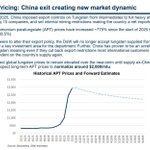
Since 2025, Beijing has tightened export controls on tungsten, licensed only 15 companies and restricted domestic mining.
From 2027, the U.S. defense sector will no longer accept Chinese tungsten for key applications, as APT prices went x8 since the beginning of the year.
The shift is now structural, with NATO members having committed to raise defense and security spending to 5% of GDP by 2035 and the U.S. seeking to rebuild its tungsten stockpile.
This creates an opportunity for Western operators, but only for those capable of delivering real supply, as new projects still face years of permitting, financing and construction.
Reliable origin, available capacity and speed to market increasingly matter more than access to the cheapest supplier.
#Tungsten

The U.S. National Defense Stockpile once held more than 37,000 tonnes of contained tungsten.
It now holds ~3,500 tonnes.
The drawdown began after a 1992 determination that more than 99% of the inventory exceeded requirements.
Sales started in 1999 and continued as China consolidated its position across tungsten mining and refining.
The policy direction has now reversed and high prices can attract capital, but the physical capacity constraint cannot be resolved immediately.
The U.S. has no operating tungsten mine, while China accounts for 79% of mine production and approximately 85% of APT (intermediate material used across most tungsten applications) refining capacity.
Meanwhile, the U.S. is rebuilding its defense stockpiles, with a domestic supply base largely disappeared and Chinese export restrictions trightening.
Tungsten is moving from an overlooked industrial metal to a strategic bottleneck.
#Tungsten #Defense

Austral Research retweeted
YPF has officially filed its $8.73 billion RIGI application for the Bajo del Toro project in Vaca Muerta, teaming up with Vista Energy.
It marks the 4th massive investment project led by YPF to be submitted to the incentive regime, bringing YPF's total RIGI capex pipeline to over $87 billion.
The new initiative includes drilling 440 wells and is set to bring in $25 billion in exports during its lifetime.
Once it hits peak production, the block will pump 80,000 barrels of oil per day, adding 52 kbpd net to YPF and scoring the company nearly $1 billion in annual revenue.
$YPF $VIST 🇦🇷

During the Q3 earnings call, YPF’s Marín highlighted that currently daily production in Vaca Muerta reached 252,330 bpd, already above the year-end target of 250,000 bpd.
Total oil production in Argentina reached 973,700 bpd in September, a 15.5% y/y jump, bringing it close to the 1 Mbpd milestone.
Q3's shale oil production averaged 224,000 bpd, 32% higher than in the third quarter of 2025.
In Q2, shale accounted for 80% of total oil output (now 86%), and Marín said that, excluding the assets being sold, about 95% would come from Vaca Muerta.
Capex totaled $1,3 billion (-4% q/q; +26% y/y), with 70% allocated to unconventional operations.
The oil company’s expansion plan includes filing three new projects under the RIGI regime, covering five blocks in the northern part of the Neuquén formation: Bajo del Toro, Bajo del Toro Norte, Narambuena, La Escalonada and Rincón de la Ceniza. The total estimated investment is $44 billion over 26 years, with 2,200 wells to be drilled.
YPF closed the third quarter of 2026 with one of the best financial results in its history, driven by growth in shale production, lower operating costs and higher international crude prices.
Argentina’s largest oil company reported an adjusted EBITDA of $2.5 billion (+84% y/y), the second-highest in its history, while net income was close to $1.2 billion.
$YPF


Argentina pumped a record 973,700 barrels a day in September, as Brent closed the week at $117, up 95% this year.
You would expect Vaca Muerta stocks to be flying.
Since May, Brent is up 8.75%. $YPF is up 8.34%. $VIST is down 1.66%. $PAM is down 8.33%.
$YPF reported close to $1.2B in Q3 profit and pitched $44B in new RIGI projects.
$VIST says output rose 33%.
Meanwhile $ARGT still fell more than 9% this week, as Brazil's Ibovespa plummeted 18%.
The barrels are priced in dollars, but the stocks are priced in country risk.
In short, Vaca Muerta trades as LatAm first and oil second.
$YPF $VIST $PAM
Since 2025, Beijing has tightened export controls on tungsten, licensed only 15 companies and restricted domestic mining.
From 2027, the U.S. defense sector will no longer accept Chinese tungsten for key applications, as APT prices went x8 since the beginning of the year.
The shift is now structural, with NATO members having committed to raise defense and security spending to 5% of GDP by 2035 and the U.S. seeking to rebuild its tungsten stockpile.
This creates an opportunity for Western operators, but only for those capable of delivering real supply, as new projects still face years of permitting, financing and construction.
Reliable origin, available capacity and speed to market increasingly matter more than access to the cheapest supplier.
#Tungsten
The U.S. National Defense Stockpile once held more than 37,000 tonnes of contained tungsten.
It now holds ~3,500 tonnes.
The drawdown began after a 1992 determination that more than 99% of the inventory exceeded requirements.
Sales started in 1999 and continued as China consolidated its position across tungsten mining and refining.
The policy direction has now reversed and high prices can attract capital, but the physical capacity constraint cannot be resolved immediately.
The U.S. has no operating tungsten mine, while China accounts for 79% of mine production and approximately 85% of APT (intermediate material used across most tungsten applications) refining capacity.
Meanwhile, the U.S. is rebuilding its defense stockpiles, with a domestic supply base largely disappeared and Chinese export restrictions trightening.
Tungsten is moving from an overlooked industrial metal to a strategic bottleneck.
#Tungsten #Defense
Austral Research retweeted
Brazil could have the world’s highest VAT under Lula’s tax reform.
Brazil’s public spending watchdog (TCU) approved a higher than expected reference rate for the federal component this week.
The combined federal and subnational rate could reach 31.3%.
Things are moving fast in Brazil.


Austral Research retweeted
Global nonferrous exploration budgets are set to rise 33% this year to their highest level in more than a decade, led by gold and copper.
#Gold #Copper $GDX $GLD $COPX $CPER

Global shortages of metals essential to the energy transition are now expected to ease significantly, with nine of the 10 materials covered by BBG having sufficient long-term supply capacity through 2050.
Copper is the exception, with a looming deficit that could reach 44% of global demand by 2050 and a $332 billion investment gap in new mines.
#Copper $CPER $COPX


YPF has officially filed its $8.73 billion RIGI application for the Bajo del Toro project in Vaca Muerta, teaming up with Vista Energy.
It marks the 4th massive investment project led by YPF to be submitted to the incentive regime, bringing YPF's total RIGI capex pipeline to over $87 billion.
The new initiative includes drilling 440 wells and is set to bring in $25 billion in exports during its lifetime.
Once it hits peak production, the block will pump 80,000 barrels of oil per day, adding 52 kbpd net to YPF and scoring the company nearly $1 billion in annual revenue.
$YPF $VIST 🇦🇷
During the Q3 earnings call, YPF’s Marín highlighted that currently daily production in Vaca Muerta reached 252,330 bpd, already above the year-end target of 250,000 bpd.
Total oil production in Argentina reached 973,700 bpd in September, a 15.5% y/y jump, bringing it close to the 1 Mbpd milestone.
Q3's shale oil production averaged 224,000 bpd, 32% higher than in the third quarter of 2025.
In Q2, shale accounted for 80% of total oil output (now 86%), and Marín said that, excluding the assets being sold, about 95% would come from Vaca Muerta.
Capex totaled $1,3 billion (-4% q/q; +26% y/y), with 70% allocated to unconventional operations.
The oil company’s expansion plan includes filing three new projects under the RIGI regime, covering five blocks in the northern part of the Neuquén formation: Bajo del Toro, Bajo del Toro Norte, Narambuena, La Escalonada and Rincón de la Ceniza. The total estimated investment is $44 billion over 26 years, with 2,200 wells to be drilled.
YPF closed the third quarter of 2026 with one of the best financial results in its history, driven by growth in shale production, lower operating costs and higher international crude prices.
Argentina’s largest oil company reported an adjusted EBITDA of $2.5 billion (+84% y/y), the second-highest in its history, while net income was close to $1.2 billion.
$YPF
Brazil could have the world’s highest VAT under Lula’s tax reform.
Brazil’s public spending watchdog (TCU) approved a higher than expected reference rate for the federal component this week.
The combined federal and subnational rate could reach 31.3%.
Things are moving fast in Brazil.

Global nonferrous exploration budgets are set to rise 33% this year to their highest level in more than a decade, led by gold and copper.
#Gold #Copper $GDX $GLD $COPX $CPER
Global shortages of metals essential to the energy transition are now expected to ease significantly, with nine of the 10 materials covered by BBG having sufficient long-term supply capacity through 2050.
Copper is the exception, with a looming deficit that could reach 44% of global demand by 2050 and a $332 billion investment gap in new mines.
#Copper $CPER $COPX
Austral Research retweeted
Gold just had its worst October since 2008.
Spot slid as much as 3% on Friday to roughly $3,890, a one-year low and about 28% below the Jan 28 record.
Silver lost its $50 level for the first time since Nov 2025 and is down about 18% on the month.
Oil is up four months straight, core PCE is 3.1%, and traders are now pricing a December Fed hike.
Add AI-stock losses forcing funds to sell whatever is liquid, and this looks more like a margin-call tape than a verdict on debasement, in my view.
Shakeout in a bull market, or the first leg of a regime change?
$GLD $SLV $GDX #Gold #Silver

Gold tumbled more than 25% since the US Iran conflict escalated, breaking below $4000 p/oz for the first time across three months.
Rather than divesting, market participants continue channeling capital into gold ETFs, lifting aggregate holdings toward 102m ounces.
Buyers keep adding gold even as stocks tumble and institutions sell to cover margin calls, suggesting higher pressure is coming from forced selling rather than deteriorating fundamental demand, and leaving room for a rebound once the broader selloff eases.
$GLD $IAU $GDX $GDXJ
