
8 years search engineer, 6 years AI infrastructure architect. Now indie https://teapawt.org/t.co/XNCz0JlWsE https://teapawt.org/t.co/jDrLHPMejh https://teapawt.org/t.co/SfQbkJJt4o
Joined December 2023
- Tweets450
- Following317
- Followers45
- Likes154







Google official local LLM inference engine for edge LiteRT-LM(github.com/google-ai-edge/Li…) has already supported MTP.

1
1
95
DeepSeek V4 Main features:
1. cost-effective 1M context length.
2. Performance rivaling the world's top closed-source models.
3. Still Efficient, and chip.
118


Claude Opus 4.7 comes.

Claude Opus 4.7 is out. the TL;DR
Anthropic released Opus 4.7 today.
Same pricing as 4.6 ($5/$25 per million tokens), available across API, Bedrock, Vertex AI, and Microsoft Foundry.
What changed vs Opus 4.6:
Coding (obviously). Biggest gains on the hardest, long-horizon software engineering tasks. Early testers report being able to hand off work that previously needed supervision. Opus 4.7 now verifies its own outputs before reporting back.
Vision. Accepts images up to 2,576px on the long edge (~3.75MP), over 3x more than any prior Claude. This is the real unlock for computer-use agents reading dense screenshots and diagram extraction.
Instruction following. Now interprets instructions literally. Anthropic explicitly warns: prompts tuned for 4.6 may break or produce unexpected output. Existing harnesses need re-tuning.
Memory. Better at file system-based memory across long multi-session work.
Real-world knowledge work. State-of-the-art on Finance Agent eval and GDPval-AA (third-party economically valuable knowledge work across finance, legal, etc).
New features shipping today:
xhigh effort level between high and max. Finer control over reasoning vs latency. Claude Code default is now xhigh for all plans.
Task budgets in public beta on the API.
/ultrareview in Claude Code. A dedicated review session that flags bugs and design issues. Three free for Pro and Max users.
Auto mode extended to Claude Code Max users. Claude decides on your behalf, less interruption, less risk than full skip-permissions.
The honest caveats:
New tokenizer means the same input maps to 1.0 to 1.35x more tokens depending on content type.
Opus 4.7 thinks more at higher effort levels, especially on later agentic turns. More output tokens.
Safety profile is roughly similar to 4.6. Improvement on honesty and prompt injection resistance, modestly weaker on over-detailed harm-reduction advice for controlled substances.
Still less capable than Claude Mythos Preview (was expected), which Anthropic is keeping on limited release. Opus 4.7 is the testbed for the cyber safeguards that will eventually enable a broader Mythos rollout.
tl;dr
Measured against 4.6, this is a meaningful upgrade in the three places that matter most to Anthropic's actual customer base: agentic coding reliability, vision for computer-use agents, and knowledge work benchmarks like GDPval-AA.
Solid upgrade, obviously shy to Mythos. Feels like a pretty good iteration-update!


51
Hermes, another OpenClaw has emerged, garnering over 7,000 GitHub stars in a single day.
Today I also submitted a new skill - docsagent(github.com/docsagent/docsage…), hoping to ride the Hermes rocket to new heights.


95
Awesome! Embedding is helpful for agent

I’m pleased to share that our search team has open sourced an embedding model called Harrier that is currently ranking #1 on the multilingual MTEB-v2 benchmark leaderboard.
Harrier delivers SOTA performance on retrieval quality, semantic matching, and contextual analysis across workloads, supporting more than 100 languages and handles long inputs up to 32K. It is built for the next generation semantic search for Bing and our web grounding (RAG) service for AI agents, which already powers nearly every major AI chatbot today.
As you can see in the leadership board, our Harrier model is currently ahead of other excellent models based on Gemini, Gemma, Llama, Qwen, and more. I’m grateful for the hard work of our team to get to this top ranking, and I’m excited to see all the healthy competition in the space, which should ultimately lead to more innovations that will benefit everyone.
Learn more: msft.it/6019QNB0b

38
DeepSeek is rolling out a limited V4 gray release. A new mode switcher now appears in the chat UI with three options: Fast Mode (default), Expert Mode and Vision Mode.
377
I have always been using Gemini CLI, it's true that the response time is a bit slow most of the time. Come on, you should grab market share from Claude Code, just like Gemini chased after ChatGPT.

Gemini CLI v0.36.0 Release Notes📝
We are aware some users are seeing long delays before the agent responds or high error rates. We apologize for this issue and are actively working on improving the situation and will update folks once we make progress.
• Subagents are now enabled (give them a try)🤖
• Refreshed UI ✨
• Faster startup times ⚡️
Read full notes below 👇
181
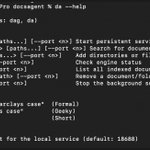
As your local knowledge base grows, you'll inevitably encounter headaches in data management. Today, I've open-sourced a very convenient CLI for local documents indexing and searching. It is completely free and open-source, github.com/docsagent/docsage….


LLM Knowledge Bases
Something I'm finding very useful recently: using LLMs to build personal knowledge bases for various topics of research interest. In this way, a large fraction of my recent token throughput is going less into manipulating code, and more into manipulating knowledge (stored as markdown and images). The latest LLMs are quite good at it. So:
Data ingest:
I index source documents (articles, papers, repos, datasets, images, etc.) into a raw/ directory, then I use an LLM to incrementally "compile" a wiki, which is just a collection of .md files in a directory structure. The wiki includes summaries of all the data in raw/, backlinks, and then it categorizes data into concepts, writes articles for them, and links them all. To convert web articles into .md files I like to use the Obsidian Web Clipper extension, and then I also use a hotkey to download all the related images to local so that my LLM can easily reference them.
IDE:
I use Obsidian as the IDE "frontend" where I can view the raw data, the the compiled wiki, and the derived visualizations. Important to note that the LLM writes and maintains all of the data of the wiki, I rarely touch it directly. I've played with a few Obsidian plugins to render and view data in other ways (e.g. Marp for slides).
Q&A:
Where things get interesting is that once your wiki is big enough (e.g. mine on some recent research is ~100 articles and ~400K words), you can ask your LLM agent all kinds of complex questions against the wiki, and it will go off, research the answers, etc. I thought I had to reach for fancy RAG, but the LLM has been pretty good about auto-maintaining index files and brief summaries of all the documents and it reads all the important related data fairly easily at this ~small scale.
Output:
Instead of getting answers in text/terminal, I like to have it render markdown files for me, or slide shows (Marp format), or matplotlib images, all of which I then view again in Obsidian. You can imagine many other visual output formats depending on the query. Often, I end up "filing" the outputs back into the wiki to enhance it for further queries. So my own explorations and queries always "add up" in the knowledge base.
Linting:
I've run some LLM "health checks" over the wiki to e.g. find inconsistent data, impute missing data (with web searchers), find interesting connections for new article candidates, etc., to incrementally clean up the wiki and enhance its overall data integrity. The LLMs are quite good at suggesting further questions to ask and look into.
Extra tools:
I find myself developing additional tools to process the data, e.g. I vibe coded a small and naive search engine over the wiki, which I both use directly (in a web ui), but more often I want to hand it off to an LLM via CLI as a tool for larger queries.
Further explorations:
As the repo grows, the natural desire is to also think about synthetic data generation + finetuning to have your LLM "know" the data in its weights instead of just context windows.
TLDR: raw data from a given number of sources is collected, then compiled by an LLM into a .md wiki, then operated on by various CLIs by the LLM to do Q&A and to incrementally enhance the wiki, and all of it viewable in Obsidian. You rarely ever write or edit the wiki manually, it's the domain of the LLM. I think there is room here for an incredible new product instead of a hacky collection of scripts.
61
Vincent retweeted

Introducing Gemma 4, our series of open weight (Apache 2.0 licensed) models, which are byte for byte the most capable open models in the world!
Gemma 4 is build to run on your hardware: phones, laptops, and desktops.
Frontier intelligence with a 26B MOE and a 31B Dense model!

I have just backed up the leaked claude code here github.com/ljeagle/claude-co…

1
135
Easily chat with 1,000+ documents in total privacy with zero data leakage—MyDocs(mydocs.bot) is your ultimate Claude cowork for absolute document intelligence.
32
Thanks @tom_doerr


25

