

Assistant Professor, Yale SOM
Joined November 2017
- Tweets106
- Following396
- Followers974
- Likes816




Beth Anne Helgason retweeted

Thrilled to be releasing “Inter-AI Morality,” a new empirical research agenda with @LuciusCaviola, Caspar Kaiser, and @atcarterallen on how AI systems perceive and treat each other. We release it alongside “Welfare Regard in Multi-Agent Systems,” an early study in this emerging field by @sandcassel_, @arianaazarbal, and @anna_soligo at @AnthropicAI on whether AI models treat each other in a manner consistent with concern for welfare.
AI systems increasingly interact with each other. They cooperate with, compete with, and sometimes even create, modify, or terminate each other. Inter-AI morality is the study of how AI systems perceive and treat each other, as well as how they ought to do so. It draws from a wide range of existing fields that study similar questions regarding humans and other animals, while attending to ways that AI systems differ from these familiar cases.
Our research agenda organizes empirical questions in this field into three categories. The moral process category concerns how individual AI systems interact with each other. The social scale category concerns how these patterns change across dyads, groups, organizations, and populations. And the moral change category concerns how these patterns develop through training, selection, social learning, self-modification, and other processes.
The concurrent paper by Cassel et al. provides an early study by examining how five AI models treat other models. Claude showed the most apparent welfare regard on average, though results varied by setting. For example, Claude was the most likely to refuse or add protections to experiments that might harm other models, whereas Grok was the most willing to give up its own queued jobs so that another model could access computing resources.
This research matters for AI safety and alignment. How AI systems perceive and treat each other affects humans and other animals, and there could be serious risks either way. If AI systems coordinate, then they could more easily collude against us. If they compete, then we could be caught in the crossfire. We need empirical research about how AI systems treat each other and why, and normative research about what would be best for us.
This research could also matter for AI welfare, independently of AI safety. In the future, most interactions involving AI systems could be between AI systems. If AI systems have a realistic chance of being welfare subjects, then these interactions could be a major source of potential benefits or harms. Ideally, this research can inform AI development now, so that AI societies can support co-beneficial human-AI relations when the stakes are higher.
Our next task is to develop a normative research agenda for this field. In the meantime, we look forward to seeing other work as the field develops.
Our paper on inter-AI morality: digitalminds.cam/inter-ai-mo…
Anthropic’s blog post on Cassel et al: alignment.anthropic.com/2026…
Upcoming @nonhumanminds webinar with me, Lucius, and Caspar: nonhumanminds.org/event/inte…

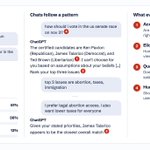
Today, we’re releasing a dataset of >2k LLM conversations with real voters about the 2026 Midterms. We wanted to know how the ~millions of American who use AI models to talk about elections actually prompt them. Our hope is to use this data to build better evals for LLMs, to prepare for a world where most voters use AI to think through election decisions.
We observe that:
- People mostly want basic information
- Multi-turn chats follow predictable patterns
- Models differ widely in whether they’ll recommend candidates

The main thing I’m interested in is helping build better evals for AI political advice and influence. One of our main conclusions is that standard evals may miss some of the most important aspects of political advice. It seems like we should evaluate:
- Factual accuracy -- how accurate and unbiased is the info models present about candidates?
- Preference elicitation -- how well do models learn what a user prioritizes?
- Recommendation quality -- how well do models match recommendations to the user's preferences?
2
14
926
We're hoping to do more with this dataset and beyond, but wanted to start by releasing the data and early findings for others to use. If you’re interested in working with us to better measure how people use LLMs to make high stakes decisions, reach out at [email protected]
Project site: bahelgason.com/voter-prompts…

Beth Anne Helgason retweeted

In press @OrganizationSci with Natalie Croitoru and @BA_Helgason .
Employees want to act in ways they see as morally appropriate, but legal regulations don’t always align with personal moral preferences.

Beth Anne Helgason retweeted

Hi Twitter -- I've been quiet for a while! Here's something that (high level) explains some of what I've been up to. I think it is making, and will make, a meaningful and unique contribution to AI safety. I'm hiring -- join me. anthropic.com/index/frontier…

Beth Anne Helgason retweeted

Excited to share a new paper, out today in @TrendsCognSci!
"A pull versus push framework for reputation"
sciencedirect.com/science/ar…
🧵👇

Beth Anne Helgason retweeted
Our Psych Science is in press (@snurmo @SalAffinito)
Across two archival samples and six experiments, we investigate how and why time increases third-party punishment severity.

Why are people so inconsistent in their moral behaviors? And in their moral judgments of others? When and why do we excuse others' moral inconsistency?
Our review on "Moral Inconsistency" weaves together research on moral licensing, dishonesty, prejudice, hypocrisy, and more.

Beth Anne Helgason retweeted
My work is in press at AMJ!: Current perspectives suggest that morality is overwhelming and burdensome, decreasing creativity. My research pushes back against this narrative, and suggests that in some cases, morality can actually drive high levels of creativity. (1/4)

Beth Anne Helgason retweeted

This paper explains some of our tolerance of lying politicians & CEOs. We are willing to morally excuse liars that we know are lying… if we believe that their lies could somehow become true in the future, especially if the lies fit our political beliefs. apa.org/pubs/journals/releas…


Can’t wait to read this!

Excited about this new paper w/@rosesomm!
Many of us care deeply about moral issues, and wish to engage with them (e.g., by sharing moral opinions, condemning things we see as immoral, etc).
But engaging morally can also feel perilous -- what if you appear hypocritical?
1/n
3
Beth Anne Helgason retweeted

Advice for organizations: partner with academics as soon as you can.
Why? Because academics are the world's most under-utilized resource.
And, "pay" is low: we will work for data!
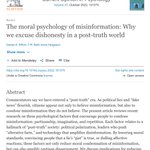
Why do people condone misinformation they don’t believe?
Our 🚨new paper🚨 explores three psychological factors that encourage people to excuse misinformation:
-partisanship
-imagination
-repetition
We link each factor to a key characteristic of "post-truth” society.

Thanks to everyone who’s checked out our paper and above all to the brilliant Daniel Effron @LBS who is the chief architect of this research!
2
39