

Using engineered immunity and synthetic immunology to investigate the underlying mechanisms of antibody-mediated treatment and prevention of infectious disease.
Cambridge, MA
Joined January 2017
- Tweets395
- Following361
- Followers3K
- Likes652




For the curious few who may want the raw data and code, please see here:
doi.org/10.5281/zenodo.18187…
ncbi.nlm.nih.gov/bioproject/…
Our results suggest that decreasing viral fitness may synergize with bNAbs when treating HIV infection. However,I want to stress that all of this work was done in humanized mice and in vitro, which may not entirely recapitulate results we might see in actual humans.
The result of this increased fitness cost was substantially better therapeutic efficacy of AAV-vectored VRC07 antibody, because the barrier to escape had been raised.

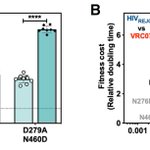
In experiments testing this pol mutation in combination with env escape mutations in envelope, we found that there was no impact on resistance benefit, but substantial increases in fitness cost, particularly with either combination of the two envelope mutations needed to escape.

To understand the contribution of viral fitness to VRC07 escape, we performed a similar experiment in mice that had been previously treated with escalating doses of antiretroviral drugs to induce escape, which occurs through a point mutation in HIV polymerase that lowers fitness.

To explore the contribution of sequence context to VRC07 escape, we created chimeric strains between the original strain and the second strain and found that sequences within the V5 loop seemed to dictate whether mutations in the D loop would result in partial or complete escape.

We then repeated these experiments with another strain and found that in contrast to the first experiment, none of the antibodies could suppress HIV replication. This was because individual mutations in this strain background enabled complete escape at minimal fitness cost.

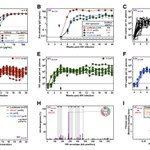
By integrating the area under the curve for each path and scaling this by the frequency with which we observed each mutation pattern, we were able to quantify an escape barrier score for each antibody and found that VRC07 posed a dramatically higher barrier than other bNAbs used.

We used these measurements of fitness cost and resistance benefits to generate "escapability" maps, showing the path taken by viruses during escape from bNAbs. This allowed us to visualize the much harder escape path posed by VRC07.

The escape mutations for N6 and PGDM had fairly limited fitness costs, but VRC07 escape mutations imposed significant penalties to viral growth.

After engineering these mutations back into the parent strain and testing their relative resistance to neutralization we found that individual mutations led to complete escape from N6 of PGDM1400, but VRC07 required at least two mutations.

When we sequenced the mutations that arose in the envelope gene from all of the mice exhibiting viral escape, we found that the virus had acquired at least two mutations in the case of VRC07, but only one mutation in the case of N6 or PGDM1400.

Deep dive:
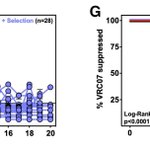
We used AAV vectors to stably express broadly neutralizing antibodies targeting HIV envelope in infected animals and found that they could be suppressed by only one of these antibodies (VRC07).

Also want to thank the team including Seo Bin Yoo, Yi Cao, Cailin Deal, Christine Boutros, Scott MacDonald, Yentli Soto Albrecht, Evan Lam, Maegan Sheehan, Dylan Parsons, Allen Lin, Martin Deymier, Jackie Brady, Ben Moon and Chris Bullock!
Many thanks to Nicolás Gálvez Arriagada and @adamnitido, who wrote this paper together as co-first authors, and who worked really hard to complete this story.
Our latest manuscript just came out in @ImmunityCP describing over a decade of work in the lab studying HIV evolution and escape from HIV broadly neutralizing antibodies.
authors.elsevier.com/a/1mgR9…
🤖 Made with AI

ALT HIV deciding whether to take the easy way, or the hard way around an antibody.
Proud to share our latest paper on SARS-CoV-2 vaccines and the variants that have emerged (and continue to emerge). Bottom line is the latest versions of the mRNA boosters are doing a pretty good job of keeping up with variants.
cell.com/cell-reports-medici…
We are looking for postdocs interested in working on this project to engineer polyclonal vectored antibody delivery!


Wonderful collaborative paper with the @DouamLab looking at SARS-CoV-2 infection in humanized mice!

New pre-print from the lab🥳🥳!! Amazing team effort between @DouamLab, @BalazsLab and Christelle Harly's group in Nantes. Congrats to @DevinKenney10 for spearheading the work. biorxiv.org/content/10.1101/…

Balazs Lab retweeted

Take a look at our new Giotto Suite spatial analysis platform and preprint! So grateful to work with such an amazing team. We started working on this massive project when I started my lab at @BUMedicine and @The_BMC in August 2020. Amazing collaboration with @gc_yuan lab.

Dear spatial afficionados, check out our latest contribution to the spatial data analysis landscape. In this work we present Giotto Suite, our completely new ecosystem designed to work with the most exciting and challenging spatial datasets. biorxiv.org/content/10.1101/…