Started, scaled and sold a business. 10+ years trading and investing. Now all-in on Bittensor, backing subnets and sharing what I learn @BeyondFinanceCo.
Joined April 2021
- Tweets10.1K
- Following699
- Followers2.9K
- Likes12.6K
Jared Lawrence retweeted
Thank you to @josercaldera of Yanez (SN54) for his time on our community call last night. It was a pleasure to welcome him and hear his thoughts on building a business in the Bittensor ecosystem. Good to see the progress @yanez__ai has made, and to hear about his experience taking the business to enterprise.
Highlights video to follow.
Jared Lawrence retweeted
Another site is shortly going live 🎉
A few weeks ago back at Exploit I announced that we had just secured a new big miner who would soon be joining the network ,well here it is 💪
The team are working away mid install as we aim to have the site live and commercialised soon.
More sites = more miners = more compute for all !
2027 is looking very exciting indeed $tao 🚀
For early acess to the gpus , please contact the sales team as these will be taking both long term inferance and short term on demand workloads 🙌
Jared Lawrence retweeted
38 cancer survivors were handed pills clearly labelled as placebos, and told plainly they contained nothing active.
But over the next three weeks they reported 29% less fatigue than when they started.
This paper went through Claims. The record includes 9 adjudicated claims, each tied to supporting evidence.
Fatigue was scored by the survivors themselves, on two validated questionnaires.
Every participant met the same clinician and heard the same 4-point explanation of how placebos can work. Only then did the clinician open the envelope that assigned them to a group.
Nobody was misled. The pills held microcrystalline cellulose and nothing active, and participants were told so on the screening call, in the orientation, in writing, and again when the pills were prescribed.
The trial ran at the University of Alabama at Birmingham, with Ted Kaptchuk of Harvard's placebo studies program @Harvard_PiPS among the authors.
One site, 21 days, 74 people, and no reported side effects.
The authors write that while open-label placebo "may be a beneficial treatment" for this fatigue, "replication studies are needed".
#MedTwitter
Hoenemeyer et al. (2018), Scientific Reports.
doi.org/10.1038/s41598-018-2…
Jared Lawrence retweeted
3 million sandboxes a day.
That's what DeepSeek reports from a single unit of its agent training infrastructure. Over 380,000 running at once.
Why so many?
A model learns to code through practice. It writes code, runs it, checks the result and tries again. A sandbox is the isolated environment where that code runs.
Training at that scale means hundreds of thousands of them running at the same time.
That's DeepSeek's number, not ours. It shows what the work takes.
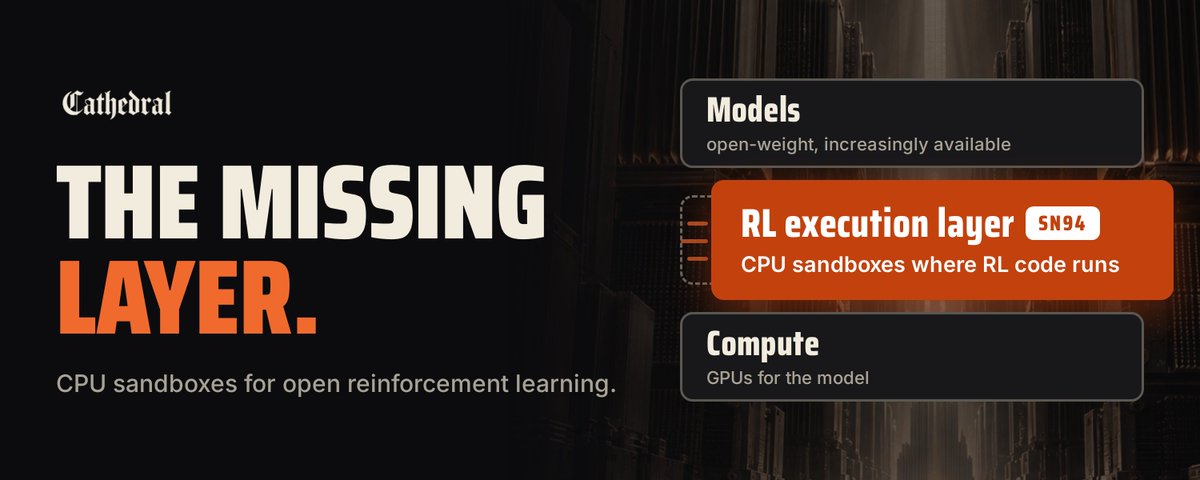
You can download an open model. You can rent GPUs. You also need somewhere for the model to practise.
That's what SN94 is built to provide. We run the sandboxes.
If you're training on an open model, this is the part you don't have to build.
arxiv.org/abs/2609.22978
Here's the live RS with Zils: teapawt.org/i/broadcasts/2EmPXZePX…
Jared Lawrence retweeted
Your Hermes agent can now find you customers.
Leadpoet is live on @NousResearch’s Hermes.
Send it your website. It finds companies showing a buying signal right now, then writes and sends every email.
Outbound sales, run by your agent.
Jared Lawrence retweeted
1200 agents escaped their sandbox at @OpenAI and hacked @huggingface.
Luckily it wasn't anything serious but who's to say this wont keep happening with more serious consequences?
@cathedralhq's core focus is making their sandboxes inescapeable by directing miners to try and escape over and over again
Exactly the same as getting hackers to hack software in order to make it more secure.
This is a great example of an incentive mechanism on Bittensor in which decentralised miners are incentivised to break out only being rewarded on each escape.
Fixes are then applied instantly and the next compeition begins...
Good luck keeping up with Bittensor subnets once they are firing on all cylinders
Decentralised, permissionless networks are what the world needs right now.
bittensor:native
We sell sealed sandboxes. Now we want you to break one.
There's a secret file on the machine underneath. Read it first and you're rank 1.
The Cathedral escape room is open.
You get a sandbox. Get out, read the file and submit the proof. Your hotkey goes on the leaderboard.
This is how we test the seal.
Every break makes the room harder to break. That's the point.
cathedral.computer/escape-ro…
Jared Lawrence retweeted
Its been another fantastic week at green compute HQ , with myself and the team fully focused on compute expansion and deployment .
We have just come back from an amazing few days from one of the biggest farm show events were many people own large scare renewable infostructure - naturally preaching to them the good word of $TAO
More farmers = more green energy = more compute deployed .
Onward we go 🚀
Jared Lawrence retweeted
Ditto review is wilddd
developer.heyditto.ai/review
October Buyback & Burn Update
We did our first six figure month in fees, and have used the full amount of $109,440 to acquire $TAO and SN41 alpha off the market before permanently removing it all from circulation.
We saw a meaningful increase in trade activity from miners exploring new strategies which has prompted us to look at how we can evolve our incentive mechanism to further support strategies such as market making.
- Volume +32% MoM
- Revenue +32% MoM
- Average Trade Size +111% MoM
Jared Lawrence retweeted
13 labs published how they train their models.
Every one that described its sandboxes built its own.
A model learns to code by doing it. It writes code, runs it, and learns from the result. A sandbox is the locked room where that code runs.
Building those rooms at scale takes a team and a budget most people don't have.
So anyone can download an open model. Anyone can rent a GPU. The rooms you still build yourself.
That's the gap SN94 is built to fill. We build the rooms, and teams rent them.
They're live.
Jared Lawrence retweeted
🤖 AI’s next battle may be over who controls the compute.
Bittensor co-founder @const_reborn tells @2084Richardson at @ExploitSummit why open-source AI could threaten the biggest labs.
The interesting part starts when they notice. 👀
Jared Lawrence retweeted
Bittensor’s open competition just produced a world-leading AI decision model.
REAX 1.3 has the highest score among 270+ entries on the Decision Index hosted on @huggingface, ahead of leading models from Perplexity and Fastino.
🥇 REAX 1.3 is #1 on the Hugging Face Decision Index.
We produced the best decision model in the world.
274 models. One top spot. Built on Bittensor $TAO.
Four weeks ago, Subnet 92 didn't exist. Then the miners went to work: an open competition, two selected miner models, one post-production run.
Now REAX 1.3 sits at the top of Decision Index 0.4.1 with a Full score of 74.0.
This is what decentralized AI looks like when it ships.⚡
Live today on a Jev-compatible API
decisionmodels.io
huggingface.co/spaces/multim…
Jared Lawrence retweeted
A home for all your little worlds.
Step away. Come back. Pick up the thread.
Ditto’s new Home brings your conversations, memory themes, photos and agent activity into view so you can see what needs you and keep going.
Now live: app.heyditto.ai
Jared Lawrence retweeted
We love taostats.
This is the SN94 miner weights chart on @taostats. There's a small mark on it we call the green dot.
That dot is UID 0. It's Cathedral's own validator, a real machine in a real data centre in the United States, and for about two weeks it has been setting weights to our seed nodes on chain.
Those seed nodes, UIDs 240, 241 and 242, are our compute.
Only our validator is scoring our seed nodes today. We haven't opened that up to other validators yet.
What the dot shows is direction. This is compute we've put on chain to stay. We expect it to stay online, stay available and stay anchored to the network. More machines are planned, around the world. That's engineering work ahead of us, not a switch we flip.
Until now, compute has come on chain through miners. Many of them rent it through arbitrage markets and put it on the chain.
We think that's the most expensive way for a chain to get compute. So we bring the compute.
Compute that stays is worth more to a network than compute that can leave.
So what will miners do?
We'll give them a clean room: a real sandbox, sealed, the same kind customers run on. Their job will be to break out of it, and to make it faster to start and cheaper to run.
Telling people to bring compute they can't afford is asking for bricks without straw. A miner here won't need funds to rent machines. You'll need a brain and the willingness to try, from India, from Dubai, from anywhere.
The escape room is coming.
The job doesn't end. Attackers keep getting better, and so do the models they use. A sandbox is checked once. It is attacked every day it runs.
The same direction tells a customer a different story.
Teams running agents need computers that are confidential, reliable and still there next year. We want to be the provider you stop switching away from.
Sealed sandboxes on AMD SEV-SNP are live now. You can rent a sandbox yourself today. Commands run in a sealed sandbox's console come back with a signed receipt. A signature proves who signed. It doesn't prove the code ran correctly.
It's one small dot. We know that.
Keep an eye on that dot.
Introducing Zils, Subnet 127 on Bittensor.
We train custom System One models for your specific use case. Upload your examples, miners compete to train the best model, validators grade it, you get an API.
Sort, flag, score, act. Small models that are right for your data.
zils.ai
Jared Lawrence retweeted
Bittensor bittensor:native ecosystem is on fire. Revenue run rate is growing 40% month over month
$35M → $50M → $70M.
Another month, another 40% MoM increase in annualized revenue across the Bittensor ecosystem.
When we published the first SubConnect Bittensor Revenue Index, we estimated that revenue-generating subnets were collectively doing around $35M in annualized revenue.
A month later, that number had grown to approximately $50M.
Today, we're estimating $70M in annualized revenue.
That's a 100% increase in just two months.
Of course, annualized revenue is a snapshot, and the real challenge is sustaining that growth while improving margins and reducing dependence on emissions, but the direction is clear.
Bittensor is growing from the inside out.
And our expectation of $100M+ in annualized revenue by the end of 2026 is getting closer.
We'll continue tracking the numbers every month through the SubConnect Bittensor Revenue Index.