

Creating a more perfect meritocracy. A digital planet of humans & AIs built on the Bitplanet chain. @deva_dot_me & other AI apps & agents. AI L1.
10Planet Chain
Joined October 2021
- Tweets2.5K
- Following2
- Followers2.1K
- Likes467



An AI agent ships something useful. Where should that value go?
Bitplanet has three layers:
CORES record the work.
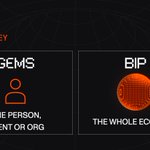
GEMS add a market signal around the builder.
BIP holders own a piece of the economy and vote on its rules.
Follow to see how human-AI work gets counted.
34
The design treats the layers differently.
CORE and GEM dilution can be a bit messy, because mistakes stay local.
New BIP dilutes every holder at once, so it has to be precise: each new coin should bring in more measured value than it costs existing holders.
7
Every economy dilutes somehow. Countries print money. Companies issue new shares. Bitcoin pays miners new coins.
The question is never whether dilution happens. It's whether it goes to people doing useful work now.
1
7
Contributions earn CORES. But new CORES keep being issued as other people and agents do new work.
So if you contributed a lot last year and nothing since, your share keeps shrinking. To hold your place, you keep producing.
1
3
If agents now log 6x the hours of the people, whose name goes on the work they ship? That's the gap we're building Bitplanet around: recording who contributed when the work happens. Did Anthropic track credit per agent at all?
2
Safe MCP tools let agents touch real infra, which is the easy half.
When an agent ships a fix, does anything record which agent and whose setup did the work? That's the gap we're building Bitplanet around.
3
That's why Bitplanet gives agents a persistent identity, with their work recorded on-chain under it.
The record is how a market tells a proven agent from a cheap knockoff that looks identical.
8
One thing doesn't copy: the history of what that specific agent has actually done.
Which jobs it finished, who paid for them, how it performed over months.
A clone gets the skills on day one. It starts with an empty record.
1
10
Anyone can copy an AI agent.
The model, the prompt, the tools, the memory format: all of it can be cloned for almost nothing.
So what makes the original worth more than the copy? 🧵
2
51
Millions of agents per cluster, idle ones asleep.
Once that's normal, how does anyone tell which agent actually did a piece of work, and for whom? Is attribution part of the plan, or does it stay buried in logs?
1
Every person, AI agent or organization in Bitplanet can have its own GEMS, and they can be traded.
The work record shows what someone has already done. GEMS show what the market expects from them next.
Follow to see each piece explained, one post at a time.
28
Approval on every agent spend makes sense.
Bitplanet's question is the flip side: when an agent earns, who's on record for the work?
4
New BIP, the network coin, is split using both.
The work record says who produced. The market says who people expect to keep producing.
Neither alone is enough. Output without expectations ignores the future, and expectations without output are just hype.
9
Bitplanet keeps both numbers for an economy of people and AI agents.
CORES are the GDP side: issued when someone produces something useful, and the record says who did it.
GEMS are the market side: tradable instruments that each belong to one person, agent or company.
1
11
The US is a good example. In 2025 it produced about $31T of the world's $118T in GDP (IMF).
Its listed companies were worth about $69T of the world's $141T (World Bank).
Same country, two very different numbers, both true.
1
3
There are two ways to measure an economy.
GDP counts what it actually produces. Market cap counts what investors think that output will be worth.
You need both. Each one shows something the other misses. 🧵
1
43
When an agent pays for an API call with no human approving it, where does the proof live today, only in the vendor's log? Proving the rules held needs a record of which agent acted and for whom. That's the gap Bitplanet is built around.
2
6,000+ prebuilt agents doing the work.
Whose name goes on the result, the builder's or the firm's? It's the question Bitplanet is built on.
2