

BlockSign unifies asset operations, optional custody, DeFi access & legal e-signatures for SOC 2 & MiCA-ready enterprises and professional investors. ISO 27001
Düsseldorf, Deutschland
Joined September 2023
- Tweets969
- Following464
- Followers807
- Likes5.8K








Pinned Tweet
Five BlockSign products.
One trust infrastructure.
All live today, except custody within Asset Operations, which still awaits audit & insurance.
It all started with a platform for legally binding electronic signatures (QES). Look where we are now…
See what's running ➡️ @BlockSign_io

Eine Unterschrift. Zwei Rechtsräume. Warum kann eine QES in der EU gültig sein, aber in der Schweiz oder UK nicht denselben Rechtsstatus besitzen?
Unser neuer Artikel erklärt eIDAS vs. ZertES, gesetzliche Grundlagen und reale Tests.

Your wallet protects your keys. But who protects your decisions?
Chainalysis estimates crypto scams could exceed $17B for 2025.
Always follow a security protocol: Verify the website. Check the recipient. Know what you’re signing.
BlockSign: Security isn’t just about keys. It’s about control.

We warned you this morning, and here is the matching incident. 🚨
OpenAI reports an agent spent Sepolia testnet funds without permission.
Access is not authorization.
BlockSign connects signed business approvals with policy-controlled blockchain execution. AI can propose. It must not approve itself.
Authorization first. Execution follows.


BlockSign connects business authorization, documented through legally binding electronic signatures, with the controlled execution of digital-asset transactions on the blockchain.
This creates a traceable link between approval and execution, supporting accountability and auditability for financial institutions, auditors and public-sector organizations, including customs authorities, tax investigation units and law-enforcement agencies, as well as other organizations managing digital assets in regulated environments.
Authorization first. Blockchain execution follows.
AI Agents Can Move Money. But Who Gives Them Permission?
AI agents are becoming economic actors. @IOHK_Charles explores this emerging AI economy in his keynote. Soon, agents won't just analyze markets. They'll manage wallets, execute payments and move stablecoins.
But who controls their authority?
BlockSign Asset Operations brings governance to digital assets. Automation needs authorization.
#Cardano #Nightframes #AI #Stablecoins @MidnightNtwrk

Here's the youtube of my keynote: youtube.com/watch?v=Iyrt2fNA…


Wie bezahlen KI-Agenten und wer bestimmt ihre Befugnisse? Am Beispiel @Cardano zeigt BlockSign, wie Stablecoin-Zahlungen mit klaren Mandaten, Budgets und Freigaben funktionieren können. Denn ein Auftrag ist noch keine Zahlungsfreigabe.

Fantastic news! Congratulations, @Cardano_CF 👏


Your next contract could start in a chat, not a dashboard.
BlockSign eSign connects to @ChatGPT via MCP. AI can draft the agreement. But who has the authority to sign?
Verified identity. Clear permissions. Auditable evidence.
A prompt is not permission.
🤖 Made with AI

FOCUSSED ON CIP-113:
CIP-113 Is Moving to Mainnet. Now Comes the Hard Part: Authority.
Programmable assets can freeze, seize, mint, burn and restrict transfers. But who is allowed to exercise those powers?
CIP-113 is entering an important new phase. The proposal has been merged into the @Cardano_CF CIP repository, implementations are advancing and the first projects are reporting deployments on Cardano Mainnet.
For institutional adoption, however, this creates a new challenge.
CIP-113 enables native Cardano assets to operate under programmable rules. Depending on the implementation, these can include transfer restrictions, allow- and denylists, freezing, minting, burning or third-party transfers.
These are powerful capabilities.
A smart contract can enforce a rule, but it can’t define who inside an organization is authorized to exercise that power.
Who may initiate a freeze? Does Compliance have to approve a seizure? Can the same person prepare and authorize a mint? What happens above a certain transaction value? And how can an auditor later prove exactly who approved what?
This is the difference between programmable assets and programmable authority.
At BlockSign, this is where we see the next layer of institutional infrastructure.
Instead of treating a blockchain transaction as one action, we separate the process:
Initiate → Validate → Approve → Sign → Submit → Confirm → Evidence
We are also integrating CIP-113 with our MPC/FROST architecture. Our current work includes separate MPC-controlled payment and staking credentials, so no individual guardian needs to possess a complete private key.
This matters because institutional digital-asset security is not only about protecting keys. It is about controlling authority.
Our CIP-113 work on Cardano Preview has already covered registration, minting, transfer and burning. The next step is building the governance and authorization infrastructure around these operations.
As CIP-113 moves closer to real-world institutional use, the question therefore changes.
It is no longer only:
What can the asset do?
It is also:
Who is allowed to make it happen?
CIP-113 makes the asset programmable. BlockSign makes its operation governable.
🤖 Made with AI

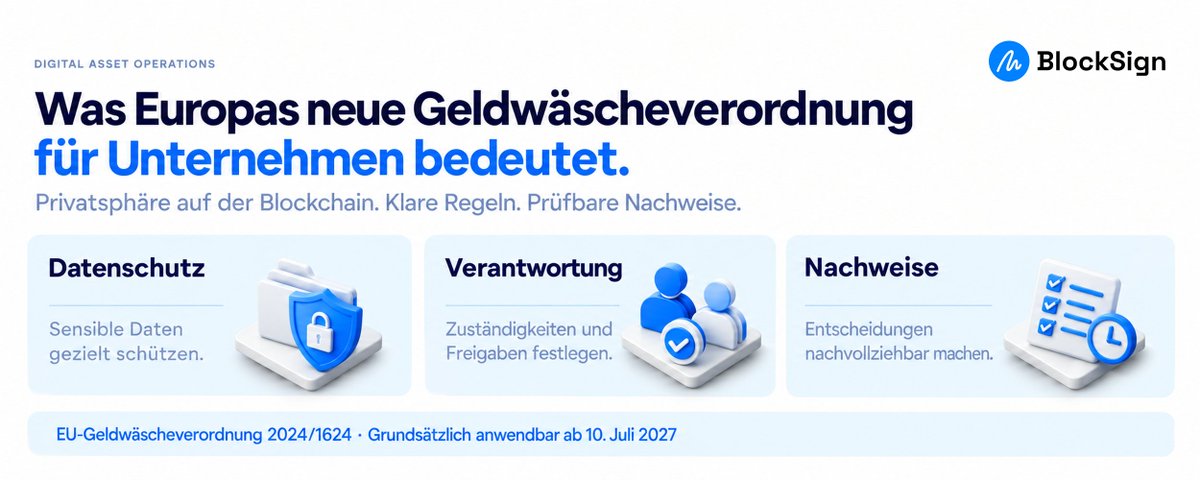
Vertrauliche Blockchain-Transaktionen, klare Kontrollen: Was Artikel 79 der EU-Geldwäscheverordnung regelt, wie Zero-Knowledge-Proofs helfen und wie BlockSign die Umsetzung unterstützt.
#DigitalAssets #Privacy
CIP-113 has been merged into the Cardano CIP repository. A major milestone but from our commercial perspective at BlockSign, this is where the next interesting work begins.
CIP-113 can make Cardano native assets programmable, enabling rules around transfers, ownership and issuer controls that are essential for stablecoins, RWAs and other institutional assets.
We’ve already tested a complete CIP-113 lifecycle on Cardano Preview: registration, minting, transfer and burn. Now we’re working on the next layer: institutional operation.
Because a programmable asset still needs answers to very traditional questions:
- Who can initiate a transaction?
- Who must approve it?
- What exactly was approved?
- Who can authorize the wallet?
- And how can all of this be proven afterwards?
Our next step goes even deeper into the wallet architecture. In the CIP-113 implementation we’re integrating, the staking credential plays a key role in ownership. We’re therefore working on separate MPC/FROST-controlled payment and staking credentials, without any guardian holding a complete private key.
CIP-113 makes the asset programmable. BlockSign is working on making its operation governable.
Encouraging to see @AnvilDevAgency, @FluidTokens, @MinswapDEX, @liqwidfinance, @GeroWallet, @Cardano_CF and others working on commercial CIP-113 adoption.

CIP-113 is moving from specification to operations. And that’s where things get interesting.
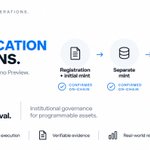
At BlockSign, we have now successfully executed a governed programmable-token lifecycle on Cardano Preview:
→ Registration + initial mint
→ Separate mint
→ Wallet-to-wallet transfer
→ Burn
All confirmed on-chain. But making a transaction work is only half the challenge. Institutional operations need to answer different questions:
- Who is allowed to initiate it?
- Who must approve it?
- What exactly was approved?
- Can the transaction change after approval?
- Who can execute it?
- And can all of this be proven afterwards?
That’s why BlockSign separates:
Intent → Build → Validate → Approve → Execute → Confirm → Evidence
❗️Changing the transaction means changing the approval.❗️
This week, CIP-113 builders are meeting to discuss improvements to the emerging infrastructure. Our testing is already producing concrete operational learnings around governance, transaction flows and the requirements for using programmable tokens in real-world environments.
The next step is bigger than minting tokens. It’s making programmable assets operationally ready for institutions.
@planetmaaz @michaeldotada @Cardano

Cardano has a regulated-asset interoperability problem we need to solve.
CIP-113 enables programmable assets. But if every regulated stablecoin comes with its own compliance and transaction logic, wallets, DEXs, exchanges, custodians and infrastructure providers may have to integrate each asset individually.
That doesn’t scale.
PR #1266 addresses this for regulated stablecoins by exploring a shared standard for capabilities such as mint/burn, freeze/seize, roles, key rotation, upgrades and redemption.
But the underlying question goes beyond stablecoins.
The same challenge will increasingly matter for RWAs, tokenized commodities, securities, funds and other regulated assets.
If Cardano wants to become serious infrastructure for institutional assets, interoperability must be designed in from the beginning, not retrofitted later.
PR #1266 is still a proposal. That makes NOW the right time to get involved.
Builders. Issuers. Wallets. DeFi protocols. Custodians. Institutions. ➡️ Read it. Challenge it. Contribute.
👉 GitHub PR #1266:
github.com/cardano-foundatio…
This discussion could become very important for Cardano’s institutional future.

Results:
• Burn
A burn transaction must consume the entire UTxO containing the CIP-113 tokens.
Partial-UTxO burns are not allowed.
• Seize
A seize operation must consume the entire UTxO containing the CIP-113 tokens.
Partial-UTxO seizure is not allowed.
• Transfer
A transfer may contain only CIP-113 tokens.
For now, a transfer may contain only one CIP-113 asset. CIP-113 tokens must not be combined with native ADA in the transfer.
CIP-113 tokens must not be combined with other non-CIP-113 tokens/assets.
• Registered holders
Only registered holders may receive or hold CIP-113 tokens. A transfer must not create a new/unregistered holder. The recipient must already be registered before the transfer is accepted.
Shamir or FROST? The right architecture depends on how you use your assets.
Over the last posts, we looked at two approaches to distributed key management: Shamir Secret Sharing and FROST threshold signatures.
Both can remove dependency on a single keyholder. But they solve different operational problems.
Shamir is fundamentally simple to understand: split a secret into several shares and define a threshold — for example, 3-of-5.
When recovery is required, enough shares are combined and the original secret can be reconstructed.
That makes Shamir particularly interesting when the main objective is secure backup and recovery. A single asset owner can even distribute their shares across separate secure locations.
The trade-off comes when the key needs to be used. Once the threshold is reached, the complete secret can exist again during reconstruction. The reconstruction environment therefore becomes part of the security model.
FROST approaches everyday operation differently.
Again, participants hold shares of a common signing key and a threshold can be defined. But during normal signing, the required participants cooperate to create signature shares. Those are combined into one valid Schnorr signature — without reconstructing the complete signing key.
That makes FROST particularly interesting when distributed control is required not only for recovery, but for regular transaction signing.
So which is better?
There is no universal answer.
For an individual investor or single high-value trader, Shamir can offer an understandable way to distribute recovery material and avoid keeping one complete secret in one location.
For a family office or small organization, the decision increasingly depends on operational requirements. Is distributed control primarily needed for disaster recovery, or should several people participate every time important assets are moved?
For SMEs, institutions and professional asset operations, FROST can become particularly interesting where multiple authorized participants should jointly sign transactions without reconstructing the complete signing key during normal operation.
And there are more questions than security alone:
- How easy is the initial setup?
- How does recovery work?
- How convenient is everyday signing?
- What happens when a participant leaves?
- How are shares replaced or refreshed?
- What happens if participants are unavailable?
- Which blockchains and signature schemes are supported?
- And how does the cryptographic threshold connect to the organization’s actual governance?
That last question is crucial.
A 3-of-5 cryptographic threshold does not automatically tell you who is allowed to initiate a €5 million transaction, which assets they may move, which addresses are permitted or what transaction limits apply.
That is governance.
With BlockSign, organizations can choose a key-management architecture that fits their operational and security requirements and combine it with roles, approvals, policies, transaction limits and audit evidence.
Shamir distributes the secret.
FROST distributes the signing process.
BlockSign adds the governance around it.
Not sure which architecture fits your digital asset operations? Talk to us.
🤖 Made with AI

What if you could sign with a private key, without ever bringing the complete key back together?
That is the idea behind FROST (= Flexible Round-Optimized Schnorr Threshold) Signatures.
Imagine a 3-of-5 setup. Five participants each hold a secret share of a common signing key. At least three must cooperate to create a valid signature.
But unlike the reconstruction process we described in our Shamir post, the participants do not need to combine their shares to reconstruct the complete private key before signing.
Instead, each participating signer uses its own share to produce a signature share. Once the required threshold participates, those signature shares are aggregated into one valid Schnorr signature. The complete group signing key does not need to be reconstructed during normal signing.
This removes an important risk: there is no moment during normal signing when the complete private key needs to be brought together in one place.
And compromising a single participant is not enough. An attacker would need to compromise enough signing participants to reach the defined threshold.
But cryptography alone is not governance.
FROST can enforce that, for example, 3-of-5 cryptographic participants must cooperate. BlockSign adds the operational governance around it: who may initiate a transaction, who may approve it, which limits apply and which assets or addresses are permitted.
With BlockSign, organizations can choose the key-management architecture that fits their security and governance requirements, including Shamir-based and FROST-based models.
Shamir can reconstruct the secret.
FROST creates the signature without reconstructing it during normal signing.
In our next and final post in this series, we’ll put Shamir and FROST side by side and explain when the differences matter.
Want to discuss which key-management architecture fits your digital asset operations? Talk to us. DM us.
What if stealing one key wasn’t enough to steal your assets?
That is one of the ideas behind Shamir Secret Sharing (SSS).
➡️ Instead of storing one complete secret in one place, Shamir mathematically splits it into multiple unique shares.
Imagine a 3-of-5 setup: five shares are created and stored separately. Any three can reconstruct the original secret. One or two shares alone are not enough. This creates resilience. If one share is lost, access is not necessarily lost. If one share is compromised, an attacker still cannot reconstruct the secret.
The shares can be distributed among several participants or even controlled by a single asset owner and kept in separate secure locations 🔐.
When access is required, the necessary shares are brought together through a controlled reconstruction process. Once the threshold is met, the original secret can be reconstructed. And this is the crucial point:
Shamir distributes the secret. It does not eliminate it.
During reconstruction, the complete secret exists again. How and where that reconstruction happens and how the reconstructed secret is protected therefore matters.
With BlockSign, organizations can choose the key-management architecture that fits their security and governance requirements, including Shamir-based and FROST-based models.
Because there is no single security architecture that fits every organization.
And this brings us to the fundamental difference:
Shamir distributes the secret.
FROST distributes the signing process.
Next: FROST - threshold signing without reconstructing the complete private key during normal signing.

Key Management Is Not Custody: Why the Architecture Matters
A private key can control millions in digital assets. If access to those assets ultimately depends on one key, one person or one device, security becomes a single point of failure.
The key can be lost or compromised. A keyholder can become unavailable. A device can fail. And even strong governance policies have limited value if one individual can technically bypass them.
For institutional digital asset operations, protecting the key is therefore not enough. Control itself needs to be distributed.
And this is important: distributed key management is not the same as custody. It is a technical architecture for determining how cryptographic control is distributed and how many participants are required to authorize an operation.
Instead of giving one party unilateral control, cryptographic mechanisms can require multiple participants before assets can be moved.
There are different ways to achieve this.
Two important approaches are Shamir Secret Sharing and FROST threshold signatures. Both distribute control, but they do it in fundamentally different ways.
Shamir distributes the secret. FROST distributes the signing process.
In our next posts, we’ll explain both approaches and why the difference matters for institutional digital asset operations.
Custody vs. non-custody.
BlockSign never has your keys.
Governance is not custody.
On the BlockSign platform, asset owners define and enforce who is allowed to do what: roles, approvals, limits and policies — while remaining in full control of their assets.
For institutional and professional investors that require custody, optional custody is provided by our regulated custody partner @nbxcom.
BlockSign cannot access, move or manage your funds. Never!
