

Artist and Storyteller, posting Folklore, Fantasy Art, Poetry, Literature, and Mythology.
Joined July 2025
- Tweets9K
- Following1.3K
- Followers13.7K
- Likes35.4K
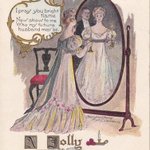




During the late 19th and early 20th centuries across North America and the British Isles, Halloween was defined by romantic superstitions.
In this era, a woman's socioeconomic future depended heavily on marriage, driving a cultural fascination with love-based divination.
This postcard illustrates one of the most famous rituals born from this period: a young woman walking backwards into a dark cellar with a hand mirror and a single lit candle.
By performing this at midnight on Halloween, she hoped to see the reflection of her future husband's face.
🎨 Published by Raphael Tuck & Sons, 1911, by an unnamed artist.


1. Hand-crafted wrought-iron sign is located outside the municipal public library in the historic, mediaeval town of La Roche-Bernard, which is situated in the Brittany (Bretagne) region of northwestern France 🇫🇷
2. Raven & Rose street sign, for a pub that was located in the historic Ladd Carriage House in Portland, Oregon, 🇺🇸
3. Two Fat Cats Bakery sign for a bakery located in Portland and South Portland, Maine. 🇺🇸
4. Sign for the Weisses Rössl Kaltern (The White Horse Inn), a historic 3-star hotel and traditional South Tyrolean restaurant, northern Italy 🇮🇹
“Warlocks and witches in a dance;
Nae cotillion brent-new frae France,
But hornpipes, jigs, strathspeys, and reels
Put life and mettle in their heels.
A winnock bunker in the east,
There sat Auld Nick in shape o' beast…”
Tam o' Shanter is a legendary Scots poem written by Robert Burns. It focuses on the main character, Tam, as he travels home from the market after a night of drinking. On the way, it begins to rain and storm, and he has a supernatural encounter riding past the local church.
🎨Tam o' Shanter by John Joseph Barker, (1866)

3/4
They called the month when the winter season began Ƿintirfylliþ, a word composed of "winter" and "full moon", because winter began on the first full moon of that month.
🎨Sarah Vivian


Winterfylleth is the Old English name for the month of October. The early Anglo-Saxons based their year on the lunar calendar, when a month was marked by the phases of the moon (hence the name monath from the word mona, meaning moon).
🎨C. Hyde


Talking about dragons… While there are different types of mythical reptiles, with their classification depending on their anatomical traits.
Let’s make things clear for a moment, first of all, they are ALL dragons.
Let’s not be petty about technical names, (honestly) most have evolved from ancient mythology and folklore, through contemporary literature and gaming lore, and classifications have changed somewhat.
Don’t let people ‘be know it alls’ telling you Habaneros or Padrón aren't peppers.
In European dragon classification, the specific limb-and-wing taxonomy was first formally recorded in the 16th and 17th centuries across regulated British and continental heraldic manuals, later codified in natural history compendiums like Edward Topsell's 1608 book The History of Serpents.
Large reptiles and land dragons, that roam the earth today, are still called Dragons in many cultures, across many centuries.
It’s about species, subspecies and hybrids. But, a pepper is still a pepper.
Teapot of the Day!
✨🫖✨
Chinese Thin-Walled Jade Teapot with Curling Branches (中华缠枝纹薄胎玉壶), carved in 2011 by master jade artist Yu Ting (俞挺) from Suzhou, China.

