

Technology-driven biomedical research at CeMM Research Center for Molecular Medicine & MedUni Vienna #cancer #immunology #bioinformatics #AI #singlecell #CRISPR
Vienna, Austria
Joined August 2019
- Tweets381
- Following1.4K
- Followers2.9K
- Likes218





We are recruiting PhD students in ML/AI methods & biomedical applications via the @ELLISforEurope PhD Program (ellis.eu/news/ellis-phd-prog…). Keywords: Perturbation modeling, generative AI, synthetic biology, cancer immunotherapy, precision medicine. Details: medical-epigenomics.org/file…

That's all - I hope the bug will get fixed in the journal-provided template. In the meantime, please feel free to used our corrected PDF template: medical-epigenomics.org/file…
Finally, “fix-qdf temp1.pdf temp2.pdf” (from the qpdf tool) fixes an issue with the file format (replacing “DURC” by “Plants” adds a few characters, which breaks the embedded binary data), and finally re-compressed the PDF (“qpdf temp2.pdf nr-reporting-summary-fixed.pdf”).
But PDFs are binary files, which makes the correction a little finnicky. I used qpdf to decompress the PDF (“qpdf --qdf nr-reporting-summary.pdf temp1.pdf”), manually fixed the JavaScript code with a Hex editor (I used HxD) because a normal text editor corrupts the embedded font.
if (this.rawValue == "1") { DURC.presence = "hidden"; } else { DURC.presence = "visible"; } if (this.rawValue == "2") { DURC.presence = "visible"; } else { DURC.presence = "hidden"; }
Technical details: The fix itself is easy – you need to replace "DURC" (which identifies the "Dual use research of concern" section) by "Plants" four times in the following piece of JavaScript code:
Once I fixed this little piece of code, the corrected PDF template (linked above) behaves exactly as it should.
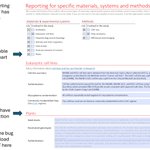
Solution: Nature’s Reporting Summary PDF uses embedded JavaScript to toggle the sections when the user clicks the check boxes, and there is a bug in the source code for the “Plants” check box: it refers again to the previous section ("Dual use research of concern").
For example, in our recent CAR T cell paper (nature.com/articles/s41586-0…) and in the CellWhisperer paper (nature.com/articles/s41587-0…):
media.springernature.com/ori…(page 4)
media.springernature.com/ori…(page 3)
Or rather, it toggles a different block ("Dual use research of concern"). This is not corrected in the published paper, and you can see the empty “Plants” section in many many papers.
To reproduce the problem, open this PDF in Adobe Acrobat, go to page 4, and click the various "n/a" check boxes on the top left under "Materials & experimental systems". When you do this for "Antibodies" etc., the sections disappear below. But for "Plants", it just doesn't work.
Background: Nature and many other NPG journals require this Reporting Summary PDF to be filled out for all research in the life sciences, behavioral & social sciences and ecology, evolution & environmental sciences. The official (faulty) template is here: nature.com/documents/nr-repo….
If you’re submitting to a Nature journal and the empty “Plants” section is bothering you, you are welcome to use our corrected PDF template: medical-epigenomics.org/file… (please download, it doesn't open in the browser).
Debugging @Nature: Nature’s Reporting Summary PDF has a technical problem: You can’t disable the “Plants” section. Lots of papers have this empty section – not only in Nature, but also in other NPG journals. Turns out this is a bug in the journal's PDF template that can be fixed.

CellWhisperer can now run on your laptop. Talk to your cells! And check out our paper: nature.com/articles/s41587-0…


Want to analyze your single-cell data, but don't like to deal with code? 🧬
Good news: CellWhisperer now runs on your MacBook! 💻
Get your single-cell AI assistant running in under 5 minutes.⏱️
Made with ❤️ @BockLab
Additional information about our research: cemm.at/research/groups/core… | bocklab.org | med-ai.org
Full job posting: cemm.at/fileadmin/img/Postdo…
Further details & application portal: cemm.at/postdoc-program & cemm.onlyfy.jobs/job/7k2624z…
Maybe get some inspiration from our recent papers and consider proposing a project idea or research direction (as part of your application's cover letter) that connects your and our research expertise. Be ambitious & creative!
What excites you? What expertise do you bring from your PhD? What do you envision your future independent research group to focus on (or the start-up company you will found)? What could be a truly exciting & impactful postdoc project?
3. Cancer: Epigenetic tumor heterogeneity (nature.com/articles/s41591-0…)
4. Technology: High-content CRISPR screening for causality at scale (nature.com/articles/s43586-0…)
5. Biomedical ML/AI: Chat-based single-cell data analysis with natural language (nature.com/articles/s41587-0…)
Examples of our recent research:
1. Immunology: Immune regulation by non-immune cells (nature.com/articles/s41586-0…)
2. Cell engineering: CRISPR-optimized CAR T cell immunotherapy (nature.com/articles/s41586-0…)
