
Investor
Singapore
Joined January 2012
- Tweets4.5K
- Following559
- Followers2K
- Likes6.8K






Pinned Tweet
Anyone want to listen to me talking about Nvidia for one hour?
I start with what Nvidia does and explain GPUs, showing how they've grown beyond just graphics. I compare GPUs with CPUs and ASICs, dive into Nvidia's main focuses, its supply chain, and how its GPUs stay useful over time.
I also look at how Nvidia keeps innovating and whether it can stay ahead of competitors. Near the end, I wrap up with a quick look at its financial health and how much it's worth.
$NVDA
youtu.be/85W0tJg3pHA

There is a famous joke among mathematicians:
In mathematics, discoveries are named after the second person to discover them, because the first person was always Euler.

257
NVIDIA Board Reinstates Jensen Huang as President, CEO and Board Director
nvidianews.nvidia.com/news/n…


Unless Jensen explicitly states that he has no intention of returning to lead Nvidia, I still believe he will eventually make a comeback as CEO. $NVDA
1
13
456


Read the Stand with Jensen letter and consider adding your name. #standwithjensen #bringjensenback standwithjensen.com/

Bring Jensen Huang back as Nvidia CEO - Sign the Petition! c.org/bFbThyBDPL via @Change


I didn't see that coming. In fact, even after reports emerged that the board was convening a meeting to decide whether to remove @JensenHuang as $NVDA CEO, I didn't believe they would go through with it.
Here's what has been reported:
1. Jensen Huang has resigned as president, CEO, and a member of the board, effective immediately.
2. Colette Kress, NVIDIA's current executive vice president and CFO, has agreed to serve as interim CEO. She will retain her existing roles while serving as interim CEO until a permanent successor is appointed. The board is initiating a search and will consider both internal and external candidates.
Jensen himself has not issued a statement. There were even reports that he was fighting hard to hold on to his CEO role. Until we hear directly from him about his plans, the situation remains fluid, and I would not rule out a comeback. After all, he is not someone who “woke up a loser,” to borrow his phrase from a podcast with Dwarkesh Patel.
What is the likely impact on NVIDIA?
1. Yesterday, I wrote a post explaining why Jensen is irreplaceable. TL;DR: It is not simply because of his technical skills or business acumen. Many people possess those qualities. Instead, it is his leadership and ability to turn technological ambition into coordinated execution. His value comes from bringing together technical judgment, commercial strategy, and organizational authority. We need someone like him to lead the AI industry forward, especially while AI development is still in its early stages.
2. I don't expect a significant financial impact on the company in the short term, say, over the next two years. Initiatives already in motion will continue, so whether NVIDIA will meet its near-term financial targets is not my main concern.
3. Over the long term, however, Jensen's vision and leadership will be crucial. Without him, will NVIDIA remain as aggressive as before? Will it continue to move at lightning speed and push its supply chain to keep pace? Or will it become bureaucratic, operate on autopilot, and set comfortable targets? If that happens, will it continue to outperform its competitors? Jensen's aggressive approach extends beyond the company's technology roadmap to acquisitions, bold moves to backstop AI investment, and other business decisions. I have more questions than answers. What seems clear is that the outlook has become much more uncertain.
What should we watch next?
1. I am looking forward to hearing directly from Jensen about this episode. What does he plan to do next? Will he continue fighting to regain control of the company? Will he remain supportive of NVIDIA, or will he turn against the company he founded?
2. We need clarity on the reported allegations and rumors, including the outcome of the reported investigation into alleged foreign intelligence involvement concerning Alice Huang, the alleged affair with Kimberly Powell, an executive reporting to Jensen, and a separate alleged affair with another NVIDIA employee.
3. Jensen has reportedly agreed to testify before Congress before Thanksgiving as questions mount over his reported relationship with Alice Huang, who allegedly has ties to Chinese intelligence.
4. Who will be appointed permanent CEO? How will that person's vision and strategy differ from Jensen's?
Conclusion
It is not an easy day for NVIDIA shareholders. There is a lot to take in and considerable uncertainty. I usually follow developments like these as a form of entertainment, but they affect market prices and, consequently, my portfolio. That makes it difficult to keep my emotions out of it.
That said, I still support the company's long-term vision. For now, I have not made any drastic changes to my portfolio in response to these developments.


I was wrong
nvidianews.nvidia.com/news/n…

1
13
1,209
The strongest argument for keeping Jensen Huang as Nvidia’s CEO is his ability to turn technological ambition into coordinated execution. In an industry where success depends on committing enormous resources before outcomes are certain, that ability is exceptionally valuable.
An engineering team can identify what might be possible. Turning that possibility into a commercial product requires a much broader commitment. Someone must decide which technologies to pursue, how aggressively to push specifications, how much risk to accept, and when the product must ship. The organization then needs to align its people, budgets and suppliers behind that decision.
This is where Jensen’s leadership matters most. His value comes from bringing technical judgment, commercial strategy and organizational authority together. He does not need to be the company’s leading expert in every emerging technology. He needs to understand the trade-offs well enough to make a decision, and ensure that Nvidia follows through.
Those decisions also shape the confidence of Nvidia’s suppliers.
When a supplier expands capacity or invests in new manufacturing capabilities, it is making a bet on future demand. A forecast helps, but confidence also depends on whether the customer can deliver the products behind that forecast. A credible roadmap gives suppliers a reason to commit capital, develop new processes and accept demanding production schedules.
From this perspective, supply chain visibility begins inside Nvidia. It rests on the company’s ability to make clear product decisions and execute them consistently. Preserving the leadership that supports those commitments has value far beyond the CEO’s office.
A leadership transition could put that coordination under pressure. A successor might be technically capable and commercially experienced, yet still need time to earn the confidence of engineering teams, resolve competing internal priorities and establish credibility with suppliers. Decisions could take longer. Ambitious projects could face additional rounds of review. Individually, those changes might appear modest; collectively, they could affect product timing and competitiveness.
That is the strongest business case for keeping Jensen: continuity helps protect an execution capability that would be difficult to recreate quickly.
It also creates an opportunity to prepare Nvidia for its eventual future without him. The company should develop leaders who can make consequential decisions, give them meaningful responsibility and establish a succession process while Jensen remains available to guide the transition. His continued leadership can provide the stability needed to make that preparation effective.
Of course, retaining a successful founder must coexist with board oversight and accountability. The case for continuity should rest on his contribution to the business, with performance and conduct assessed on their merits.
Ultimately, Nvidia’s board should consider how a change in leadership would affect the company’s ability to make difficult bets and deliver on them. Jensen’s importance lies in the judgment, authority and relationships that help turn those bets into products.
Keeping him as CEO while deliberately building the next generation of leadership would preserve that strength today and give Nvidia a better foundation for tomorrow.
6
641
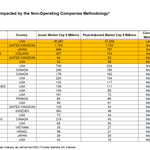
THIS IS AN ANNOUNCEMENT FOR THE MSCI GLOBAL STANDARD INDEXES
MSCI ANNOUNCES FINAL IMPACT LIST OF THE NON-OPERATING COMPANIES METHODOLOGY
MSCI today announced the final list of GIMI securities impacted by the implementation of the Non-Operating Companies Methodology, effective as part of the November 2026 Index Review.
$MSTR will be deleted.

*JENSEN HUANG SAID TO HAVE HAD RELATIONSHIP WITH NVIDIA EXEC:NYT
*HUANG SAID TO HAVE RELATIONSHIP WITH VP AT NVIDIA: NYT

2
358
👀

On a June night in 2024, Nvidia CEO Jensen Huang held court with several of his company’s major Asian customers at a bar in Taipei. Next to him was Huang Xiaole (黄小乐) aka Alice Huang, an executive of Megaspeed, a shady Singapore-based data center company.
Nvidia’s compliance team has looked into Megaspeed and determined it’s “wholly owned and operated by a company based and headquartered outside China, with no China shareholder.”
Megaspeed was created in 2023 when 🇨🇳 7Road, a gaming company with ties to 🇨🇳 state-backed investors, split off its overseas operation in Singapore and renamed it Megaspeed, which in early 2024 set up Speedmatrix, a subsidiary in Malaysia that quickly snapped up ~$2B worth of Nvidia’s most advanced chips. Most of those chips came from Aivres, the US subsidiary of 🇨🇳 Inspur, a major tech company added to the 🇺🇸 Entity List in 2023 for supporting 🇨🇳 military 👉🏻 Nvidia is barred from selling its technology to Inspur without a special license. But since Aivres is based in California and records sales as a US company, it can buy Nvidia chips freely.
Megaspeed has funneled those chips to data centers in Malaysia and Indonesia that appear to remotely serve customers in China. That is not necessarily illegal, but it can be found unlawful if it is done on behalf of a 🇨🇳 company. US officials have also been scrutinizing whether Megaspeed diverted some of those chips on to China, in violation of US law.
Megaspeed is also facing scrutiny from Singaporean police.
Megaspeed listed Alice Huang as its managing director for its first 8 months, and its current director James Tan is from Singapore but is based in Shanghai.
It’s not clear when Jensen Huang and Alice Huang, who are not related, first met. She was mingling with a crowd of tech executives just after midnight at the Taipei bar in early June 2024 when she offered to ask Jensen Huang to join them.
“I bet you guys I can get Jensen here,” she said, and shortly afterwards Jensen Huang arrived in his trademark black leather jacket and drank a whiskey shot with the group.
Jensen Huang and Alice Huang were photographed together again in May, exiting a restaurant in Taipei with an Nvidia aide after a business dinner with other AI suppliers.
Alice Huang spent much of her career in China, including working as a TV reporter for 🇨🇳 state media and as a private banker. Huang left Megaspeed in recent months. It’s unclear when and why she left and what she’s doing now.
Both she and 🇨🇳 7Road, the Chinese company that Megaspeed split off from, have close ties to a web of wealthy investors and tech companies with data center projects in China.
The owners of 7Road include 🇨🇳 central government and several local governments. Before joining Megaspeed, Ms. Huang was executive director for a Shanghai-based fund that had invested in 7Road and had ties to state-backed firms.
Reporters looking into Megaspeed’s opaque operation have tracked business listings that led to a Malaysian data center and shopping mall, a near-empty office in Singapore and a dilapidated storefront outside Kuala Lumpur.
It’s not clear where Megaspeed’s billions of dollars came from. But a few weeks after the gathering in Taipei last year, Megaspeed began receiving a steady supply of multimillion dollar shipments of some of Nvidia’s most advanced chips.
Over the next 3 months, Megaspeed bought a billion $ of Nvidia technology. Within the next 9 months, it secured roughly a billion $ more. The bulk of those advanced Nvidia chips were purchased from 🇨🇳 Inspur’s US subsidiary Aivres. The shipments went to Megaspeed’s Malaysian subsidiary Speedmatrix.
The registered address for Speedmatrix on the shipping records led to a dilapidated storefront outside Kuala Lumpur, where the sign out front advertised a construction company. No one was inside when a reporter visited the address in late Sep. Employees at the law firm next door said they rarely saw people in the office.
1/2
nytimes.com/2025/10/09/techn…


3
497