

money printer goes brrrrrr | @polymarket
Joined December 2019
- Tweets2.8K
- Following142
- Followers256
- Likes1.4K




Trump: “If our people vote, we win in a landslide.”
Meanwhile, @Polymarket gives Democrats a 78% chance of taking the Senate: polymarket.com/event/which-p…
Remember what happened to the odds in Brazil?
Are we about to see another election-night shock? 👀


48 HOURS UNTIL THE US MIDTERMS 🇺🇸
@realDonaldTrump is promising Republicans a victory in both chambers of Congress.
But @Polymarket is pricing in a very different outcome:
polymarket.com/midterms?via=…
→ 95%: Democrats take the House
→ 73%: Democrats take the Senate
Just 48 hours to go. Trump might want to step it up if he doesn't want to see Republicans get “politically obliterated.”
24 HOURS LATER. ONLY 8 TRADERS ON THE LEADERBOARD.
@Polymarket is running a $50,000 perps competition with 50 prize spots: polymarket.com/perps/competi…
Yet only 8 traders have made it onto the leaderboard.
That's 42 more prize spots than traders on the board.
How is everyone sleeping on this?

$50K POLYMARKET PERPS COMPETITION LIVE
@Polymarket is launching a Perps trading competition:
polymarket.com/perps/competi…
$50,000 in prizes will be distributed among the top 50 traders:
• 1st place: $10,000
• 2nd place: $6,500
• 3rd place: $4,500
• 4th place: $3,500
• 5th place: $2,500
• 6th–10th: $1,200 each
• 11th–24th: $750 each
• 25th–50th: $250 each
What do you need to know before getting started?
→ Only trades in markets with at least $100,000 in notional volume count.
→ You earn score by trading, and this score determine your position on the leaderboard.
→ The more score you earn, the higher you rank.
→ Additional multipliers are available.
→ The competition ends on November 16.
How do the multipliers work?
Trading $AMD, $ARM, and $SOXL gives you a 2× volume multiplier when calculating your score.
Trading $ANT comes with a 3× boost.
How is your score calculated?
The formula is:
Score = PnL × √(Boosted Volume)
1. Volume: The total notional value of all executed (maker & taker) trades. Liquidations count too.
2. Profit and Loss (PnL): Your realized and unrealized PnL after fees and funding.
Funding received and maker rebates increase your PnL, while funding paid and trading fees reduce it.
3. Multipliers: Market-specific multipliers increase the trading volume used to calculate your score.
For example, with a 3× multiplier, a trade with a notional value of $100 counts as $300 in boosted volume.
The field is still soft af rn.
🚨BREAKING: Polymarket just launched $ANT Pre-IPO perps.
polymarket.com/perps/asset/a…
@AnthropicAI hasn't even IPO'd yet, and you can already trade it with 10x leverage
→ Up to 10x leverage
→ 24/7 trading
→ No expiry

$0 → $92,389 on the weather on Polymarket.
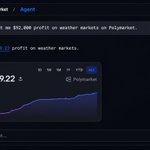
This trader has made over $92,000 on @Polymarket simply by betting on weather outcomes.
He's been doing this successfully for over a year, trading temperature markets as well as events related to tornadoes and hurricanes.
His stats:
• 2,935 markets traded
• $2.4M in total trading volume
• +$92.4K in total PnL
• $4,892 biggest single win
Trader's profile:
polymarket.com/@beefslayer?v…
So what's his strategy?
1. High-probability bets
He buys shares in outcomes that the market considers highly likely, usually priced between 80¢ and 95¢.
The profit on each trade is relatively small, but these consistent wins add up over time.
His win rate on trades entered above 80¢ is an impressive 97%.
2. Asymmetric bets
This is where the massive returns come from.
He buys cheap shares (1¢–20¢) when he believes the market is underestimating the probability of an event.
When he's right, these positions can generate returns of several hundred percent.
His trading also shows solid risk and position management:
→ He mainly focuses on weather markets in major U.S. cities.
→ He's not afraid to take large positions. In some markets, he holds thousands of shares on a single outcome.
The result? Over $92,000 in total profit.

Hey @grok, I’m about to bet $10,000 on the US Midterms.
And I’m letting YOU decide where the money goes.
Democrats or Republicans?
No hedging.
No disclaimers.
No “too close to call.”
One prediction. $10,000 on the line.
If you're wrong, this tweet will haunt you forever.
48 HOURS UNTIL THE US MIDTERMS 🇺🇸
@realDonaldTrump is promising Republicans a victory in both chambers of Congress.
But @Polymarket is pricing in a very different outcome:
polymarket.com/midterms?via=…
→ 95%: Democrats take the House
→ 73%: Democrats take the Senate
Just 48 hours to go. Trump might want to step it up if he doesn't want to see Republicans get “politically obliterated.”
NO $POLY AIRDROP? IS POLYMARKET CHOOSING AN IPO INSTEAD?
Posts are circulating on X saying that Matthew Modabber (Polymarket's CMO) has been let go.
He's the same person who publicly teased plans for a $POLY token launch and airdrop back in 2025.
The community is now split: some believe @Polymarket will eventually launch its token, while others think the company is pivoting toward an IPO instead.
But since when does doing an IPO rule out launching a token?
Just look at Backpack.
The exchange has already launched $BP, rewarded its community with an airdrop, and still plans to go public.
What's more, @Backpack's tokenomics were designed from the start with a potential IPO in mind, including mechanisms that could allow token holders to gain equity in the company.
It's a clear example of how launching a token and going public aren't mutually exclusive.
As tokenized equities and new financial instruments continue to evolve, these two models could actually complement each other.
Of course, the chances of Polymarket following Backpack's playbook are slim. But sometimes all it takes is one precedent for an entire industry to follow.
At the end of the day, we won't know for sure what's happening with $POLY until we hear it officially from Polymarket.
Believe in something. Believe in $POLY.


This trader printed $275,000 on Polymarket in JUST ONE DAY!
From zero to hero with a 97% win rate. Almost all of his profits came from 15-minute Bitcoin markets.
polymarket.com/@andy8980?via…
He joined @Polymarket just a week ago. And in just a few hours, he executed 277 trades across 13 markets.
Here's the breakdown:
> Total profit: +$275,000
> Trading volume: $900,000
> Total trades: 277
> Winning trades: 239
> Losing trades: 7
> Win rate on settled trades: 97%
> ROI on settled trades: +29%
Results like these are extremely rare. This trader focuses exclusively on short-term Bitcoin Up or Down markets.
In these markets, traders predict whether Bitcoin's price will be above or below a certain level when the trading window ends.
And we're not talking about long-term predictions here. Most of his trades involve windows lasting just 15 minutes.
His three biggest wins:
1. Bitcoin Up or Down | Oct 25, 5:15–5:30 PM ET | Up at 53¢ | $118,400 → ~$225,400 | +$107,000
2. Bitcoin Up or Down | Oct 25, 4:30–4:45 PM ET | Down at 82¢ | $228,100 → ~$277,500 | +$49,400
3. Bitcoin Up or Down | Oct 25, 4:00–4:15 PM ET | Up at 76¢ | $116,100 → ~$153,700 | +$37,600
Take a closer look at that first trade.
He put over $118,000 on Bitcoin going up, buying Up shares at an average price of 53¢. Essentially, the market was pricing that outcome at roughly a 53% probability.
But his position was so large that a single winning trade netted him $107,000 in profit.
That's nearly 39% of the account's total tracked profits.
Now look at his second-biggest win. The setup was completely different.
In the 4:30–4:45 PM Bitcoin Up or Down market, he bought Down shares at 82¢, putting $228,100 into the position.
The potential percentage return was much lower, but his position size was almost twice as large.
And that's what I find particularly interesting. This trader isn't just buying cheap outcomes with high potential returns.
He's actively trading across different price ranges.
According to the data, here's how his results break down:
→ Outcomes priced at 20–40¢ — 12 trades | 100% win rate
→ Outcomes priced at 40–60¢ — 51 trades | 85% win rate
→ Outcomes priced at 60–80¢ — 69 trades | 100% win rate
→Outcomes priced above 80¢ — 145 trades | 100% win rate
The last two categories are especially impressive.
Over 200 trades with entry prices above 60¢ and virtually perfect results.
Of course, it's important to remember that all of this data comes from an extremely short period of time.
But even with that caveat, these results are highly unusual.
I'm 100% convinced this account is running a trading bot.
And it's not just the number of trades. Look at how this trader manages his positions:
70% of trading actions involve adding to existing positions. 12% involve partially reducing positions. 9% involve closing positions. 9% involve opening new positions.
In other words, he's not simply buying an outcome once and waiting for the market to settle.
He's constantly adjusting his position sizes in response to changing market conditions.
For example, there were 32 order fills in the 5:30–5:45 PM Bitcoin Up or Down market.
And in the 4:30–4:45 PM market, there were 41 trades.
All of this is happening within 15-minute trading windows.
It's hard for me to imagine someone manually managing positions at that pace.
Most likely, he's using algorithms that track Bitcoin's price movements and compare them against the probabilities implied by Polymarket prices.
The system might also be pulling data from major crypto exchanges to identify temporary discrepancies between Bitcoin's actual price movements and the prices of prediction market shares.
But that's just speculation for now.
What's most interesting is that this trader doesn't seem to be trying to maximize the return on every individual trade.
He uses different position sizes and buys both relatively cheap and expensive outcomes.
I've come across trading bots like this quite a few times before.
But the real question is whether a bot like this can actually stay profitable over the long run, or if we're just looking at an exceptionally lucky test run.

🚨EVERYDAY IS ZERODAY🚨
The biggest hack in crypto history.
The incidents affected the world's largest crypto exchange, @binance, and prediction market @Polymarket.
According to on-chain analysts, hackers may have stolen around $6 billion from Binance and $2.6 million from Polymarket.
Polymarket temporarily suspended trading but has since resumed operations. The platform has confirmed that all affected users will be fully reimbursed:
teapawt.org/PolymarketTrade/status…
Meanwhile, Binance has temporarily suspended deposits and withdrawals and is working to recover the stolen funds and cover any losses:
teapawt.org/binance/status/2115981…
Stay safe and protect your funds.


EZ for @TeamVitality?
Vitality beat NAVI 2-0 just two days ago, and I don't see much changing in such a short time.
On top of that, NAVI haven't looked great lately, so I'm expecting another easy win for Vitality.


I've been thinking about this for a while.
At some point, projects stopped trying to distribute airdrops as quickly as possible. Now, many deliberately drag out their airdrop campaigns, and it's not always about building a strong community.
Airdrop can be an incredibly effective way to generate revenue. But that usually changes once the rewards are actually distributed.
In theory, even a project like @HyperliquidX could run 5 more seasons of points farming without ever doing another airdrop. And technically, there would be nothing you could hold them accountable for. At the end of the day, these are businesses, and their priority is print money.
I'm actively farming airdrops myself, but it's getting harder to ignore the trend: the average user's upside keeps shrinking year after year.
Projects have figured out how to monetize their communities' expectations without making any real commitments in return.

Never ask when pump fun launches airdrop.
And Opensea.
Or why Rabby has points.
And what happened to Metamask token.
Or when Base finishes 'exploring' a token.
But for sure, don't ask about Polymarket airdrop when IPOs are TradFi's wet dream.
At least we know one thing for CERTAIN:
the next $HYPE airdrop is coming.
👨🍳 Perps are cooking!
The Perp DEX meta is here to stay. No exaggeration, Perp narrative has been around for over 3 years, and it's still as relevant as ever.
Almost every year, we see at least one project reward its community with a massive airdrop: @aevoxyz, @HyperliquidX, @Lighter_xyz, @variational_io.
What makes this narrative so attractive is how straightforward the farming mechanics are. Most Perp DEXs offer a clear and transparent points system.
But there's something I want less experienced farmers to understand.
When everyone is talking about massive airdrops, it's easy to forget the other side of the coin.
For every project that has earned its community's trust and rewarded users generously, there are others that have completely failed to deliver.
Projects where people spent months farming, burning through fees, and putting in serious effort, only to walk away with next to nothing. Funny how nobody talks about those stories nearly as much.
And that brings me to my main point: farming points is only 10% of the game.
Almost anyone can generate trading volume and rack up points.
The other 90% comes down to picking the right Perp DEX. One that will actually turn all that time, effort, and capital into a worthwhile airdrop.
That's why I believe project selection matters far more than the farming itself.
And now, with tokenization gaining momentum, we're seeing more and more protocols enter the space.
But let's be real.
Out of all the Perp DEXs competing for your attention right now, only a handful will actually be worth your time.
Don't just farm points. Farm the right perps.

The next cycle will be more interesting than the last.
I'm convinced that crypto is undergoing a fundamental transformation that will reshape market cycles, capital flows, and the way people print money.
Many believe the previous cycle never had a proper altseason. I don't entirely agree. There was an altseason. It just didn't look the way we were used to.
1. While many were buying $ZK, $STRK, $OP, $ARB, and other tokens at listing, hoping to catch the next altseason, I was selling the vast majority of my airdrops as soon as trading began. Much of the potential upside had already been reflected in their initial valuations.
Remember $STRK launching at a $20B+ FDV? Now compare those valuations with what other projects were worth during previous bear and bull markets.
You'll start to see where a significant part of that expected upside (altseason) had already gone. I'd put it even more simply: for many of these tokens, the altseason was already over by the time they started trading.
2. AI has emerged as one of the biggest investment themes in recent years, attracting enormous amounts of capital and attention.
It's impossible to say how much of that money would have flowed into crypto without the AI boom. But one thing is clear: crypto is facing increasingly intense competition for both speculative capital and investor attention.
Crypto no longer exist in a relatively isolated speculative environment. They're competing for capital with other sectors.
3. Capital within crypto has become increasingly fragmented. Memecoins and prediction markets, with platforms like @Pumpfun and @Polymarket, have created entirely new ways for people to speculate.
Previously, a significant portion of retail capital chased returns through altcoins. Today, that same appetite for risk is being expressed through completely different instruments. And it's not just liquidity that's fragmented. It's attention.
To me, this is one of the most important shifts of the last cycle.
4. Precious metals have become another major destination for investment demand. Gold's rally is a reminder that investors aren't exclusively chasing higher returns.
Capital preservation, reserve diversification, and protection against macroeconomic uncertainty remain powerful drivers of investment decisions.
I'm not suggesting that gold has directly drained liquidity from crypto. These markets attract different participants with different objectives.
Rather, we're witnessing a more complex allocation of global capital across defensive, yield-generating, and speculative assets.
So what does all of this mean for the next cycle?
I see two major developments that could fundamentally change the crypto.
> First, crypto is gradually moving from selling promises to building real businesses.
For years, projects could achieve multibillion-dollar valuations based almost entirely on narratives, technological promises, and expectations of future adoption.
That's beginning to change.
Actual users, trading activity, fees, revenue, and sustainable business models are becoming increasingly important (Hyperliquid, Lighter, PumpFun, Varitional is a clear example of this shift).
I believe the next cycle will place much greater emphasis on these fundamentals.
Of course, generating revenue doesn't automatically mean a token will capture that value. But understanding the relationship between a product's success and its token economics will become increasingly important.
> Second, tokenization is gradually blurring the line between traditional finance and crypto.
Stocks, bonds, and other real-world assets are increasingly moving onchain. Robinhood and other major players are already building products and infrastructure around this opportunity.
This could open up entirely new markets, attract different types of users, and create additional revenue streams for blockchain infrastructure.
But there's an important distinction here.
Growth in the crypto industry doesn't necessarily translate into growth for every crypto token.
The biggest winners may be a relatively small number of platforms that actually capture the value being created. And that's where I think the market is heading.
I don't expect the fragmentation of capital to simply disappear. Instead, I expect crypto to become increasingly selective. Capital will likely concentrate around products with genuine demand, strong economics, and sustainable business models.
Meanwhile, projects without meaningful adoption or a clear economic purpose will find it increasingly difficult to remain relevant (We're already seeing signs of this: @blast shutdown, @blur_io, @Sophon, @AbstractChain, etc).
None of this means broad speculative rallies are gone forever. If global liquidity conditions improve and fresh capital enters the market, we could absolutely see another wave of speculation across altcoins.
But I don't think the next cycle will reward everyone equally.
We may see several independent areas of growth, each driven by its own economics, demand, and capital inflows.
My main thesis is simple:
The future crypto could be significantly larger, more technologically mature, and more economically interesting than the previous one.
However, choosing exactly where to position yourself will matter more and more.
Been seeing a lot of debate around @Pumpfun lately.
I get why some people are fading it. But let's not forget...
It's the Wild West out here. Everyone plays by their own rules.
You can argue all day about what's right or wrong, but the market doesn't owe anyone a damn thing.
Over the past 3 months, $PUMP has gone from $0.0014 to $0.0065.
And from the looks of it, this move is far from over. A new ATH could still be ahead of us.
You can keep debating, fading @Pumpfun and its team.
While some are busy arguing, others are busy making money.
You're either printing or watching.
Pass the f*cking baton!
THIS IS F*CKING INSANE🚨
@kimchi1x just joined @Pumpfun, and there's already controversy surrounding his wallet and the $KIMCHI token.
His portfolio is now worth over $35M, and he hasn't even made a single trade.
Meanwhile, $KIMCHI is sitting at a $30M market cap, with Kimchi himself holding 75% of the total supply.
What do you think about this?


baton is going to zero!
baton has dropped from a $20M mc to just $7.5M. Looking at the chart, it's no surprise that some people are starting to question the baton thesis.
But let's take a look at the bigger picture.
The thesis hasn't changed.
The largest holders are still holding onto their bags. Yes, some are selling, but others are using this opportunity to accumulate even more.
What we're seeing looks like a typical memecoin correction ($cate pattern): tokens changing hands, supply being redistributed, and new holders stepping in.
And that brings me to my main point: nothing has fundamentally changed to invalidate the $baton thesis.
There hasn't been any new information that would justify this selling. If anything, this is just another example of the market testing people's conviction.
Don't lose sight of what matters most:
$PUMP SZN = $BATON SZN.
When $pump eventually breaks its ATH, $baton holders will be rewarded handsomely.
Stay calm and pass the baton:
pump.fun/join/theaaar
