

BrainWare Learning Company offers programs to further the application of neuroscience research to learning and teaching. We build capable, confident learners.
Chicago, IL
Joined May 2009
- Tweets2.6K
- Following4.1K
- Followers4.1K
- Likes11




JOIN US LIVE!
Is your child working hard but still struggling to learn?
Sometimes, the answer isn’t more studying, practice, or repetition.
Join us for:
5 Simple Steps to Help Children Overcome Learning Struggles and Become Capable, Confident Learners
🤖 Made with AI

Register: us02web.zoom.us/webinar/regi…

Can weak cognitive skills actually get stronger?
We analyzed 7 years of data from nearly 1,800 students who participated in CICT.
Across 10 cognitive skills, initially weak skills gained 17–33 percentile points, with 43–63% moving out of the Support Range.
That is the central idea behind the book, Your Child Learns Differently, Now What?
As Dr. Rebecca Estes, former Asst Secretary at the Indiana Department of Education, observed:
“Learning IS what truly counts, and teaching is only really important if learning is taking place.”
Tens of thousands of parents have watched our 5 Simple Steps presentation. On Sept. 22, I’m presenting it live.
We’ll explore why children struggle with learning—and what can change when we understand how they learn.
Register: us02web.zoom.us/webinar/regi…

More students need special education services—even as schools provide more interventions, specialists and accommodations.
The question is: What are we missing?
We took a closer look in The Special Education Surge: What the Numbers Are Really Telling Us.
et-mag.com/the-special-educa…

When the first Labor Day was celebrated in 1882, work depended largely on physical strength, endurance and skilled hands.
144 years later, the tools have changed dramatically.
What will work look like 144 years from now?
🤖 Made with AI

For 20 years, “brain games,” “brain training” and “cognitive training” have been treated as though they were the same thing.
They aren’t.
We now know cognitive capacity can be strengthened.
The question for education is: What do we do with that knowledge?
Our new article in ET Magazine: et-mag.com/the-cognitive-tra…

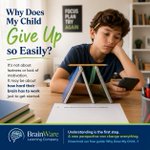
“If your child is struggling in school, is the answer really to study more, practice more, and repeat it again?”
Practice matters. Repetition matters.
But they don’t fix weak working memory, focus, slow processing, or other cognitive skills that can make learning hard.

And asking a struggling child to just do more can sometimes mean more time, more effort—and more frustration.
Maybe the better question is:
What is making learning so hard in the first place?
That’s what we’ll talk about tomorrow in my free LIVE parent webinar, 5 Simple Steps. Register: tinyurl.com/mvvx85xk

Artificial Intelligence (AI) is changing the nature of school and work. When information is instant and answers are easily generated, the challenge shifts from finding the right answer to evaluating, adapting, and applying knowledge in situations where the path isn’t clear.
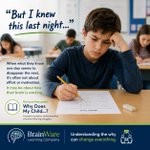
“But you knew this yesterday!”
Few things confuse parents more than a child who can do something perfectly one day...and seems unable to do it the next.
But inconsistent performance doesn't necessarily mean inconsistent effort.
🤖 Made with AI

Learning depends on many cognitive skills working together.
Change the complexity of the task, the distractions in the room, or how much information your child has to hold in mind—and suddenly the demands on the brain are different.
It's the same child.
But it may not be the same cognitive demand.
Our free parent guide, Why Does My Child...?, explores this and five other common learning questions.
mybrainware.com/why-does-my-…
