

Official account of the Phil & Penny Knight Initiative for Brain Resilience at @StanfordBrain. Pursuing a bold new science of healthy brain aging.
- Tweets1.4K
- Following193
- Followers973
- Likes9.1K


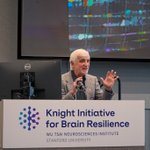

ALT Shagayeg Navabpour (Postdoctoral Researcher, Department of Psychiatry and Behavioral Sciences, Stanford University) gives a talk on "From Genetic Risk to Brain Cell Types: Insights from Psychiatric and Neurodegenerative Disorders."

ALT Scott Dixon (Prof. Scott Dixon, Department of Biology, Stanford University) gives a talk on "Regulation of non-apoptotic cell death by disease-associated genes in the endolysosomal network."


ALT NeURO and NeURO-CC students pose for a photo outside the Stanford Neurosciences Building. Image credit: Julia Diaz.

ALT De Anza College biomedical engineering student An Nguyen worked with Hillary Vossler in the Mormino Lab. Image credit: Julia Diaz.

ALT Ozomatli Santana speaks to another person in front of a research poster in a courtyard. Image credit: Julia Diaz.

ALT NeURO and NeURO-CC program participants present their research in the courtyard of the Stanford Neurosciences Building. Image credit: Julia Diaz.

ALT Stanford Medicine researchers and their colleagues hope that brain activity patterns can help identify people who are likely to develop Alzheimer’s, allowing for early interventions. Image credit: Zhang lab.

ALT Kanhao (Alex) Zhao, PhD, a postdoctoral scholar in psychiatry and lead author of the study.

ALT Yu Zhang, PhD, assistant professor of psychiatry and behavioral sciences and senior author of the study.

ALT Stanford geneticist Anne Brunet opens the Knight Initiative - Rosenkranz Aging Symposium. She introduces keynote speaker Luigi Ferrucci.

ALT In the final talk of the Fall 2026 Symposium, Henne Holstege discusses her research on “Decoding natural resilience against cognitive decline: the 100-plus Study.”

ALT Knight Initiative Associate Director Albina Ibrayeva (left) presents the Rosenkranz Poster Award to Jingxun Chen (right) for research related to aging and/or rejuvenation that received the most votes.

ALT Knight Initiative Associate Director Albina Ibrayeva (left) presents the Knight Initiative Poster Award to Komal Sharm (right) for research related to brain resilience and/or neurodegeneration that received the most votes.




ALT Text: Knight Initiative for Brain Resilience, Fall 2026 Symposium. Photo collage: Top row, left to right: Luigi Ferrucci and Henne Holstege. Bottom row, left to right: Ashley Webb, Felix Boos, and Yue Sun.
ALT Text: Knight Initiative for Brain Resilience, Fall 2026 Symposium. Photo collage: Top row, left to right: Luigi Ferrucci and Henne Holstege. Bottom row, left to right: Ashley Webb, Felix Boos, and Yue Sun.


ALT Faculty members and trainees involved in the Stanford Digital Brain Project at the Wu Tsai Neurosciences Institute, pictured in the courtyard of the Stanford Neurosciences Building. Back: Laura Gwilliams, Dan Yamins, Justin Gardner, Brian Wandell, Jonathan Polimeni, Jiyao Wang, Ehsan Adeli, Tony Norcia, Anthony Wagner; Front: Kalanit Grill-Spector, Atlas Kazemian, Wonkyeong Lee, Vaidehi Natu, Seda Akbiyik, Saskia Bollmann, Milena Kaestner, Xan McPherson, Klemen Kotar. Not pictured: Russ Poldrack.

ALT Koret Human Neurosciences Community Lab Director Milena Kaestner (left) and Wu Tsai Neuro and HAI Faculty Scholar and Assistant Professor of Psychology Laura Gwilliams (right) demonstrate the OPM-MEG system, a key pillar of the Stanford Digital Brain Project's experimental campaign, with Alexandria McPherson, a postdoctoral fellow in the Gwilliams Laboratory of Speech Neuroscience.

ALT Associate Professor of Radiology Jonathan Polimeni, Research Engineer Saskia Bollmann, Psychology Postdoctoral Fellow Seda Akbiyik, and Kalanit Grill-Spector, the Susan S. and William H. Hindle Professor in the School of Humanities and Sciences and professor of psychology, discuss data from the 7T MRI at the Lucas Center for Imaging at Stanford Medicine.

ALT Aaron Gitler is a professor of genetics and a member of the Steering Committee for the Knight Initiative for Brain Resilience. His lab studies ALS and other neurodegenerative diseases.
