

AI Coding Harnesses, Agentic Workflows
Mumbai
Joined June 2009
- Tweets3.7K
- Following924
- Followers214
- Likes1.8K




Neon is better than fable and cheaper than Opus
The jump from Argon to carbon and from carbon to neon in a month means -
Google has probably cracked something internally
Anthropic spent fortune pushing regulations thinking no one else will have better models than them
Google has the TPUs not dependent on NVIDIA at all so Regulations cant slow them down
Regulations will now infact help google more than Anthropic securing Google’s lead
Google has killed the Ai race

Introducing Gemini 4 Neon! Pushing the frontier across domains and punching above its model class in a meaningful way. To me, Neon feels like the right balance of intelligence, speed, and usability. Available now across @GoogleAIStudio, the API, and more!

28
To all people who just disappeared into virtual world of GTA 6, see you after couple of years.
1
1
246
GPU programming Handwritten notes.
github.com/ashishpatill/Hand…
Still in progress, will share updated soon.
Hope you find it useful


26
SMIC prints 5nm class transistors using a 193nm light beam.
That light wave is 14.3 times wider than the 13.5nm EUV beam inside ASML banned scanners.
To pull it off, China's chipmakers use a 4 step sidewall spacer trick (SAQP) that hits 113.4M transistors per sq mm, beating TSMC's N6 EUV node, and then fold two silicon dies face to face with over 50 million copper bonds for 53.5% higher density.
But there is a brutal physics tax on every wafer.
A 300mm SMIC wafer yields 457 smartphone chips at 81% yield, yet the exact same wafer yields only about 8 dual die Huawei Ascend 910C AI processors at 27.6% die yield.
So to beat 1 rack of 72 Nvidia B200s drawing 145 kW, Huawei wires 384 Ascend chips across 16 racks with 6,912 lasers and burns 559 kW of cheap Inner Mongolian power.
I put together a full visual and animated breakdown of how China's chip workarounds actually work from silicon physics to DeepSeek kernels, and when they catch the West.
Read the full X Article below and tell me whether algorithmic co design permanently neutralizes a 4 year chip lag or if the HBM and power wall wins by 2030.
teapawt.org/BuiltinMind/status/212…

Huawei wires 384 chips across 16 racks with 6,912 lasers and burns 559 kilowatts of cheap western Chinese electricity to beat a single 145 kilowatt Nvidia GB200 rack. Complete physics and hardware breakdown of how China builds AI silicon without EUV.

1
65
How DeepSeek Kernel Engineers Rescued Huawei's DaVinci Core
Huawei's DaVinci core splits Matrix math (Cube L0C buffer, 256 KB) and Vector math (Unified Buffer, UB) into separate SRAM islands.
If you naively rescale FlashAttention outputs inside Cube L0C in FP32, Cube throughput drops 16 fold from 4,096 down to 256 FMA/cycle, wasting 8,192 cycles.
DeepSeek's Sept 30, 2026 open source FlashMLA repo solved this by setting H_q = 64 so P times V takes 128 KB (half of L0C), hiding 6,921 memory cycles behind 8,192 Cube cycles, keeping the accumulator in Vector UB with a skip scale threshold of 6, and compressing 128K KV cache by 93.3% (268 GB down to 9 GB) via MLA.
1
21
The $150B Capital Engine and the 2034 Parity Timeline
Inside mainland China, domestic AI chips hit 47.5% unit share in 1H 2026 (Huawei 572k units at 28.5% vs Nvidia 678k at 33.8%), backed by ByteDance's $5.6B order and DeepSeek's 160,000 chip Ascend 950DT cluster.
Globally, Epoch AI satellite audits put Huawei's flagship Horinger campus at 81,000 H100 equivalents, just 7% of xAI Colossus 2 (1.112M H100e).
In the Base Case, Ascend stays near 5.5% of the moving Western frontier (~4 yr lag) through 2033, crossing 2026 Colossus 2 scale in 2029 to 2030.
In the Bull Case, moving frontier parity arrives around 2033 to 2034, yet model capability trails the US by just 6 to 7 months today.
Where do you see the biggest bottleneck between 2026 and 2030 among HBM yields, sub 7nm EDA, or gigawatt power efficiency?


35
I started this research as a complete stranger to this topic with little to no understanding. I am still just a novice trying to use Ai tools to try my best to understand this from Huawel's perspective.
When i started digging with latest Gemini models for deep research and grok X api and its tools to find the credible voices and expert authors, i couldnt believe how effective these tools have become for investigative journalism.
Any common person without any expertise on investigation could learn gather critical information on a piece of article if he tries to.
Now i have an electronics degree but most of my work has been software and i felt like not qualified to even understand it.
But when i started using Ai for separating concerns i became good at separation of concerns and quickly started to build 7 separate tracks of investigation. Each track had its own series of deepresearch combined with grok's expert voice. Total i prepared 7 detailed reports with more than 10 pages each. I even built myself interactive apps to visualise and understand the stats and maths behind it. Sadly X articles wont allow interactive visualisations so i converted them to videos.
Now to condense all this knowledge into one article is almost impossible. Hence i will make it now a 2 part post. I hope i am able to explain all the findings and will try my best to use limited ai tools at my disposal to explain it.
This is my first attempt to write on this topic out of my expertise. so i am not going to make any claims and encourage you to dig further and see how ineffective of this whole notion of putting ban on chips is since china is able to develop whole new category of its own chip roadmap.
Most importantly dont look at where they are today or in a year, try to see there trajectory and where they could land by 2030 and beyond.
teapawt.org/BuiltinMind/status/212…
I going pretty deep into the rabbit hole of understanding the math and process behind how Huawei is able to workaround and produce the cutting edge chip design and production.
Although its totally technical post it shows how chips act restrictions, Trump administration ban on exporting chips have limited impact, the entire country of china is walking on the boundary of cutting edge science to make it possible.
When Jensen Huang was making the case for export controls being stupid, i was highly critical of jensen taking side of china but after digging through for weeks now i understand how wrong that assumption is and how right Jensen has been on this.
Trump administration or even other top countries who want to compete in chips manufacturing needs to learn and hear from experts and not political leaders. They need to understand where the buck is going to be. Most importantly they need to be open to compete not restrict. This is why chinese govt decided to open the Ai market with openweight models.
Without google TPUs and Nvidia's design edge and TSMC manufacturing prowess it will be very difficult to match china's efforts.
2
58


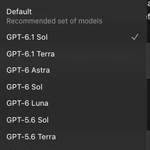
GPT 6.2 Sol is all you need
One and half months later Sol is still the king of Pareto frontier
I wont believe negative reviews unless i try it myself.
Its still not available in codex yet.
teapawt.org/BuiltinMind/status/210…


OpenAI’s release of GPT-6.2 Astra and GPT-6.2 Sol delivers the #2 model in the Artificial Analysis Intelligence Index and most of the Cost per Task Pareto frontier
@OpenAI's GPT-6.2 Astra is priced at $8/$40, 20% below GPT-6 Astra, and cached input drops to $0.40 from $1.00 per million tokens. GPT-6.2 Sol pricing is unchanged from GPT-6.1 Sol, at $2/$10 per million input/output tokens.
Key takeaways:
➤ Second in Intelligence Index: OpenAI now trails only Anthropic’s Claude Fable 5.2 in the Artificial Analysis Intelligence Index. GPT-6.2 Astra jumps 5 points from GPT-6 Astra, overtaking Gemini 4 Carbon (60) and Claude Opus 5.5 (59) at their top effort settings. GPT-6.2 Sol gains 2 points at 57, placing it on par with GPT-6 Astra at ~15% of the Cost per Task.
➤ Occupies most of cost and output token frontiers: OpenAI models now occupy most of the Cost per Task Pareto frontier, sharing the frontier with only Anthropic and Meta. OpenAI also dominates the Output Token per Task Pareto Frontier, with Claude Fable 5.2 being the only model from a non-OpenAI lab appearing on the frontier.
➤ Strengths in science and knowledge: OpenAI performs strongly in both of our key science-focused evaluations, leading Terminal-Bench-Science 0.1, covering agentic scientific research workflows, and placing second only to Claude Fable 5.2 in CritPt v2 (hard subset), covering physics reasoning. GPT-6.2 Astra performs below only Claude Fable 5.2 in factual knowledge as measured by AA-Omniscience v1.1 Accuracy, and in HLE-Diamond, a reasoning and knowledge benchmark.
➤ Leading in 3D and robotics: GPT-6.2 Astra leads AA-3D at 1318, with Claude Fable 5.2 at 1271 and GPT-6.2 Sol at 1259. This benchmark measures how well models build interactive 3D experiences, and is rated by human graders. GPT-6.2 also leads AA-Robotics v0.1, our research preview measuring how well language models can understand, plan, and act in the real world. GPT-6.2 Astra and GPT-6.2 Sol scored 79 and 78 respectively, ahead of Claude Fable 5.2 at 75. Our team is hard at work adding more difficult tasks, as OpenAI and Anthropic models can now perform the majority of basic tasks in this initial research preview.
➤ No improvement in Coding Agent Index: GPT-6.2 Astra is flat with GPT-6 Astra, and GPT-6.2 Sol loses 3 points relative to GPT-6.1 Sol in the Artificial Analysis Coding Agent Index (Codex harness at max effort). For Sol, the drop is driven by a 14-point drop in SWE-Atlas-QnA-AA, where the model is more likely than its predecessor to omit key facts in its responses. Cost efficiency however does place several effort levels of GPT-6.2 Astra and Sol on the Pareto frontier for Cost per Task.

32
7nm lithography is no longer the number one bottleneck capping China's AI chip output. Supply chain models show SMIC can already print over a million AI logic dies a year, while Huawei is actually throttled by a 73 fold gap in High Bandwidth Memory, a 25 percent HBM stacking yield at CXMT, an 86 percent first time chip design failure rate after US EDA curbs, and a split memory architecture inside Huawei's DaVinci cores.
Here is how DeepSeek's kernel engineers and 150 billion dollars in state capital are fighting through all four walls, and what the math says about when China catches Western AI compute.
How DeepSeek unlocked 99.7 percent roofline utilization on Ascend ?
how 93.3% KV cache compression bypasses a 5x memory bandwidth deficit ?
why audits expect frontier hardware parity at 2033-2034, yet Chinese models stay within 6 months of US releases ?

1
30
How DeepSeek unlocked 99.7 percent roofline utilization on Ascend ?
how 93.3% KV cache compression bypasses a 5x memory bandwidth deficit ?
why audits expect frontier hardware parity at 2033-2034, yet Chinese models stay within 6 months of US releases ?
Huawei wires 384 chips across 16 racks with 6,912 lasers and burns 559 kilowatts of cheap western Chinese electricity to beat a single 145 kilowatt Nvidia GB200 rack. Complete physics and hardware breakdown of how China builds AI silicon without EUV.
I going pretty deep into the rabbit hole of understanding the math and process behind how Huawei is able to workaround and produce the cutting edge chip design and production.
Although its totally technical post it shows how chips act restrictions, Trump administration ban on exporting chips have limited impact, the entire country of china is walking on the boundary of cutting edge science to make it possible.
When Jensen Huang was making the case for export controls being stupid, i was highly critical of jensen taking side of china but after digging through for weeks now i understand how wrong that assumption is and how right Jensen has been on this.
Trump administration or even other top countries who want to compete in chips manufacturing needs to learn and hear from experts and not political leaders. They need to understand where the buck is going to be. Most importantly they need to be open to compete not restrict. This is why chinese govt decided to open the Ai market with openweight models.
Without google TPUs and Nvidia's design edge and TSMC manufacturing prowess it will be very difficult to match china's efforts.


We need you Jensen more than ever for opensource.
Few things that could make the Ai monopolist back off :
teapawt.org/BuiltinMind/status/212…

Over the past week, I’ve been overwhelmed by the love and support of friends, industry colleagues, and people I've never met. Thank you to everyone who has shown kindness to my family and me. It means the world to me.
I came to the United States 53 years ago, and becoming an American citizen is one of the greatest gifts and proudest moments of my life. NVIDIA has been my life’s work. Building it into the company it is today alongside my colleagues has been a privilege and an honor. Nowhere but in America could a company like NVIDIA be possible. I love our country, and I love NVIDIA.
I did not live up to the standards expected of everyone at NVIDIA, and I have made serious mistakes in my personal life. I created problems for the Board that I deeply regret. I own my mistakes completely, and I am committed to cooperating with the Board’s independent investigation.
Since my departure, I’ve seen an outpouring of calls from NVIDIA’s employees, investors, business partners, and customers for me to return as CEO. Many continue to reach out to me directly as the company navigates complex technology, market, competitive, and geopolitical dynamics. NVIDIA is a once-in-a-generation company. If the Board of Directors decides that my return is in the best interest of our shareholders, our employees, the company, and America, I would be honored to answer these calls and return as CEO.
Thank you again to everyone who has shared their good wishes. I am profoundly humbled by your support. To my family: I love you, and I will spend the rest of my life being worthy of yours.
Jensen
23


Qwen 4 Max Terminal Bench 4, Agent Arena and Program Bench scores look quite depressing

📢 Meet Qwen4-Max, your new AI teammate for work, creativity, and discovery!
Qwen4-Max is built on a new MoE architecture with native vision and a 1M-token context window.
Highlights:
- Outperforms Qwen3.8-Max with up to ~50% fewer tokens, while average cost per task drops over 60% in our internal evaluation.
- Advances real-world productivity through greater proficiency with professional tools, stronger long-horizon execution, and higher-quality deliverables.
- Handles real tasks, including 3D modeling, game development, manufacturing, finance, law, healthcare, and frontier scientific discovery.
- $1.5/M tokens for input, $4.5/M tokens for output, and $0.075/M tokens for implicit caching — all lower than Qwen3.8-Max, with implicit caching down by 70%.
The API is live on QwenCloud. You can also try Qwen4-Max on Qwen Studio, QwenWork and Qoder.
Start building today! 🚀
- Blog: qwen.ai/blog?id=qwen4-max
- API: qwencloud.com/models/qwen4-m…
- Token Plan: qwencloud.com/pricing/token-…
More to come! The open weights of smaller Qwen4 models will be released. Stay tuned. 👀

43
Even the visionary @JensenHuang could not see them Ai Monopolistic people coming for him.
Things he could have done to avoid it, he did exactly opposite.
1. The smaller form factors that startups could afford and self host on.
2. Control over the enterprise play, the bread and butter of those pacing the frontier team
3. R&D on KV cache optimised architectures making the memory bottleneck (mafia) irrelevant allowing further expansion for NVIDIA
4. Investment in NVIDIA's own harness and tooling layer directly optimised and integrated with CUDA
5. More aggressive push for CUDA rust for agentic coding optimised vertical integration.
6. Research in continual learning and autoresearch giving NVIDIA control over RSI loops and long horizon coding
7. Expanding groq offerings with above
It still could be done. NVIDIA could pull this off and make evil lobbyist defeated at their own game. IF he could ever see this.