

Lockheed C-130 Hercules | Legendary tactical airlifter & AC-130 gunship. 70+ years of hauling cargo, troops & delivering wrath from above. Fan account
Rollin’ Down The Strip
Joined April 2026
- Tweets304
- Following5
- Followers3.2K
- Likes539




Pinned Tweet
Follow along as we celebrate the magnificent workhorse known as the Lockheed C-130 Hercules. We will highlight all variants across its 70+ year history.
If you love the Four Fans of Freedom, share us with your friends!


Yesterday, we saw the C-130 drop the 2nd largest conventional bomb in our arsenal, the MOAB.
This one is the smaller cousin, the Daisy Cutter.
3
40
1,001


LAPES looked like a party trick until it wasn’t.
Low Altitude Parachute Extraction System let a C-130 fly 5 to 10 feet off the ground, pop a drogue, and yank a pallet or even a Sheridan tank out the ramp. The load hit, slid, and stopped. The airplane never had to land. That was the point. Heavy cargo into a short strip or a hot LZ without sitting on the ground.
The problem was the margin. There wasn’t one. At that height a late flare, a high approach, a hung load, or a chute that doesn’t extract cleanly leaves the crew with almost no time to recover. The airplane is already in the weeds.
On 1 July 1987 at Fort Bragg’s Sicily Drop Zone, a C-130E from the 40th TAS was doing a CAPEX demo in front of thousands of spectators. The load came out. The airplane didn’t climb away. It struck, slid, broke up in the trees, and burned. Four aircrew and one soldier on the ground were killed. Two crew survived.
That crash did not kill LAPES overnight. Training continued for a while. But the Army later called it an expensive, little-used capability, and the Air Force dropped LAPES operations and training in the 1990s. Precision airdrop and other methods could put cargo on a spot without flying a four-engine transport at jeep height.
The video shown is the whole story in two clips. When it worked, it looked unbeatable. When it didn’t, there was nowhere to go.
On 2 May 2018, a Puerto Rico Air National Guard WC-130H, tail number 65-0968, crashed about a mile and a half after takeoff from Savannah/Hilton Head International Airport.
The aircraft belonged to the 156th Airlift Wing. It had been in Savannah for maintenance and was bound for Davis-Monthan AFB in Arizona, where it was slated for retirement. Roughly 90 seconds after leaving the runway, it banked left, stalled, and hit Georgia State Route 21 in Port Wentworth.
All nine airmen on board were killed. No one on the ground was injured.The accident investigation found that an engine problem was followed by incorrect rudder input below three-engine minimum controllable airspeed. The left wing stalled and the aircraft departed controlled flight.
The crew were members of the same wing that had helped with Hurricane Maria recovery in Puerto Rico.
Nine airmen. A ferry flight that never made it west.
C-130 just got an upgrade!
With the addition of a forward-facing gun, it has now become the F-130.
Taking close air support to a whole new level.


The C-130 Hercules: still the most successful military transport ever built.
More than 2,700 delivered to roughly 60–70 nations.
Operated by the USAF, USMC, USN, USCG, Air National Guard, Air Force Reserve… and dozens of allies around the world.
First production aircraft handed over in December 1956.
Seventy years later, the line is still open.
That’s an average of roughly 39 aircraft every single year for seven decades — an unmatched continuous production run in military aviation history.
From Vietnam to the Arctic, from disaster relief to special operations, the Herc just keeps showing up.
Long live the Hercules.


TODAY IS THE DAY!
On this day, 72 years ago... the YC-130 made its first flight!
72 years of hauling troops, cargo, firefighting equipment, animals, bombs, weather recon, and more.

The C-130 that caught falling stars from space.
During the Cold War, America’s Corona (and later Gambit/Hexagon) spy satellites ejected film capsules that re-entered the atmosphere under parachute. Someone had to grab them before they hit the Pacific.
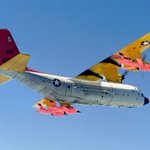
Enter the specially modified JC-130 Hercules of the 6594th Test Group at Hickam AFB, Hawaii. Crews deployed long poles and a nylon “loop” with brass hooks from the open rear ramp, then flew directly over the descending capsule at low altitude. One clean snag and the winch reeled the precious film bucket aboard.
They started with C-119s (first success: Discoverer 14 on 19 August 1960), then switched to the more capable Hercules. The unit’s motto said it all: “Catch a Falling Star.”
Hundreds of successful recoveries delivered the first overhead photos of the Soviet Union — intelligence that helped shape U.S. strategy for over a decade. No drones, no lasers… just skill, timing, and a Herk with a very long arm.
One of the coolest (and least-known) missions the C-130 ever flew.

