open to new crypto and or legal projects. Crypto-law enthusiast. ZK-Lawyer
Cryptoland
Joined March 2021
- Tweets1.8K
- Following2K
- Followers862
- Likes4.4K


CryptoLawyer retweeted

Been watching Bessent plug the UST market from every direction.. the sovereign cracks are starting to show: buybacks, defending Yen (raising dollars against USTs instead of BOJ dumping them into the market) plus AI capex arms race is now competing for the same pool of capital
Hard not to be reminded of the the historical parallels Plaza in 1985, joint yen buying in 1998, G7 yen selling after Fukushima in 2011. historical context is diff but whenever Washington enters fx market the spillover is always bigger than fx itself
When the anchor asset of global capital markets, the presumed “safest asset”, needs this much active maintenance, you know something structurally unstable is cooking
CryptoLawyer retweeted

In a 2023 podcast, Dwarkesh asked me if HFT was zero-sum for society. I argued that extreme competition at the margins for nanosecond-level advantage might subsidize the creation of broadly beneficial new technology. How AI training/inference stacks have become a clear example of this
Over the last ten years, quantitative trading firms built or invested in the fundamental components of distributed systems and high-performance computing. Many technologies now commonly associated with AI were created for HFT during this period or reached scale because of it. A non-exhaustive list of these technologies, from high-throughput networking to vectorized databases to precision timestamping:
• Mellanox InfiniBand and ConnectX NICs: HFT colocation and cross-connect environments drove early large-scale deployment of RDMA-capable InfiniBand and the ConnectX series. These became the default high-bandwidth, low-latency fabric inside modern GPU pods for all-reduce, parameter servers, and expert parallelism. Mellanox was acquired by Nvidia in 2020.
• Solarflare/OpenOnload (and later Xilinx/AMD equivalents): Kernel-bypass networking stacks and specialized low-latency Ethernet NICs let applications DMA packets straight into user space. These techniques were required for software-based trading systems to reach the microsecond range of tick-to-trade latency. Engineers for hyperscalers commonly use this technology today for distributed cloud training and inference networks.
• RDMA and RoCE: Remote Direct Memory Access, refined under HFT firms’ nanosecond requirements, has become the transport that allows GPUs to exchange gradients and activations with microsecond-scale latency and minimal CPU involvement.
• FPGA feed handlers and inline accelerators (Alveo, custom RTL on Xilinx/Intel): FPGAs are not the hardware solution of choice for AI, where GPUs and custom ASICs have dominated. However, HFT use of FPGAs for wire-speed market-data parsing, book building, and sub-microsecond decision logic created a pipeline of talent and verification processes that transferred into AI inference accelerators.
• Vectorized/columnar analytics engines: Quant and HFT shops require extreme scan and aggregation performance over massive tick and order-book histories, using pioneering technologies like KDB/Q. Several firms I’ve worked at became large users and funders of ClickHouse, which has become essential to logging and offline data preparation for large model training.
• Hardware timestamping and PTP: HFT firms’ need for exact packet ordering and latency measurement hardened the timing infrastructure that distributed AI training and multi-node inference rely on for correct collective operations and debugging.
• Lock-free, zero-allocation, cache-aware software patterns: The performance culture and specific techniques developed for tick-to-trade loops became standard practice in high-performance CUDA kernels, inference servers, and communication libraries. These techniques include carefully tuned concurrent data structures, huge pages, CPU pinning, and avoidance of syscalls in the critical path.
The natural followup question in 2023 was whether too much capital and talent had been or could be spent on HFT. The HFT industry is still relatively small, employing around 10,000 people and producing about as much yearly revenue as Nvidia’s and AMD’s R&D budgets. If an ancillary use case for HFT is a bounty program to fund the infrastructure of our next technological epoch, the costs still seem low.
CryptoLawyer retweeted

My latest video for @AlphaBetaSoup_ explores the current state of the economy, and how bad data doesn't seem to matter because the top 20% of earners are doing so well.
Give it a watch, subscribe to my channel, etc. YT link in the retweet below. Appreciate the engagement!
Have a great weekend

This Economy Sucks ... But is Also Pretty Good ?
ABS Episode #108
youtu.be/QC2E7nZD9Rc
Have a great weekend, friends 🤝
CryptoLawyer retweeted

Something that got missed in the noise last week: Coinbase got approved to offer true global crypto perps in the US. This took many years of work, and we're the first to offer this global liquidity to US users.
Backstory: For many years crypto trading has been moving offshore because the US didn't have clear rules, and perpetual futures were a superior product that traders wanted but it wasn't allowed in the US.
If we're being honest, probably ~half of all perpetual futures volume was Americans using offshore products via VPN with loose KYC controls (an open secret in the industry). Penalties for this were rarely, if ever, enforced, which as you can imagine, was frustrating for us as an American company following the rules. Others set up offshore entities and found ways around it.
After dozens of personal visits to DC, and many more from our policy team, I'm really proud we finally got approval to give US users access to true, global perpetual futures. This is important because we'll now see pooled global liquidity in perpetual futures, with the US and international markets being connected instead of fragmented.
Coinbase is strongest in the US, and the US is the largest market for trading, so there is now a chance to build a global network effect around liquidity. And US traders can now use these products in a compliant way with a US company, which hopefully provides greater customer protection.
Major credit to Chair Selig and Atkins on recognizing the importance of this for US capital markets. And we will keep working to update the system in a compliant way, and to be the best place you can trade.
CryptoLawyer retweeted

The Clarity Act passed committee. The floor is next. We did not come this far to quit at the 5 yard line.


CryptoLawyer retweeted

Look guys, it's actually really straightforward, a bunch of people staked their ETH on the Ethereum blockchain to earn yield, except they didn't want their capital to be locked up, so they actually staked with a liquid staking protocol called Lido who provided them a liquid staking receipt token called stETH, except they decided to juice their yield further by depositing their stETH receipt tokens into a restaking protocol called Eigenlayer, except they didn't want to lock up their capital, so they actually restaked with a liquid restaking protocol called KelpDAO who provided them with a liquid restaking receipt token called rsETH, except they decided to juice their yield further by depositing their rsETH tokens into a lending protocol called Aave so that they could open a leveraged looping position that borrows ETH against the rsETH collateral and restakes the ETH into rsETH which is then deposited as collateral, except it turns out rsETH used a cross-chain bridge called LayerZero that was hacked by north koreans causing rsETH to become undercollateralized and now these looping positions are stuck and unprofitable, and everyone is pointing fingers at each other, and also DeFi is a very serious industry

CryptoLawyer retweeted

“The ability to exercise collateral value on your assets makes DeFi instantly more productive.”
@calilyliu, President of the @SolanaFndn explains why programmable collateral is DeFi’s real edge.


CryptoLawyer retweeted

First Ken Griffin screwed over Constitution DAO
Now he's coming for DeFi, asking the SEC to treat software developers of decentralized protocols like centralized intermediaries
Bet Citadel has been lobbying behind closed doors on this for years
Okay thats all pretty bad, but the actual nerve for one of their arguments to be that there is no way for DeFi protocols to provide "fair access" of all things lmao
Makes sense the king of shady tradfi market makers doesn't like open source, peer-to-peer tech that can lower the barrier to liquidity creation
sec.gov/files/citadel-securi…

CryptoLawyer retweeted

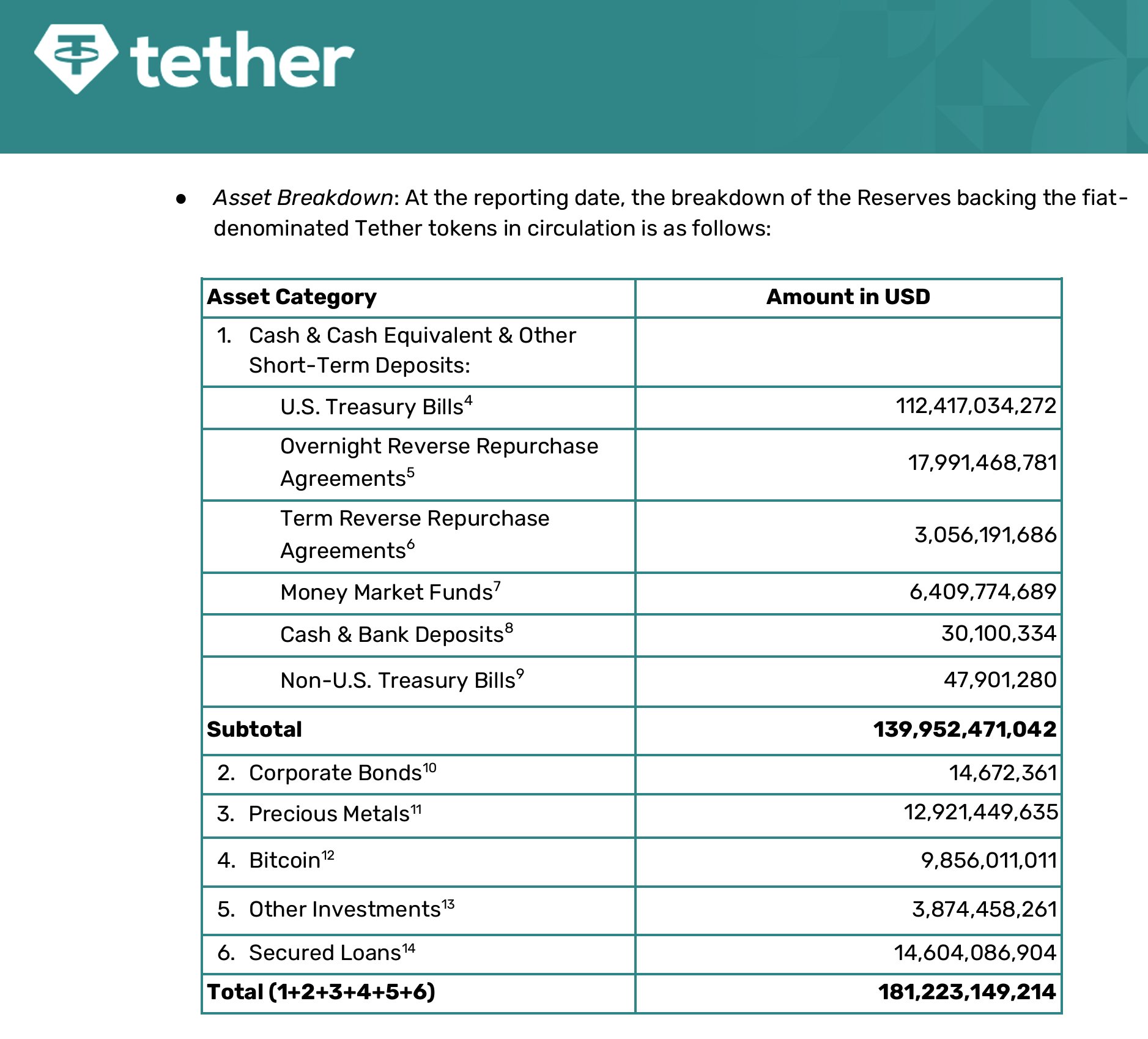
The Tether folks are in the early innings of running a massive interest rate trade. How I read this audit is they think the Fed will cut rates which crushes their interest income. In response, they are buying gold and $BTC that should in theory moon as the price of money falls.
A roughly 30% decline in the gold + $BTC position would wipe out their equity, and then USDT would be in theory insolvent. I'm sure some large holders and exchanges will demand a real-time view of their B/S so they can assess the solvency risk of Tether. Get out your popcorn, I expect the MSM to run wild with this, especially all the editors with TDS who want to shit on Lutnick and Cantor for backing this stablecoin.
CryptoLawyer retweeted

Why Tether’s Gold & Bitcoin Bets May Be the Only Real Hedge Against the GENIUS Act’s “Reverse-Yield” Risk
This week, S&P downgraded its stability assessment of Tether’s USDT from “constrained” to “weak”—the lowest score on S&P’s five-point stablecoin stability scale. S&P cited Tether’s increased reliance on gold and Bitcoin reserves.
Tether is now the largest non-state holder of physical gold in the world, and approximately 13% of USDT reserves are backed by gold and Bitcoin. Under the GENIUS Act, Tether’s U.S.-issued stablecoin, USA₮, is mandated to hold 1:1 short-term U.S. Treasury bills.
For its offshore stablecoin, USDT, Tether is relying more heavily on gold and Bitcoin as reserve assets. This move may well be a strategic hedge against a mass U.S. stablecoin liquidation event.
In such an event, Tether would not be forced to shore up reserves by liquidating short-term T-bills at a loss. It would have the option to meet redemptions by liquidating its gold and Bitcoin reserves instead. The more Tether’s reserves rely on gold and BTC—instead of exclusively on short-term T-bills—the less its overall balance sheet is exposed to a reverse-yield liquidation crisis.
As noted in Shanaka’s article, the GENIUS Act forces U.S.-regulated stablecoins into one of the safest assets on earth: short-term U.S. Treasury bills. While that’s great for reducing Terra/Luna-style risks and for lowering U.S. borrowing costs, it does come with a structural problem: when stablecoins grow, they gently push yields down; when they contract, they can violently push yields up.
This is the convexity trap. A few billion dollars entering stablecoins barely moves yields—but a few billion dollars leaving stablecoins can spike yields two to three times harder.
If Tether held exclusively short-term T-bills, then in a redemption crisis, it would be forced to dump T-bills into a stressed market—further accelerating a T-bill yield spike—or take mark-to-market losses on its remaining T-bill holdings.
In that scenario, Tether gets hit twice, right when confidence in stablecoins is already fragile. That’s the “reverse-yield” problem.
A stablecoin built entirely on U.S. Treasuries therefore becomes brittle at the exact moment the system needs stability most. Here’s where Tether’s controversial reserve mix makes more sense than critics admit.
Gold & Bitcoin Break the Convexity Loop
By holding a meaningful slice of reserves in gold and Bitcoin, Tether gives itself something almost no other issuer—including Circle—has:
🚫 Assets it can liquidate during redemptions without dumping T-bills.
🚫 Assets that aren’t mechanically tied to short-term rates.
🚫 Assets—like gold and Bitcoin—that may rise or stay stable in the exact macro scenarios that crush Treasuries.
As a consequence:
➕Gold reduces Tether’s exposure to interest-rate convexity.
➕Bitcoin hedges the tail-risk of a U.S. sovereign credibility event.
Together, they give Tether something a 100% T-bill model cannot: the ability to meet redemptions without feeding the very crisis that threatens its peg.
Do these assets introduce volatility? Absolutely.
But they also break the one-way valve the GENIUS Act accidentally created. This is why Tether’s diversification looks reckless to regulators—but smart to anyone who understands convexity.
In a world where every GENIUS-compliant stablecoin becomes a leveraged bet on the short-end of the U.S. curve, Tether is quietly building the only balance sheet not fully dependent on the thing everyone else assumes will never break.

THE SILENT COUP’S FATAL FLAW
Treasury just wired America’s $38 trillion debt to crypto volatility. Nobody told you.
Here is what the Bank for International Settlements discovered in May 2025, buried in Working Paper 1270:
When stablecoins grow, Treasury yields fall 2 basis points per $3.5 billion inflow.
When stablecoins contract, yields spike 6 to 8 basis points.
The ratio is not symmetric. Outflows hit three times harder than inflows help.
The GENIUS Act, signed July 18, 2025, mandates that stablecoin issuers hold reserves exclusively in Treasury bills. Tether alone now holds $135 billion in U.S. government debt. This created captive demand that suppresses borrowing costs during expansion.
November 2025 delivered the first reversal in 26 months. Market cap fell $4.5 billion. Three days ago, S&P downgraded Tether to its lowest stability rating, citing 24 percent high risk reserves including Bitcoin that now exceeds the company’s entire overcollateralization buffer.
The arithmetic is devastating.
A 20 percent stablecoin contraction at current scale forces $60 billion in Treasury liquidations. At 3x convexity, yields spike 60 basis points. Against $38 trillion in debt, each basis point costs $3.8 billion annually.
Total damage: $228 billion added to yearly interest expense. That is a 22 percent increase in debt servicing from a single quarter of crypto outflows.
The Strategic Bitcoin Reserve provides no hedge. Post seizure holdings of 326,000 BTC cover 0.078 percent of federal debt. When crypto crashes, that reserve loses value precisely when protection is needed.
The administration banned CBDCs in January. Powell confirmed no digital dollar during his tenure. Yet the very crisis this architecture creates hands the Federal Reserve its strongest argument for reasserting control.
Treasury built a demand engine with no reverse gear.
The engine just shifted.
Read the deep dive analysis here 👇
open.substack.com/pub/shanak…


CryptoLawyer retweeted

My favorite thing about this chart is that the median homebuyer age rose from 39 in 2005 to 59 in 2025
20 years over 20 years
It’s literally the same people buying the homes two decades later

CryptoLawyer retweeted

It’s true 😍

J.P. Morgan just bought 1,974,144 shares of @BitMNR worth $102M
the largest bank in america is buying ETH