

Distributed Systems, Blockchain, Algorithms, Game Theory, Voting @category_xyz @discoETH
Zurich, Switzerland
Joined December 2022
- Tweets12
- Following122
- Followers53
- Likes23
Smart contracts can do incredibly involved things… but then stop, waiting to be woken up by hand.
Time they learned to wake themselves up:

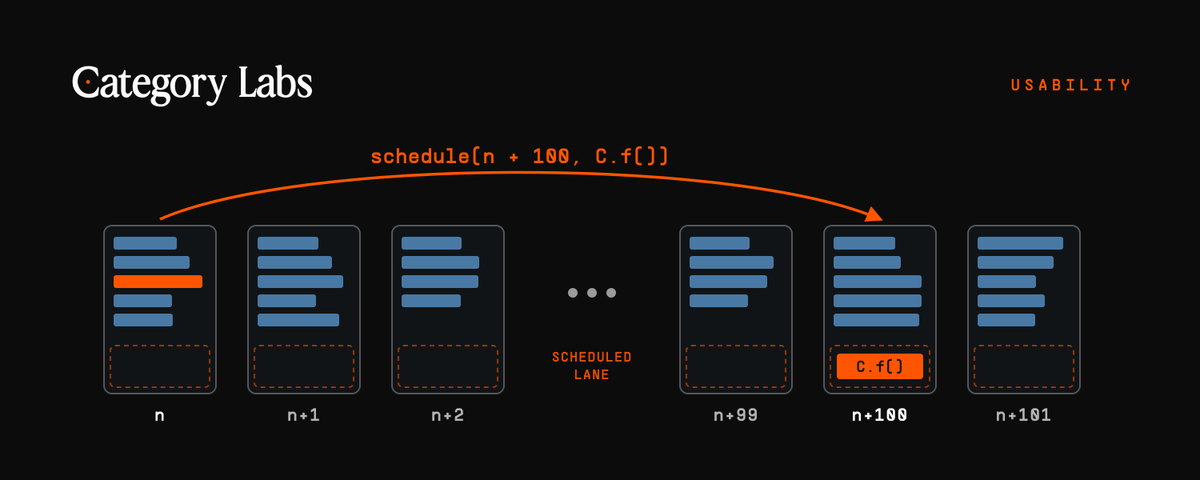
Building on Monad with an off-chain cron job somewhere behind your app?
Tell us what it does, and whether anything in our design would get in your way: forum.monad.xyz/t/scheduled-…

Privacy is coming to Monad. Check out what I've been working on together with the amazing team at @category_xyz ! Stay tuned for more!
#TOKEN2049

JUST IN: @category_xyz revealed Monad Private Settlement
Private Settlement is being developed to provide confidential execution domains with encrypted transactions, atomic settlement, and access to L1 liquidity.
Designed for banks, funds, and other institutions that need a privacy solution for their activity.
Andrei Constantinescu retweeted

Category Labs is proud to introduce Cadence, our multiple-concurrent-proposers (MCP) consensus protocol that matches the optimal good-case latency of single-leader consensus while supporting arbitrarily short block intervals. When combined with BTX, our design for encrypted mempools, this represents a significant step towards solving the problem of MEV at the protocol level.
In nearly every blockchain today, a single party ends up in control of each block: it decides which transactions get in, and can reorder them at will. MCP is the natural fix, but most recent designs pay for it with a separate aggregation phase, adding two extra communication rounds per block.
Cadence makes the proposers part of consensus itself. Its fast path finalizes in an optimal three communication rounds, even when proposers are offline. Cadence also offers speculative finality, similar to MonadBFT, after just two rounds, revertible only if a proposer provably equivocated. In a simulation using estimated network delays between Monad mainnet's 200 globally distributed validators, finalization takes 219 ms on average, speculative finality 167 ms.
Cadence pushes pipelining to the extreme: each block is proposed and finalized in its own independent consensus instance, without waiting on preceding blocks. The block interval then becomes a protocol parameter that can be arbitrarily small. At our initial target of 100 ms, a transaction waits on average just 50 ms to enter a proposal, and oracle prices, liquidations, and auctions can update every 100 ms. Cadence dynamically throttles the opening of new instances to bound the number of outstanding slots even during periods of network instability.
When the network is healthy (under synchrony), a transaction included by an honest proposer can be neither dropped nor deferred (short-term censorship resistance), and no proposer can see the others' proposals in time to react (hiding). We prove both, together with safety and liveness under partial synchrony at the optimal 3f+1 fault bound.
The Cadence protocol is modular: each module is simple on its own, and any of them can be swapped out without touching the rest.
Cadence also builds on components already being deployed: proposals are disseminated as erasure-coded chunks over Deterministic RaptorCast, now rolling out on Monad, and validators vote on proposal digests, so voting does not wait for the full data to arrive.
Start with the interactive tutorial: category.xyz/cadence.
Full paper: arxiv.org/abs/2607.02275.
Joint work by Kushal Babel, Fatima Elsheimy, Lioba Heimbach, Mohammad Mussadiq Jalalzai, Tobias Klenze, Jovan Komatovic, Jason Milionis, Mike Setrin, and Victor Shoup.
Andrei Constantinescu retweeted

If only this award winning paper about "Stable Dinner Party Seating Arrangements" had been published before Christmas...
brnw.ch/21wG23f
#DinnerSeatingProblem #BestPaperAward
Andrei Constantinescu retweeted

"Stable Dinner Party Seating Arrangements" wins the best paper award at WINE 2023! The paper studies avoiding conflict when seating your guests at the dining table. Congrats Andrei @CAndrei1998 and Damien!
Paper: tik-db.ee.ethz.ch/file/61c3e…

Andrei Constantinescu retweeted
A democratically chosen policy might face opposition from a majority of the voters! What is the minimum change to the policy to gain majority support? Andrei Constantinescu @CAndrei1998 presents this computational problem at AAMAS 2023. arxiv.org/abs/2303.00660
