

Foreign policy news and analysis. CFR takes no institutional positions on policy. Follows, RT ≠ endorsements. ✉️ Subscribe for more: https://xitter.cf/t.co/ehd5lKYrLs
New York, NY
Joined November 2008
- Tweets86.8K
- Following145
- Followers58K
- Likes2K





Pinned Tweet
“The stable and open international order erected during America’s watch—Pax Americana—is unraveling, giving way to global disarray,” argues expert @CharlesKupchan.
In his new book, Bringing Order to Anarchy: Governing the World to Come, Kupchan lays out a guide for building a new order fit for the emerging multipolar world. Learn more: cfr.org/books/bringing-order…

CFR’s annual Preventive Priorities Survey helps policymakers anticipate and avert international crises. In the survey, experts assess ongoing and potential violent conflicts and sources of instability that could worsen in the coming year.
What emerging or escalating conflicts do you think should be on the 2027 survey? Let us know and submit your suggestions: docs.google.com/forms/d/e/1F…

Israeli elections next week will determine whether Benjamin Netanyahu and his right-wing Likud party remain in power, or if Gadi Eisenkot’s centrist Yashar party will be able to form a new government. So far, polls indicate that neither party will gain enough votes to establish a sixty-one-seat majority, which could trigger another round of elections. "Israelis aren't really enthusiastic about this election. People are dragging themselves across the finish line, dreading what the outcome might be," says CFR expert @stevenacook in a dispatch from Israel.
Sir Ken McCallum, director general of MI5—the United Kingdom’s domestic security and counterintelligence agency—delivered his annual threat update last week. He warned of a “new era” for national security, one that required “a new response.”
“The speech could still have gone further in underscoring the importance of soft power and connecting the dots between what is happening in society—polarization, distrust, bigotry, racism—and the country’s vulnerabilities to terrorists or state actors," writes expert @Farah_Pandith and Ezra Hess.

Read more: cfr.org/articles/unpacking-m…

“These faith-based awards have all gone to Christian charities; there are no other faiths that are represented. Is the Trump administration, in your opinion, missing a complete faith-based aid package here, or is this not faith-based aid, it’s Christian aid from the United States?” asks Sam Vigersky, CFR expert.
“The realities of societies—and let’s just take sub-Saharan Africa—are that they are multifaith, particularly as we get into parts of eastern and western Africa with majority-Muslim populations. It will be impossible to deliver this kind of assistance at the community level without involving Islamic organizations, individual imams and mosques, and community groups,” argues William Steiger, CEO of Malaria No More.
Watch the full conversation here: cfr.org/event/faith-based-hu…
Council on Foreign Relations retweeted

#OnThisDay in 1962, President John F. Kennedy faked a fever to cancel a campaign trip and return to the White House to meet with his national security team to discuss how to respond to the news that the Soviets were installing ballistic missiles in Cuba. cfr.org/articles/president-j…

Over the weekend, France had its worst day of urban violence in years. The protests began a month ago among high school students who complained about school conditions and budget cuts. At the same time, the government announced that 25-30% of the education budget would go to pensions.
Unrest quickly spread around the country and, according to CFR expert @m2matthijs, “a protest about schools became a protest about everything, from the cost of living to higher diesel prices and government austerity.” Matthijs explains how France got here, what could come next, and how the situation could benefit France's far right.
The next leader of the United Nations will need to steer the global body through a time of crises.
In CFR's series profiling candidates for UN Secretary-General, Carolyn Rodrigues Birkett, the former minister of foreign affairs of Guyana, talked to us about why she's suited for this moment.
Coming from a small state, Rodrigues Birkett says she understands how the UN’s problems ripple outward: a liquidity crisis, off-track development goals, and growing criticism from other smaller member states that UN staff isn't geographically representative.
Read the full takeaways: cfr.org/articles/how-carolyn…

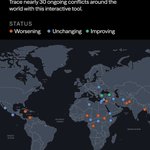
Our Global Conflict Tracker traces ongoing armed conflicts around the world. It includes background information, the latest news developments, conflict status assessments, and resources for further research—all updated regularly.
Use the interactive tool to learn more: cfr.org/global-conflict-trac…

Council on Foreign Relations retweeted

Out today, my new book "Bringing Order to Anarchy." A world in disarray. How did we get here? What do we do now? The book provides a roadmap for building order in the world to come. @CFR_org @georgetownsfs @yalepress
cfr.org/books/bringing-order…
“Instead of burying ‘America first,’ Trump’s successor should salvage its best elements and implement them more capably,” writes expert Charles Kupchan. “The next version of U.S. foreign policy should marry the realist impulses that shape ‘America first’ with the liberal cause that remains at the heart of the American experience.”
Read his essay in Foreign Affairs: foreignaffairs.com/united-st…

Ukrainian drones took out three data centers owned by Yandex, the internet conglomerate sometimes referred to as Russia’s Google, last week in retaliation for Russian strikes on its data centers.
The strikes caused severe disruptions across the country, impeding Russians’ ability to send emails, make payments, and navigate the streets.
"These strikes will have minimal effect on the global race to develop and adopt artificial intelligence," writes expert @ConnorMauthor. "Russia is nowhere close to the cutting edge of the field . . . hamstrung by lack of access to cutting-edge chips and by a brain drain of engineers."
“But the bigger implication of the Ukrainian strikes is that they have laid bare a fundamental risk to the development and deployment of AI worldwide: its physical infrastructure is vulnerable.”
“Companies and nations seeking to protect their data centers should therefore pursue a strategy of redundancy and resiliency.”
“At its highest levels of performance, AI’s capabilities can appear otherworldly—but it is fundamentally a technology dependent on physical things. Defending it is just a new version of the oldest problem in warfare: how to hit your enemy’s infrastructure while stopping them from hitting yours.”
"As long as they provide value, data centers will be targets," Martin writes. "Countries and companies are well advised to prepare for that future now.”

Read more: cfr.org/articles/ukraines-at…

“Today, as the population rapidly grays, China’s political system is becoming increasingly regressive and rigid,” writes expert Carl Minzner. “China can build new high-speed rail lines or aircraft carriers but not, it seems, a sustainable social safety net for its rapidly graying countryside.”
Read his essay in Foreign Affairs: foreignaffairs.com/china/chi…

“Most states even today reward utilities for selling you more energy and penalize them for cutting your bill,” says Amory Lovins, cofounder and chairman emeritus of the Rocky Mountain Institute. “There are hosts of perverse incentives like this, carefully designed often by the incumbents who do very nicely out of selling the energy.”
Watch the full conversation: cfr.org/event/the-road-not-t…

When President Donald Trump announced a deal to buy diesel from Russia, “it was easy to shrug off the move as a feeble effort to limit energy prices in advance of the midterms,” writes expert Stephen Sestanovich.
The story now looks "disturbingly different; the possible consequences, much more serious, and likely to last well beyond the midterms."
A day after announcing new diesel imports from Russia, Trump began calling for Ukrainian President Volodymyr Zelenskyy’s removal from office. He followed this up by claiming that Moscow and Kyiv had agreed to suspend attacks on each other’s main energy targets.
"This, it quickly became clear, was pure invention. Reports suggested what had actually happened was that U.S. negotiators were pressing the Ukrainian government to do something far more radical than a mutual ceasefire—to cease its attacks unilaterally, whether Russia complied or not," Sestanovich writes.
“It is hard to overstate how much this new public hostility by U.S. officials—above all, the president—has disoriented Ukraine’s leadership,” he writes. “In searching for a new way to handle Trump, Ukraine’s leadership has seemed suddenly at sea."
"Rather than see the prospect of postwar riches as the key that will bring Putin to the table, he now acts as though pressure—on Zelenskyy, not Putin—will be the crucial instrument of a breakthrough,” Sestanovich argues.

Read his full analysis: cfr.org/articles/trumps-dies…

Council on Foreign Relations retweeted

China is headed for a demographic cliff, writes @CarlMinzner. By the 2040s, it “will shed around one percent of its population annually—roughly ten million people, more than the population of New York City.”
foreignaffairs.com/china/chi…