

Médico intensivista. Escéptico. Estudioso de la neurociencia, la bioética y la historia. Abuelo y padre de gente con AACC. Evolucionista y ciclista.
Spain
Joined July 2021
- Tweets6.6K
- Following526
- Followers354
- Likes4K




Con respecto a esto, y sin meterme en las causas de lleno, hay una curiosidad histórica, si se me permite seguir en la conversación…
En Londres hubo un juicio en 1877 contra Charles Bradlaugh y Annie Besant, dos librepensadores, por reeditar un manual de control de la natalidad. Tras el juicio, la fecundidad cayó más en los distritos de Inglaterra y Gales con mayor exposición a la cobertura periodística del caso. Un estudio de 2023 estima que la mayor parte de esa caída adicional se produjo dentro del matrimonio y propone que la publicidad del juicio facilitó la difusión de información y la aceptación del control de la natalidad.
Bradlaugh pidió a Darwin que testificara para dar respaldo científico a la defensa, que invocaba argumentos evolucionistas. Darwin declinó por escrito y le dijo que se oponía al uso de medios artificiales para evitar la concepción.
1
50
Between 1792 and 1798, Jean-Baptiste Delambre and Pierre Méchain used triangulation to measure the meridian arc between Dunkirk and Barcelona. Their aim was to establish the length of the metre, defined as one ten-millionth of the distance from the equator to the pole, measured along a meridian.
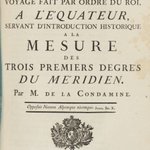
Because the Earth is flattened at the poles, the length of one degree of meridian varies with latitude. To calculate the length of the full quadrant, the 1799 commission therefore had to compare the European arc with the equatorial arc measured more than half a century earlier by the Franco-Spanish expedition to Quito. The commission used the figure Pierre Bouguer had published at the time to estimate the Earth’s flattening. From that estimate, it extrapolated the length of the quadrant and fixed the length of the standard metre. Laplace explains this explicitly in his "Exposition du système du monde".


In 1792, two French astronomers set out to measure the Earth. Their goal was to determine the length of ONE METRE.
Jean-Baptiste Delambre and Pierre Méchain had been entrusted with an ambitious task. France wanted a universal unit of length, defined as one ten-millionth of the distance from the North Pole to the equator.
But how could anyone measure such an enormous distance?
They used triangles. Over several years, the astronomers constructed a network of approximately 115 giant triangles stretching from Dunkirk to Barcelona.
They measured angles between distant landmarks using precision instruments. Once one side of a triangle was known, trigonometry revealed the others.
But someone still had to measure that first distance.
Delambre spent 41 days measuring one road near Paris, then 43 days measuring a second road in southern France. The two baselines helped establish and check the scale of the entire network.
With those measurements and the angles of their enormous triangles, the astronomers calculated an arc of Earth's meridian.
Their result helped establish the original metre in 1799.
The expedition took place amid the turmoil of the French Revolution and years of war.
Today, the metre is defined using the speed of light. But its historical origin lies in an extraordinary chain of triangles across France and Spain.
Matt Parker recounts this achievement in Love Triangle: How Trigonometry Shapes the World.

1
79
The expeditions to Lapland and Quito also helped settle the debate over whether the Earth was flattened at the poles or elongated along its polar axis. The question was a point of scientific rivalry between France and Britain and divided the Paris Academy of Sciences itself. Jacques Cassini took the measurements of the French meridian to indicate that the Earth was elongated along its polar axis. His fellow Frenchmen Maupertuis and Clairaut set out to test Newton’s prediction. In Lapland they worked with the Swedish astronomer Anders Celsius, while in Quito members of the French Academy worked with Jorge Juan and Antonio de Ulloa.
1
41
The controversy was settled in several stages. In Lapland in 1737, Maupertuis’s team found that a degree of meridian covered a greater distance than it did in France. In 1739–1740, Cassini de Thury, Jacques Cassini’s son, and Lacaille remeasured the French meridian and obtained results that supported polar flattening. The Quito expedition corroborated that conclusion at the other end of the comparison by providing a measurement near the equator. To calculate the length of a meridian quadrant and fix the length of the metre, the 1799 commission adopted an estimate of approximately 1/334 for the Earth’s flattening.
24

Ramon Diaz retweeted

Sorry, the stairs are currently out of service…we’re busy building harmonies for ‘Samhain’ 🍂
Harvey Williams Cushing (1869 - 1939) fue un cirujano, patólogo, escritor y dibujante estadounidense conocido como el padre de la neurocirugía moderna. Fue el primer neurocirujano exclusivo y la primera persona en describir la enfermedad de Cushing.

ALT Autor deconocido. https://wellcomeimages.org/indexplus/image/V0027585.html
Las gráficas de anestesia siguieron teniendo ese aspecto hasta casi la introducción del modelo electrónico. Varió básicamente solo el número de datos que se graficaban y la anotación de la medicación.
1
2
21