

Solo dev @ Bayou Bytes Making StarStranded(on-device AI NPCs) + ForecastSpread pixel-art weather app + Remote Sensing side quests. Come try my latest builds 👇
Joined February 2015
- Tweets444
- Following212
- Followers52
- Likes121


Weather alerts are boring, so every alert in my app gets its own animated pixel-art scene.
Long-press the notification and the scene plays. 37 of them so far:
1- 25 hazard alerts
2- rain soon and snow soon
3- a cold front moving in
4- Model Divergence, for when the forecast models stop agreeing
2
29
It's ForecastSpread, my pixel-art weather app that puts up to 17 forecast models side by side.
Free beta on iPhone + Apple Watch: testflight.apple.com/join/mX…
Android: play.google.com/apps/testing…

23
Claude users: when you use a Fable reset you Get that usage back in your weekly! They need to promote this more it’s a big deal.

33

Anthropic just gave Ultra users 3 Fable 5.2 resets on top of the Weekly they gave us for testing Duet?!? good lord that some serious $$$

1
52
My NPCs can't ramble, break format, or lose track of their mood, because the model isn't allowed to.
Every NPC in StarStranded runs on Phi-3.5-mini (Q4_K_M, about 2.4 GB) through llama.cpp, fully offline. Each reply is grammar-locked to a JSON schema:
1- emotion streams first, one of 6 values, so the Piper voice picks its delivery before the first word arrives
2- dialogue is the actual line
3- intent is one of 6 gameplay moves: trade, give_quest, take_payment, attack, refuse, or none
4- action is flavor, like "nods slowly"
Only emotion and dialogue are required, so a short answer never breaks the parser.
If you're shipping a local model in a game, are you constraining output with a grammar(do this😎), or parsing free text and hoping(don't do this 😆)?

35
Already living this. Omarchy on my old Intel Touch Bar MacBook Pro, running OpenCode with Qwen 3.8 Flash-Next as its main model. The model is served by Strata on my 5090 desktop over Tailscale.
It's my spare machine for local API work and prototyping. I can kick off jobs there without eating into the PC serving the model or my daily MacBook's resources. teapawt.org/dhh/status/21197136412…

Local AI is getting really good. Omarchy 4.6 will make it trivial to get started by recommending the very best model that's available for your machine. This is Flash Next on the insane AMD 495 that @AnushElangovan gave me. Shockingly capable.

69
NGL, I’ve had Claude Duet early access from the start and still haven’t found a use case for it. The Claude mobile app is just better. Why not go the Dot route and build it into the main app so it can access all your projects and stand alone sessions? A separate, less capable app feels like its purely a reaction to GrokBot.
And honestly, without its exclusive X access, I wouldn’t have much use for GrokBot either. But the time it saves me by curating posts worth reading instead of scrolling this app is astounding.
4
5
237
Unsloth says its new Dynamic V3.1 GGUFs for Qwen 3.8 Flash-Next are 15% more accurate, so I put UD-IQ3_XXS against the ISTA IQ3_S I run every day. Same 5090, same Strata 0.2.10 flags. Only the model file changed. 🦥
Six long-context tasks on my own codebase (122-129K tokens), scored blind: 1- Unsloth: 29/30 2- ISTA: 28.5/30 (it got 29/30 two days ago, so that's noise)
Standard coding benchmarks: 1- HumanEval+: Unsloth 94.5%, ISTA 92.7% 2- LiveCodeBench v6 (45 problems): Unsloth 84.4%, ISTA 80.0%
Speed at a 128K prompt: 1- ISTA: 238 tok/s 2- Unsloth: 214 tok/s First token in 23 s on both.
I run it with a refusal vector, so I checked that too. 0/24 refusals on both with it on.
Unsloth's coding lead is 2-3 problems, which is inside single-run noise. The 15% didn't show up against ISTA's quant, and it's not worth another 84 GB and a 10% speed hit to me. ISTA stays my strata default.
One run per task, so read it as directional.
5090, Ryzen 9 9950X3D, 64 GB DDR5.


We’re releasing new Qwen3.8-Flash-Next GGUFs with 15% higher accuracy.
Unsloth Dynamic V3.1 outperforms others by >15% on Terminal Bench, DeepSWE & more benchmarks (256K context).
Run on 32GB+ RAM setups.
GGUF: huggingface.co/unsloth/Qwen3…
Blog: unsloth.ai/docs/models/qwen3…

1
2
266
I was excited by @coldniko update to strata yesterday so I decided to test the DeepSeek 4.1 coder it now supports.
I put it against Qwen 3.8 Flash-Next on my 5090. Same score, a lot more waiting. 🐢
Speed at a 128K prompt:
1- Qwen: first token in 24.5 s, then 235 tok/s
2- DeepSeek Coder: first token in 49 s, then 34 tok/s
Six long-context tasks on my own codebase (122-129K tokens), scored blind:
1- Qwen: 29.5/30 in 12 min
2- DeepSeek Coder: 28.5/30 in 59 min
Then Standard coding benchmarks:
1- HumanEval+: Qwen 92.7%, DeepSeek 92.1%
2- LiveCodeBench v6 (45 problems): DeepSeek 82.2%, Qwen 80.0%
3- Time for both: Qwen 1 h 19 min, DeepSeek 5 h 17 min
Every coding gap is one problem. On LiveCodeBench they solved the same 33, so I call it a tie.
To be fair, the Coder writes about twice as fast as the 2.25 bpw DeepSeek I tested last week, and it handled 250K without breaking. It just doesn't do anything Qwen doesn't, and it takes 3-6x longer to do it. Flash-Next with DFlash2 stays my default.
I think this release is mainly for folks with small VRAM/RAM systems.
One run per task, so read it as directional.
5090, Ryzen 9 9950X3D, 64 GB DDR5


1
1
213
I can run a coding agent(qwen 3.8 flash-next) on my home PC from my wrist, and nothing touches a cloud model.
It's a small Apple Watch and iPhone app I built for myself called Relay:
1- I dictate a task on the Watch, read it back, then tap to run it. Capture and approval are separate taps, so a stray tap never runs a command on my PC.
2- The task goes through my iPhone over Tailscale to my RTX 5090, where a Claude Code style harness drives a local Qwen with shell, files and browser tools.
3- When the agent needs a decision, my wrist taps with "Reply needed." I answer by voice and the same job picks back up with its saved context.
If you run agents locally, what happens when one needs you and you're not at the keyboard?


5
4
244
Tomorrow in OKC is a good example of why i don't trust one model.
Same city, same day, and the models are miles apart on rain:
1- ECMWF has about 1.4" and NBM 1.1"
2- GFS, AIGFS, UKMO and NAM cluster around 0.7 to 0.9"
3- HRRR has almost nothing, 0.02"
HRRR still shows plenty of instability by mid afternoon, over 1,200 J/kg of CAPE. So it's either a few isolated storms or a wet, messy day, and that's not a small difference when you're watching for tornadoes.
Ryan, which model are you leaning on for Monday's storm timing?


Tomorrow's best chance for a tornado in the country is centered on Oklahoma City, Tulsa, and Wichita. That's a Level 2 risk, with a few storms capable of reaching EF2 strength.

98
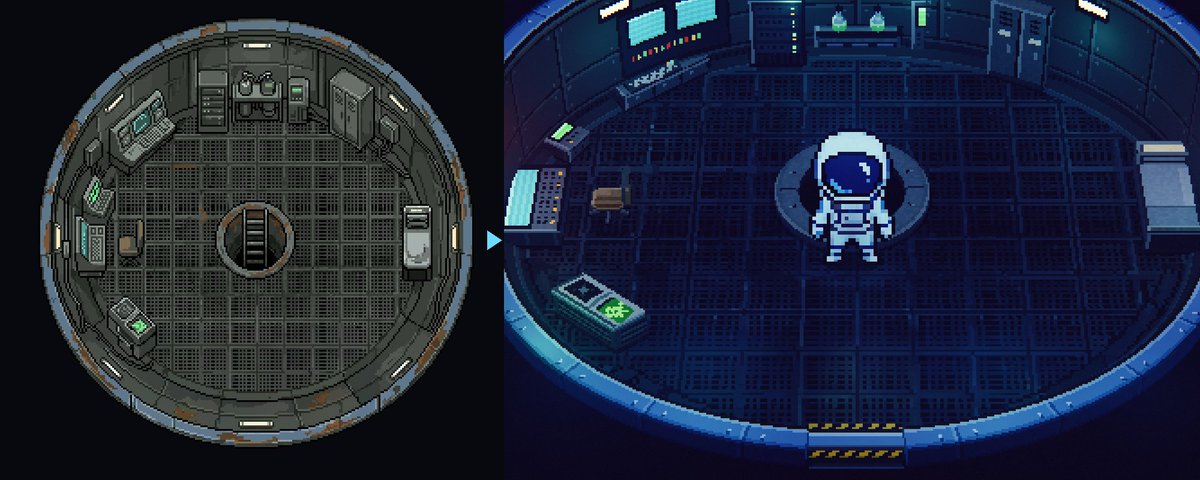
What if StarStranded was 2.5D?
This is the escape pod from my top-down pixel-art game, rebuilt as a 3D room. It's still rendered at 640x360, with outlines and a perspective camera, and the player is still the original sprite.
The hard part was keeping the pixel art's character:
1- Pasting the 2D art onto the 3D models failed. It read like smeared stickers.
2- What worked was modeling each object the art draws, one prop at a time, in the game's own palette.
It's a test scene for now, not the shipping look. Would you rather play it flat 2D or 2.5D like this? #ScreenshotSaturday

5
3
219
This is the kind of setup i love watching. GFS and AIGFS both spin something up in the Caribbean, AIFS says no, and a surprising chunk of the ECMWF ensemble sides with development.
Physics and AI on the same side, a different AI model on the other. That's why i built my weather app to show the models side by side instead of picking a winner.
Andy, at 8 or 9 days out, how much weight do you give the ensemble split vs the El Niño climatology?

GFS and AIGFS are both showing some development in the Caribbean in about 8-9 days as a frontal boundary stalls and helps to create some spin and convergence in the region. AIGFS has a very favorable upper pattern, which would be a bit of a surprise in November of a strong El Niño year. The AIFS (which doesn't show development) looks a little more realistic and less favorable.
I will say there's a surprising number of ECMWF ensemble members that show something forming down there. It doesn't usually have the same Caribbean bias as the GFS/GEFS. We'll see what happens.
I think at this point I'd lean towards the Niño climatology winning out and no development (or maybe something subtropical in the SW Atlantic), but we'll see.


1
93
"Run on 64GB+ RAM" is exactly my box. 64 GB of DDR5 plus a 5090, so this one's going on the list.
One thing i learned the hard way running big quants on a single 32 GB card: leave about 1.5 GB of VRAM free. When i kept that headroom, decode held near 196 tok/s. When i filled the card, it fell to 24.
So for me the real question with a new GGUF isn't just the benchmark. It's how much fits on the GPU before it falls off a cliff.
Which quant would you actually run on one 32 GB card plus 64 GB of RAM, the biggest one that fits or a smaller one with room to breathe?
We’re releasing new DeepSeek-V4.1-Flash-1017 GGUFs, ranking highest across benchmarks.
Dynamic V3.1 leads across nearly all benchmarks: GPQA Diamond, AIME25, LiveCodeBench v6, MMLU-Pro, Aider & more.
Run on 64GB+ RAM.
GGUF: huggingface.co/unsloth/DeepS…
Blog: unsloth.ai/docs/models/deeps…

43
Halloween is tomorrow, and the pixel town in my weather app is already dressed for it 🎃
ForecastSpread's town follows the calendar and the real forecast at the same time:
1- Bats over the rooftops all October, a flickering jack-o'-lantern, and a water tower in costume.
2- The sky above it is your actual forecast, so a rainy Halloween looks rainy.
3- Snow only shows up where it actually snows, and if you're in Australia it's summer in December.
The Apple Watch app has the same town, with the current hour's weather playing behind it.
I'm building this solo. Do you add seasonal touches to your apps and games? Life is too short not to have fun 👻
1
69
Free beta, every feature unlocked.
iPhone + Apple Watch (TestFlight): testflight.apple.com/join/mX…
Android (Google Play): play.google.com/apps/testing…
28