

CTO @ IDlayr. I build products and engineering teams for a living. 🏋 https://teapawt.org/t.co/06OgEO5eSl 👨🏫 https://teapawt.org/t.co/ocz86QvOLZ ⛏️ https://teapawt.org/t.co/DfRunYEFmS
Porto, PT
Joined April 2010
- Tweets4K
- Following749
- Followers749
- Likes7.5K







Pinned Tweet
I've been doing CrossFit for 8 years now, and have tried most timer apps out there. Most are bloated, though, and try to be everything-apps. I always felt underserved for such a simple need: a timer like the ones you see mounted on a box wall, but on your phone.
So I built one: boxclock.app/
Out now on iPhone and iPad. Free, with a $4.99 one-time premium unlock. No subscription. No ads. No workouts. No diet plans. Just a timer.
v2.0 now out, with improved Live Activities and timer beeps that don't fight your music/podcast apps.
I would love some feedback on it!


Traditional compliance is broken, there's no way it will survive this new era.
I think true compliance, from the auditor's perspective, will need to be agentic. Auditors letting their “KYA’ed” agents into someone's infra and org, with appropriate guardrails, and assess if the company's agents and humans are following the right policies, in practice, in real-time.
Many auditors and auditing companies are several years behind and rely a lot on manual work and point-in-time checks.
Vanta solved the compliance burden for companies, which is great. But who is solving the auditor's side of the equation?

Fireworks is SOC 2 and ISO 27001/27701/42001 compliant. They’re still getting hacked. These certs are just security theater at this point.
Companies pay tens/hundreds of thousands a year for these audits because their customers assume it means their data is safe. And clearly, it does not.
Before we had cyber capable AI, it was much less obvious. But now it just means you had like $12,000 to pay a compliance shop and you have the bare minimum in place.
It’s time for an actually comprehensive framework that, you know, works.
1
90
💯
Passkeys are a knowledge factor. There, I said it.
If you perform a degradation attack on them, you’re left with a pin code to guess.
And despite webauthn allowing vendors to configure passkey implementations to be device-bound, those settings get ignored and they’re turned into synched passkeys.
I like passkeys, but let’s be honest about what they are. They’re no inherence nor possession factor.

This is correct
Passkeys should be used as passwords, since they're stored in a password manager
They're "supposed" to use biometrics, but realistically they don't, you just unlock your password manager and your passkey is stored there
So passkeys are not 2FA, they're single factor authentication
Prove me wrong
2
1
150
To be clear, a downgrade attack doesn’t break the crypto algorithm behind a passkey. It basically brings it down to the weakest claim (a pin code or an alternative factor, often OTP or other knowledge factors).
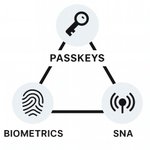
The first two gates are: possession (of the private key), as well as inherence (the local biometric check on device).
The argument against it being a possession factor
If a passkey is synched (like most, depending on configuration), then the private key is behind a password manager of some sort… which in turn is protected by a… password (knowledge)! This feature (synched passkeys), although convenient, makes the case against a passkey being a device possession factor.
The argument against it being an inherence factor
The biometric check is local, not validated remotely. The fallback for a failed biometric check is a pin code after a few attempts (not done via document id). So if an attacker forces the downgrade, it becomes a simple pin code - something people have to memorise (knowledge!).
So, since it’s not a device possession factor, and since it’s also not biometric factor, then it’s a knowledge factor 🔓
23
As anthropic models get better and better, there's one thing that hasn't changed: the text output, no matter how much promoting and rules I add, is always terrible.
I had it learn from how I write from my blog; I added specific rules on how to write (avoid poetic rhythms, etc). Nothing works sustainably.
Where on earth did these models learn from? Pompous fiction books from the 1800s? Most of my time now is spent iterating on tone and language than actual value.
Has anyone figured this out? What's wrong with simple story-telling without clever word tricks?
1
1
73
Carlos Vilhena retweeted

Agents resend the whole context on every call, often dozens of times per request. If you change one token near the top, you pay full price for everything under it.
Context layout is a cost decision. I wrote up a few months of harness design research. Highlights below 🧵

Bob Lutz, former GM vice chairman, on CNBC in November 2017:
“The company [Tesla], folks, is going out of business. At this rate they’ll never get to 2019.”

AT&T CEO says Elon Musk's SpaceX phone strategy not "viable" axios.com/2026/09/29/att-ceo…

1
2
152
It would be a great outcome for sure, but I can’t stop thinking about how much potential is still left on the table compared to others like Revolut… is it too late now?

EXCLUSIVE: Monzo, the digital lender which has become one of Britain's biggest consumer banks, is in talks about a sale to Brazil's Nu Holdings which could value it at between £8bn and £10bn, ending the prospect of a near-term IPO of a UK fintech champion. news.sky.com/story/digital-b…

121
📣 We're bringing @TheLeadDev Meetups to Porto!! 📣
Porto has grown into a strong engineering hub over the last few years. I'd love to help it become a phenomenal talent community for tech leadership too, and that starts with having the right forums to grow together.
AI is changing how we work, how we organise ourselves, and what’s expected of each role. Layers are collapsing, and many of us are rethinking what an engineer, a tech lead, a staff engineer or an engineering manager is responsible for. The goal hasn't changed: build great products that customers love. But how we build, and how we lead (as ICs or as managers), is changing fast.
I don't think anyone has this figured out yet. I certainly haven't. Which is why I believe we need more places where we can learn from each other: what's working, what needs to change, and what we're still trying to understand.
So I'm really happy to share that, together with @nchaganlal , @LiliSousa and José António Silva, we're bringing LeadDev Meetups to Porto.
Join here: meetup.com/leaddev-meetup-po…
And if you have a story to share on stage, send me a message. We're finalising the line-up and still have some room.


Outsource the work to LLMs, but don’t outsource the thinking.

I am done with this shit. It is over. The state of engineering right now is horrible. It has been half a month since I started a new role at a big company. Nobody knows anything here. The specs, code, tests, PRDs, tickets, resolution of those tickets, reports, etc., everything is made by Claude Code. Nobody on my team likes this. They are being forced to ship as much as they can. I have heard multiple times from higher management that pushing code is not a bottleneck, so why are we slow? People are working 12 to 13 hours a day just to press enter. Nobody is reading anything. Humans in corporate are doing nothing on their own. Everyone, literally everyone, from an L1 to an L7 engineer here is doing the same thing. Talk to Claude. There is no sense of victory. Nobody is resolving bugs. In reality, nobody is thinking anymore. Everything is done by LLMs. It is so soul-sucking. I would not mind it, to be honest, if we were at least given the time to check out the code and see what is going where. But no, the goal is to just ship. No matter what happens.
1
89
Hey 👋 I am hiring again, and I would love your help!
IDlayr is looking for engineers in and around Porto:
🔗 Backend Engineer: notion.so/idlayr/Backend-Eng…
🔗 Senior Mobile Engineer (SDKs): notion.so/idlayr/Senior-Mobi…
We work remotely and meet in Porto regularly. If someone comes to mind, tag them or forward this to them!
DM me for details, or email [email protected] with your application.
𝐖𝐡𝐞𝐫𝐞 𝐰𝐞 𝐚𝐫𝐞 𝐠𝐨𝐢𝐧𝐠
Every time you log in to your bank, pay someone, or open a new account, somebody has to answer one question: is this really you? Today that answer usually comes from a six digit code sent by SMS. It works, most of the time, and it is also the step fraudsters attack first. It's also a medium that regulators are challenging more and more for this type of verifications.
We answer that question differently. Every phone with a SIM already has a cryptographic identity, the one your operator uses to connect you to the network. We ask the network to vouch for the phone number, silently, with nothing for the user to type. Banks and payment providers in Europe and the Americas use this today in their login, onboarding and payment flows.
That is where we started, and it is not where we want to stop. Until now, every check we ran was used once and then forgotten. From now on, each check also strengthens a credential: a record of trust in a phone number, the SIM, the device and the person behind them, that grows every time a customer verifies. Over time, a bank stops re-proving who you are from scratch and starts recognising the customer it has known for years.
I believe the phone we carry can become the identity layer for the internet. It will take mobile operators, banks and companies like ours working together, and we are early. But we are in production, we are shipping every week, and moving fast!
If you want to see what shipping looks like for us, our changelog is public: docs.idlayr.com/changelog
𝐖𝐡𝐲 𝐣𝐨𝐢𝐧 𝐧𝐨𝐰
The team is small, so what you build shapes the product. The platform is live, so your work reaches real users. And we have an ambitious vision, backed by a clear strategy, and an exciting roadmap.
We offer equity, a training budget, direct contact with customers and partners, and a team that values clarity, autonomy and agency.
If this sounds exciting, hit the links or DM me 😁

Fear is the ultimate tool for control in society, it has always been like that. Look back at any crisis, recent or ancient, and the playbook for control is always the same: fear.
Today it’s about AI.
You can manage risks in many ways. I wish we left constant fearmongering out of it.

This has been fun!
When I launched BoxClock back in April, I decided to run a small experiment on the side: I wrote the App Store listing and the website with LLMs in mind, as much as for humans. Simple language, clear definitions and pricing, llms.txt, schema dot org, structured FAQs, etc. I had no idea if any of it would pay off, to be honest... SEO and AEO sounds a bit like dark magic to me.
The reality is that my largest referrer is now ChatGPT. I'm not yet sure what people search for; where do you folks even get that data from?
The money I did spend on Apple Search Ads turned out to be a bad investment: about €150 for three sales. I killed the campaign after a week. Without a subscription model, my customer lifetime value is low, making it hard to make paid acquisition work.
What has actually been moving the needle, as far as I can tell, is App Store reviews; conversion keeps climbing as they come in. But it takes a long time to get those to meaningful numbers, and many folks don't rate apps...
That and also SEO, with a few of my important pages finally reaching Google's first page (but still positions 7-10).
My day-35 download-to-paid rate is sitting at 8.57%, which is not bad at all for a $4.99 one-time payment app. Getting more downloads is key to accelerate revenue.
And then there's the odd part: BoxClock is currently trending in Georgia and Serbia (!), with plenty of downloads but almost no purchases. My suspicion is that $4.99 is too much money over there, so I will have to play with regional pricing.
I don't want to spend ad money, but unsure what else to optimise besides tweaking the functionality that asks for a review or more nudges for the in-app purchase.
What else have app devs tried that has worked well?

I've been doing CrossFit for 8 years now, and have tried most timer apps out there. Most are bloated, though, and try to be everything-apps. I always felt underserved for such a simple need: a timer like the ones you see mounted on a box wall, but on your phone.
So I built one: boxclock.app/
Out now on iPhone and iPad. Free, with a $4.99 one-time premium unlock. No subscription. No ads. No workouts. No diet plans. Just a timer.
v2.0 now out, with improved Live Activities and timer beeps that don't fight your music/podcast apps.
I would love some feedback on it!