

@PrismaXai GTM - solving the data bottleneck in physical AI | Venture partner @symbolicvc | Mathematics @PKU1898 | Business @Wharton
Joined March 2024
- Tweets393
- Following322
- Followers467
- Likes877





this is truly exciting. cross-embodiment is the future.

Announcing the beta release of the Pi API. We’ve partnered with companies across diverse industries to adapt our models to their robots and applications, from harvesting strawberries to assembling servers. Now we’re opening access to more teams.
2
230
If specialized robots already run factories, why is everyone racing to build generalist robots? Will they replace the specialized ones?
I find it easier to answer with a similar question. If scripts could already automate work, why did we need LLMs?
chadl.me/writings/generalist…

3
118
A robot foundation model that learns a real scaling law from 1M hours of human video, then transfers to robots. A genuine milestone for physical AI.
Human video gives you breadth and scale cheaply, the priors, the diversity, the long tail. A powerful new axis. And it works precisely because it's paired with real robot demonstrations, the teleoperation data that provides the fidelity and grounding only on-robot collection can.
The winning data strategy is BOTH. Massive human video for pre-training, high-quality teleoperation on the target robot for the last mile. Whoever produces both at scale supplies the whole stack. Physical AI's data decade is here.

Today we are introducing Dyna-2, a world-action model pre-trained on one million hours of human video. At this scale, for the first time, we discovered several new scaling laws:
• world-action models exhibit scaling law on human data across four orders of magnitude, from 1000 to 1,000,000 hours,
• this human data scaling law implied a scaling law on never seen robot data,
• both data and objective matter; world modeling and scaling on video data are essential for cross-embodiment scaling transfer to emerge
🧵
5
380
great summary of robot companies in the bay area. Robotic is going through the pre-GPT moment

This is the capital of robotics! 🌁
Silicon Valley is home to so many physical AI companies that you could spend a month visiting them and still not see even 10% of them (trust me, I tried).
It took me 3x to create this map as it did to create any other. And the truth is, it's still incomplete.
Let’s see why this is the case.
So, the Bay Area is the world's leading ecosystem for robotics startups, bringing together top AI talent, top universities, experienced founders, and unmatched access to capital.
The region is anchored by Stanford University and University of California, Berkeley, two of the world's top universities for AI and robotics. They produce a constant stream of researchers, founders, and breakthrough technologies.
The Bay Area is also home to many of the companies shaping the future of robotics and AI, including @Figure_robot, @physical_int , and major AI labs such as @OpenAI.
This concentration of talent makes it easy for startups to recruit experienced engineers and collaborate with leaders in embodied AI.
Not mentioning that it is also home to leaders such as @NVIDIARobotics , whose headquarters and leadership in AI chips power much of today's robotics revolution, and @Tesla, whose work on autonomous driving and humanoid robots has created a deep pool of robotics, AI, and manufacturing talent.
Perhaps its biggest advantage is access to capital and ambition.
The Bay Area has the world's deepest network of venture capital firms, serial entrepreneurs, and technical leaders who are willing to fund bold, long-term robotics companies.
In the comments I'll post the companies from the ecosystem.
‼️ Note that Bay Area has >300 robotics companies, research labs, and innovation hubs, so this is a curated selection of the notable product companies, not an exhaustive census!
P.S. I'm constantly working on improving these maps, so if your company is missing, please DM me with basic info about the co, and I will include it in the next release.
~~
♻️ Join the weekly robotics newsletter, and never miss any news → ziegler.substack.com

9
1,283
On the crypto stack, DeFi is the app layer, an application running on a blockchain. But for the next wave of fintech, DeFi is the infrastructure layer. Lending, swaps, stablecoins, and settlement become the rails new products build on.
teapawt.org/alive_/status/20664903…

there will be no more fintech without crypto.
the playbook for financial applications going forward is the defi mullet:
fintech in the front, defi in the back
2
121
There are a hundred AI writing tools now and most are honestly fine. The part I haven't cracked: getting one to suggest ideas that feel personal and actually interesting, not generic. Anyone found a workflow that makes the idea suggestions genuinely good?
1
1
75
Shipping a feature used to take months. Now it takes minutes. In the past, difficulty was a filter: building was so expensive you only built what mattered. That filter is gone. The new challenge for builders is to build less.
1
82
Every product that mattered started with ONE thing. Google was a search box. Stripe was a few lines to take a payment. They won by doing one thing so well they were the obvious choice. Every feature you add blurs that one thing.
1
84
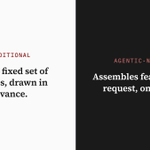
For thirty years, software was a tool you operated. Agentic-native software breaks that. The product isn't the tool anymore. It's an agent that assembles capability on demand from a model, your content, and your tools.

1
1
65
The catch nobody mentions: when software can do anything, people don't know what to ask. A blank prompt is intimidating in a way a button never is. Most underwhelming agent products aren't short on capability. They're short on a way in.
1
1
17
For thirty years, software was a tool you operated. Agentic-native software breaks that. The product isn't the tool anymore. It's an agent that assembles capability on demand from a model, your content, and your tools.

1
45
The catch nobody mentions: when software can do anything, people don't know what to ask. A blank prompt is intimidating in a way a button never is. Most underwhelming agent products aren't short on capability. They're short on a way in.
1
12